Advanced Technical Ceramics, Precision Alumina, Silicon Carbide, Crucible Parts



Chemical Processing & Fluid Control
Engineered Ceramics for Critical Chemical Processing & Fluid Control Systems
Chemical processing and fluid control equipment operate under demanding conditions where material compatibility, dimensional accuracy, and mechanical reliability directly influence process stability and equipment performance. Pumps, control valves, metering systems, mechanical seals, and chemical transfer equipment frequently handle corrosive liquids, abrasive slurries, high-pressure fluids, and chemically reactive media. Under these conditions, critical components must maintain their structural integrity and functional precision despite continuous exposure to chemical attack, fluid erosion, friction, and fluctuating operating temperatures.
The engineering challenges extend beyond corrosion resistance alone. In dynamic sealing and fluid metering systems, surface finish, component clearance, and dimensional stability can significantly affect leakage rates, frictional behavior, and flow accuracy. Abrasive particles suspended in process fluids may accelerate wear at sealing interfaces, valve seats, pump plungers, and flow-control orifices. Meanwhile, chemical degradation, localized contact stresses, and differential thermal expansion can further compromise component reliability, particularly in equipment operating under repeated pressure and temperature cycles.
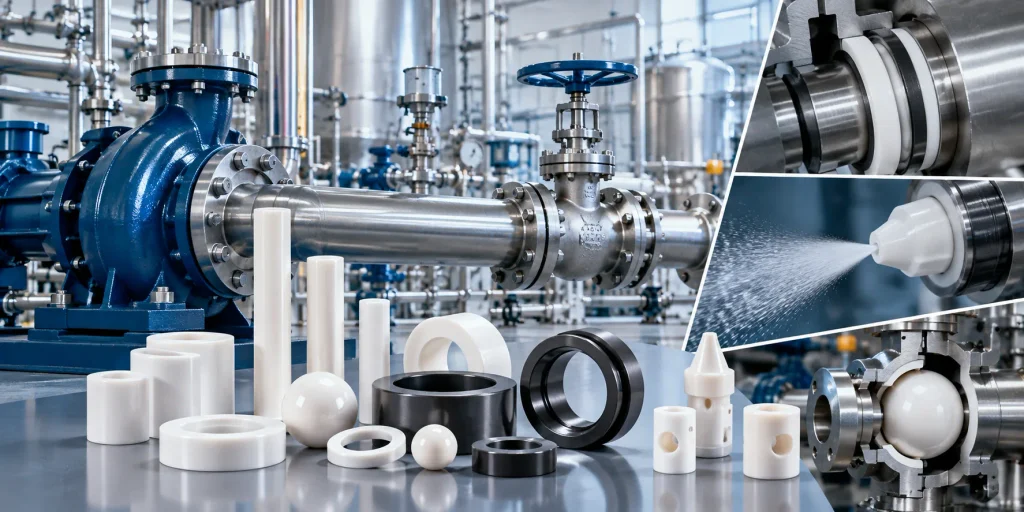
Advanced technical ceramics, including alumina (Al₂O₃), zirconia (ZrO₂), silicon carbide (SiC), and silicon nitride (Si₃N₄), offer distinct combinations of hardness, wear resistance, chemical stability, mechanical strength, and dimensional precision. Their suitability depends on the specific chemical medium, operating temperature, pressure, mechanical loading, and component design. In properly engineered applications, ceramic components can provide durable alternatives to conventional metallic or polymer-based parts, particularly where abrasion, corrosion, or contamination presents a significant limitation. For chemical processing and precision fluid control applications, selecting the appropriate ceramic material requires a comprehensive evaluation of operating conditions, component geometry, mating surfaces, and manufacturing tolerances. A properly specified ceramic component must not only resist the process environment but also maintain the dimensional and surface characteristics required for consistent sealing, controlled fluid movement, and reliable mechanical operation.
Understanding the Failure Mechanisms in Corrosive & Abrasive Fluid Systems
In chemical processing and fluid handling systems, component failure rarely results from a single operating factor. Chemical corrosion, particle erosion, mechanical wear, pressure fluctuations, and thermal stresses often interact, accelerating material degradation and reducing equipment reliability. Even minor changes in sealing surface geometry, valve-seat contact conditions, or pump component clearances can lead to increased leakage, unstable flow control, and premature mechanical failure. Understanding these interacting failure mechanisms is essential when specifying advanced ceramic components for demanding fluid-handling applications.
Chemical Corrosion & Material Degradation: Aggressive acids, alkaline solutions, oxidizing agents, and reactive process chemicals can cause surface dissolution, grain-boundary attack, or chemical changes in susceptible materials. Corrosion resistance depends on chemical concentration, temperature, exposure duration, and ceramic composition. In multiphase ceramics, secondary phases or residual processing constituents may exhibit different chemical stability from the primary ceramic phase, making grade-specific compatibility evaluation essential.
Abrasive Erosion & Sliding Wear: Suspended solid particles can cause progressive material removal in pump sleeves, valve seats, nozzles, and flow-control passages. Erosion severity depends on particle hardness, concentration, impact angle, and fluid velocity. Sliding components are additionally affected by contact pressure, surface roughness, lubrication conditions, and counterface compatibility. High hardness alone does not guarantee wear resistance when brittle fracture, particle impact, or insufficient lubrication dominates the failure mechanism.
Pressure Cycling & Mechanical Contact Stress: Repeated pressure fluctuations and valve actuation can generate localized stresses at sealing interfaces, component edges, and mounting surfaces. Ceramic components are particularly sensitive to tensile stresses and concentrated contact loads because of their limited plastic deformation. Poorly controlled assembly tolerances, misalignment, or excessive interference fits may initiate microcracks that propagate during operation, potentially causing chipping, leakage, or catastrophic fracture.
Thermal Expansion & Sealing Instability: Temperature changes affect component dimensions, fluid viscosity, sealing clearances, and contact stresses. Differences in thermal expansion between ceramic components, metallic housings, and sealing elements may create excessive compression or loss of contact pressure. In precision metering pumps and mechanical seals, even small dimensional changes can alter leakage behavior and frictional performance. Material selection and mechanical design must therefore account for thermal expansion compatibility, heat generation, and the complete operating temperature range.
Selecting Ceramics for Aggressive Chemical & Fluid Environments
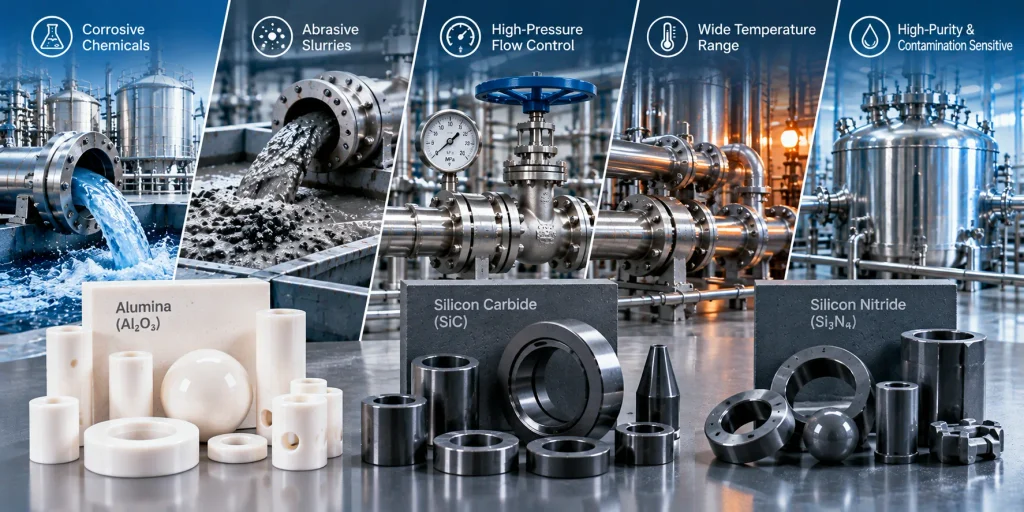
Material selection for chemical processing equipment requires a systematic evaluation of fluid chemistry, operating temperature, pressure, flow velocity, abrasive particle content, and mechanical loading. Although advanced ceramics generally provide excellent hardness and wear resistance, their chemical compatibility and fracture behavior can vary considerably between material grades. The most suitable ceramic must be selected according to the dominant degradation mechanism and the functional requirements of the component.
Corrosive Acids & Alkaline Solutions: Chemical resistance must be evaluated using the specific chemical composition, concentration, temperature, and exposure duration. High-purity alumina and selected silicon carbide grades are frequently considered for chemically demanding applications, but their resistance differs across acidic, alkaline, and fluoride-containing environments. Dense sintered silicon carbide can provide excellent resistance to many aggressive chemicals, while the residual silicon phase in reaction-bonded silicon carbide may introduce additional compatibility limitations. Material selection should therefore be supported by grade-specific chemical resistance data rather than broad assumptions about ceramic inertness.
Abrasive Slurries & Particle-Laden Fluids: Slurry-handling components are exposed to combined erosion, abrasion, and sometimes chemical corrosion. Silicon carbide is often considered for high-wear applications because of its hardness and chemical stability, while zirconia may be advantageous in selected precision components where fracture toughness and resistance to localized mechanical damage are important. Engineers must consider particle size distribution, solids concentration, impact velocity, flow direction, and component geometry when evaluating material suitability.
High-Pressure Metering & Precision Flow Control: Metering pumps, dosing systems, and precision valves require stable clearances, controlled surface finishes, and reliable sliding or sealing interfaces. Zirconia and alumina are commonly considered for precision plungers, valve seats, and sleeves, depending on mechanical loads and fluid compatibility. Material selection must be coordinated with dimensional tolerances, counterface properties, operating pressure, and lubrication conditions to prevent excessive friction, leakage, or premature wear.
Dynamic Sealing & Rotating Equipment: Mechanical seal faces and rotating pump components operate under combined contact pressure, sliding velocity, frictional heating, and chemical exposure. Silicon carbide is frequently used in mechanical sealing applications because of its hardness, wear resistance, thermal conductivity, and corrosion resistance in suitable environments. However, seal performance also depends on mating material selection, lubrication film formation, surface flatness, contact geometry, and operating conditions. Dry-running or inadequate lubrication can generate severe thermal and mechanical stresses even when highly wear-resistant ceramics are used.
High-Purity & Contamination-Sensitive Processes: In chemical dosing, analytical instrumentation, and selected high-purity fluid systems, component selection may be influenced by extractable impurities, particle generation, surface condition, and cleaning requirements. High-purity alumina and other dense engineering ceramics may be considered where chemical compatibility and low contamination are important. However, suitability should be verified through application-specific testing, including evaluation of surface degradation, particle release, and interactions with the process fluid.
Engineering Properties & Ceramic Material Comparison
The performance of ceramic components in chemical processing and fluid control systems depends on the interaction between material properties, chemical exposure, contact mechanics, and operating conditions. Hardness and fracture toughness influence resistance to abrasive wear and mechanical damage, while elastic modulus and thermal expansion affect stress distribution in assembled components. Thermal conductivity becomes particularly important in mechanical seals and sliding interfaces, where frictional heat must be dissipated to prevent localized thermal damage.
For precision pump plungers, valve seats, sealing rings, and fluid-control components, material properties must also be considered alongside surface finish, dimensional tolerances, and mating material compatibility. The following data provide representative properties of commonly used dense engineering ceramics for preliminary material comparison. Actual values vary with material grade, composition, microstructure, processing method, and test conditions.
Typical Material Properties
| Property | Alumina (99%+) | Zirconia (Y-TZP) | Silicon Carbide (SiC) | Silicon Nitride |
|---|---|---|---|---|
| Density (g/cm³) | 3.8–3.95 | 5.9–6.1 | 3.05–3.2 | 3.15–3.3 |
| Vickers Hardness (GPa) | 14–20 | 11–13 | 22–28 | 14–17 |
| Flexural Strength (MPa) | 250–400 | 800–1,200 | 300–500 | 600–1,000 |
| Fracture Toughness (MPa·√m) | 3–5 | 5–10 | 3–5 | 5–8 |
| Young’s Modulus (GPa) | 300–380 | 190–220 | 380–430 | 280–320 |
| Thermal Conductivity (W/m·K) | 25–35 | 2–3 | 80–150 | 20–90 |
| CTE (×10⁻⁶/K) | 7–8.5 | 10–11 | 4–5 | 2.5–3.5 |
Material Selection by Fluid System Requirements
| Operating Condition | Material Candidates | Key Engineering Considerations |
|---|---|---|
| Aggressive chemical liquids | SSiC, high-purity Al₂O₃ | Chemical concentration, temperature, compatibility |
| Abrasive slurry handling | SiC, ZrO₂ | Particle erosion, impact, fracture resistance |
| Precision metering pumps | ZrO₂, Al₂O₃ | Surface finish, clearance, dimensional stability |
| Mechanical seal faces | SSiC, Al₂O₃ | Face flatness, lubrication, frictional heat |
| High-load sliding components | Si₃N₄, ZrO₂ | Contact stress, toughness, counterface wear |
| High-purity fluid systems | High-purity Al₂O₃, selected SiC | Extractables, particle release, surface cleanliness |
Critical Design Parameters for Precision Fluid Control Components
Surface Finish & Sealing Geometry: Surface roughness, flatness, roundness, and contact geometry directly influence the performance of sealing and sliding components. Mechanical seal faces require controlled surface geometry to maintain an appropriate lubricating film, while ceramic plungers and sleeves require compatible surface finishes and clearances to achieve stable motion and acceptable leakage characteristics.
Pressure, Contact Stress & Fracture Resistance: Ceramic components subjected to fluid pressure and mechanical contact must be designed to minimize tensile stresses and localized loading. Sharp corners, excessive interference fits, and misaligned mating components can significantly increase fracture risk. Material strength values should be evaluated together with actual component geometry, assembly conditions, and expected pressure cycles.
Chemical Compatibility & Temperature: Chemical resistance cannot be determined from pH alone. Concentration, temperature, dissolved species, exposure duration, and ceramic composition all influence corrosion behavior. Particular attention should be given to fluoride-containing chemicals, concentrated alkaline solutions, and reactive process environments, where differences between ceramic grades may become significant.
Dimensional Accuracy & Manufacturing Tolerances: Critical dimensions should be specified according to functional requirements, including sealing clearance, component alignment, concentricity, and assembly fit. Precision grinding and lapping may be required for certain sealing and sliding surfaces. Tolerances must be evaluated in relation to ceramic manufacturing capabilities, inspection methods, and the dimensional changes expected during operation.
Frequently Asked Questions About Chemical Processing & Fluid Control Ceramics
1. Which ceramic material provides the best chemical resistance for corrosive fluid applications?
There is no single ceramic material that provides the best resistance to every corrosive chemical environment. Material compatibility depends on the specific chemical species, concentration, temperature, exposure duration, and ceramic composition. High-purity alumina offers good resistance to many industrial chemicals, while dense sintered silicon carbide provides excellent corrosion resistance across a broad range of aggressive process media. However, certain concentrated alkaline solutions, fluoride-containing chemicals, and high-temperature reactive environments can produce significantly different corrosion behavior.
Engineers must also distinguish between different grades of the same ceramic. For example, reaction-bonded silicon carbide may contain residual free silicon, which can affect chemical resistance compared with fully sintered silicon carbide. For critical applications, material selection should be supported by grade-specific corrosion data, chemical compatibility testing, and evaluation of the complete operating environment rather than relying on general descriptions such as acid-resistant or chemically inert.
2. Why are silicon carbide ceramics commonly used for mechanical seal faces?
Silicon carbide is widely used in mechanical sealing systems because it combines high hardness, excellent wear resistance, relatively high thermal conductivity, and strong chemical stability in many industrial environments. Its thermal conductivity helps dissipate frictional heat generated at the sealing interface, while its hardness contributes to resistance against abrasive particles and surface wear.
However, successful seal operation depends on much more than the ceramic material itself. Surface flatness, roughness, contact pressure, sliding velocity, lubrication film formation, and counterface compatibility all influence leakage and wear behavior. Excessive frictional heating during dry running or insufficient lubrication can produce severe thermal gradients and cracking, even in silicon carbide components.
Engineers should therefore evaluate the complete seal system, including operating pressure, fluid properties, shaft speed, expected thermal conditions, and mating materials. The selection of an appropriate SiC grade and carefully controlled sealing surface geometry is essential for reliable long-term performance.
3. How do alumina and zirconia ceramics compare in precision pump and valve components?
Alumina and zirconia are both widely considered for precision fluid-control components, but they offer different mechanical and thermal characteristics. Alumina provides high hardness, excellent electrical insulation, good wear resistance, and chemical stability in many process environments. It is commonly considered for ceramic sleeves, valve seats, plungers, and insulating components where mechanical impact is limited.
Zirconia, particularly selected stabilized grades, generally provides higher fracture toughness and bending strength than conventional alumina. These properties can be advantageous for precision plungers, valve balls, and components subjected to repeated mechanical contact or localized stresses. However, zirconia typically has lower thermal conductivity and higher thermal expansion than alumina, and its chemical and temperature limitations depend on the stabilizer system.
The final material choice should consider fluid chemistry, contact pressure, operating temperature, sliding conditions, dimensional requirements, and potential impact loading. Neither material should be selected based solely on hardness or fracture toughness.
4. What causes premature wear in ceramic pump plungers and sleeves?
Premature wear in ceramic plungers and sleeves can result from abrasive contamination, excessive contact pressure, misalignment, insufficient lubrication, unsuitable surface finish, or improper operating clearance. Although advanced ceramics are highly wear-resistant, sliding contact can still produce surface damage when hard particles become trapped between mating components or when local contact stresses exceed the material’s resistance to fracture.
Surface finish and dimensional accuracy are particularly important in precision metering systems. Excessive roughness may increase friction and accelerate counterface wear, while incorrect clearances can lead to leakage, vibration, or localized contact loading. Differences in thermal expansion between the ceramic component and surrounding metallic assemblies may also change operating clearances as temperature increases.
Engineers should evaluate the complete tribological system, including ceramic material, mating surface, fluid viscosity, lubrication conditions, particle contamination, pressure, and operating speed. Corrective measures may involve improving filtration, adjusting clearances, optimizing surface finish, or selecting a more suitable ceramic grade.
5. Can ceramic components withstand high-pressure chemical processing applications?
Advanced ceramic components can be used in high-pressure fluid systems when their material properties, geometry, and mounting conditions are appropriately engineered. However, ceramics generally exhibit limited plastic deformation and are particularly sensitive to tensile stresses, sharp geometric transitions, and localized contact loading.
The pressure capability of a ceramic component cannot be determined from material compressive strength alone. Internal pressure may generate tensile hoop stresses, while assembly loads, thermal expansion mismatch, and mechanical misalignment can introduce additional stress concentrations. Repeated pressure cycling may also promote the growth of existing surface flaws or machining-related defects.
For pressure-loaded ceramic sleeves, valve seats, plungers, and other critical components, engineers should evaluate stress distribution, wall thickness, support conditions, fracture strength, and manufacturing quality. Finite element analysis, proof testing, and representative operating tests may be appropriate for safety-critical or highly loaded applications. A pressure rating should only be assigned to a validated component design under defined operating conditions.
6. How do surface finish and dimensional tolerances affect ceramic sealing performance?
Surface finish and dimensional tolerances are critical to the performance of ceramic sealing and sliding components. In mechanical seals, the flatness and surface condition of the mating faces influence fluid film formation, contact pressure distribution, frictional heating, and leakage. In precision plungers and sleeves, diameter tolerance, roundness, straightness, and operating clearance affect sealing efficiency and resistance to mechanical wear.
Extremely smooth surfaces are not automatically optimal for every application. Surface requirements must be determined according to the lubrication regime, mating material, fluid viscosity, contact conditions, and component function. Excessively tight clearances may increase friction or cause seizure under thermal expansion, while excessive clearances can reduce metering accuracy and increase leakage.
Engineers should define critical dimensions using functional tolerances and specify appropriate inspection methods. Precision diamond grinding, honing, polishing, or lapping may be required depending on the ceramic material and component geometry. The final specification should balance sealing performance, manufacturability, and inspection capability.