Advanced Technical Ceramics, Precision Alumina, Silicon Carbide, Crucible Parts



Nozzles

Overview
Silicon Carbide Nozzles are high-performance ceramic flow-control components manufactured primarily from silicon carbide (SiC), engineered for applications where a nozzle must maintain dimensional accuracy, mechanical integrity, and stable flow performance under high temperatures, abrasive particles, corrosive gases, or chemically aggressive process conditions. Unlike conventional metallic nozzles, which may suffer from oxidation, corrosion, erosion, or deformation when exposed to severe operating environments, Silicon Carbide Nozzles combine high hardness, excellent wear resistance, strong chemical stability, relatively high thermal conductivity, and low thermal expansion to provide reliable long-term performance. The internal flow passage is particularly important because nozzle geometry directly influences velocity, pressure drop, spray distribution, gas flow, and material consumption; even relatively small changes caused by erosion or deposition can alter process performance. SiC's high hardness helps resist abrasive wear when the flowing medium contains solid particles, while its chemical resistance allows it to operate in many environments where conventional metals have limited service life. The material's thermal characteristics also help the nozzle tolerate repeated heating and cooling, although actual thermal shock resistance depends on geometry, wall thickness, temperature gradients, heating rate, cooling rate, and manufacturing quality. Silicon Carbide Nozzles can be produced in straight, tapered, venturi, burner, spray, injection, or other customized geometries according to the requirements of the specific equipment. Selection should therefore consider not only material properties but also internal diameter, outlet geometry, pressure, flow rate, operating temperature, atmosphere, particle loading, chemical environment, mounting method, and expected service life.
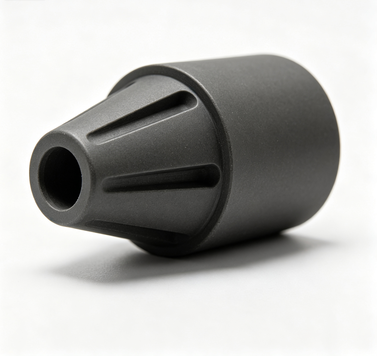
Classification and Key Characteristics of Silicon Carbide Nozzles
1. High Hardness and Excellent Abrasion Resistance
Silicon Carbide Nozzles possess exceptionally high hardness, allowing them to withstand continuous contact with abrasive particles and high-velocity process streams. In applications where gases, liquids, slurries, powders, or molten particles pass through a nozzle at high velocity, erosion can progressively enlarge or distort the internal passage and eventually change the flow characteristics. The high hardness of SiC significantly improves resistance to this type of mechanical wear compared with many conventional materials. This makes SiC particularly suitable for processes involving abrasive powders, particulate gases, ceramic materials, mineral particles, and other erosive media. Maintaining the original internal geometry is important because nozzle performance is directly related to passage diameter, taper, surface condition, and outlet profile. Engineers should therefore evaluate not only initial hardness but also the expected erosion mechanism, particle velocity, particle size, concentration, impact angle, and operating duration when specifying Silicon Carbide Nozzles.
2. Excellent High-Temperature Performance
Silicon carbide retains useful mechanical and structural properties at temperatures far above those tolerated by many conventional metals, making Silicon Carbide Nozzles suitable for high-temperature gas, combustion, spraying, and thermal-processing systems. A nozzle operating at elevated temperature must resist softening, deformation, oxidation, thermal stress, and chemical attack while maintaining a stable flow passage. SiC's refractory characteristics allow it to function in demanding thermal environments where dimensional stability is essential. The actual maximum service temperature depends strongly on the SiC grade, bonding system, atmosphere, wall thickness, geometry, thermal cycling, and contact with reactive materials. Therefore, a nominal maximum temperature should not be treated as a universal operating limit. For high-temperature nozzle design, engineers should analyze both the bulk temperature and local hot spots because temperature gradients can generate stresses that are more damaging than uniform heating at the same average temperature.
3. High Thermal Conductivity and Thermal Shock Resistance
The relatively high thermal conductivity of SiC allows Silicon Carbide Nozzles to transfer heat efficiently through the ceramic body, helping reduce severe local temperature differences under suitable operating conditions. This characteristic can be especially useful in thermal-processing equipment where the nozzle is exposed to intense radiant heat or high-temperature gases while its mounting region remains comparatively cooler. Lower temperature gradients can reduce thermally induced stress and help improve resistance to cracking during heating and cooling cycles. SiC also has a relatively low coefficient of thermal expansion compared with many refractory materials, which further contributes to dimensional stability during temperature changes. However, thermal shock resistance is strongly affected by nozzle geometry, wall thickness, internal corners, surface defects, mounting constraints, heating rate, cooling rate, and temperature distribution. A nozzle with an optimized geometry can therefore perform very differently from a geometrically similar component containing sharp stress concentrations or manufacturing defects.
4. Strong Chemical and Corrosion Resistance
Silicon Carbide Nozzles offer excellent resistance to many chemically aggressive environments, making them suitable for selected applications involving corrosive gases, liquids, vapors, slurries, and process chemicals. Metallic nozzles may gradually lose material through oxidation or corrosion, which can enlarge the flow passage, alter spray characteristics, or contaminate the process stream. SiC can avoid many of these metal-specific degradation mechanisms and maintain a relatively stable surface under suitable chemical conditions. This property is particularly valuable when the process combines elevated temperature with chemical exposure because both factors can accelerate degradation of conventional materials. Nevertheless, SiC is not universally inert, and chemical compatibility depends on the specific reagent, concentration, temperature, atmosphere, impurities, and exposure time. Engineers should therefore evaluate the complete chemical environment before selecting Silicon Carbide Nozzles, especially for strongly oxidizing or otherwise reactive process conditions.
5. Stable Flow Geometry and Dimensional Accuracy
The performance of a nozzle depends heavily on its internal geometry because the passage diameter, taper, outlet shape, and surface condition determine how the process medium accelerates and exits the component. Silicon Carbide Nozzles provide high hardness and dimensional stability, helping the internal passage resist progressive enlargement caused by erosion or mechanical wear. This is important in applications where a small change in nozzle diameter can significantly affect flow rate, pressure, velocity, spray angle, or particle distribution. For precision applications, dimensional tolerance and surface finish must therefore be specified together with the material grade. Manufacturing quality is particularly important around the outlet and internal transitions because sharp edges, uneven machining, or surface defects can create localized turbulence and stress concentration. Customized Silicon Carbide Nozzles can be produced with controlled internal and external dimensions to match specific flow requirements and mounting interfaces.
6. Long Service Life in Demanding Environments
The combination of high hardness, wear resistance, chemical stability, and high-temperature capability allows Silicon Carbide Nozzles to provide extended service life in many demanding industrial environments. Longer nozzle life can reduce unplanned equipment shutdowns, replacement frequency, process interruptions, and maintenance costs, particularly when nozzle replacement requires significant disassembly or kiln downtime. Stable nozzle geometry also helps maintain more consistent process conditions over the service period. However, service life is not determined by material properties alone. Particle velocity, particle concentration, impact angle, temperature, chemical composition, pressure, thermal cycling, mounting stress, and nozzle geometry can all accelerate degradation. For this reason, engineers should evaluate the expected failure mechanism—erosion, corrosion, thermal cracking, mechanical damage, or deposition—before selecting the appropriate Silicon Carbide Nozzles.

Typical Specifications of Silicon Carbide Nozzles
The following values represent typical engineering specifications. Actual performance and dimensions can be customized according to the nozzle application, operating temperature, flow conditions, pressure, chemical environment, and equipment interface.
| Property | Typical Specification |
|---|---|
| Product | Silicon Carbide Nozzles |
| Material | Silicon Carbide (SiC) |
| SiC Content | Typically ≥85%, depending on grade |
| Density | ≥3.10 g/cm³ for dense grades |
| Flexural Strength | ≥350 MPa |
| Compressive Strength | ≥2000 MPa |
| Thermal Conductivity | 100–150 W/m·K |
| Coefficient of Thermal Expansion | Approx. 4.0–5.0 × 10⁻⁶/K |
| Maximum Service Temperature | Up to approx. 1600°C, depending on grade and atmosphere |
| Hardness | Typically HRA ≥90 |
| Water Absorption | Very low |
| Thermal Shock Resistance | Excellent under suitable conditions |
| Wear Resistance | Excellent |
| Chemical Resistance | Excellent against many process chemicals |
| Nozzle Type | Straight, tapered, venturi, spray, burner, injection, customized |
| Internal Diameter | Customized |
| Outer Diameter | Customized |
| Length | Customized |
| Surface Finish | Machined, ground, or customized |
| Outlet Geometry | Customized according to flow requirements |
| Color | Black or dark gray |
The technical design of Silicon Carbide Nozzles requires close attention to both material properties and fluid dynamics. The internal passage determines pressure drop and flow velocity, while the outlet geometry controls the final flow pattern, spray distribution, or particle trajectory. Increasing the flow velocity may improve process intensity but can also accelerate erosion when solid particles are present. Wall thickness must provide sufficient mechanical and thermal strength without creating unnecessary thermal mass or restricting the required flow passage. For high-temperature systems, the difference between the temperature of the nozzle tip and its mounting area can create substantial thermal gradients, so the transition geometry and mounting method should be designed to avoid excessive restraint. Density, porosity, SiC content, bonding phase, surface finish, and internal defects can also influence the nozzle's resistance to erosion and thermal cracking. Therefore, Silicon Carbide Nozzles should be specified according to the actual flow, thermal, mechanical, and chemical environment rather than by temperature rating alone.
Advantages of Silicon Carbide Nozzles
1. Superior Resistance to High-Velocity Abrasive Flow
Silicon Carbide Nozzles are particularly effective in environments where the process stream contains abrasive particles traveling at high velocity. Particle impact and sliding contact can gradually erode softer materials, changing the internal diameter and outlet geometry and ultimately reducing process consistency. The exceptional hardness of SiC provides strong resistance to this type of mechanical degradation, helping maintain the intended flow passage for longer periods. This is valuable in powder injection, thermal spraying, combustion-related systems, and other processes involving particulate flow. By slowing the rate of geometric change, SiC can help reduce nozzle replacement frequency and maintain more stable flow conditions. The actual wear rate still depends on particle size, hardness, concentration, velocity, impact angle, temperature, and nozzle geometry.
2. Reliable Operation at Elevated Temperatures
The high-temperature stability of Silicon Carbide Nozzles allows them to operate in thermal environments where conventional polymeric materials or many metals may lose strength, oxidize, or deform. SiC maintains useful structural integrity under suitable high-temperature conditions and can withstand repeated exposure to elevated temperatures without the rapid softening associated with lower-temperature materials. This makes it suitable for selected kiln, furnace, combustion, spraying, and thermal-processing systems. The practical operating limit depends on atmosphere, material grade, geometry, thermal gradients, and chemical exposure rather than the SiC material alone. Engineers should also consider the temperature difference between the nozzle tip and mounting region because constrained thermal expansion can create significant mechanical stress.
3. Excellent Chemical and Corrosion Resistance
Silicon Carbide Nozzles can provide significant advantages in corrosive environments because SiC is resistant to many acids, alkalis, process gases, and chemically aggressive fluids under suitable conditions. Corrosion or oxidation of a metallic nozzle can gradually change its internal dimensions, contaminate the process stream, and eventually cause leakage or structural failure. SiC's ceramic composition avoids many of these conventional metallic corrosion mechanisms, helping preserve surface integrity and dimensional stability. This is especially valuable when chemical exposure occurs simultaneously with elevated temperature or abrasive flow. However, chemical compatibility should always be verified for the actual process because highly reactive chemicals, oxidizing atmospheres, temperature, concentration, and exposure duration can influence long-term performance.
4. Stable Thermal and Mechanical Performance
The combination of relatively high thermal conductivity, low thermal expansion, high hardness, and strong compressive strength provides Silicon Carbide Nozzles with a balanced set of thermal and mechanical properties. High thermal conductivity can help distribute heat through the nozzle body, while relatively low thermal expansion limits dimensional changes during temperature fluctuations. High mechanical strength allows the component to resist pressure and mechanical loading, while high hardness protects the flow passage from abrasive wear. This combination is particularly valuable when a nozzle must simultaneously handle heat, pressure, particle flow, and thermal cycling. Proper geometry remains essential because even a high-performance SiC material can fail if the nozzle contains severe stress concentrations or is mounted in a way that excessively restricts thermal expansion.
5. Consistent Flow and Process Control
Maintaining a stable internal passage is essential for controlling the performance of any industrial nozzle. Silicon Carbide Nozzles resist erosion and deformation, helping preserve the internal diameter, outlet profile, and flow direction during extended operation. This can improve the consistency of gas velocity, liquid flow, spray distribution, particle trajectory, or combustion conditions depending on the specific application. Stable geometry is particularly important when the process has narrow operating tolerances because even gradual nozzle enlargement can increase flow rate and alter pressure conditions. By maintaining dimensional integrity, SiC nozzles can contribute to more predictable process behavior and reduce the need for frequent calibration or replacement. Dimensional accuracy and surface finish should therefore be treated as important specifications alongside material composition.
6. Extended Service Life and Reduced Maintenance
The combination of high wear resistance, chemical stability, thermal resistance, and mechanical strength enables Silicon Carbide Nozzles to provide long service life in demanding operating environments. Extending nozzle life can reduce replacement costs and minimize production interruptions, especially when nozzle replacement requires cooling the equipment or accessing difficult-to-reach internal components. More stable nozzle dimensions can also reduce the frequency of process adjustments caused by progressive erosion or corrosion. Nevertheless, long service life depends on proper application matching. Excessive particle velocity, thermal shock, chemical attack, mechanical impact, improper mounting, or operation beyond the recommended conditions can shorten the service life even when the material itself has excellent properties. Regular inspection of the outlet, internal passage, mounting region, and surface condition is therefore recommended for critical systems.
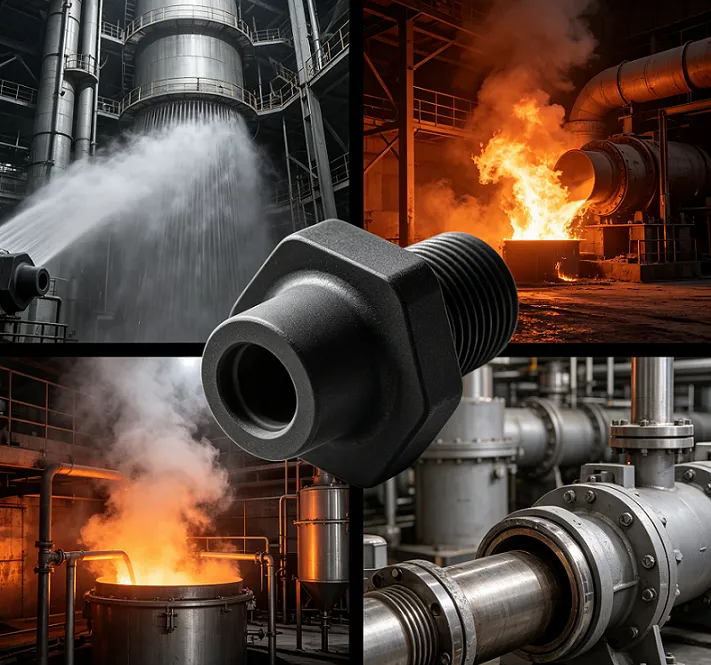
Applications of Silicon Carbide Nozzles
1. High-Temperature Kilns and Furnace Systems
Silicon Carbide Nozzles are suitable for selected high-temperature kiln and furnace systems where the nozzle must withstand elevated temperatures while maintaining stable flow characteristics. They can be used for controlled delivery of combustion gases, process gases, cooling media, or other high-temperature streams depending on the equipment configuration. SiC's high-temperature stability and thermal conductivity help the nozzle tolerate intense thermal exposure while reducing the risk of deformation that could alter the internal flow passage. Its resistance to thermal cycling can also be beneficial in equipment that undergoes repeated heating and cooling. Engineers should consider flame or gas temperature, flow velocity, atmosphere, nozzle wall thickness, mounting arrangement, and thermal gradients when designing the component. The relationship between nozzle geometry and kiln airflow is equally important because changing the outlet profile can influence temperature uniformity and overall process efficiency.
2. Thermal Spraying and Powder Injection
In thermal spraying and related powder-injection processes, the nozzle may be exposed to high temperatures and a continuous stream of abrasive powder particles. Silicon Carbide Nozzles provide high hardness and strong wear resistance, helping resist erosion caused by particles moving at high velocity through the internal passage. Maintaining a consistent nozzle diameter is important because erosion can change gas velocity, particle acceleration, spray distribution, and coating quality. SiC also provides thermal stability for applications where the nozzle is exposed to elevated-temperature process gases. The exact nozzle geometry should be designed according to powder size, carrier-gas flow, pressure, temperature, and required particle trajectory. For high-performance systems, engineers should monitor both internal erosion and outlet wear because small geometric changes can significantly affect the final spray pattern.
3. Abrasive Powder and Particle Injection
Processes involving abrasive powders, minerals, ceramic particles, or other solid particulates can cause rapid erosion of conventional nozzle materials. Silicon Carbide Nozzles are well suited to selected particle-injection systems because of their exceptional hardness and resistance to abrasive wear. The SiC nozzle helps maintain a relatively stable internal passage even when particles repeatedly impact the wall at high velocity. This can improve flow consistency and extend the interval between nozzle replacements. However, erosion depends strongly on particle hardness, particle size distribution, concentration, velocity, impact angle, and whether the particles slide or directly strike the nozzle wall. Engineers should therefore optimize the internal geometry and material grade according to the actual particle-flow regime rather than assuming that all abrasive streams will produce the same wear behavior.
4. Chemical Processing and Corrosive Fluid Delivery
Silicon Carbide Nozzles can be used in selected chemical-processing systems where fluids, gases, or slurries may attack conventional metallic components. Their strong resistance to many corrosive environments can help preserve the internal flow passage and reduce corrosion-related dimensional changes. This is particularly useful when stable flow control is required over extended periods and when metallic contamination must be minimized. SiC can also provide an advantage when chemical exposure is combined with elevated temperature or abrasive solids because it offers both chemical and mechanical resistance. Before specifying the nozzle, engineers should evaluate chemical concentration, pH, temperature, pressure, suspended solids, flow velocity, and exposure duration. Material compatibility testing is recommended when the process involves highly reactive chemicals or unusual combinations of temperature and chemistry.
5. Combustion and Gas Flow Systems
In selected combustion and industrial gas-flow systems, Silicon Carbide Nozzles can provide stable delivery of gases under high-temperature conditions. The nozzle geometry controls the velocity, direction, and distribution of the gas stream, making dimensional stability essential for maintaining predictable combustion or heating behavior. SiC's high-temperature capability allows it to operate close to intense heat sources while maintaining structural integrity under suitable conditions. Its thermal conductivity can also help distribute heat through the component, although the actual temperature profile depends on the entire burner or gas-flow system. Engineers should consider gas composition, pressure, flow rate, flame temperature, atmosphere, outlet geometry, mounting stress, and thermal cycling when designing the nozzle. Properly matched geometry can help maintain stable gas delivery and improve the consistency of thermal processing.
6. Spray Drying and High-Temperature Powder Processing
Spray drying and related powder-processing systems require nozzles that maintain precise flow characteristics while handling liquid suspensions, droplets, or particulate-containing streams. Silicon Carbide Nozzles can be considered for selected high-temperature or abrasive powder-processing applications where wear resistance and chemical stability are important. A stable nozzle orifice helps maintain consistent spray characteristics, droplet formation, and material distribution throughout the process. SiC's resistance to abrasion can be beneficial when the feed contains suspended ceramic or mineral particles that would progressively enlarge softer nozzle openings. Engineers should evaluate feed viscosity, solids concentration, particle hardness, pressure, flow rate, nozzle geometry, temperature, and cleaning procedures before selecting the material. For long-term production, maintaining a stable orifice is essential because gradual wear can change spray performance even before visible nozzle damage becomes apparent.
7. Slurry and Abrasive Fluid Systems
Slurries combine liquid flow with suspended solid particles, creating simultaneous chemical and mechanical challenges for nozzle materials. Silicon Carbide Nozzles offer a combination of high hardness, wear resistance, and chemical stability that can be advantageous in selected abrasive slurry applications. The material can resist particle erosion while also tolerating many process liquids that might cause corrosion in metallic components. Stable internal geometry helps maintain predictable flow rate and pressure characteristics over the operating period. However, slurry behavior depends strongly on particle concentration, viscosity, particle size, flow velocity, and turbulence, all of which influence erosion. Engineers should also consider whether particles impact the nozzle directly or primarily move along the wall because the wear mechanism can vary significantly with flow pattern and outlet design.
8. High-Temperature Material Processing
Silicon Carbide Nozzles can serve in specialized high-temperature material-processing equipment where gases, powders, or process fluids must be delivered accurately into heated zones. Their combination of thermal stability, high hardness, thermal conductivity, and chemical resistance makes them suitable for environments where multiple degradation mechanisms occur simultaneously. The nozzle can help maintain controlled flow while resisting deformation and erosion under demanding conditions. This is particularly useful when process stability depends on consistent gas distribution, powder injection, or localized cooling. Engineers should evaluate the actual temperature at the nozzle wall rather than relying only on the furnace's nominal temperature, because local radiant heating and flow conditions can create significant temperature differences. Mounting design is also critical because thermal expansion must be accommodated without introducing excessive mechanical restraint.
Engineering Considerations for Silicon Carbide Nozzle Design
The design of Silicon Carbide Nozzles should begin with a complete understanding of the process flow rather than simply selecting a high-temperature ceramic material. Internal diameter, outlet geometry, taper angle, wall thickness, length, surface finish, pressure, flow rate, temperature, and particle concentration all directly influence nozzle performance and service life. For abrasive flows, erosion rate is strongly affected by particle hardness, size, velocity, concentration, and impact angle, so a geometry that works well for clean gas may have a very different lifetime when used with a particle-loaded stream. In high-temperature systems, engineers must evaluate thermal gradients between the nozzle tip and mounting region because constrained thermal expansion can generate tensile stress in the brittle ceramic. Sharp internal corners, sudden changes in wall thickness, machining damage, and edge defects should be minimized because they can create stress concentrations and initiate cracks during thermal cycling. Chemical compatibility should also be evaluated according to the actual process atmosphere or fluid, particularly when high temperature and corrosive chemistry occur simultaneously. Mounting should provide adequate mechanical support without applying excessive point loads or preventing necessary thermal expansion. For precision Silicon Carbide Nozzles, dimensional tolerance and surface finish should be specified carefully because changes in the internal passage can alter pressure drop, velocity, spray pattern, and material throughput. A complete engineering evaluation should therefore consider fluid dynamics, thermal stress, mechanical loading, erosion, corrosion, manufacturing tolerances, and maintenance requirements together.
Company Profile
JianXun Advanced Ceramic Technology is a professional manufacturer specializing in high-performance ceramic products, including Silicon Carbide Nozzles, alumina ceramics, boron nitride ceramics, silicon carbide ceramics, silicon nitride ceramics, aluminum nitride ceramics, mullite ceramics, quartz ceramics, and customized precision ceramic components. The company focuses on finished ceramic products with controlled material composition, density, mechanical properties, thermal performance, dimensional accuracy, surface quality, and customized geometries for demanding industrial applications.
Payment Terms: T/T, PayPal, Credit Card, Western Union, etc.
Shipment Terms: By air, by sea, by express, or according to customer request.
Storage Conditions: Store Silicon Carbide Nozzles in a clean, dry environment and protect them from impact, dropping, excessive vibration, and contamination. Keep machined outlet surfaces and internal passages protected during storage and transportation. Before installation, inspect the nozzle for cracks, chips, deformation, or foreign particles, and ensure that the mounting interface is clean and properly aligned.
FAQs About Silicon Carbide Nozzles
Q1: Why are Silicon Carbide Nozzles suitable for high-temperature applications?
A: Silicon Carbide Nozzles are suitable for high-temperature applications because SiC combines high-temperature structural stability, excellent thermal conductivity, relatively low thermal expansion, and strong resistance to wear and chemical attack. A nozzle operating in a high-temperature environment must maintain its internal geometry while resisting deformation, thermal stress, oxidation, and chemical interaction with the process stream. SiC can maintain useful mechanical integrity at temperatures significantly above those tolerated by many conventional materials, making it suitable for selected kiln, furnace, combustion, thermal spraying, and material-processing applications. Its thermal conductivity can also help distribute heat through the nozzle body and reduce certain localized temperature gradients. However, the practical operating temperature depends on the SiC grade, bonding system, atmosphere, geometry, wall thickness, heating rate, cooling rate, and chemical environment, so the material's nominal maximum temperature should not be treated as a universal service limit.
Q2: Why are Silicon Carbide Nozzles effective in abrasive particle-flow applications?
A: The main reason is the exceptional hardness and wear resistance of silicon carbide. When abrasive powders or solid particles pass through a nozzle at high velocity, repeated impact and sliding contact can gradually erode the internal wall and enlarge the outlet. Silicon Carbide Nozzles resist this mechanical erosion more effectively than many conventional materials, helping preserve the designed passage diameter and outlet geometry for a longer period. Maintaining the original geometry is important because nozzle erosion can change flow velocity, pressure drop, particle trajectory, spray distribution, and material throughput. However, the actual erosion rate depends on particle hardness, size, concentration, velocity, impact angle, temperature, and nozzle geometry. For this reason, the nozzle should be designed around the specific particle-flow regime rather than selected solely according to the material's hardness value.
Q3: How should the internal diameter and outlet geometry of a Silicon Carbide Nozzle be determined?
A: The internal diameter and outlet geometry of a Silicon Carbide Nozzle should be determined from the required flow rate, operating pressure, fluid or gas properties, particle loading, temperature, desired outlet velocity, and application-specific flow pattern. A smaller passage can increase velocity and pressure drop, while a larger passage may reduce velocity but increase throughput; the optimum balance depends on the process requirements. Outlet taper, length-to-diameter ratio, transition radius, and surface finish can also influence turbulence, pressure loss, spray angle, and particle trajectory. For abrasive media, geometry must additionally account for expected erosion because even a small increase in the internal diameter can gradually change the process conditions. Engineers should therefore use the actual flow requirements and, where necessary, computational or experimental validation to establish the final geometry rather than selecting dimensions only from a standard nozzle size.
Q4: Can Silicon Carbide Nozzles withstand thermal cycling?
A: Yes, properly designed Silicon Carbide Nozzles can provide good resistance to repeated heating and cooling because SiC combines relatively low thermal expansion with high thermal conductivity and good thermal stability. These properties help reduce temperature gradients and limit the dimensional changes that occur during thermal cycling. However, thermal shock performance depends strongly on nozzle geometry and mounting conditions. A thick section, sharp internal corner, sudden change in wall thickness, machining defect, or rigid mounting arrangement can create localized stress even when the SiC material itself has excellent thermal properties. Heating and cooling rates also play an important role, particularly when the nozzle tip is exposed directly to a high-temperature stream while the mounting region remains relatively cool. Therefore, Silicon Carbide Nozzles intended for severe thermal cycling should be designed with appropriate wall thickness, smooth transitions, controlled surface quality, and a mounting system that accommodates thermal expansion.
Q5: What factors determine the service life of Silicon Carbide Nozzles?
A: The service life of Silicon Carbide Nozzles depends on the combined effects of erosion, corrosion, thermal cycling, mechanical loading, and process conditions. In abrasive applications, particle size, hardness, concentration, velocity, and impact angle are major factors controlling internal wear. In chemically aggressive environments, fluid composition, pH, temperature, concentration, and exposure duration can determine the rate of chemical degradation. High-temperature applications introduce additional factors such as thermal gradients, heating and cooling rates, atmosphere, and mounting constraints. Nozzle geometry and surface finish are also critical because sharp corners, dimensional deviations, and machining defects can increase turbulence or create stress concentrations. Engineers should monitor changes in internal diameter, outlet condition, flow rate, pressure drop, surface erosion, cracking, and process performance during operation. This approach provides a more reliable basis for predicting replacement intervals and optimizing Silicon Carbide Nozzles than relying solely on a nominal material service-life value.