Advanced Technical Ceramics, Precision Alumina, Silicon Carbide, Crucible Parts



Insulating Sleeve

Overview
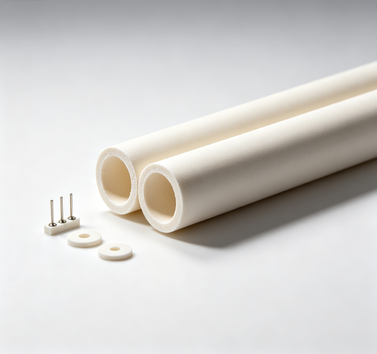
Boron Nitride Insulating Sleeve is a precision ceramic insulation component manufactured primarily from high-purity hexagonal boron nitride (h-BN), designed to electrically isolate rods, wires, electrodes, thermocouple elements, heating components, or other conductive parts operating in demanding thermal environments. Unlike polymeric sleeves, BN sleeves retain their inorganic structure at temperatures where conventional organic insulation rapidly decomposes, softens, or outgasses, while the low coefficient of thermal expansion helps limit dimensional changes during repeated heating and cooling. The combination of high electrical resistivity, low dielectric loss, good chemical stability, low wettability, and useful thermal conductivity makes Boron Nitride Insulating Sleeve particularly valuable when electrical isolation must coexist with high temperature and controlled heat transfer. From an engineering perspective, the sleeve should not be selected simply according to a maximum temperature rating. Wall thickness, inner diameter, outer diameter, concentricity, dielectric strength, thermal expansion of the enclosed component, installation clearance, atmosphere, mechanical vibration, and chemical exposure all influence actual service reliability. In particular, BN is a brittle ceramic, so dimensional accuracy and stress control during assembly are just as important as its intrinsic high-temperature properties.

Classification and Key Characteristics of Boron Nitride Insulating Sleeve
1. High Electrical Resistivity
The primary function of a Boron Nitride Insulating Sleeve is to prevent electrical contact between an internal conductive element and the surrounding structure. High-purity BN can provide electrical resistivity above 10¹³ Ω·cm, giving it strong insulating capability under appropriate operating conditions. For engineers, however, bulk resistivity is only one part of the insulation design: actual leakage current can be influenced by temperature, wall thickness, surface contamination, moisture, voltage, electrode geometry, and the presence of conductive deposits. A properly designed BN sleeve therefore provides not only a high-resistivity material but also a controlled physical separation distance around the conductive element.
2. High-Temperature Stability
Boron Nitride Insulating Sleeve is suitable for high-temperature environments where polymeric, glass, or lower-temperature ceramic insulation may become dimensionally unstable or chemically degraded. Hexagonal BN maintains its structural characteristics at very high temperatures under vacuum or inert atmospheres, making it useful for thermal-processing and high-temperature electrical assemblies. The practical temperature limit must nevertheless be defined by atmosphere and exposure duration because oxidation becomes increasingly important in oxygen-containing environments. Engineers should therefore distinguish between the intrinsic thermal stability of BN and the actual continuous service temperature of a specific sleeve installed in a particular process.
3. Low Thermal Expansion
The low coefficient of thermal expansion of BN, typically around 1–2 × 10⁻⁶/K depending on grade and orientation, is an important advantage for components exposed to repeated temperature changes. A sleeve with low thermal expansion can reduce dimensional movement relative to many surrounding ceramic or metallic structures, helping minimize thermally induced interference and stress. This is particularly important when the sleeve surrounds a metal conductor whose thermal expansion coefficient may be significantly higher than that of BN. The engineering objective is not necessarily to eliminate clearance, but to establish sufficient radial clearance throughout the complete temperature range while preventing excessive movement, vibration, or loss of positional accuracy.
4. Electrical Insulation with Thermal Management
A distinctive characteristic of Boron Nitride Insulating Sleeve is its ability to combine electrical insulation with useful thermal transport. BN is electrically insulating but can conduct heat considerably better than many conventional electrical insulation materials, allowing heat generated by an internal conductor or process to move toward the surrounding structure. This can be beneficial when the sleeve must isolate an electrical element without creating a severe thermal bottleneck. Engineers should evaluate the thermal path using the actual sleeve geometry, wall thickness, BN orientation, contact conditions, and surrounding materials because the effective thermal resistance of the assembled sleeve is not determined solely by the material's nominal thermal conductivity.
5. Chemical Stability and Low Wettability
High-purity BN provides good resistance to many chemical environments and exhibits relatively low wettability toward numerous molten materials, making Boron Nitride Insulating Sleeve useful in selected high-temperature processing systems. This property can reduce unwanted adhesion or reaction between the insulating sleeve and adjacent materials under suitable conditions. However, chemical stability is application-specific; molten salts, oxides, metals, reactive vapors, and process additives can behave differently at elevated temperatures. Engineers should therefore evaluate the actual chemical environment, exposure time, temperature, and material contact conditions rather than treating BN as universally inert.
6. Precision Ceramic Geometry
A Boron Nitride Insulating Sleeve can be manufactured with controlled inner diameter, outer diameter, wall thickness, length, and other dimensional characteristics to match a specific electrical or thermal assembly. Geometry is particularly important because a sleeve normally functions as both an electrical barrier and a mechanical interface around another component. Excessive wall thickness may increase thermal resistance and overall assembly size, while an excessively thin wall can reduce mechanical robustness and electrical insulation margin. Concentricity and inner-surface quality are also important when the sleeve surrounds a precision rod, wire, sensor, or electrode because local contact can generate concentrated stress or create an unintended electrical path.
Typical Specifications of Boron Nitride Insulating Sleeve
The following values represent typical engineering ranges for high-purity BN insulating sleeves. Actual specifications should be established according to the required electrical insulation, temperature, atmosphere, dimensions, mechanical loading, and thermal-management conditions.
| Property | Typical Value |
|---|---|
| Material | Hexagonal Boron Nitride (h-BN) |
| BN Purity | ≥99% |
| Density | 1.8–2.2 g/cm³ |
| Electrical Resistivity | >10¹³ Ω·cm |
| Thermal Conductivity | 50–70 W/m·K |
| Coefficient of Thermal Expansion | 1–2 × 10⁻⁶/K |
| Dielectric Constant | Approx. 3.5–4.5 |
| Dielectric Loss | Low |
| Flexural Strength | 50–100 MPa |
| Maximum Temperature | Up to 2000°C+ in inert/vacuum conditions* |
| Oxidizing Atmosphere | Lower practical temperature limit |
| Inner Diameter | Customized |
| Outer Diameter | Customized |
| Wall Thickness | Customized |
| Length | Customized |
| Surface Finish | Customized |
| Color | White to light gray |
Actual temperature capability depends on BN grade, purity, density, atmosphere, heating duration, mechanical loading, and surrounding materials. The dimensions of Boron Nitride Insulating Sleeve should be treated as functional engineering parameters rather than simple manufacturing data. The inner diameter determines the radial clearance around the conductive component, while the wall thickness establishes the electrical separation distance and contributes directly to radial thermal resistance. For high-temperature assemblies, engineers should calculate dimensional changes for both the BN sleeve and the internal conductor because the clearance available at room temperature may change significantly during operation. Surface finish and concentricity also become important where the sleeve is installed over a precision component, since localized contact can generate mechanical stress and potentially compromise insulation. For vacuum or high-purity applications, material purity, particle generation, outgassing, and surface cleanliness should be specified together with the dimensional requirements.
Applications of Boron Nitride Insulating Sleeve
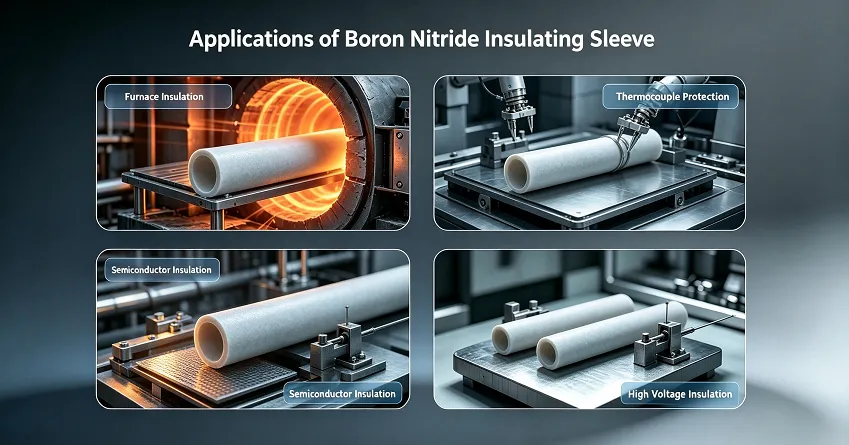
1. High-Temperature Electrode Insulation
Boron Nitride Insulating Sleeve can electrically isolate electrodes and conductive rods from surrounding metallic or ceramic structures in high-temperature equipment. The sleeve creates a controlled dielectric barrier while maintaining dimensional stability during heating, which is particularly useful when the electrode must remain accurately positioned throughout repeated thermal cycles. Engineers should calculate the required insulation distance from the operating voltage and dielectric strength while also considering the temperature-dependent electrical resistance of BN. Mechanical clearance must be sufficient to prevent the electrode from contacting the sleeve as both components expand at different rates.
2. Thermocouple and Temperature-Sensing Assemblies
BN sleeves can be used to electrically isolate and mechanically protect selected conductive elements within high-temperature temperature-measurement assemblies. Their high-temperature stability allows the insulating structure to remain functional near demanding thermal zones where polymeric sleeves would not survive. The sleeve geometry can also help maintain separation between multiple conductive elements and reduce the possibility of unintended electrical contact. For accurate temperature measurement, however, engineers should consider thermal conduction through the BN sleeve because the sleeve itself can influence heat transfer between the sensing element and surrounding environment.
3. Furnace Heating Components
In thermal-processing equipment, Boron Nitride Insulating Sleeve can be used around electrical conductors or heating-related components where reliable isolation is required under elevated temperatures. BN's low thermal expansion can help maintain dimensional stability during repeated heating and cooling, while its thermal conductivity can provide a controlled path for heat dissipation. The design must account for furnace atmosphere because the maximum usable temperature in an oxidizing environment can be substantially lower than under vacuum or inert gas. Electrical contamination from furnace deposits should also be considered because surface contamination may reduce the effective insulation performance even when the bulk BN remains intact.
4. High-Temperature Electrical Feedthrough Components
Boron Nitride Insulating Sleeve can serve as an insulating element around conductive pins, rods, or terminals passing through high-temperature assemblies. The sleeve physically separates the conductor from the surrounding structure and can help maintain a defined electrical path through a compact component. In these applications, engineers must consider creepage and clearance distances, terminal geometry, thermal expansion, mechanical retention, and potential electrical arcing at elevated temperature. The sleeve should not be regarded as an independent insulation component; its performance depends on the geometry and cleanliness of the entire feedthrough assembly.
5. Semiconductor and High-Purity Processing Equipment
BN sleeves are suitable for selected semiconductor and high-purity thermal-processing environments where electrical insulation must be combined with high-temperature stability and low contamination potential. High-purity BN can provide a chemically stable ceramic interface without introducing conventional organic insulation materials into the process environment. For these applications, engineers should specify purity, surface quality, dimensional tolerances, particle generation, and vacuum compatibility in addition to electrical and thermal properties. The appropriate BN grade should also be evaluated for interaction with process gases, deposited films, and adjacent materials at the actual process temperature.
6. Molten Material and High-Temperature Processing Systems
Because BN has low wettability toward many molten materials, Boron Nitride Insulating Sleeve can be used in selected high-temperature systems where an insulating component may come into contact with molten or semi-molten process materials. The sleeve can provide both electrical isolation and a chemically stable interface around conductive components. The actual suitability depends strongly on the molten material, temperature, atmosphere, contact duration, and impurity level, so compatibility testing may be necessary for long-duration service. Dimensional stability is equally important because penetration, reaction, or adhesion at the sleeve surface can alter the effective clearance and compromise the intended insulation function.
Engineering Considerations for Boron Nitride Insulating Sleeve Design
When designing a Boron Nitride Insulating Sleeve, engineers should begin with the electrical requirement and then integrate thermal, mechanical, dimensional, and chemical constraints into the final geometry. The inner diameter and wall thickness must provide sufficient electrical separation while maintaining adequate radial clearance over the entire operating-temperature range, particularly when the internal component is metallic and has a substantially higher coefficient of thermal expansion than BN. The sleeve should normally avoid carrying significant tensile or bending loads because ceramic materials are sensitive to flaws and tensile stress; installation forces should instead be distributed uniformly, with sharp edges and local point loading eliminated wherever possible. The thermal path must also be analyzed because increasing wall thickness improves physical separation but can increase radial thermal resistance, potentially causing the internal conductor to operate at a higher temperature than expected. Surface finish, concentricity, straightness, and dimensional tolerance become critical for long sleeves because small geometric deviations can create localized contact or uneven loading. In vacuum and inert-atmosphere applications, purity, outgassing, particle generation, and surface contamination should be controlled, while oxidizing applications require a more conservative temperature limit. Finally, engineers should consider thermal cycling, vibration, assembly/disassembly frequency, chemical exposure, and expected service life rather than qualifying the sleeve only against a single maximum-temperature condition.
Company Profile
JianXun Advanced Ceramic Technology is a professional manufacturer specializing in high-performance ceramic products, including Boron Nitride Insulating Sleeve, alumina ceramics, boron nitride ceramics, silicon carbide ceramics, silicon nitride ceramics, aluminum nitride ceramics, mullite ceramics, quartz ceramics, and customized precision ceramic components. The company focuses on finished ceramic products with controlled material composition, density, mechanical properties, thermal performance, dimensional accuracy, surface quality, and customized geometries for demanding industrial applications.
Payment Terms: T/T, PayPal, Credit Card, Western Union, etc.
Shipment Terms: By air, by sea, by express, or according to customer request.
Storage Conditions: Store Boron Nitride Insulating Sleeve in a clean, dry environment and protect it from moisture, oil, conductive contamination, impact, and excessive mechanical loading. Sleeves should be properly supported during storage to prevent bending, deformation, or edge damage.
FAQs About Boron Nitride Insulating Sleeve
1. What is the main engineering function of a Boron Nitride Insulating Sleeve?
The primary function of a Boron Nitride Insulating Sleeve is to create a stable electrical and physical barrier between a conductive component and its surrounding structure while operating in a demanding thermal environment. Unlike conventional polymer sleeves, BN can maintain its inorganic structure at much higher temperatures under suitable atmospheres. At the same time, its low thermal expansion and useful thermal conductivity allow engineers to manage dimensional stability and heat transfer. The sleeve therefore performs several functions simultaneously: electrical isolation, controlled clearance, thermal management, and protection of the internal component.
2. How should the wall thickness of a Boron Nitride Insulating Sleeve be determined?
Wall thickness should be selected by balancing dielectric separation, mechanical robustness, thermal resistance, dimensional clearance, and manufacturing capability. A thicker wall increases the physical distance between the conductor and surrounding structure and generally provides greater mechanical protection, but it also increases the radial thermal path and may enlarge the overall assembly. An excessively thin wall can be more vulnerable to handling damage, dimensional variation, and local electrical failure. Engineers should therefore determine wall thickness from the actual voltage, temperature, conductor diameter, required dielectric margin, thermal load, and allowable dimensional envelope rather than selecting a standard thickness solely by nominal temperature rating.
3. Can a Boron Nitride Insulating Sleeve be used around metal components?
Yes. Boron Nitride Insulating Sleeve is commonly suitable for electrically isolating metallic rods, wires, electrodes, pins, and other conductive components in high-temperature systems. However, the different thermal expansion coefficients of BN and metals must be considered carefully. If the initial clearance is too small, heating can cause the metal component to expand into the ceramic sleeve and generate excessive contact pressure; if the clearance is too large, the conductor may move or vibrate during operation. The correct design therefore requires thermal-expansion calculations across the complete operating-temperature range.
4. Is Boron Nitride Insulating Sleeve suitable for vacuum and high-temperature environments?
High-purity BN is well suited to many vacuum and inert-atmosphere high-temperature applications because it has excellent thermal stability and electrical insulation characteristics under controlled conditions. Nevertheless, the sleeve should be evaluated for purity, outgassing, particle generation, surface contamination, dimensional stability, and interaction with neighboring materials. A material's theoretical temperature capability does not automatically define its service temperature inside a vacuum system because the actual assembly may experience mechanical constraint, thermal gradients, and chemical reactions with process residues.
5. What causes Boron Nitride Insulating Sleeve failure during service?
Failure can result from several interacting mechanisms, including thermal shock, differential thermal expansion, excessive mechanical interference, tensile stress, impact damage, electrical breakdown, surface contamination, chemical attack, and oxidation. A sleeve may appear structurally intact but still lose insulation performance if conductive deposits form on its surface or if cracks create an unintended electrical path. Similarly, a mechanically sound sleeve can fail if an expanding metal component produces excessive radial stress during heating. For this reason, reliable Boron Nitride Insulating Sleeve design requires analysis of electrical, thermal, mechanical, and environmental conditions as one integrated system.