Advanced Technical Ceramics, Precision Alumina, Silicon Carbide, Crucible Parts



Nozzle
Overview
Boron Nitride Nozzle is a precision-engineered ceramic component manufactured primarily from high-purity hexagonal boron nitride (h-BN) for controlled delivery, injection, guiding, or transfer of molten materials, high-temperature gases, powders, and other process media. Unlike conventional oxide ceramics, h-BN combines electrical insulation, low thermal expansion, relatively high thermal conductivity, excellent thermal shock resistance, low wettability, and good chemical stability, making Boron Nitride Nozzle particularly valuable where a nozzle must repeatedly experience severe temperature gradients without introducing excessive thermal stress or unwanted adhesion. The layered crystal structure of BN also gives it a comparatively low friction surface and allows many BN components to be machined into precise geometries after sintering, which is important for controlling internal flow passages, outlet dimensions, and wall thickness. From an engineering perspective, nozzle performance is determined by much more than the nominal maximum temperature of the ceramic. Internal diameter, outlet geometry, wall thickness, surface roughness, pressure differential, flow velocity, thermal gradient, material compatibility, installation stress, and atmosphere must all be considered because local erosion, thermal shock, blockage, chemical attack, or stress concentration can become the actual service-life-limiting mechanism.

Classification and Key Characteristics of Boron Nitride Nozzle
1. High-Temperature Structural Stability
Boron Nitride Nozzle is designed for applications where the nozzle body must maintain dimensional integrity while exposed to elevated temperatures. High-purity h-BN can remain stable at very high temperatures under vacuum or inert atmospheres, allowing it to operate in environments that are unsuitable for polymeric components or many conventional insulation materials. However, an engineering temperature rating must always be interpreted together with atmosphere and exposure time because oxidation becomes increasingly important when BN is exposed to oxygen at elevated temperature. For continuous industrial service, the relevant parameter is therefore the actual operating temperature and atmosphere at the nozzle surface rather than the theoretical temperature at which BN begins to degrade.
2. Excellent Thermal Shock Resistance
The low coefficient of thermal expansion of BN, combined with its favorable thermal transport characteristics, gives Boron Nitride Nozzle strong resistance to thermal shock compared with many conventional brittle ceramics. This is particularly important for nozzles because the inner surface can be exposed to a hot process stream while the external surface remains significantly cooler, creating a through-wall temperature gradient. A material with high thermal expansion and low thermal conductivity can accumulate substantial thermal stress under these conditions, increasing the probability of cracking. BN reduces this risk through a combination of low expansion and relatively efficient heat distribution, although geometry remains critical. Sharp transitions, sudden changes in wall thickness, small outlet openings, and constrained mounting can still create localized thermal stress even when the bulk material has excellent thermal-shock resistance.
3. Low Wettability and Non-Stick Surface Characteristics
One of the most important advantages of Boron Nitride Nozzle in high-temperature material processing is its low wettability toward many molten substances. Poor wetting reduces the tendency of molten material to spread across or strongly adhere to the nozzle surface, which can help maintain a more stable outlet geometry and reduce accumulation around the flow passage. This characteristic is particularly valuable where nozzle blockage or dimensional changes caused by deposited material can affect process consistency. However, BN is not universally non-wetting to every material, and wetting behavior changes with temperature, composition, surface condition, atmosphere, and impurities. Engineers should therefore evaluate the actual process medium rather than treating low wettability as an absolute material property.
4. High Thermal Conductivity with Electrical Insulation
Boron Nitride Nozzle offers an unusual combination of thermal conductivity and electrical insulation. Unlike electrically conductive graphite components, high-purity BN can electrically isolate the process system while still transferring heat away from localized hot zones. This can be advantageous in electrically heated or electrically controlled high-temperature equipment where the nozzle must remain thermally connected to the surrounding structure without creating an unintended electrical path. The actual heat-transfer performance depends on BN grade, crystal orientation, density, wall thickness, contact resistance, and mounting configuration. Consequently, engineers should analyze the complete thermal path rather than using the bulk thermal conductivity value alone when determining nozzle operating temperature.
5. Chemical Resistance in Demanding Processing Environments
High-purity BN exhibits good chemical stability against many molten materials, gases, and processing environments, making Boron Nitride Nozzle suitable for selected applications where conventional ceramics may react with the process medium. Its chemical inertness and low wettability can reduce contamination and prolong the dimensional stability of the flow channel under suitable conditions. Nevertheless, chemical compatibility must be evaluated at the actual operating temperature because reactions that are negligible at room temperature may become significant during high-temperature exposure. Oxidizing atmospheres, reactive vapors, molten oxides, and process additives can all change the long-term behavior of BN, so compatibility should be established based on the complete chemical environment rather than a generic corrosion-resistance statement.
6. Precision Machinability and Customized Flow Geometry
A major engineering advantage of Boron Nitride Nozzle is the ability to manufacture customized flow passages, outlet openings, wall thicknesses, mounting interfaces, and external geometries. BN is comparatively machinable for a technical ceramic, allowing designers to produce precision features that would be difficult or expensive to obtain in some dense sintered ceramic systems. This is important because nozzle geometry directly influences pressure loss, velocity distribution, shear stress, residence time, and the potential for local deposition or erosion. The internal transition between the inlet and outlet should ideally avoid abrupt changes in cross-section that create flow separation or localized turbulence, while the wall thickness must provide sufficient mechanical and thermal margin without unnecessarily increasing thermal resistance.

Typical Specifications of Boron Nitride Nozzle
The following values represent typical engineering ranges for high-purity BN nozzles. Actual values depend on BN grade, manufacturing route, density, crystal orientation, dimensions, surface finish, and intended operating environment.
| Property | Typical Value |
|---|---|
| Material | Hexagonal Boron Nitride (h-BN) |
| BN Purity | ≥99% |
| Density | 2.0–2.25 g/cm³ |
| Thermal Conductivity | 180–220 W/m·K* |
| Coefficient of Thermal Expansion | Approx. 4.5 × 10⁻⁶/K |
| Electrical Resistivity | >10¹³ Ω·cm |
| Flexural Strength | 50–100 MPa |
| Compressive Strength | 100–300 MPa |
| Dielectric Constant | Approx. 3.5–4.5 |
| Maximum Temperature | Up to 2000°C+ in inert/vacuum conditions* |
| Internal Diameter | Customized |
| Outlet Diameter | Customized |
| Wall Thickness | Customized |
| Length | Customized |
| Surface Finish | Customized |
| Color | White to light gray |
Thermal conductivity and maximum temperature vary considerably with BN grade, density, orientation, atmosphere, and measurement conditions. For Boron Nitride Nozzle design, the dimensional specification is often more important than a simple material-property comparison because the nozzle directly controls the process flow. Internal diameter determines the available flow area, while outlet geometry controls exit velocity and pressure loss; even a small dimensional deviation can become significant when the nozzle is used for precision material delivery. Wall thickness must simultaneously withstand thermal gradients, mechanical loads, and handling forces while providing an acceptable thermal path. Surface roughness is also important because deposits tend to accumulate preferentially around imperfections, sharp transitions, or regions of reduced flow velocity. For this reason, engineers should specify the internal geometry, dimensional tolerance, surface condition, and mounting interface together rather than purchasing a nozzle solely by material grade.
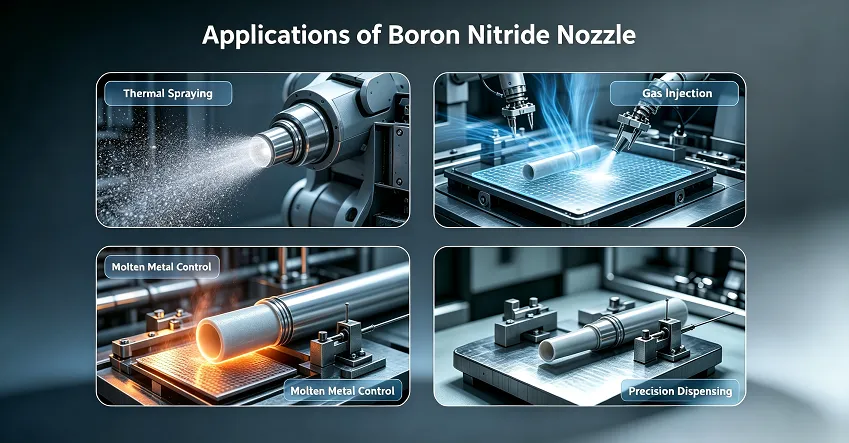
Applications of Boron Nitride Nozzle
1. Molten Material Delivery and Controlled Flow
Boron Nitride Nozzle can be used for controlled delivery of molten materials where the nozzle must maintain a stable flow passage while resisting wetting, thermal shock, and chemical interaction. Its low wettability can reduce material adhesion around the outlet, helping minimize progressive blockage and changes in discharge geometry. The low thermal expansion of BN is also valuable when the nozzle experiences rapid heating during startup or cooling during shutdown. From an engineering perspective, the nozzle must be designed according to the viscosity, temperature, pressure, chemical composition, and solidification behavior of the process medium, because even a chemically compatible ceramic can experience blockage if the local wall temperature falls below the medium's required processing temperature.
2. High-Temperature Furnace and Thermal Processing Systems
In high-temperature furnace equipment, Boron Nitride Nozzle can serve as a controlled outlet, gas-delivery component, protective flow channel, or process-material transfer element. BN's low expansion and thermal-shock resistance help it tolerate repeated temperature changes, while its electrical insulation can be advantageous around electrically heated assemblies. The nozzle geometry must be matched to the required flow rate and pressure conditions, and the installation should avoid rigidly constraining the ceramic against surrounding structures with substantially different thermal expansion coefficients. For long-term service, engineers should also consider furnace atmosphere because BN oxidation can become the dominant degradation mechanism in oxygen-containing environments.
3. High-Temperature Gas Injection and Flow Control
Boron Nitride Nozzle can be engineered for high-temperature gas injection, directional gas delivery, or localized flow control where dimensional stability and electrical insulation are required. BN's low thermal expansion helps maintain the outlet geometry under large temperature variations, while its thermal conductivity can help reduce localized overheating in the nozzle wall. The internal geometry should be optimized according to gas velocity, pressure differential, temperature, and desired flow pattern. If the outlet is exposed to a high-velocity stream, erosion or particle impact may become more important than static chemical compatibility, so nozzle life should be evaluated from both fluid-dynamic and materials-engineering perspectives.
4. Semiconductor and High-Purity Processing Equipment
High-purity Boron Nitride Nozzle is suitable for selected semiconductor and advanced-material processing equipment where contamination control is critical. BN can provide a high-temperature ceramic flow path without introducing metallic conductive materials into sensitive processing zones, while its chemical stability helps reduce unwanted interaction with process gases or materials under suitable conditions. For these applications, purity, surface finish, dimensional tolerance, particle generation, and outgassing characteristics should be controlled carefully. The internal surface is particularly important because microscopic defects or accumulated process residues can alter gas flow, create particles, or affect the repeatability of a precision process.
5. Powder, Vapor, and High-Temperature Process-Media Delivery
Boron Nitride Nozzle can also be used as a precision outlet for powders, vapors, or other process media in high-temperature equipment where conventional materials may suffer from adhesion or thermal degradation. The low-friction characteristics of h-BN can help reduce material retention under suitable conditions, while the ceramic structure provides stability at temperatures beyond the range of many organic nozzle materials. However, particulate flow introduces additional wear mechanisms, including abrasion, particle impact, and erosion at bends or outlet edges. Engineers should therefore evaluate particle size, hardness, velocity, concentration, flow rate, and wall thickness when determining the appropriate BN grade and nozzle geometry.
6. Electrical and Thermal Isolation in High-Temperature Assemblies
Because Boron Nitride Nozzle combines high electrical resistivity with thermal stability, it can function as a process-flow component in electrically active high-temperature assemblies where the nozzle must remain electrically isolated from adjacent conductive components. This is particularly useful where a conductive graphite or metallic nozzle could create an unwanted current path or interfere with electrical control. Engineers should consider dielectric strength, operating voltage, temperature-dependent resistivity, wall thickness, surface contamination, and the possibility of electrical discharge around the outlet. In such systems, the nozzle's electrical performance must be considered together with its thermal and mechanical design rather than evaluated as an isolated ceramic component.
Engineering Considerations for Boron Nitride Nozzle Design
When designing a Boron Nitride Nozzle, engineers should begin with the process-flow requirements and then work backward to material grade, geometry, thermal management, and mounting conditions. The internal diameter and outlet geometry determine flow velocity and pressure loss, while abrupt changes in cross-section can generate turbulence, dead zones, or localized deposition that gradually changes the effective flow area. Thermal analysis is equally important because the nozzle often operates under a strong radial or axial temperature gradient; low thermal expansion helps reduce thermal stress, but sharp corners and abrupt wall-thickness changes can still create local stress concentrations. The mounting system should allow for controlled thermal expansion and avoid excessive interference forces because BN is a brittle ceramic with limited tolerance for tensile and impact loading. Engineers should also examine the process medium's viscosity, melting or solidification temperature, wettability, chemical reactivity, and erosive characteristics because nozzle failure may result from blockage or erosion rather than fracture. Atmosphere must be specified explicitly, particularly for temperatures above approximately 800–1000°C, because oxidation behavior can substantially reduce the practical service temperature of BN in air. For precision applications, internal surface roughness, outlet concentricity, dimensional tolerance, material purity, and particle generation should be controlled as tightly as the process requires.
Company Profile
JianXun Advanced Ceramic Technology is a professional manufacturer specializing in high-performance ceramic products, including Boron Nitride Nozzle, alumina ceramics, boron nitride ceramics, silicon carbide ceramics, silicon nitride ceramics, aluminum nitride ceramics, mullite ceramics, quartz ceramics, and customized precision ceramic components. The company focuses on finished ceramic products with controlled material composition, density, mechanical properties, thermal performance, dimensional accuracy, surface quality, and customized geometries for demanding industrial applications.
Payment Terms: T/T, PayPal, Credit Card, Western Union, etc.
Shipment Terms: By air, by sea, by express, or according to customer request.
Storage Conditions: Store Boron Nitride Nozzle in a clean, dry environment and protect it from moisture, impact, contamination, and excessive mechanical loading. Keep precision nozzles properly supported and protect internal flow passages and outlet edges from contact damage during storage and handling.
FAQs About Boron Nitride Nozzle
1. Why is Boron Nitride used for high-temperature nozzle applications?
Boron Nitride Nozzle is selected because h-BN combines several properties that are difficult to obtain simultaneously in conventional nozzle materials: high-temperature stability, low thermal expansion, thermal shock resistance, electrical insulation, low wettability, and good chemical stability under suitable conditions. These characteristics allow BN to maintain a controlled flow geometry while exposed to rapid temperature changes and demanding process environments. However, the best nozzle material still depends on the process medium and atmosphere; BN should be selected only after evaluating chemical compatibility, erosion, thermal cycling, and mechanical loading.
2. How does the internal geometry of a Boron Nitride Nozzle affect performance?
The internal geometry directly determines flow area, pressure drop, velocity distribution, turbulence, and the tendency of material to deposit inside the nozzle. A small reduction in outlet diameter can significantly increase flow resistance or exit velocity, particularly in precision delivery systems. Abrupt internal transitions can also generate recirculation zones where particles or molten material accumulate. Therefore, Boron Nitride Nozzle geometry should be designed according to the required flow rate, pressure, temperature, viscosity, and process medium rather than simply selecting a standard opening size.
3. Can Boron Nitride Nozzle be used with molten materials?
Yes, BN is suitable for selected molten-material applications because of its low wettability and chemical stability toward many materials. These characteristics can reduce adhesion and help preserve the outlet geometry during repeated thermal operation. However, compatibility depends on the exact molten composition, temperature, atmosphere, impurities, and exposure duration. Engineers should also determine whether the local nozzle-wall temperature remains sufficiently high to prevent premature solidification because blockage caused by thermal conditions can occur even when the BN itself is chemically stable.
4. What causes cracking in a Boron Nitride Nozzle?
Cracking can result from thermal gradients, rapid temperature changes, mechanical interference, impact, tensile stress, machining defects, or localized stress concentration caused by nozzle geometry. Although BN has excellent thermal-shock resistance compared with many ceramics, it remains a brittle material and should not be subjected to uncontrolled mechanical constraint. Sharp internal corners, abrupt wall-thickness transitions, and excessive interference fits are common design risks. Proper radius design, controlled tolerances, uniform mounting pressure, and gradual heating and cooling can significantly improve operational reliability.
5. How should Boron Nitride Nozzle be selected for long-term high-temperature service?
Long-term selection should consider the complete process rather than the maximum temperature alone. Engineers should define the process temperature, atmosphere, pressure, flow rate, medium composition, wettability, viscosity, erosion potential, thermal cycling frequency, required dimensional tolerance, and expected service life. For vacuum or inert environments, high-purity BN can provide excellent high-temperature performance, while oxidizing environments require a lower and more conservative practical temperature limit. A reliable Boron Nitride Nozzle should therefore be specified as a complete engineered component, including BN grade, density, geometry, surface finish, mounting method, and operating environment.