Advanced Technical Ceramics, Precision Alumina, Silicon Carbide, Crucible Parts



Refractory Brick
Overview
Refractory Brick is a high-temperature ceramic product designed to maintain structural integrity, thermal insulation, and chemical stability when exposed to severe heat and aggressive operating environments. Unlike ordinary construction bricks, refractory bricks are engineered around controlled mineral composition, porosity, thermal expansion, mechanical strength, and resistance to chemical attack. These parameters directly determine whether a refractory lining can survive continuous heating, thermal cycling, mechanical abrasion, and contact with process materials. From an engineering perspective, selecting a Refractory Brick is not simply a matter of choosing the highest temperature rating. A brick that performs well at 1700°C in one furnace may fail prematurely in another operating below 1500°C if the atmosphere, slag chemistry, thermal cycling, mechanical loading, or brick joint design is unfavorable. The correct selection therefore requires matching the refractory microstructure and chemical composition to the actual service conditions. Alumina-based refractory bricks are particularly important where high refractoriness, mechanical strength, corrosion resistance, and dimensional stability are required. Depending on the Al₂O₃ content and manufacturing process, these products can be engineered for furnace linings, kiln structures, heat-treatment equipment, high-temperature reaction zones, and other thermal-processing systems.
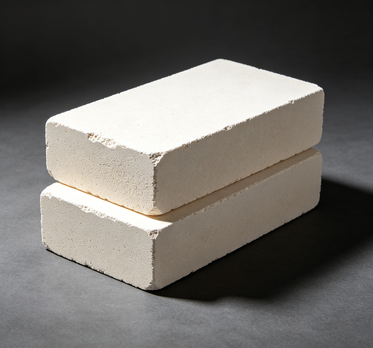
Classification and Key Characteristics of Refractory Brick
1. Alumina Content Determines the Fundamental Performance Envelope
Alumina refractory bricks are generally classified according to their Al₂O₃ content, with higher alumina grades providing improved refractoriness and resistance to many high-temperature corrosive environments. Common engineering grades may range from approximately 55% Al₂O₃ to more than 90% Al₂O₃, while specialized high-purity grades can contain even higher alumina levels. However, alumina percentage should not be considered independently. Two bricks with similar Al₂O₃ content can exhibit significantly different service performance because of differences in apparent porosity, bulk density, crystalline phases, grain size, impurity content, and firing conditions. For example, silica, iron oxide, alkali oxides, and other fluxing impurities can affect the high-temperature deformation behavior of the brick.
2. Refractoriness and High-Temperature Structural Stability
The primary function of a Refractory Brick is to maintain its structure under elevated temperature without excessive softening, deformation, melting, or chemical degradation. Alumina has a melting point above 2000°C, but the practical service temperature of a refractory brick is considerably more dependent on its complete composition and microstructure than on the melting point of pure Al₂O₃. At high temperatures, the interaction between the ceramic matrix and secondary phases becomes increasingly important. Engineers therefore evaluate refractoriness under load, permanent linear change, creep resistance, and thermal stability rather than relying only on a maximum-temperature number. These properties determine whether the lining can maintain its geometry during prolonged operation.
3. Bulk Density and Porosity Control Heat Transfer and Mechanical Behavior
The porosity of a Refractory Brick has a direct influence on thermal conductivity, mechanical strength, permeability, and resistance to molten-material penetration. Lower porosity generally increases density and mechanical strength, while higher controlled porosity can reduce thermal conductivity and improve insulation. There is therefore no universally ideal porosity. Dense bricks are often preferred in areas exposed to mechanical wear, molten materials, or corrosive gases, whereas insulating refractory structures prioritize low thermal conductivity and reduced heat storage. An engineer should select porosity according to the location of the brick within the thermal system rather than treating low porosity as automatically better.
4. Thermal Shock Resistance Is a Microstructural Problem
Repeated heating and cooling can be more damaging than continuous operation at a stable high temperature. Temperature gradients create differential thermal expansion within the brick, generating internal stresses that can initiate and propagate cracks. The thermal-shock behavior of a Refractory Brick depends on thermal expansion coefficient, thermal conductivity, elastic modulus, fracture toughness, porosity, grain structure, and component geometry. A refractory with extremely high strength is not necessarily the best choice for severe thermal cycling. In some applications, a controlled microstructure with moderate porosity can provide better resistance to crack propagation and repeated thermal gradients.
5. Chemical Compatibility Determines Long-Term Lining Life
High temperature alone does not define the service environment. Refractory bricks may come into contact with alkaline compounds, acidic components, molten oxides, process dust, metal oxides, or gaseous species. Chemical reactions can cause penetration, dissolution, formation of low-melting phases, volume changes, or progressive loss of the original microstructure. Alumina-based Refractory Brick generally provides strong resistance to many aggressive high-temperature environments, but the actual performance depends on the chemistry of the process material. Engineers should therefore evaluate the refractory against the expected slag or reaction products instead of selecting a brick based only on its nominal temperature rating.

Typical Specifications of Refractory Brick
The following values represent typical engineering ranges for alumina-based refractory bricks. Actual specifications vary according to alumina grade, manufacturing technology, firing temperature, porosity, and intended service environment.
| Property | Typical Specification |
|---|---|
| Product | Refractory Brick |
| Primary Material | Aluminum Oxide (Al₂O₃) |
| Al₂O₃ Content | 55–99% |
| Bulk Density | 2.3–3.7 g/cm³ |
| Apparent Porosity | 12–25% |
| Cold Crushing Strength | 30–150 MPa |
| Refractoriness | ≥1700°C depending on grade |
| Maximum Service Temperature | Approximately 1400–1800°C+ depending on composition |
| Thermal Conductivity | Approximately 1.5–3.0 W/m·K |
| Permanent Linear Change | Grade dependent |
| Thermal Expansion | Typically around 6–9 × 10⁻⁶/K |
| Thermal Shock Resistance | Grade and microstructure dependent |
| Chemical Resistance | High against many high-temperature corrosive media |
| Shape | Standard or customized |
| Dimensional Tolerance | Customized according to application |
The table should be interpreted as an engineering reference rather than a universal specification. For a production furnace, the relevant technical datasheet should define the actual values at the required temperature and test conditions. One particularly important distinction is between cold crushing strength and actual high-temperature mechanical performance. A brick may have excellent room-temperature strength but exhibit creep or deformation when subjected to prolonged load at elevated temperature. For load-bearing furnace structures, refractoriness under load and high-temperature creep should therefore be included in the material qualification process. Thermal conductivity also requires careful interpretation. Dense high-alumina bricks can have relatively high thermal conductivity compared with lightweight insulating refractories. This can be beneficial when rapid heat transfer or thermal uniformity is desired, but disadvantageous when the primary objective is reducing heat loss through the furnace wall.
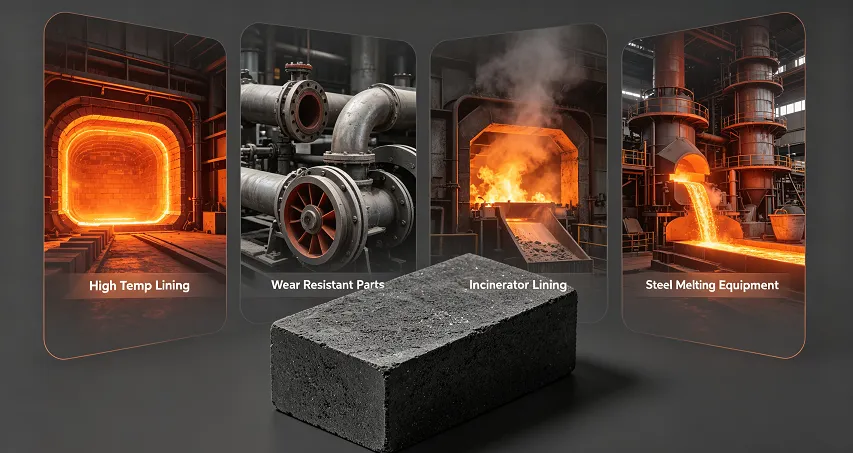
Applications of Refractory Brick
1. Industrial Furnace Linings
Refractory Brick is widely used to construct protective hot-face and structural layers inside industrial furnaces. The brick separates the furnace structure from the high-temperature working zone while resisting heat, mechanical stress, and chemical attack. For continuous furnaces, the brick must withstand prolonged exposure without excessive dimensional change. Engineers normally divide the lining into different zones because the temperature, atmosphere, mechanical loading, and chemical exposure are not uniform throughout the furnace. A dense high-alumina brick may therefore be selected for the most aggressive hot-face regions, while other refractory grades can be used farther from the process zone.
2. Kilns and High-Temperature Thermal Processing Equipment
Kilns used for ceramic, mineral, powder, and other thermal-processing operations require refractory structures capable of surviving repeated heating cycles. The refractory lining influences not only service life but also furnace energy efficiency and temperature uniformity. In these systems, thermal expansion must be considered during both initial installation and operation. Expansion joints, brick arrangement, anchoring, and furnace shell constraints all affect the stress state of the refractory lining. Even a high-quality Refractory Brick can crack if the lining system does not provide sufficient allowance for thermal expansion.
3. Heat-Treatment Equipment
High-temperature heat-treatment equipment uses refractory bricks to protect furnace structures and maintain stable thermal conditions around the working zone. Alumina-based bricks are particularly useful when high mechanical stability and resistance to contamination are required. The selection should consider whether the brick will be exposed to oxidizing, reducing, inert, or otherwise controlled atmospheres. The atmosphere can influence surface reactions, impurity behavior, and the stability of secondary phases, especially at elevated temperature.
4. High-Temperature Reaction and Processing Zones
Certain industrial processes expose refractory linings to both high temperature and chemically reactive materials. In these conditions, the refractory is not merely an insulating wall; it becomes a material interface with the process environment. A suitable Refractory Brick must resist penetration and chemical reaction while maintaining sufficient mechanical strength. Dense high-alumina compositions are often considered where corrosion and structural stability are major concerns, but the final choice should be based on compatibility testing against the actual process chemistry.
5. Thermal Equipment Requiring Customized Refractory Geometry
Industrial thermal equipment rarely consists entirely of simple rectangular surfaces. Door sections, burner zones, inspection openings, corners, curved structures, channels, supports, and transition areas may require specially shaped refractory components. Customized Refractory Brick geometries can reduce unnecessary joints and improve the mechanical continuity of a lining. Accurate dimensions are particularly important for complex furnace structures because excessive gaps can increase heat leakage and permit hot gases or corrosive materials to penetrate deeper into the lining.
Engineering Considerations When Selecting Refractory Brick
The first parameter engineers should establish is the actual temperature profile rather than simply the furnace's maximum rated temperature. A refractory operating continuously at 1500°C can experience a more demanding service condition than one briefly exposed to 1700°C, particularly when mechanical load and chemical attack are present. The second consideration is atmosphere and process chemistry. Oxidizing conditions, reducing conditions, volatile compounds, molten phases, and alkaline or acidic materials can interact differently with the refractory matrix. Chemical compatibility should therefore be evaluated together with temperature. The third consideration is thermal cycling. If the furnace experiences frequent start-up and shutdown cycles, door opening, rapid product loading, or localized heating, thermal-shock resistance may become more important than maximum refractoriness. Finally, engineers should evaluate the entire lining system rather than an individual brick. Brick dimensions, joint thickness, mortar or bonding method, expansion allowance, support structure, anchoring, installation quality, and furnace operating procedures can all influence refractory life.
Company Profile
JianXun Advanced Ceramic Technology is a professional manufacturer specializing in high-performance ceramic products, including Refractory Brick, alumina ceramics, boron nitride ceramics, silicon carbide ceramics, silicon nitride ceramics, aluminum nitride ceramics, mullite ceramics, quartz ceramics, and customized precision ceramic components. The company focuses on finished ceramic products with controlled material composition, density, mechanical properties, thermal performance, dimensional accuracy, and customized geometries for demanding industrial applications.
Payment Terms: T/T, PayPal, Credit Card, Western Union, etc.
Shipment Terms: By air, by sea, by express, or according to customer request.
Storage Conditions: Store Refractory Brick in a dry, covered, and well-ventilated environment. Prevent exposure to rain, groundwater, oil, and other contaminants. Bricks should remain on stable pallets or supports and be handled carefully to prevent edge damage and cracking before installation.
FAQs About Refractory Brick
1. Why does alumina content matter when selecting a Refractory Brick?
Alumina content directly influences the high-temperature stability and chemical behavior of an alumina-based refractory, but it is not the only factor determining performance. Increasing Al₂O₃ content generally improves refractoriness and resistance to many corrosive high-temperature environments because fewer low-melting impurity phases are present. However, the manufacturing process, porosity, density, grain structure, and secondary mineral phases can substantially change the actual performance of the finished brick. For this reason, engineers should compare the complete technical specification rather than selecting a brick solely because it has the highest Al₂O₃ percentage. In load-bearing applications, high-temperature deformation and refractoriness under load may be more important than chemical composition alone.
2. How should engineers choose between dense and insulating Refractory Brick?
The choice depends primarily on where the brick is located in the furnace and what function it must perform. Dense refractory bricks generally provide higher mechanical strength, better resistance to abrasion and molten-material penetration, and greater structural stability. Insulating refractories, in contrast, are designed around lower density and lower thermal conductivity to reduce heat loss and furnace-wall temperature. Using a highly insulating brick in a severe hot-face environment may result in rapid mechanical or chemical degradation, while using a dense refractory throughout the entire furnace can unnecessarily increase heat storage and energy consumption. In many industrial furnaces, the optimal solution is therefore a multilayer lining that combines a dense working layer with insulating backup materials.
3. What causes premature cracking of Refractory Brick during furnace operation?
Premature cracking is commonly associated with thermal gradients, improper expansion allowance, mechanical constraint, impact, installation defects, or chemical degradation. During heating, different regions of a brick expand at different rates, generating internal thermal stress. If the lining is tightly constrained by the furnace shell or adjacent bricks, this stress can become sufficiently high to initiate cracking. Rapid heating and cooling can intensify the problem because the surface and interior experience different temperatures. Cracks can also originate from damaged edges, excessive joint pressure, or poor installation practices. Consequently, refractory failure analysis should examine furnace temperature history, brick geometry, joint design, installation quality, and operating conditions rather than attributing failure only to the material itself.
4. Why can a Refractory Brick with a high maximum temperature rating still fail in service?
A maximum temperature rating does not describe every failure mechanism that occurs inside a working furnace. A brick may tolerate a certain temperature under controlled laboratory conditions but perform poorly when simultaneously exposed to mechanical loading, thermal cycling, corrosive process materials, gas penetration, or prolonged high-temperature deformation. For example, chemical reactions can generate low-melting phases that weaken the refractory well below the theoretical melting temperature of alumina. Similarly, continuous mechanical loading can cause creep or deformation over time. Engineers should therefore evaluate refractoriness under load, permanent linear change, chemical resistance, thermal shock, porosity, and service atmosphere in addition to the nominal maximum temperature.
5. How can the service life of a Refractory Brick lining be extended?
Service life can be improved by selecting the refractory according to the actual temperature, atmosphere, chemical environment, mechanical loading, and thermal-cycle frequency. Correct installation is equally important because poorly aligned bricks, excessive joint gaps, insufficient expansion allowance, and damaged components can create localized failure points. Furnace operation should also avoid unnecessary thermal shock, rapid temperature changes, and prolonged operation outside the material's design conditions. Periodic inspection can identify erosion, cracking, spalling, and chemical penetration before they develop into major lining failures. In demanding applications, the most effective approach is usually to optimize the complete lining system—including hot-face refractory, backup insulation, joints, expansion design, and installation method—rather than simply switching to a higher-rated brick.