Advanced Technical Ceramics, Precision Alumina, Silicon Carbide, Crucible Parts



Sealing Rings

Overview
Silicon Carbide Sealing Rings are precision-engineered ceramic sealing components designed for demanding mechanical, thermal, and chemical environments where conventional metallic sealing materials may experience excessive wear, corrosion, deformation, or thermal instability. Manufactured from high-performance silicon carbide, these sealing rings combine high hardness, excellent wear resistance, high compressive strength, low thermal expansion, high thermal conductivity, and strong chemical stability. These properties make Silicon Carbide Sealing Rings particularly suitable for mechanical sealing systems, high-temperature rotating equipment, chemical processing equipment, pumps, semiconductor-related equipment, industrial furnaces, and other systems where the sealing interface must remain dimensionally stable under continuous operating stress. Unlike polymeric sealing materials, SiC does not rely on elasticity to maintain its basic material integrity at elevated temperatures, while unlike many metallic materials, it offers significantly higher hardness and stronger resistance to abrasive particles and aggressive chemical media. However, the engineering performance of a SiC sealing ring depends not only on the material itself but also on the mating material, surface finish, flatness, ring geometry, contact pressure, rotational speed, lubrication conditions, temperature distribution, and installation accuracy. Silicon carbide is extremely hard but inherently brittle, meaning that edge chipping, impact damage, excessive tensile stress, or misalignment can cause premature failure even when the bulk material properties are excellent. Properly designed Silicon Carbide Sealing Rings therefore function as engineered tribological components rather than simply being treated as generic ceramic rings. Material grade, density, SiC content, microstructure, porosity, machining quality, and dimensional tolerance should all be evaluated according to the actual sealing environment. For applications involving elevated temperature, abrasive particles, corrosive liquids, or long operating cycles, the combination of low wear rate, thermal stability, and chemical resistance can significantly improve sealing reliability and reduce maintenance frequency.
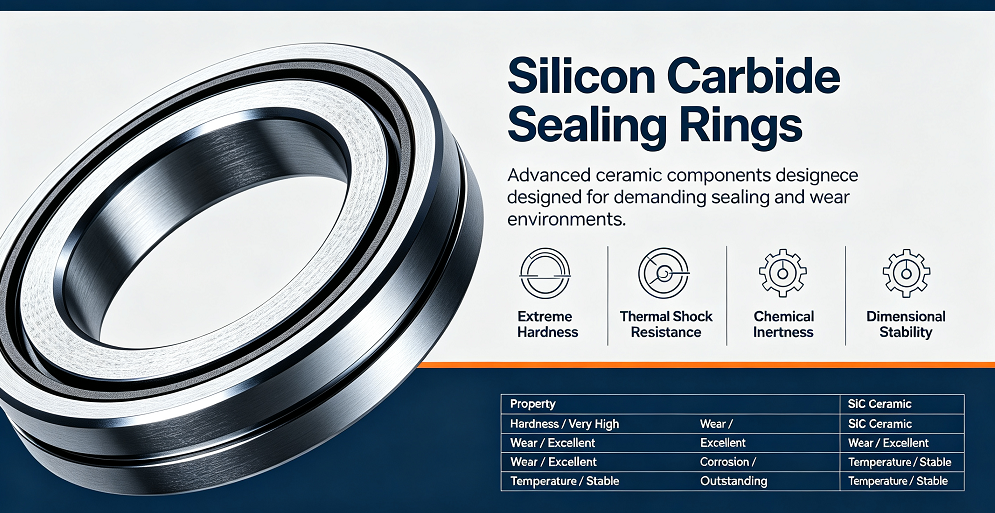
Classification and Key Characteristics of Silicon Carbide Sealing Rings
1. High Hardness and Outstanding Wear Resistance
The high hardness of silicon carbide is one of the most important reasons for using Silicon Carbide Sealing Rings in demanding sealing interfaces. SiC is substantially harder than most conventional metals and many engineering ceramics, allowing the sealing face to resist scratching, abrasive wear, micro-cutting, and surface damage caused by hard particles suspended in liquids or gases. This is particularly valuable in pumps and process equipment where the sealing interface may be exposed to contaminated fluids, slurries, mineral particles, ceramic particles, or other abrasive media. A harder sealing surface can maintain its geometry for a longer period, helping preserve the designed contact pattern and reducing leakage caused by progressive face wear. However, hardness alone does not determine sealing life. The opposing face, surface roughness, lubrication regime, contact pressure, particle concentration, and running speed all influence the actual tribological behavior. Therefore, the high hardness of SiC should be considered together with the complete sealing-system design rather than treated as an isolated material advantage.
2. High Compressive Strength for Stable Sealing Contact
Silicon Carbide Sealing Rings provide excellent resistance to compressive loading, making them suitable for applications where the sealing interface must maintain controlled contact pressure over extended operating periods. Ceramic sealing faces are frequently subjected to localized mechanical stresses rather than simple uniform compression, especially when the ring has a narrow contact band or when the component experiences shaft movement, pressure fluctuations, or installation tolerances. Silicon carbide's high compressive strength allows it to withstand substantial contact loads without plastic deformation, which is a major difference from softer metallic or polymeric materials. Maintaining a stable sealing face is essential because even relatively small changes in flatness or geometry can increase leakage or generate uneven frictional heating. At the same time, engineers must remember that ceramic materials have much lower tolerance for tensile and impact stresses than compression. The ring should therefore be designed so that operating loads remain predominantly compressive and stress concentrations at corners, grooves, and mounting interfaces are minimized.
3. Excellent Thermal Shock Resistance and Thermal Stability
Silicon carbide combines relatively low thermal expansion with high thermal conductivity, giving Silicon Carbide Sealing Rings strong resistance to temperature-induced dimensional changes and thermal gradients. In high-temperature equipment, one side of a sealing ring may heat more rapidly than another, producing differential expansion and localized stress. If the sealing material has a high coefficient of thermal expansion or poor heat dissipation, thermal distortion can alter the contact pressure and accelerate leakage or face wear. SiC helps reduce this problem because heat can be transferred efficiently through the ceramic while its low thermal expansion limits dimensional movement. This characteristic is especially useful in equipment subjected to repeated heating and cooling cycles. Nevertheless, thermal shock resistance depends strongly on ring geometry, wall thickness, thermal gradient, heating rate, cooling rate, and mounting constraints. A thick ring with sharp corners and restricted thermal expansion may experience higher internal stresses than a properly optimized geometry, so thermal performance should always be evaluated at the component level.
4. Strong Chemical and Corrosion Resistance
Silicon Carbide Sealing Rings are highly resistant to many chemically aggressive environments, which makes them valuable in chemical processing, water treatment, high-purity fluid handling, and industrial pumping systems. Silicon carbide generally shows strong resistance to many acids, alkalis, solvents, and corrosive process fluids, although actual compatibility depends on chemical concentration, temperature, pressure, impurities, and the specific SiC grade or bonding system. Compared with metals that may suffer from oxidation, pitting, or chemical corrosion, dense SiC can provide a much more stable sealing surface under suitable conditions. This stability helps prevent surface roughening and dimensional degradation that could otherwise compromise the sealing interface. For highly corrosive processes, however, engineers should evaluate not only the SiC ring but also the mating face, spring components, secondary seals, adhesives, and housing materials because the weakest component in the complete sealing system can determine overall service life.
5. Low Thermal Expansion and Excellent Dimensional Stability
The relatively low coefficient of thermal expansion of silicon carbide allows Silicon Carbide Sealing Rings to maintain dimensional stability across substantial temperature variations. This is particularly important when the ring operates against another precision-machined component because changes in ring diameter, thickness, or face flatness can directly affect contact pressure and leakage. Low thermal expansion can also reduce differential expansion when SiC is combined with other ceramic components or specially selected mating materials. In precision sealing applications, dimensional stability is not simply a material-property issue; it is also determined by machining accuracy, grinding method, surface flatness, parallelism, roundness, and assembly tolerance. SiC sealing faces are therefore normally precision ground or lapped to achieve the required surface condition. When the ring is specified for high-speed or high-pressure equipment, engineers should consider thermal deformation, shaft runout, housing distortion, and dynamic movement together with the nominal thermal expansion coefficient.
6. High Thermal Conductivity for Frictional Heat Management
High thermal conductivity is another important characteristic of Silicon Carbide Sealing Rings, especially in dynamic mechanical seals where friction at the sealing interface generates heat continuously during operation. If frictional heat cannot be removed efficiently, the local interface temperature may rise significantly above the average equipment temperature, resulting in thermal distortion, accelerated wear, lubricant degradation, or damage to secondary sealing elements. Silicon carbide can transfer heat away from the contact region more effectively than many conventional sealing materials, helping moderate localized temperature increases under suitable operating conditions. This becomes increasingly valuable as rotational speed and contact pressure increase. However, thermal conductivity does not eliminate frictional heating; lubrication, face loading, surface finish, cooling flow, and seal geometry remain critical. A properly engineered SiC sealing system should therefore use the material's thermal conductivity as part of a broader thermal-management strategy.
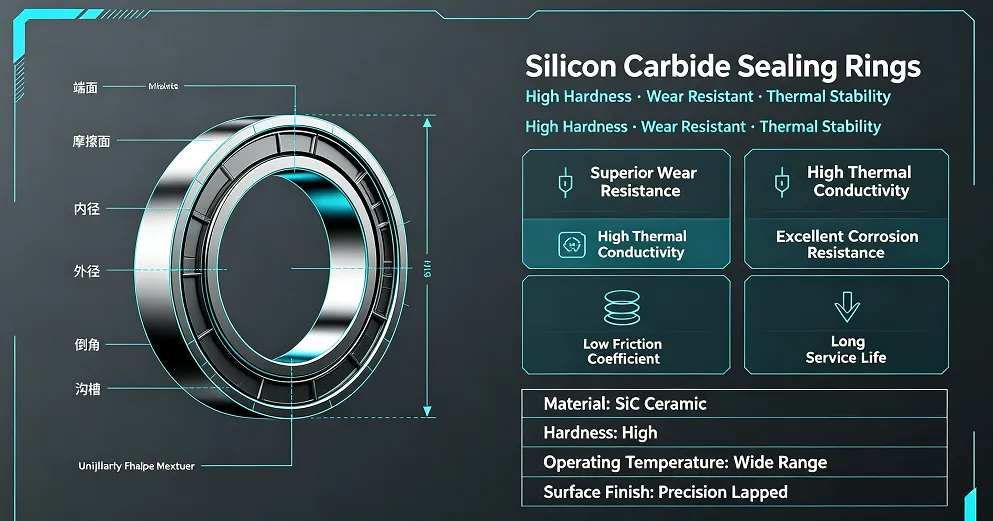
Typical Specifications of Silicon Carbide Sealing Rings
The following values represent typical engineering ranges for dense silicon carbide sealing components. Actual specifications vary according to manufacturing technology, SiC content, bonding system, microstructure, dimensions, and application requirements.
| Property | Typical Specification |
|---|---|
| Product | Silicon Carbide Sealing Rings |
| Material | Silicon Carbide (SiC) |
| SiC Content | Typically ≥85%, depending on grade |
| Density | ≥3.10 g/cm³ for dense grades |
| Flexural Strength | ≥350 MPa |
| Compressive Strength | ≥2000 MPa |
| Hardness | HRA ≥90 / very high ceramic hardness |
| Thermal Conductivity | Approx. 80–150 W/m·K |
| Coefficient of Thermal Expansion | Approx. 4.0–5.0 × 10⁻⁶/K |
| Maximum Service Temperature | Up to approximately 1600°C, depending on grade and atmosphere |
| Thermal Shock Resistance | Excellent |
| Wear Resistance | Excellent |
| Chemical Resistance | Excellent under suitable media conditions |
| Water Absorption | Very low for dense grades |
| Electrical Properties | High electrical resistance depending on grade and temperature |
| Manufacturing Options | Reaction-bonded, pressureless sintered, recrystallized, or other SiC grades |
| Ring Configuration | Solid ring, stepped ring, split ring, custom sealing geometry |
| Surface Finish | Precision ground, lapped, polished, or customized |
| Dimensions | Customized OD, ID, thickness, groove, profile, and tolerances |
The numerical specifications above should not be interpreted as guaranteed values for every SiC sealing ring. For a sealing component, dimensional accuracy and surface quality can be just as important as bulk strength. In particular, the sealing face may require controlled flatness, parallelism, roughness, roundness, and edge geometry depending on whether the ring is used in a static or dynamic sealing configuration. Reaction-bonded SiC can provide excellent wear and thermal performance but contains a silicon-containing bonding phase, while other SiC grades may offer different combinations of density, toughness, thermal conductivity, and high-temperature capability. For this reason, the correct grade should be selected according to actual operating temperature, pressure, speed, chemical medium, abrasive loading, mating material, and lubrication conditions.
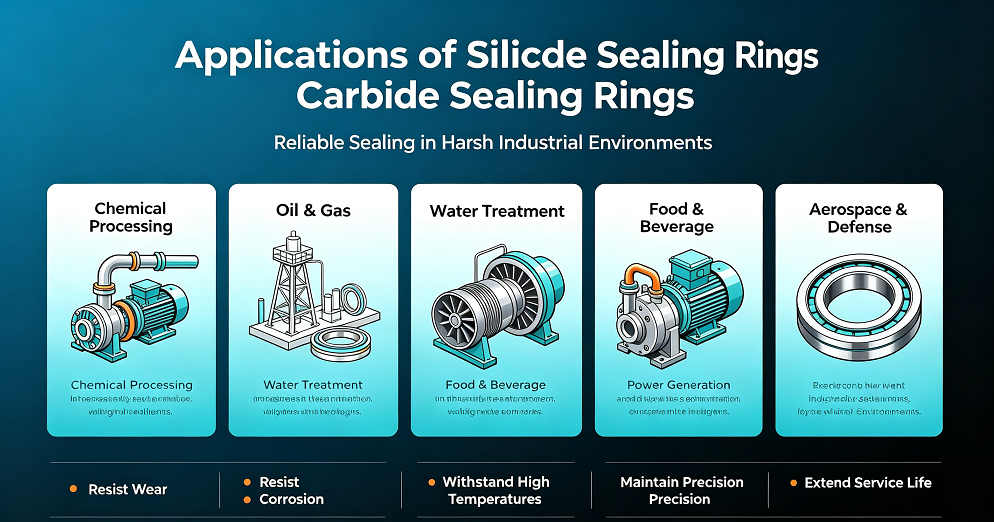
Applications of Silicon Carbide Sealing Rings
1. Mechanical Seal Systems for Industrial Pumps
Silicon Carbide Sealing Rings are widely suited to mechanical seal systems used in industrial pumps because the sealing face must withstand continuous sliding contact, pressure loading, frictional heating, and exposure to process fluids. In a typical mechanical seal, the stationary and rotating faces must maintain controlled contact while accommodating shaft rotation and small mechanical movements. The high hardness of SiC helps resist wear, while its thermal conductivity assists in dissipating frictional heat generated at the interface. Chemical resistance is also valuable when the pumped medium contains corrosive components or suspended particles. For water, chemical, process, and industrial circulation systems, the sealing ring can be engineered with a specific inner diameter, outer diameter, thickness, face width, and surface finish to match the mechanical seal assembly. Engineers should pay particular attention to shaft runout, face alignment, contact pressure, cooling or flushing conditions, and the compatibility of the opposing sealing face because these factors strongly influence actual service life.
2. High-Temperature Rotating Equipment
In high-temperature rotating machinery, conventional polymers and some metallic sealing components can experience softening, thermal deformation, oxidation, or accelerated wear. Silicon Carbide Sealing Rings provide a ceramic alternative where dimensional stability and thermal resistance are critical. Their low coefficient of thermal expansion helps limit dimensional changes as temperature rises, while high thermal conductivity can reduce localized thermal gradients generated by friction. SiC can therefore be useful in sealing arrangements associated with thermal processing equipment, high-temperature pumps, rotating process assemblies, and other systems where elevated temperatures are sustained or repeatedly cycled. The practical operating temperature must still be determined from the specific SiC grade, atmosphere, load, lubrication, and mating material. In particular, engineers should not use the nominal material temperature capability as the direct allowable sealing temperature without considering thermal stresses, mechanical loading, oxidation behavior, and the temperature of secondary sealing components.
3. Chemical Processing and Corrosive Fluid Handling
Chemical processing equipment can expose sealing components to acids, alkalis, solvents, salts, and other aggressive media. Silicon Carbide Sealing Rings are attractive for these environments because dense SiC offers strong resistance to many corrosive chemicals and maintains high surface hardness compared with conventional elastomeric or metallic materials. The stable ceramic surface can reduce degradation caused by corrosion, helping preserve the geometry required for reliable sealing. This is particularly important in pumps, mixers, circulation systems, chemical reactors, and fluid-transfer equipment where leakage can affect process safety, product purity, and equipment reliability. Chemical compatibility must nevertheless be checked under actual conditions because concentration and temperature can change corrosion behavior substantially. The complete assembly should also be reviewed, including secondary seals, springs, housings, adhesives, and mating faces, rather than evaluating the SiC ring alone.
4. Abrasive Slurry and Particle-Laden Fluid Systems
When pumps or rotating equipment handle abrasive slurries, sealing faces can suffer rapid mechanical wear from hard particles entering the contact interface. Silicon Carbide Sealing Rings are particularly useful in these conditions because their high hardness and abrasion resistance allow the sealing face to withstand particle-related surface damage better than many softer materials. Applications may include mineral processing, ceramic slurry handling, powder-processing systems, industrial wastewater, and other fluid systems containing suspended solids. However, material hardness does not prevent all forms of failure. Particle size, concentration, velocity, flushing conditions, seal-face pressure, and the ability of the seal geometry to prevent particles from entering the interface are equally important. Engineers should therefore optimize the sealing arrangement to control particle ingress and avoid excessive contact loading. A SiC ring can provide excellent wear resistance, but a poorly designed seal can still fail rapidly if abrasive particles continuously penetrate the sealing interface.
5. High-Purity and Semiconductor-Related Processing Equipment
High-purity processing systems require sealing components that can maintain dimensional stability while minimizing contamination and particle generation. Silicon Carbide Sealing Rings can be used in selected semiconductor and advanced-material processing equipment where high-temperature resistance, chemical stability, wear resistance, and controlled surface quality are required. Dense SiC can provide a hard, stable surface that resists mechanical degradation and can be manufactured to tight dimensional specifications. For high-purity applications, engineers must evaluate the material composition, impurity level, manufacturing route, machining process, cleaning procedure, packaging method, and surface condition because contamination performance depends on the complete manufacturing chain. The sealing geometry must also be designed to avoid unnecessary particle generation caused by rubbing, chipping, or excessive mechanical contact. When specified correctly, SiC can provide a stable ceramic interface for demanding thermal and chemical processing environments.
6. Water Treatment and Industrial Fluid Circulation
Industrial water-treatment systems often operate continuously and may expose sealing components to suspended solids, dissolved chemicals, temperature variations, and long operating cycles. Silicon Carbide Sealing Rings can provide a durable sealing interface because of their combination of hardness, chemical resistance, low thermal expansion, and resistance to abrasive wear. This makes them suitable for selected pumps and circulation equipment used in water treatment, industrial cooling, filtration systems, and process-water handling. Compared with softer sealing materials, SiC can maintain a relatively stable face under prolonged mechanical contact, particularly where water contains abrasive particles. The final design should account for fluid chemistry, solids concentration, operating pressure, rotational speed, temperature, and flushing conditions. Proper installation is equally important because ceramic rings can be damaged by impact or uneven mechanical loading during assembly.
7. Thermal Processing and Furnace-Related Equipment
Certain high-temperature thermal-processing systems require precision ceramic rings for separation, protection, sealing, positioning, or controlled interfaces between components. Silicon Carbide Sealing Rings can be selected where high-temperature dimensional stability, chemical resistance, and resistance to thermal cycling are more important than the flexibility offered by polymeric sealing materials. SiC's low thermal expansion reduces dimensional movement, while its high thermal conductivity helps manage temperature differences within the component. Depending on the furnace atmosphere and design, SiC rings may be used around high-temperature process chambers, gas-handling interfaces, thermal-processing fixtures, or other specialized assemblies. The engineer must distinguish between a true pressure-tight seal and a ceramic sealing or interface component used primarily for positioning and separation. For pressure-containing systems, the complete sealing design, including contact pressure and compliant elements, must be evaluated rather than assuming the ceramic ring itself can accommodate large dimensional mismatch.
8. Customized Precision Sealing Components
Many industrial machines use sealing geometries that cannot be satisfied by standard catalog rings. Silicon Carbide Sealing Rings can be manufactured with customized inner and outer diameters, thicknesses, stepped profiles, grooves, chamfers, face widths, mounting features, and precision sealing surfaces. This allows the component to be engineered around the actual mechanical assembly rather than forcing the equipment to use a generic ring dimension. Customized SiC rings are particularly useful when equipment operates at unusual temperatures, pressures, rotational speeds, chemical conditions, or abrasive loads. During design, engineers should provide the complete dimensional drawing together with material grade, tolerance requirements, face flatness, surface roughness, operating temperature, pressure, speed, mating material, and process medium. These parameters allow the manufacturer to determine an appropriate SiC grade and machining process while reducing the risk of premature cracking, leakage, or excessive face wear.
Engineering Considerations for Silicon Carbide Sealing Rings
The design of Silicon Carbide Sealing Rings should begin with the actual stress and tribological conditions rather than simply selecting the hardest available ceramic. The first consideration is whether the ring is used for static sealing, dynamic mechanical sealing, positioning, separation, or a specialized high-temperature interface, because each function imposes different requirements. For dynamic seals, engineers need to evaluate face pressure, sliding speed, lubrication, heat generation, shaft runout, vibration, and the material of the mating face. For static applications, dimensional tolerance, compressive loading, thermal expansion, surface flatness, and assembly stress become particularly important. Because SiC is a brittle ceramic, sharp corners, sudden section changes, interference fits, impact loading, and excessive tensile stress should be minimized. The sealing face normally requires precision grinding or lapping, and surface roughness must be selected according to the opposing material and lubrication regime. Thermal design is also important because low CTE and high thermal conductivity reduce thermal distortion but cannot completely eliminate thermal stress caused by severe temperature gradients. Chemical compatibility should be evaluated at the actual process concentration and temperature, while abrasive environments require analysis of particle size, velocity, concentration, and flushing conditions. Finally, installation procedures should prevent impact and edge damage; even a small chip at the sealing face can become a leakage path or stress concentrator during operation.
Company Profile
JianXun Advanced Ceramic Technology is a professional manufacturer specializing in high-performance ceramic products, including Silicon Carbide Sealing Rings, alumina ceramics, boron nitride ceramics, silicon carbide ceramics, silicon nitride ceramics, aluminum nitride ceramics, mullite ceramics, quartz ceramics, and customized precision ceramic components. The company focuses on finished ceramic products with controlled material composition, density, mechanical properties, thermal performance, dimensional accuracy, surface quality, and customized geometries for demanding industrial applications.
Payment Terms: T/T, PayPal, Credit Card, Western Union, etc.
Shipment Terms: By air, by sea, by express, or according to customer request.
Storage Conditions: Store Silicon Carbide Sealing Rings in a clean, dry, dust-free environment. Keep precision sealing faces protected from impact, contamination, moisture, and direct contact with hard objects, and use suitable protective packaging during storage and transportation.
FAQs About Silicon Carbide Sealing Rings
Q1: What makes Silicon Carbide Sealing Rings suitable for mechanical sealing applications?
A: Silicon Carbide Sealing Rings are suitable for many mechanical sealing applications because silicon carbide combines very high hardness, excellent wear resistance, high compressive strength, strong chemical resistance, high thermal conductivity, and relatively low thermal expansion. These properties allow the sealing face to maintain its geometry under prolonged contact, friction, pressure, and temperature changes. The material is especially useful when the sealing medium contains abrasive particles or corrosive chemicals that can rapidly degrade softer materials. However, successful mechanical sealing depends on the entire tribological system, including the opposing face material, surface roughness, face pressure, rotational speed, lubrication, cooling, alignment, and shaft runout. Therefore, SiC should be selected as part of a complete mechanical-seal design rather than solely on the basis of its hardness or temperature capability.
Q2: Why do Silicon Carbide Sealing Rings resist wear better than many conventional sealing materials?
A: The primary reason is the extremely hard SiC ceramic structure, which provides strong resistance to abrasive scratching, micro-cutting, and surface deformation. During operation, hard particles or rough mating surfaces can gradually remove material from a sealing face, changing its geometry and eventually increasing leakage. The high hardness of Silicon Carbide Sealing Rings helps maintain a stable sealing surface under suitable operating conditions. In addition, SiC has high compressive strength and good thermal conductivity, which help the component withstand mechanical contact and dissipate frictional heat. Nevertheless, wear resistance is not determined by hardness alone. A poorly lubricated interface, excessive contact pressure, high sliding speed, particle contamination, misalignment, or an unsuitable mating material can still cause rapid wear or damage, so the complete operating environment must be considered.
Q3: How should the dimensions and surface finish of a Silicon Carbide Sealing Ring be specified?
A: The dimensions should be determined from the actual sealing assembly, including inner diameter, outer diameter, thickness, face width, mounting configuration, groove dimensions, axial movement, and required installation tolerances. For dynamic sealing, engineers should additionally specify the operating speed, contact pressure, shaft diameter, shaft runout, mating face material, lubrication conditions, and expected temperature because these parameters influence the required face geometry and surface finish. Silicon Carbide Sealing Rings often require precision grinding or lapping on their sealing faces, with flatness, parallelism, roundness, and surface roughness controlled according to the application. Edge chamfers or radii should also be considered because sharp edges can become stress concentrations and are more susceptible to chipping during assembly. Providing a detailed engineering drawing is therefore preferable to specifying only the nominal ring diameter.
Q4: Why can a Silicon Carbide Sealing Ring crack even though silicon carbide has very high strength?
A: Silicon carbide has excellent compressive strength and hardness, but it remains a brittle ceramic and has limited tolerance for tensile stress, impact, and sudden localized loading. Cracking can occur when the ring experiences an excessive interference fit, uneven mounting pressure, thermal gradients, shaft misalignment, edge impact, sudden mechanical shock, or stress concentration around grooves and sharp corners. A sealing ring may therefore fail even when its average operating load appears to be below the published strength value. Silicon Carbide Sealing Rings should be installed using controlled procedures that avoid point loading and impact, while the housing and mating components should provide sufficiently uniform support. Thermal expansion differences between the SiC ring and surrounding components must also be considered, particularly when the equipment experiences rapid heating or cooling.
Q5: What information should be provided when ordering customized Silicon Carbide Sealing Rings?
A: A complete engineering specification should ideally include the required inner diameter, outer diameter, thickness, sealing-face width, profile or drawing, dimensional tolerances, surface roughness, face flatness, and edge configuration. The operating information should include temperature, pressure, rotational speed if applicable, process medium, chemical concentration, abrasive particle content, lubrication or cooling conditions, and expected operating cycle. It is also important to specify the mating sealing-face material because the tribological performance of Silicon Carbide Sealing Rings depends strongly on the material pair and interface conditions. If the application involves high-purity processing, the required purity level and contamination-control requirements should also be provided. With these parameters, the ceramic grade, density, manufacturing method, machining process, and final surface treatment can be selected more accurately.