Advanced Technical Ceramics, Precision Alumina, Silicon Carbide, Crucible Parts



Grinding Balls

Overview
Silicon Carbide Grinding Balls are high-performance ceramic grinding media manufactured primarily from silicon carbide (SiC), designed for demanding grinding, milling, dispersion, and particle-size reduction processes where conventional steel or lower-hardness ceramic media may suffer from excessive wear, contamination, or insufficient temperature resistance. Silicon carbide combines extremely high hardness, relatively low density, high thermal conductivity, chemical stability, and strong resistance to abrasive wear, allowing Silicon Carbide Grinding Balls to maintain their dimensional integrity during prolonged milling operations. Their high hardness enables efficient size reduction of hard and abrasive materials, while their ceramic composition helps minimize metallic contamination that can occur when steel balls are used. Compared with many conventional grinding media, SiC grinding balls can also provide favorable performance in processes involving elevated temperatures or chemically aggressive environments, provided that the selected SiC grade and operating atmosphere are compatible with the process. The relatively low density of SiC must also be considered during equipment design because grinding efficiency depends not only on hardness but also on impact energy, ball diameter, slurry viscosity, mill speed, filling ratio, and the physical properties of the material being processed. Therefore, Silicon Carbide Grinding Balls should be selected according to the complete grinding system rather than simply choosing the hardest available media. Diameter tolerance, surface finish, internal density, porosity, fracture resistance, chemical purity, and dimensional stability can all influence grinding efficiency, media consumption, contamination level, and service life.

Classification and Key Characteristics of Silicon Carbide Grinding Balls
1. Extremely High Hardness and Superior Wear Resistance
Silicon Carbide Grinding Balls are manufactured from high-hardness silicon carbide, typically achieving a hardness of around HRA 90 or above depending on the grade, density, and manufacturing process. This exceptional hardness enables the grinding media to withstand repeated impact, rolling, sliding, and abrasive contact with hard particles during continuous milling operations. Compared with conventional grinding media, SiC balls are less susceptible to surface deformation and abrasive wear, helping maintain a relatively stable grinding geometry throughout extended service. This characteristic is particularly important when processing hard ceramic powders, minerals, refractory materials, and other highly abrasive substances where rapid media wear can reduce grinding efficiency and increase operating costs. The combination of high hardness and excellent wear resistance also helps reduce media consumption and maintain more consistent particle-size distribution during long-duration grinding.
2. High Thermal Conductivity and Temperature Stability
Silicon carbide has relatively high thermal conductivity compared with many conventional ceramic materials, allowing Silicon Carbide Grinding Balls to transfer heat generated by friction, impact, and particle deformation more efficiently within the grinding system. This property can be beneficial in intensive milling processes where excessive localized heat may influence powder characteristics, binder stability, phase composition, or chemical reactions. In addition to thermal conductivity, SiC maintains good structural stability at elevated temperatures, making these grinding balls suitable for selected high-temperature material-processing environments. Their performance can remain stable under conditions where polymer-based or lower-temperature grinding media would soften, degrade, or lose mechanical integrity. However, actual thermal performance depends on the ball grade, milling equipment, atmosphere, heat-transfer conditions, and operating temperature, so the nominal temperature capability should always be evaluated together with the complete process environment.
3. Chemical Stability and Corrosion Resistance
Silicon Carbide Grinding Balls exhibit strong chemical stability and resistance to many corrosive environments, making them suitable for selected wet and dry grinding processes involving chemically aggressive materials. Unlike steel grinding media, SiC does not introduce iron-based corrosion products through conventional metallic corrosion mechanisms, which can be particularly important when processing high-purity powders or chemically sensitive materials. The dense ceramic structure also provides low water absorption and good resistance to many process liquids, helping maintain stable media performance during prolonged wet grinding. Nevertheless, chemical compatibility should not be assumed to be universal. Engineers should evaluate the specific solvent or slurry, pH value, oxidizing or reducing conditions, additives, dissolved salts, temperature, and exposure time before selecting Silicon Carbide Grinding Balls for a chemically demanding process.
4. Controlled Grinding Performance with Lower Media Density
Compared with steel grinding media, silicon carbide has a lower density, which gives Silicon Carbide Grinding Balls different impact and movement characteristics inside a mill. This lower density can help reduce the mechanical loading of certain milling systems and may be advantageous where controlled grinding action, lower equipment stress, or reduced media weight is desired. At the same time, lower density means that SiC balls cannot simply replace steel balls on a one-to-one basis while maintaining identical grinding conditions. Ball diameter, mill speed, filling ratio, slurry viscosity, feed hardness, and target particle size should all be reconsidered when changing media materials. Properly optimized, the combination of high hardness and controlled density can provide stable grinding and dispersion performance while reducing excessive impact or unnecessary mechanical energy in selected applications.
5. Low Metallic Contamination and High-Purity Processing Capability
One of the major advantages of Silicon Carbide Grinding Balls is their suitability for applications where metallic contamination must be controlled. Steel grinding media can gradually release iron and other metallic elements through wear, impact, or corrosion, potentially changing the chemical composition and performance of the processed powder. SiC grinding media provide a non-metallic alternative that can significantly reduce iron-related contamination, making them attractive for advanced ceramics, electronic materials, high-purity chemicals, and other specialized powder-processing applications. At the same time, SiC media are not completely contamination-free because microscopic wear particles can still enter the processed material. For this reason, engineers should consider SiC purity, manufacturing quality, surface condition, wear rate, cleaning procedures, and the acceptable level of silicon- or carbon-containing contamination when specifying Silicon Carbide Grinding Balls for high-purity production.

Typical Specifications of Silicon Carbide Grinding Balls
The following values represent typical engineering ranges. Actual specifications can be customized according to grinding equipment, material composition, operating conditions, and required purity.
| Property | Typical Specification |
|---|---|
| Product | Silicon Carbide Grinding Balls |
| Material | Silicon Carbide (SiC) |
| SiC Content | ≥99% |
| Bulk Density | 3.10–3.20 g/cm³ |
| Hardness | HRA ≥90 |
| Flexural Strength | Typically ≥300 MPa, depending on grade |
| Compressive Strength | Typically ≥2000 MPa |
| Thermal Conductivity | 80–120 W/m·K |
| Coefficient of Thermal Expansion | Approx. 4.0–4.8 × 10⁻⁶/K |
| Maximum Temperature | Up to approx. 1380°C under suitable conditions |
| Water Absorption | Very low |
| Wear Resistance | Excellent |
| Chemical Resistance | Excellent against many acids, alkalis, and process chemicals |
| Ball Diameter | Customizable, commonly according to mill requirements |
| Surface | Smooth, dense, precision-ground |
| Shape | Spherical |
| Color | Black or dark gray |
The specification of Silicon Carbide Grinding Balls should not be evaluated from hardness alone. Ball density affects impact energy, while diameter determines contact area and collision frequency; larger balls generally provide stronger individual impacts, whereas smaller balls provide a greater number of contact points and are often preferred for finer grinding. Porosity and internal defects are also important because grinding media experience repeated cyclic loading, and internal flaws can accelerate crack initiation and catastrophic breakage. For precision powder processing, dimensional tolerance and spherical accuracy can influence mill behavior, grinding uniformity, and media packing. Engineers should therefore consider hardness, density, fracture resistance, purity, ball diameter, surface finish, and wear rate as an integrated set of parameters when specifying Silicon Carbide Grinding Balls.
Advantages of Silicon Carbide Grinding Balls
1. Efficient Processing of Hard and Abrasive Materials
The exceptional hardness of Silicon Carbide Grinding Balls enables them to process a wide range of hard ceramic, mineral, refractory, and inorganic materials that can cause rapid wear of conventional grinding media. During milling, the grinding balls are subjected to repeated impact, compression, rolling, and sliding forces, while abrasive particles continuously interact with their surfaces. The high hardness of SiC helps resist surface degradation and maintain stable grinding performance over extended operating periods. This is particularly important for applications requiring controlled particle-size reduction, deagglomeration, or dispersion of highly abrasive powders. By maintaining a relatively consistent grinding surface, Silicon Carbide Grinding Balls can help improve process stability and reduce fluctuations in grinding efficiency caused by excessive media wear. The appropriate ball diameter and size distribution should still be selected according to feed particle size, mill type, grinding intensity, and the required final particle size.
2. Reduced Metallic Contamination
Metallic contamination is a critical consideration when processing high-purity powders, especially when the final material is intended for advanced ceramics, electronic components, chemical products, or other applications with strict impurity limits. When steel grinding balls are continuously exposed to impact and abrasive contact, small quantities of iron and other metallic elements can gradually enter the processed material through media wear or corrosion. Silicon Carbide Grinding Balls provide a ceramic grinding solution that avoids iron-based media at the grinding interface and can therefore significantly reduce the risk of Fe-related contamination. This advantage allows engineers to maintain better control over powder composition and minimize the possibility that metallic impurities will influence electrical, thermal, chemical, or mechanical properties. However, SiC media should not automatically be considered contamination-free because microscopic SiC wear particles may still enter the product. For demanding applications, SiC purity, wear rate, manufacturing quality, cleaning procedures, and the acceptable contamination level of the final powder should all be evaluated.
3. Long Service Life Under Suitable Grinding Conditions
The combination of high hardness, excellent wear resistance, and strong compressive strength enables Silicon Carbide Grinding Balls to provide a long service life when the milling system is properly designed and operated. Compared with softer grinding media, SiC balls can experience relatively low dimensional loss during continuous contact with hard and abrasive materials, helping reduce the frequency of media replacement. Stable ball dimensions are also important because excessive wear can gradually change the grinding media size distribution and consequently affect collision behavior, grinding efficiency, and final particle-size distribution. Longer media life can therefore contribute not only to lower media consumption but also to more consistent process operation and reduced maintenance requirements. Nevertheless, actual service life depends strongly on ball diameter, feed hardness, mill speed, filling ratio, impact intensity, slurry chemistry, temperature, mill lining material, and the presence of internal defects or surface damage. Selecting high-quality Silicon Carbide Grinding Balls with controlled density, low porosity, and good dimensional consistency is particularly important for high-energy milling applications.
4. Stable Performance in Thermally Demanding Processes
The high-temperature capability and relatively high thermal conductivity of silicon carbide make Silicon Carbide Grinding Balls suitable for selected grinding and material-processing systems where heat generation and thermal stability are important considerations. During intensive milling, mechanical energy is converted into heat through friction, impact, and deformation of the processed material, which can increase the temperature of the grinding chamber and slurry. Excessive temperature rise may affect viscosity, dispersant performance, binder stability, chemical reactions, or even the phase composition of temperature-sensitive materials. The good thermal conductivity of SiC can contribute to more efficient heat transfer within the grinding environment, while its ceramic structure maintains good stability at temperatures substantially above those tolerated by polymeric grinding media. This makes SiC attractive for specialized thermal-processing or combined grinding and heat-treatment operations. However, the grinding media alone cannot control system temperature; cooling design, mill configuration, processing speed, atmosphere, and heat generation rate must also be considered when evaluating Silicon Carbide Grinding Balls for thermally demanding applications.
5. Excellent Chemical and Corrosion Resistance
SiC exhibits strong chemical stability and good resistance to many corrosive and chemically aggressive environments, giving Silicon Carbide Grinding Balls an important advantage in selected wet-grinding and slurry-processing applications. When metallic grinding media are exposed to water, acids, alkaline solutions, salts, or process additives, corrosion and surface reactions may release metallic ions into the slurry and gradually reduce media integrity. SiC avoids many of these conventional metal-corrosion mechanisms and can therefore help maintain a cleaner grinding environment under suitable conditions. This characteristic is particularly useful when the processed material is chemically sensitive or when metallic ion contamination must be minimized. At the same time, chemical resistance is not absolute, and the performance of SiC depends on the specific chemical environment. Engineers should evaluate slurry composition, pH, oxidizing conditions, additives, operating temperature, concentration, and exposure duration before selecting Silicon Carbide Grinding Balls for chemically demanding processes. Compatibility testing under actual operating conditions is recommended for highly aggressive formulations.
6. Suitable for High-Purity Ceramic Processing
Advanced ceramic powders often require strict control of contamination, particle size, morphology, and chemical composition throughout the entire powder-processing chain. Because Silicon Carbide Grinding Balls are ceramic rather than metallic, they provide a useful option for processes where high hardness, wear resistance, and reduced metallic contamination are required simultaneously. They can be considered for processing materials such as technical ceramic powders, refractory compounds, inorganic functional materials, and selected high-purity chemical powders, depending on the required composition and acceptable contamination level. Their high hardness helps maintain effective grinding against difficult materials, while their chemical stability supports reliable operation in selected wet and dry milling environments. For high-purity applications, however, the grinding media should be treated as one part of the complete contamination-control system. Engineers should specify SiC purity, density, manufacturing route, surface finish, dimensional accuracy, wear characteristics, cleaning procedure, and compatibility with the mill lining and process fluid. Proper selection of Silicon Carbide Grinding Balls can therefore contribute to cleaner powder processing, more stable particle-size control, and improved consistency in demanding advanced-material manufacturing.
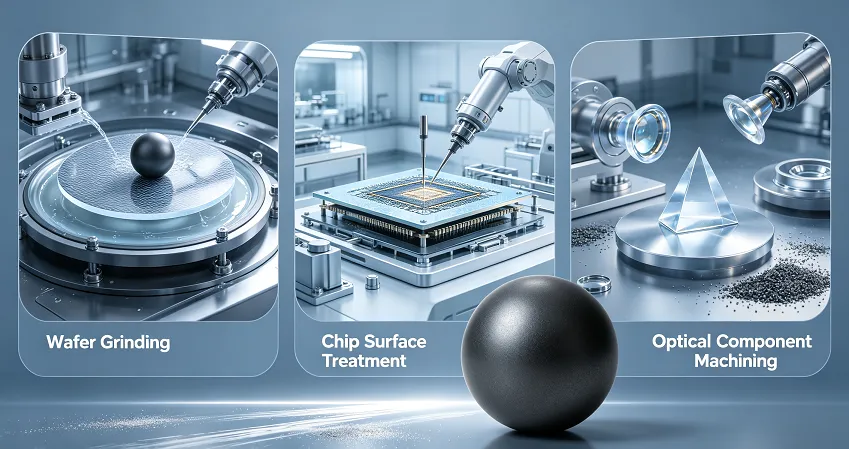
Applications of Silicon Carbide Grinding Balls
1. Advanced Ceramic Powder Processing
Silicon Carbide Grinding Balls are well suited for grinding, homogenizing, and deagglomerating hard ceramic powders where conventional grinding media may experience excessive wear or introduce unwanted metallic impurities. They can be used in selected processing operations involving alumina, zirconia, silicon carbide, silicon nitride, and other technical ceramic powders, provided that the chemical composition and contamination requirements of the final product are compatible with SiC media. Their high hardness allows repeated mechanical interaction with difficult powders while maintaining relatively stable ball geometry and grinding performance. The dense ceramic structure and strong wear resistance can also help reduce media consumption during extended milling cycles, which is important for continuous or batch production. For fine ceramic powders, engineers should carefully balance ball diameter, filling ratio, mill speed, slurry concentration, and residence time because these parameters directly influence impact frequency, shear forces, and final particle-size distribution. Media purity should also be selected according to the maximum acceptable SiC contribution to the processed powder.
2. Silicon Carbide and Other Hard Ceramic Materials
Processing silicon carbide itself requires grinding media capable of withstanding highly abrasive contact without suffering rapid surface degradation. Silicon Carbide Grinding Balls provide a compatible combination of high hardness, wear resistance, and chemical stability, making them suitable for selected SiC powder grinding, dispersion, and particle-size reduction processes. When SiC-based materials are processed with SiC media, the grinding system can be designed around a chemically similar ceramic material, which may simplify contamination analysis compared with using steel or other dissimilar media. This can be particularly valuable when the processed powder has strict requirements for metallic impurities. The performance of the grinding system still depends on feed particle size, powder hardness, slurry concentration, mill type, ball diameter, ball-size distribution, and energy input. For demanding SiC processing, engineers should also monitor media wear, particle-size distribution, temperature rise, and changes in powder morphology to determine whether the selected Silicon Carbide Grinding Balls are providing the required grinding efficiency.
3. Mineral and Inorganic Powder Grinding
Many mineral and inorganic materials possess high hardness and strong abrasive characteristics, which can rapidly consume conventional grinding media during continuous operation. Silicon Carbide Grinding Balls provide high hardness and excellent wear resistance, allowing them to maintain relatively stable performance when processing selected abrasive mineral powders and inorganic compounds. Their dense structure can also support repeated impact and rolling contact while minimizing excessive media deformation. In wet grinding systems, the chemical stability of SiC provides an additional advantage because the media can tolerate many process environments in which metallic grinding media may experience corrosion or release metal ions. This can help improve process cleanliness and reduce certain forms of contamination in the finished powder. Before selecting Silicon Carbide Grinding Balls, engineers should evaluate the Mohs hardness or abrasive characteristics of the feed material, required grinding fineness, slurry chemistry, mill configuration, operating temperature, and expected media wear rate. These factors determine whether SiC can provide a practical balance between grinding performance, media life, and operating cost.
4. High-Purity Chemical and Functional Materials
High-purity chemical powders and functional inorganic materials often require precise control over particle size while minimizing contamination introduced during mechanical processing. Silicon Carbide Grinding Balls can provide an alternative to steel grinding media when iron contamination or metallic ion release is undesirable. Their high hardness supports efficient particle-size reduction, while their chemical stability makes them suitable for selected wet-processing environments containing process liquids, dispersants, or other additives. This combination is useful when the grinding process must maintain consistent powder characteristics over relatively long milling cycles. However, using SiC media does not by itself guarantee ultra-high-purity processing because the media can still contribute small quantities of silicon carbide through normal wear. Engineers should therefore evaluate SiC purity, media wear rate, surface quality, cleaning procedures, mill lining, seals, process fluid, and the chemical composition of the final product as an integrated contamination-control system. For sensitive functional materials, laboratory-scale qualification before production-scale adoption can help determine whether Silicon Carbide Grinding Balls meet the required purity and particle-size specifications.
5. Electronic and Semiconductor-Related Powder Processing
Electronic and semiconductor-related materials often require tightly controlled chemical composition, particle-size distribution, and extremely low levels of metallic impurities during powder preparation. Silicon Carbide Grinding Balls may be considered for selected grinding, mixing, and dispersion processes where high hardness and non-metallic grinding media are advantageous. Their excellent wear resistance can help reduce uncontrolled media degradation during prolonged processing, while their ceramic composition avoids the iron contamination associated with conventional steel grinding balls. This can be important when trace metallic impurities could influence electrical, dielectric, thermal, or sintering characteristics of the final material. At the same time, semiconductor-related applications generally have much stricter contamination requirements than conventional powder processing, so engineers must determine whether SiC-derived particles are acceptable for the specific formulation. The selected Silicon Carbide Grinding Balls should therefore be evaluated according to SiC purity, density, wear behavior, ball diameter, surface finish, cleaning method, and compatibility with the target powder. Mill lining and other equipment-contact materials should also be reviewed because contamination can originate from multiple components of the grinding system.
6. Pigment, Filler, and Fine Powder Dispersion
Fine powders used as pigments, fillers, functional additives, and inorganic processing agents often require effective deagglomeration and homogeneous dispersion rather than simple coarse particle fracture. Silicon Carbide Grinding Balls can provide stable mechanical contact during prolonged milling because their high hardness and wear resistance allow them to withstand repeated rolling and collision with abrasive powder particles. Their spherical geometry creates multiple contact points within suitable milling equipment, supporting particle breakup and dispersion when the ball diameter and operating conditions are properly matched to the material. For very fine products, smaller Silicon Carbide Grinding Balls can provide a higher number of grinding contacts and may improve the ability to break down smaller agglomerates, while larger balls can provide greater individual impact energy for coarser feed materials. Engineers should also consider slurry viscosity, solids loading, dispersant concentration, mill speed, and residence time because these parameters influence media movement and grinding efficiency. Proper media selection can help achieve a more uniform particle-size distribution while maintaining controlled wear and minimizing unwanted contamination.
7. Wet Grinding and Slurry Processing
Wet grinding places additional demands on grinding media because the balls remain in continuous contact with process liquids, dissolved chemicals, dispersants, suspended particles, and sometimes elevated temperatures. Silicon Carbide Grinding Balls can be considered for selected slurry-processing systems because SiC combines high hardness, low water absorption, good chemical stability, and strong wear resistance. Their dense ceramic structure helps limit liquid penetration, while their resistance to abrasive wear supports stable operation when large quantities of hard particles are continuously circulated through the mill. The chemical stability of SiC can also reduce some corrosion-related contamination mechanisms associated with metallic grinding media. Nevertheless, the suitability of Silicon Carbide Grinding Balls must be assessed against the actual slurry rather than water alone. Engineers should evaluate pH, solvent composition, oxidizing conditions, additives, temperature, solids concentration, viscosity, and residence time, as these factors can affect both media stability and grinding behavior. Mill lining compatibility should also be considered because the interaction between the SiC media and lining can influence overall wear, contamination, and equipment service life.
Engineering Considerations for Silicon Carbide Grinding Balls
The selection of Silicon Carbide Grinding Balls should begin with the grinding mechanism and target particle size rather than simply the nominal hardness of the media. Ball diameter has a direct influence on impact energy, contact frequency, grinding efficiency, and final particle distribution; therefore, the optimum size depends on whether the process emphasizes coarse fracture, fine grinding, deagglomeration, or dispersion. Ball density should also be considered because SiC is substantially lighter than steel, meaning that mill speed and filling ratio may require adjustment when changing media materials. For wet grinding, chemical compatibility with the slurry, dispersant, pH, temperature, and suspended solids is essential. For high-purity applications, engineers should evaluate both media wear and the chemical composition of the wear debris. Internal porosity, cracks, inclusions, and dimensional irregularities can accelerate ball breakage under repeated impact, so dense and consistently manufactured media are preferred for demanding applications. Mill lining compatibility is equally important because the interaction between Silicon Carbide Grinding Balls and the lining can become a significant source of wear or contamination. During system qualification, media consumption, particle-size distribution, temperature rise, slurry viscosity, contamination level, and energy consumption should be measured together rather than evaluating grinding performance through a single parameter.
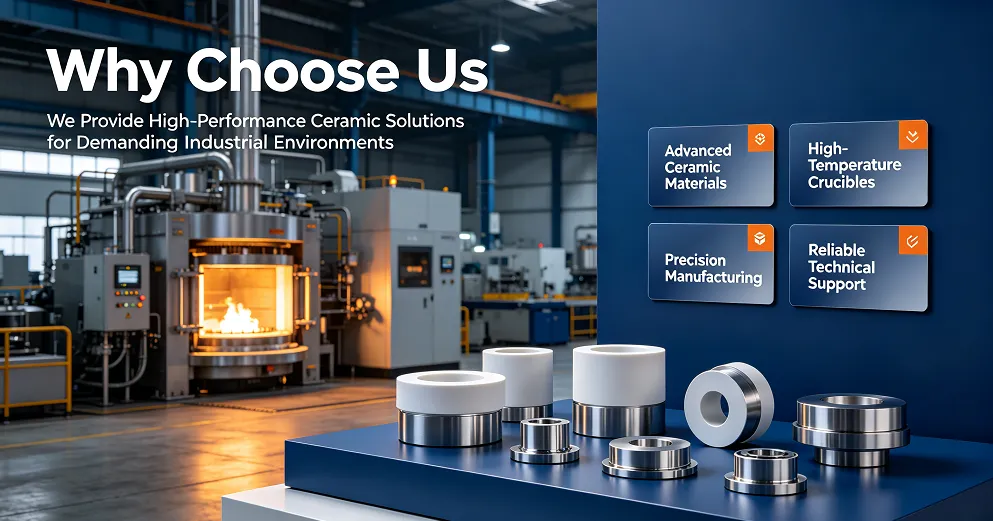
Company Profile
JianXun Advanced Ceramic Technology is a professional manufacturer specializing in high-performance ceramic products, including Silicon Carbide Grinding Balls, alumina ceramics, boron nitride ceramics, silicon carbide ceramics, silicon nitride ceramics, aluminum nitride ceramics, mullite ceramics, quartz ceramics, and customized precision ceramic components. The company focuses on finished ceramic products with controlled material composition, density, mechanical properties, thermal performance, dimensional accuracy, surface quality, and customized geometries for demanding industrial applications.
Payment Terms: T/T, PayPal, Credit Card, Western Union, etc.
Shipment Terms: By air, by sea, by express, or according to customer request.
Storage Conditions: Store Silicon Carbide Grinding Balls in a clean, dry environment and protect them from impact, contamination, and contact with incompatible chemicals. For high-purity applications, keep the grinding media sealed or covered until use and clean them according to the required process standard before loading into the mill.
FAQs About Silicon Carbide Grinding Balls
Q1: Why are Silicon Carbide Grinding Balls suitable for grinding hard and abrasive materials?
A: Silicon Carbide Grinding Balls are particularly suitable for hard and abrasive materials because silicon carbide combines exceptionally high hardness, strong compressive strength, and excellent resistance to abrasive wear. During milling, the grinding media are continuously subjected to impact, compression, rolling, sliding, and direct contact with hard particles, which can quickly wear softer media and gradually change their size and shape. The high hardness of SiC helps maintain a stable grinding surface and reduces excessive dimensional loss, allowing the media to remain effective over extended milling cycles. This is especially valuable when processing technical ceramics, refractory powders, minerals, SiC powders, and other materials with high abrasive characteristics. In addition, maintaining relatively stable media dimensions can contribute to more consistent collision behavior and particle-size distribution throughout the grinding process. However, Silicon Carbide Grinding Balls should not be selected according to hardness alone; ball diameter, density, mill speed, filling ratio, feed particle size, slurry properties, and target fineness must all be considered to achieve the desired grinding efficiency.
Q2: Why choose Silicon Carbide Grinding Balls instead of steel grinding balls?
A: The primary reasons for choosing Silicon Carbide Grinding Balls over steel grinding balls are reduced metallic contamination, high wear resistance, and good chemical stability. During prolonged milling, steel media can gradually release iron and other metallic elements through mechanical wear or corrosion, which may negatively affect the purity and functional properties of sensitive powders. SiC provides a non-metallic grinding interface and can therefore significantly reduce iron-related contamination, making it attractive for advanced ceramics, electronic materials, high-purity chemicals, and other applications with strict impurity requirements. Silicon carbide also offers excellent hardness and resistance to many chemically aggressive environments, providing advantages in applications where steel media may suffer from corrosion or excessive wear. However, replacing steel with SiC changes the grinding dynamics because SiC has a different density and impact behavior. Engineers may therefore need to optimize ball diameter, filling ratio, mill speed, and grinding time rather than directly transferring the operating parameters used for steel media.
Q3: How should the diameter of Silicon Carbide Grinding Balls be selected?
A: The diameter of Silicon Carbide Grinding Balls should be selected according to the feed particle size, desired final particle size, material hardness, mill type, grinding mechanism, slurry viscosity, and required energy input. Larger grinding balls generally provide stronger individual impacts and are more effective for breaking relatively coarse particles or hard agglomerates, while smaller balls provide a greater number of contact points and can be more effective for fine grinding, dispersion, and deagglomeration. In some industrial processes, a combination of different ball sizes is used to provide both sufficient impact energy for initial particle fracture and a high contact frequency for subsequent fine grinding. Ball diameter also affects media movement, packing behavior, grinding chamber loading, and heat generation, so it should be considered as part of the complete milling system. When selecting Silicon Carbide Grinding Balls, engineers should ideally evaluate the media through laboratory or pilot-scale trials and compare particle-size distribution, grinding efficiency, media wear, temperature rise, and energy consumption rather than relying on a universal ball-size recommendation.
Q4: Can Silicon Carbide Grinding Balls be used for wet grinding?
A: Yes, Silicon Carbide Grinding Balls can be used in selected wet-grinding applications because SiC combines high hardness, low water absorption, good wear resistance, and resistance to many chemical environments. In a wet mill, the grinding media are continuously exposed to water or other process liquids, dissolved chemicals, dispersants, suspended particles, and sometimes elevated temperatures. The dense ceramic structure of SiC helps limit liquid penetration, while its chemical stability can reduce some corrosion-related problems associated with metallic grinding media. This makes SiC media suitable for certain ceramic slurries, inorganic powders, chemical processing systems, and other applications where both wear resistance and controlled contamination are important. Nevertheless, wet-grinding compatibility must be evaluated using the actual process chemistry rather than assuming that SiC is resistant to every liquid. Engineers should consider pH, solvent composition, oxidizing conditions, additives, dissolved salts, temperature, solids concentration, viscosity, and exposure time, while also checking compatibility between the Silicon Carbide Grinding Balls, mill lining, and processed material.
Q5: What factors determine the service life of Silicon Carbide Grinding Balls?
A: The service life of Silicon Carbide Grinding Balls is determined by a combination of material properties, media geometry, milling conditions, feed characteristics, and equipment design rather than by hardness alone. Important factors include ball diameter, density, internal porosity, manufacturing quality, surface condition, mill speed, filling ratio, impact intensity, feed hardness, particle concentration, slurry chemistry, operating temperature, and the material of the mill lining. Even highly wear-resistant SiC media can experience chipping, cracking, or fracture if the impact energy is excessive, the balls are improperly sized, or the grinding system contains severe mechanical stress concentrations. Chemical conditions can also influence long-term stability, particularly in aggressive wet-grinding environments. To determine the practical service life of Silicon Carbide Grinding Balls, engineers should monitor media weight loss, diameter reduction, breakage rate, surface damage, powder contamination, particle-size distribution, and grinding efficiency over time. These measurements provide a much more reliable basis for determining media replacement intervals and optimizing operating parameters than simply relying on the manufacturer's nominal wear-resistance specification.