Advanced Technical Ceramics, Precision Alumina, Silicon Carbide, Crucible Parts



Firing Plate
Overview
Boron Nitride Firing Plate is a high-performance advanced ceramic component designed for high-temperature firing, sintering, heat treatment, and material processing applications where contamination control, thermal shock resistance, chemical stability, and surface release performance are critical. Unlike conventional ceramic setter plates manufactured from alumina or zirconia, boron nitride firing plates utilize the unique properties of hexagonal boron nitride (h-BN), including low wettability, excellent thermal stability, low thermal expansion, and outstanding resistance to chemical interaction. From an engineering perspective, a Boron Nitride Firing Plate is not simply a support plate used inside a furnace. It functions as a controlled interface between the processed material and the thermal environment. The interaction between the plate surface and the fired material directly affects product quality, surface defects, contamination level, material yield, and production efficiency. In advanced ceramic manufacturing, semiconductor processing, powder metallurgy, and high-temperature material synthesis, improper setter plate selection can lead to sticking, chemical diffusion, cracking, warping, or unwanted reactions between the product and the support surface. Boron nitride firing plates are specifically engineered to minimize these problems through their chemically inert surface and excellent release characteristics. The performance of a Boron Nitride Firing Plate depends on several engineering parameters, including BN purity, density, grain orientation, porosity, surface finish, thermal conductivity, mechanical strength, and furnace atmosphere. The correct material selection should consider not only the maximum operating temperature but also the processed material chemistry, heating cycle, atmosphere condition, and required service life.

Classification and Key Characteristics of Boron Nitride Firing Plate
1. Hexagonal Boron Nitride Structure and Material Advantages
The fundamental advantage of a Boron Nitride Firing Plate comes from the unique layered structure of hexagonal boron nitride. Similar to graphite, h-BN consists of hexagonal atomic layers, but unlike graphite, it provides excellent electrical insulation and superior oxidation resistance under many operating conditions. The layered crystal structure gives boron nitride a naturally low-friction and non-stick surface. This property reduces adhesion between the firing plate and processed materials, allowing easier removal after high-temperature treatment. For engineers, this means reduced product damage, improved production yield, and less frequent cleaning or replacement of furnace components. The microstructure of the BN ceramic must be carefully controlled during manufacturing. Excessive porosity may reduce mechanical strength, while overly dense structures may influence thermal shock behavior and machining characteristics. Therefore, the balance between density, strength, and surface properties is essential for reliable firing plate performance.
2. Excellent Non-Wetting and Release Performance
One of the most important characteristics of a Boron Nitride Firing Plate is its extremely low wettability. Many molten metals, ceramic powders, glass materials, and reactive compounds show limited adhesion to BN surfaces, allowing the processed materials to separate easily after firing. This non-wetting behavior provides significant advantages compared with conventional ceramic setter plates. In high-temperature sintering processes, material sticking can cause surface defects, cracking during removal, contamination, and increased labor for cleaning operations. From an engineering viewpoint, the release performance of the firing plate is influenced by BN purity, surface roughness, firing temperature, atmosphere, and the chemical composition of the processed material. A smooth and chemically stable BN surface provides better separation performance and longer service intervals.
3. High Thermal Shock Resistance
Thermal shock resistance is one of the critical reasons engineers select boron nitride for repeated heating and cooling applications. A Boron Nitride Firing Plate typically has a low coefficient of thermal expansion, around 1–2 × 10⁻⁶/K, which reduces internal stress during rapid temperature changes. During furnace operation, setter plates may experience repeated thermal cycling, including rapid heating, cooling, loading, and unloading. Materials with high thermal expansion coefficients may develop cracks because of temperature gradients between different regions of the component. Boron nitride's combination of low expansion, moderate thermal conductivity, and layered crystal structure allows it to tolerate repeated thermal cycling better than many traditional ceramic materials. This property is particularly valuable in production environments where furnace downtime and component replacement costs must be minimized.
4. High Chemical Stability and Low Contamination
A major requirement in advanced material processing is preventing contamination from the support material. A Boron Nitride Firing Plate provides excellent chemical stability because BN does not easily react with many metals, oxides, semiconductor materials, and ceramic powders. In high-purity applications, even trace contamination from a support material can affect electrical properties, crystal quality, optical performance, or final material reliability. Boron nitride is therefore widely considered when material purity is a critical requirement. However, engineers should evaluate compatibility according to the actual atmosphere. Although BN provides excellent performance in inert and vacuum environments, oxidation behavior must be considered when operating at high temperatures in oxygen-containing atmospheres.
5. High-Temperature Performance
Boron nitride has excellent temperature resistance and can maintain stable performance at temperatures approaching 2000°C under inert or vacuum conditions. A Boron Nitride Firing Plate is therefore suitable for demanding thermal processes requiring controlled environments.
The maximum usable temperature depends strongly on atmosphere. In vacuum, nitrogen, or inert gas environments, BN can maintain its structure at very high temperatures. In oxidizing atmospheres, the service temperature is reduced because boron nitride can react with oxygen at elevated temperatures.
For this reason, furnace atmosphere is one of the most important parameters when selecting BN firing plates. Engineers should consider temperature, atmosphere composition, exposure time, and thermal cycling frequency together.
6. Electrical Insulation Capability
Unlike graphite-based materials with similar layered structures, boron nitride provides excellent electrical insulation. This unique combination of thermal performance and electrical insulation makes a Boron Nitride Firing Plate suitable for applications where conductive materials cannot be used. High-purity BN typically provides electrical resistivity above 10¹³ Ω·cm, allowing it to function as both a thermal support material and an electrical insulating component. This advantage is particularly important in semiconductor manufacturing, electronic material processing, and high-temperature electrical equipment where electrical isolation must be maintained during heating.

Typical Specifications of Boron Nitride Firing Plate
The following specifications represent typical engineering values for high-performance boron nitride firing plates. Actual properties depend on manufacturing process, BN purity, density, and application requirements.
| Property | Typical Specification |
|---|---|
| Product | Boron Nitride Firing Plate |
| Material | Hexagonal Boron Nitride (h-BN) |
| BN Purity | ≥99% |
| Density | 1.9–2.3 g/cm³ |
| Flexural Strength | 40–100 MPa |
| Compressive Strength | 200–500 MPa |
| Thermal Conductivity | 30–80 W/m·K |
| Coefficient of Thermal Expansion | 1–2 × 10⁻⁶/K |
| Electrical Resistivity | >10¹³ Ω·cm |
| Maximum Working Temperature | Up to 2000°C (inert/vacuum atmosphere) |
| Surface Finish | Machined or polished |
| Chemical Stability | Excellent against many metals and ceramics |
| Water Absorption | Low depending on density |
| Shape | Plate, disc, customized geometry |
| Thickness | Customized |
| Dimension Tolerance | Customized |
The selection of specifications should be based on actual furnace conditions rather than individual parameters. For example, increasing density may improve mechanical strength but can influence thermal shock behavior and machining characteristics. For high-temperature production systems, engineers should also evaluate plate thickness. A thicker plate provides greater mechanical support but increases thermal mass and may affect heating uniformity. A thinner plate improves thermal response but requires careful consideration of mechanical loading and handling conditions.
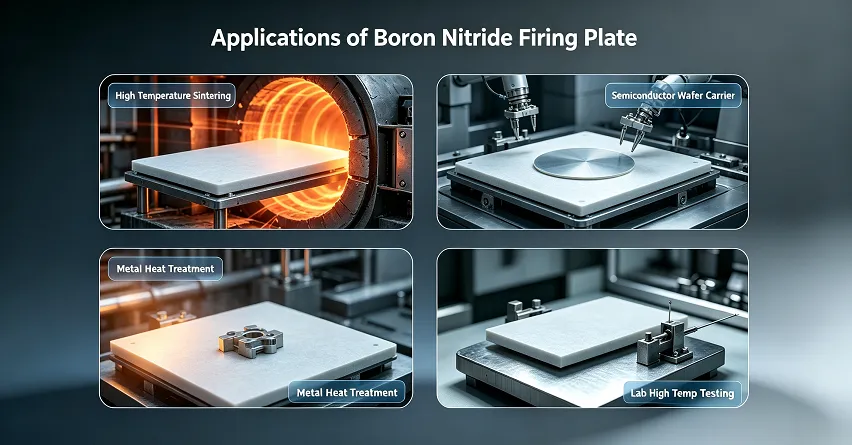
Applications of Boron Nitride Firing Plate
1. Advanced Ceramic Sintering
A major application of Boron Nitride Firing Plate is supporting advanced ceramic components during high-temperature sintering processes. During ceramic sintering, materials such as aluminum nitride, silicon nitride, and other technical ceramics require controlled heating environments. BN plates provide a stable support surface that minimizes sticking and contamination. The non-wetting characteristics of boron nitride improve product release after firing, reducing surface damage and improving manufacturing consistency. This is especially valuable for expensive ceramic components where material loss must be minimized.
2. Semiconductor and Electronic Material Processing
Semiconductor manufacturing requires extremely clean thermal environments. Boron nitride firing plates are used in selected thermal processing applications because of their high purity, electrical insulation, and low contamination characteristics. During high-temperature processing of electronic materials, unwanted impurities can negatively affect electrical performance. BN provides a chemically stable surface that reduces interaction between the support material and processed components. Its low thermal expansion also helps maintain dimensional stability during repeated thermal cycles.
3. Powder Metallurgy and Material Synthesis
In powder metallurgy, materials are often processed at elevated temperatures where interaction between powder materials and furnace supports can become a major challenge. Boron Nitride Firing Plate reduces adhesion between powders and the support surface, improving material recovery after firing. This is particularly useful for expensive powders, specialty alloys, and advanced ceramic materials.
The chemical stability of BN also helps prevent unwanted reactions that may change the composition or microstructure of the final product.
4. Crystal Growth and High-Purity Material Processing
Crystal growth processes require extremely controlled thermal environments. Boron nitride firing plates are used because they provide excellent purity, thermal stability, and resistance to chemical contamination. The low reactivity of BN helps maintain the integrity of sensitive materials during high-temperature processing. In applications where even minor contamination can affect crystal properties, BN provides a reliable support solution.
5. Vacuum and Inert Atmosphere Furnace Applications
Vacuum furnaces and inert atmosphere furnaces often require ceramic components that can survive extreme temperatures without reacting with processed materials. A Boron Nitride Firing Plate performs well in these environments because of its high-temperature stability and chemical inertness. Engineers must still consider furnace atmosphere carefully because oxygen exposure at high temperature can influence BN service life.
Engineering Considerations for Boron Nitride Firing Plate Design
The first consideration when selecting a BN firing plate is atmosphere compatibility. Boron nitride performs exceptionally well in vacuum, nitrogen, and inert gas environments, but continuous exposure to oxygen at elevated temperatures can accelerate oxidation. The second consideration is mechanical loading. Although BN provides excellent thermal properties, its mechanical strength is lower than alumina or silicon carbide. The plate design should minimize bending stress, impact loading, and uneven support conditions. The third consideration is surface condition. A smooth BN surface generally provides better release performance, but excessive machining damage can introduce defects. The final surface finish should match the requirements of the processed material. The fourth consideration is thermal cycling frequency. For applications involving repeated furnace cycles, engineers should evaluate thermal expansion, plate thickness, heating rate, cooling rate, and support structure together.
Company Profile
JianXun Advanced Ceramic Technology is a professional manufacturer specializing in high-performance ceramic products, including Boron Nitride Firing Plate, boron nitride crucibles, BN setter plates, alumina ceramics, silicon carbide ceramics, silicon nitride ceramics, aluminum nitride ceramics, mullite ceramics, quartz ceramics, and customized precision ceramic components. The company focuses on finished ceramic products with controlled material composition, density, thermal performance, mechanical properties, dimensional accuracy, and customized solutions for demanding industrial applications.
Payment Terms: T/T, PayPal, Credit Card, Western Union, etc.
Shipment Terms: By air, by sea, by express, or according to customer request.
Storage Conditions: Store Boron Nitride Firing Plate in a dry, clean environment away from moisture, dust, and mechanical impact. Protect precision surfaces from scratches and avoid stacking methods that may cause bending or edge damage.
FAQs About Boron Nitride Firing Plate
1. Why is boron nitride preferred over alumina for certain firing plate applications?
Boron nitride is preferred when non-wetting behavior, contamination control, and thermal shock resistance are more important than maximum mechanical strength. Alumina provides higher hardness and compressive strength, making it suitable for many structural applications. However, alumina surfaces may interact more strongly with certain processed materials, causing sticking or contamination problems during high-temperature firing. A Boron Nitride Firing Plate provides a naturally low-adhesion surface because of its layered crystal structure, allowing easier product removal after firing. For semiconductor materials, advanced ceramics, and high-value powders, this release performance can significantly improve production yield and reduce cleaning requirements.
2. How does furnace atmosphere affect the service life of a Boron Nitride Firing Plate?
Furnace atmosphere is one of the most important factors determining BN firing plate lifetime. In vacuum, nitrogen, and inert gas environments, boron nitride can maintain excellent stability at temperatures approaching 2000°C. However, in oxygen-containing atmospheres, oxidation may occur at elevated temperatures and gradually reduce material performance. Engineers should evaluate oxygen concentration, temperature profile, exposure duration, and thermal cycling frequency when selecting BN plates. In some applications, protective atmosphere control is more important than simply choosing a higher purity BN grade.
3. What causes cracking or failure of Boron Nitride Firing Plates during operation?
Failure is usually related to mechanical stress, thermal shock, improper installation, or unsuitable operating conditions. Although BN has excellent thermal shock resistance, excessive bending, uneven support, impact during loading, or rapid temperature changes can still cause damage. Cracks may also develop if the plate is constrained by surrounding structures and cannot freely expand during heating. Proper plate thickness selection, uniform support design, controlled heating rates, and careful handling are essential for maximizing service life.
4. How should engineers select the correct density of a Boron Nitride Firing Plate?
The correct density depends on the balance between mechanical strength, thermal response, and application environment. Higher-density BN plates generally provide improved mechanical stability and lower gas permeability, which can be beneficial for demanding production environments. Lower-density BN may provide better thermal shock resistance and easier machining. Engineers should evaluate loading conditions, furnace cycle frequency, processed material weight, temperature range, and required lifetime before selecting the appropriate density grade.
5. Can Boron Nitride Firing Plates be customized according to furnace requirements?
Yes. Boron Nitride Firing Plate products can be customized in dimensions, thickness, holes, slots, grooves, surface finish, and complex geometries according to specific furnace designs. Customization is often necessary because thermal processing equipment varies significantly in loading method, heating configuration, and product arrangement. Engineers should provide detailed drawings, operating temperature, atmosphere condition, processed material information, and expected service requirements to ensure the optimized BN plate design.