Advanced Technical Ceramics, Precision Alumina, Silicon Carbide, Crucible Parts



Pressureless-sintered Silicon Carbide
Overview
Pressureless-Sintered Silicon Carbide (SSiC) is a high-performance silicon carbide ceramic manufactured through a pressureless sintering process in which shaped SiC powder is densified at elevated temperature without applying external mechanical pressure during the final sintering stage. This manufacturing route allows engineers to produce dense, complex-shaped, and dimensionally stable ceramic components while retaining the fundamental advantages of silicon carbide, including high hardness, excellent wear resistance, strong chemical stability, relatively low thermal expansion, good thermal conductivity, and reliable performance at elevated temperatures. Unlike reaction-bonded SiC, where residual free silicon can remain in the final structure, properly produced Pressureless-Sintered Silicon Carbide can achieve a highly dense SiC matrix with very low residual free-silicon content, making it attractive for applications where high-temperature behavior, chemical compatibility, dimensional stability, and purity are important. The final properties are controlled by powder characteristics, additives, forming method, green density, sintering atmosphere, sintering temperature, grain growth, and post-processing. The pressureless sintering route is particularly valuable for precision ceramic components because near-net-shape forming can reduce the amount of difficult machining required after densification, while diamond grinding or polishing can further improve dimensional accuracy and surface finish when necessary. However, Pressureless-Sintered Silicon Carbide should not be evaluated only by its nominal maximum temperature or hardness. Engineers must consider the actual microstructure, density, porosity, grain-boundary chemistry, surface condition, thermal gradients, mechanical loading, atmosphere, and chemical environment because these factors determine the component's real service performance.

Classification and Key Characteristics of Pressureless-Sintered Silicon Carbide
1. High Density and Low Open Porosity
A major advantage of Pressureless-Sintered Silicon Carbide is its ability to achieve a highly densified microstructure through controlled powder processing and sintering. High density reduces interconnected pores and other pathways through which corrosive liquids, gases, or contaminants could penetrate the component. This is especially important for sealing rings, wear components, furnace parts, precision shafts, nozzles, and other products exposed to aggressive operating environments. A dense microstructure also improves mechanical strength and wear resistance because large internal voids can act as stress-concentration sites where cracks initiate under repeated loading. The achievable density depends on the powder particle-size distribution, forming process, additive system, green density, and sintering schedule, so not every pressureless-sintered SiC product will have identical properties. For engineering procurement, density should therefore be considered together with open porosity, flexural strength, fracture toughness, and microstructural uniformity. Properly manufactured Pressureless-Sintered Silicon Carbide can provide the dense and stable structure required for demanding precision ceramic applications where conventional porous refractory SiC would not provide sufficient mechanical or sealing performance.
2. Excellent Wear and Abrasion Resistance
The intrinsic hardness of silicon carbide makes Pressureless-Sintered Silicon Carbide particularly effective in applications involving continuous sliding, particle impact, erosion, or contact with abrasive materials. The dense sintered structure helps maintain surface integrity during repeated mechanical interaction, reducing dimensional loss and extending component service intervals under suitable conditions. This property is valuable for seal faces, wear plates, liners, bushings, mechanical components, flow-control parts, and other ceramic products exposed to abrasive media. Wear performance is influenced not only by hardness but also by grain size, grain-boundary characteristics, surface roughness, opposing material, contact pressure, lubrication, particle size, and operating temperature. A highly polished SiC surface can behave very differently from a rough surface containing machining damage or exposed pores. For this reason, engineers selecting Pressureless-Sintered Silicon Carbide should define the actual wear mechanism—abrasive, adhesive, erosive, or tribochemical—rather than simply specifying “high wear resistance.” Matching the SiC grade and surface finish to the specific wear mechanism is essential for achieving predictable long-term performance.
3. High-Temperature Mechanical Stability
Pressureless-Sintered Silicon Carbide maintains useful mechanical properties at temperatures where many metallic materials experience significant softening, creep, oxidation, or dimensional instability. The strong Si–C bonding within the ceramic lattice contributes to its high-temperature hardness and structural stability, making pressureless-sintered grades suitable for selected furnace, kiln, heat-treatment, semiconductor-processing, and high-temperature mechanical applications. However, the practical temperature limit depends strongly on the atmosphere. In oxidizing conditions, silicon carbide can form a protective silica-based surface layer, but prolonged exposure at high temperature can still change surface chemistry and dimensions; in inert or vacuum environments, different limitations may become dominant. Mechanical loading must also be considered because the maximum temperature for a lightly loaded component is not necessarily appropriate for a heavily stressed component. Pressureless-Sintered Silicon Carbide should therefore be specified using an application-based service temperature rather than an isolated material-property value, with atmosphere, load duration, thermal cycling, and component geometry included in the evaluation.
4. Low Thermal Expansion and Excellent Thermal Shock Resistance
Silicon carbide has a relatively low coefficient of thermal expansion combined with high thermal conductivity, giving Pressureless-Sintered Silicon Carbide excellent resistance to many forms of thermal shock. When a ceramic component is heated or cooled rapidly, the surface and interior can experience significantly different temperatures, creating thermal stresses. Materials with high thermal expansion or poor thermal conductivity can develop large internal stress gradients and become susceptible to cracking. SiC's ability to conduct heat efficiently helps reduce these gradients, while its relatively low thermal expansion limits the amount of strain generated by a given temperature change. This combination is particularly useful for kiln furniture, furnace components, heat-treatment fixtures, burner-related components, and other products exposed to repeated heating and cooling. Nevertheless, thermal shock resistance is not unlimited. Component thickness, geometry, holes, sharp corners, mounting constraints, heating rate, cooling rate, and temperature difference all influence actual thermal stress. Properly designed Pressureless-Sintered Silicon Carbide components can therefore provide excellent thermal cycling performance when the geometry and operating cycle are appropriately controlled.
5. Excellent Chemical and Corrosion Resistance
Dense Pressureless-Sintered Silicon Carbide provides strong resistance to many corrosive chemicals and aggressive process environments, which is one reason SiC is widely considered for demanding chemical-processing and fluid-handling applications. Its chemical stability can help maintain dimensional integrity when components are exposed to acids, alkalis, solvents, abrasive slurries, or reactive gases, depending on the specific chemistry and temperature. The low porosity of pressureless-sintered material is also important because it limits fluid penetration into the ceramic body compared with more porous SiC structures. However, chemical resistance should never be treated as universal. Strong oxidizing environments, molten substances, specific alkali systems, and high-temperature reactive atmospheres can produce different degradation mechanisms. Grain-boundary additives used during pressureless sintering may also influence chemical compatibility. Therefore, Pressureless-Sintered Silicon Carbide should be evaluated against the actual medium, concentration, temperature, exposure time, pressure, and flow velocity before final material selection, especially in continuously operated chemical equipment.
6. Precision Machinability After Sintering and Complex Component Capability
Although fully densified SiC is extremely difficult to conventionally machine because of its high hardness, Pressureless-Sintered Silicon Carbide can be formed into complex geometries before sintering and then finished using diamond-based grinding, lapping, polishing, or other specialized techniques. This combination of near-net-shape forming and precision finishing makes the material suitable for components where dimensional accuracy and complicated geometry are both required. Engineers can specify internal channels, holes, grooves, sealing surfaces, mounting features, and customized external profiles depending on the forming and finishing capabilities available. Post-sintering grinding is generally reserved for surfaces requiring tight tolerances or controlled roughness because removing large amounts of material from dense SiC is expensive and time-consuming. The design should therefore consider shrinkage during sintering from the beginning, because green-body dimensions must be compensated according to the material system and manufacturing process. For Pressureless-Sintered Silicon Carbide, successful component design is closely connected to manufacturing engineering: geometry, wall thickness, sintering shrinkage, machining allowance, surface finish, and tolerance should be developed as one integrated process.

Typical Specifications of Pressureless-Sintered Silicon Carbide
The following values represent typical engineering ranges for dense pressureless-sintered silicon carbide. Actual properties vary with powder grade, sintering additives, density, grain structure, forming method, and processing conditions.
| Property | Typical Specification |
|---|---|
| Product | Pressureless-Sintered Silicon Carbide |
| Abbreviation | SSiC |
| Material | Silicon Carbide |
| SiC Content | Typically ≥98–99%, depending on grade and additive system |
| Density | Approx. 3.05–3.20 g/cm³ |
| Open Porosity | Typically very low, often <1% for dense grades |
| Flexural Strength | Approx. 300–600 MPa |
| Compressive Strength | Typically ≥2000 MPa |
| Hardness | HRA ≥90 or approx. 2000–2800 HV, depending on grade |
| Fracture Toughness | Approx. 3–5 MPa·m¹/², depending on microstructure |
| Thermal Conductivity | Approx. 80–150 W/m·K |
| Coefficient of Thermal Expansion | Approx. 4.0–4.5 × 10⁻⁶/K |
| Electrical Resistivity | Depending on grade and additive system |
| Maximum Service Temperature | Approx. 1400–1800°C, depending on atmosphere and application |
| Wear Resistance | Excellent |
| Chemical Resistance | Excellent |
| Thermal Shock Resistance | Excellent |
| Water Absorption | Very low |
| Typical Color | Black to dark gray |
| Manufacturing Route | Pressureless sintering |
| Surface Finish | As-fired, ground, lapped, or polished |
| Shape | Tubes, rings, plates, nozzles, seals, rollers, shafts, complex components |
| Customization | Geometry, dimensions, tolerance, surface finish, material grade |
The technical data should be interpreted as a material-selection framework rather than a universal specification for every Pressureless-Sintered Silicon Carbide component. In particular, density and flexural strength can vary with sintering additives and microstructure, while thermal conductivity may change significantly depending on the grade and temperature. One important engineering distinction is that pressureless-sintered SiC generally achieves a dense structure without the residual free silicon associated with reaction-bonded silicon carbide, but this does not mean that every pressureless-sintered grade is chemically identical. Sintering additives and grain-boundary phases can affect high-temperature strength, electrical behavior, oxidation, and chemical compatibility. Engineers should therefore request the actual material grade and certified test data when the component is used in a high-temperature, high-purity, sealing, or precision application. For dimensional applications, the drawing should additionally define tolerance, flatness, concentricity, cylindricity, roundness, surface roughness, chamfer dimensions, and allowable machining defects.
Applications of Pressureless-Sintered Silicon Carbide
1. Mechanical Seals and High-Wear Sealing Components
Pressureless-Sintered Silicon Carbide is widely considered for mechanical seal faces and other precision sealing components because it combines high hardness, excellent wear resistance, chemical stability, and low thermal expansion. In a mechanical seal, the working surfaces may experience continuous sliding contact, fluid pressure, frictional heating, and exposure to chemically aggressive liquids. Any significant surface wear can increase leakage or change the contact pressure distribution, so dimensional stability is critical. Dense pressureless-sintered SiC can maintain a highly stable sealing surface under suitable conditions, while its chemical resistance allows it to operate with many process fluids that would attack conventional materials. Surface finish is particularly important because seal performance depends strongly on flatness, roughness, and mating-surface compatibility. Engineers should also consider thermal conductivity, lubrication regime, pressure differential, shaft speed, and the counter-face material when selecting the grade. Properly specified Pressureless-Sintered Silicon Carbide can therefore provide long-term sealing performance in demanding pumps, chemical equipment, and industrial fluid-handling systems.
2. Chemical Processing Equipment and Corrosive Fluid Handling
Chemical equipment often combines corrosion, abrasion, temperature, and pressure, creating a difficult environment for conventional metals and many engineering plastics. Pressureless-Sintered Silicon Carbide provides an attractive ceramic solution because its dense microstructure and strong chemical stability allow selected components to operate in aggressive process environments. Potential applications include seal components, pump parts, liners, nozzles, flow-control elements, tubes, and specialized wear components exposed to corrosive liquids or abrasive slurries. The dense SiC structure reduces fluid penetration and provides good resistance to particle erosion, while its high hardness helps preserve critical flow or sealing geometry. However, the correct grade must be selected based on actual chemical conditions because sintering additives and grain-boundary phases may influence corrosion behavior. Flow velocity is also important: a chemically stable component can still suffer erosion if high-speed particles continuously impact the surface. For demanding chemical systems, Pressureless-Sintered Silicon Carbide should therefore be evaluated using both chemical compatibility and hydraulic wear analysis.
3. High-Temperature Furnace and Kiln Components
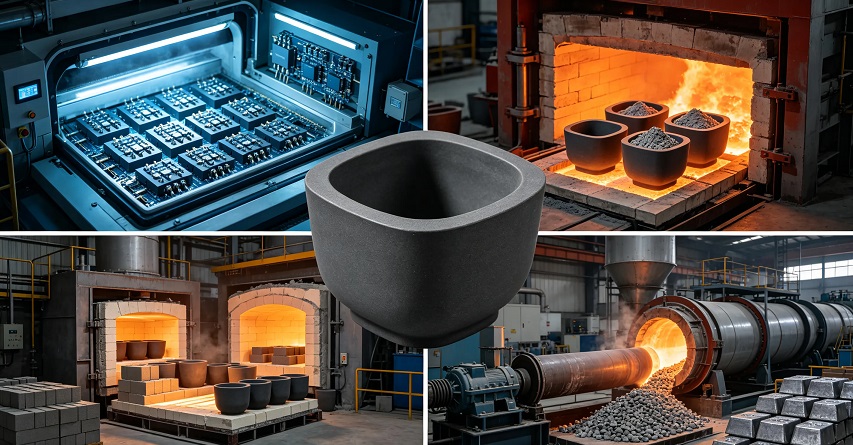
Pressureless-Sintered Silicon Carbide can be manufactured into high-temperature components requiring dimensional stability, thermal shock resistance, and resistance to deformation under repeated thermal cycles. Depending on geometry and loading, these components can include supports, fixtures, tubes, plates, protective parts, and customized structures used in high-temperature processing equipment. The material's low thermal expansion reduces thermally induced dimensional changes, while high thermal conductivity helps distribute heat and reduce localized temperature gradients. This can be particularly useful when components repeatedly move between ambient temperature and elevated processing temperatures. Nevertheless, furnace atmosphere must be carefully considered because oxidation, volatilization, and reactions with surrounding process materials can influence service life. Component geometry also matters: thin sections generally respond differently to thermal cycling than thick sections, while sharp internal corners can concentrate stress. When properly designed, Pressureless-Sintered Silicon Carbide can provide stable performance through repeated heating cycles while reducing deformation and maintenance requirements.
4. Wear-Resistant Liners, Plates, and Flow Components
Abrasive particles moving at high velocity can gradually erode the surfaces of pipes, chutes, nozzles, valves, and processing equipment. Pressureless-Sintered Silicon Carbide offers excellent resistance to this type of wear because its high hardness makes it difficult for abrasive particles to remove material from the surface. This makes dense SiC suitable for selected liners, wear plates, flow-control components, and protective inserts used in mineral processing, powder handling, slurry transport, and other abrasive industrial systems. The actual erosion rate depends on particle hardness, particle size, concentration, impact angle, velocity, temperature, and surface geometry. A properly designed SiC liner can significantly reduce dimensional loss, but the ceramic must be mechanically supported so that impact loads are distributed without creating excessive tensile stress. Engineers should also account for joints and transitions between ceramic and metallic sections because abrupt geometry changes can produce local stress concentrations. Pressureless-Sintered Silicon Carbide performs best when the material, component geometry, mounting method, and flow conditions are considered as a complete wear-control system.
5. Semiconductor and High-Purity Thermal Processing Components
The combination of high-temperature stability, dimensional accuracy, low porosity, and controlled material composition makes Pressureless-Sintered Silicon Carbide suitable for selected high-purity thermal-processing components. Depending on the specific grade and surface treatment, SiC components can be used as supports, structural fixtures, process tubes, protective parts, or other customized components where stable performance at elevated temperature is required. Dimensional stability is particularly important because thermal processing often involves repeated temperature changes and tight alignment requirements. Surface condition and impurity control are equally important when the component is located close to sensitive process materials. Engineers should not assume that all pressureless-sintered SiC grades are suitable for high-purity environments, because sintering additives and machining residues can influence contamination behavior. For these applications, the material specification should include impurity limits, surface-cleaning requirements, density, open porosity, and appropriate finishing procedures. Properly selected Pressureless-Sintered Silicon Carbide can provide a robust structural ceramic solution for demanding thermal-processing environments.
6. Precision Nozzles and Fluid-Flow Components
Pressureless-Sintered Silicon Carbide can be used to manufacture nozzles and flow-control components that must withstand abrasive particles, elevated temperatures, or chemically aggressive media. In a nozzle, the internal passage geometry directly influences pressure drop, velocity distribution, spray pattern, and particle trajectory, so dimensional stability is essential. SiC's high hardness helps resist erosion when abrasive powders or particles pass through the nozzle at high velocity, while its chemical resistance can provide longer service life in corrosive process environments. The material's thermal properties also help maintain stable geometry during temperature changes. Engineers should carefully define internal diameter, outlet geometry, wall thickness, length, surface finish, and dimensional tolerance because small changes in the flow passage can influence process performance. Mounting design is equally important because ceramic nozzles can fracture if excessive mechanical preload or localized clamping stress is applied. With appropriate design, Pressureless-Sintered Silicon Carbide can provide a durable and dimensionally stable solution for demanding industrial flow-control applications.
7. Precision Shafts, Bushings, and Bearings
The high hardness and wear resistance of Pressureless-Sintered Silicon Carbide make it suitable for selected precision rotating components such as shafts, bushings, bearing-related parts, and sliding-contact components. These applications benefit from the material's resistance to abrasive wear and its relatively low thermal expansion, which can help maintain dimensional relationships during temperature changes. SiC's low density compared with many metals can also be advantageous in certain rotating systems, although the brittle nature of ceramics requires careful attention to impact and tensile loading. Surface finish is critical for sliding and rolling interfaces, and diamond grinding or polishing may be required to achieve the necessary roughness and dimensional tolerance. The mating component must also be carefully selected because two extremely hard surfaces can produce unfavorable tribological behavior if lubrication and contact geometry are not properly controlled. Pressureless-Sintered Silicon Carbide is therefore best suited to precision mechanical applications where its hardness, chemical resistance, and thermal stability provide a clear advantage over conventional materials.
8. Customized High-Temperature Ceramic Components
Beyond standardized products, Pressureless-Sintered Silicon Carbide is particularly valuable for customized components where engineers need a combination of high-temperature capability, wear resistance, chemical stability, and dimensional precision. Components can be designed as rings, tubes, plates, blocks, nozzles, rollers, sleeves, seals, protective covers, or complex structures with machined holes and channels. The pressureless sintering route allows near-net-shape forming before final densification, while post-sintering diamond machining can provide controlled dimensions and surface finishes for critical interfaces. Successful customization requires early consideration of sintering shrinkage, wall thickness, geometry, machining allowance, thermal gradients, and mounting stress. A design that is mechanically acceptable in metal may require modification when transferred to SiC because ceramic components are much less tolerant of tensile stress and sudden impact. For this reason, Pressureless-Sintered Silicon Carbide should be engineered from the beginning around ceramic-specific manufacturing and failure mechanisms rather than simply replacing a metallic part with the same geometry.
Engineering Considerations for Pressureless-Sintered Silicon Carbide Design
When designing Pressureless-Sintered Silicon Carbide components, the most important consideration is to connect material selection with the complete manufacturing route and service environment. The first stage is determining the required density, strength, fracture toughness, thermal conductivity, chemical resistance, and electrical properties, followed by selecting a compatible SiC powder and sintering-additive system. Component geometry must then account for predictable sintering shrinkage in three dimensions, because green-body dimensions are intentionally larger than final dimensions and the shrinkage behavior may vary with section thickness and forming conditions. Sharp corners, abrupt wall-thickness changes, deep narrow holes, and internal features can create density variations or stress concentrations and should be minimized where possible. After sintering, critical sealing or contact surfaces may require diamond grinding, lapping, or polishing, and sufficient machining allowance should be incorporated into the original design. During operation, engineers should evaluate thermal gradients, mechanical loading, mounting constraints, vibration, chemical exposure, particle erosion, and atmosphere together. Because SiC has excellent compressive strength but limited tolerance for tensile stress and impact, clamping forces should be distributed uniformly and point loading should be avoided. For high-temperature applications, the actual atmosphere and exposure duration must be specified rather than relying on a generic maximum temperature. A well-designed Pressureless-Sintered Silicon Carbide component is therefore the result of coordinated material engineering, ceramic forming, sintering control, precision finishing, and application-specific mechanical and thermal analysis.
Company Profile
JianXun Advanced Ceramic Technology is a professional manufacturer specializing in high-performance ceramic products, including Pressureless-Sintered Silicon Carbide, alumina ceramics, boron nitride ceramics, silicon carbide ceramics, silicon nitride ceramics, aluminum nitride ceramics, mullite ceramics, quartz ceramics, and customized precision ceramic components. The company focuses on finished ceramic products with controlled material composition, density, mechanical properties, thermal performance, dimensional accuracy, surface quality, and customized geometries for demanding industrial applications.
Payment Terms: T/T, PayPal, Credit Card, Western Union, etc.
Shipment Terms: By air, by sea, by express, or according to customer request.
Storage Conditions: Store Pressureless-Sintered Silicon Carbide components in a clean, dry, dust-free environment. Protect precision surfaces from impact, scratching, moisture contamination, and contact with hard foreign objects. For finished sealing or polished components, retain the original protective packaging until installation.
FAQs About Pressureless-Sintered Silicon Carbide
Q1: What is Pressureless-Sintered Silicon Carbide and how is it different from reaction-bonded SiC?
A: Pressureless-Sintered Silicon Carbide is produced by forming SiC powder into the desired geometry and densifying it at high temperature without applying external pressure during the final sintering stage. In contrast, reaction-bonded SiC is generally manufactured by infiltrating a porous carbon-containing preform with molten silicon, which can leave a significant free-silicon phase in the final material. Pressureless-sintered SiC can achieve a highly dense SiC-based microstructure with very low open porosity and, depending on the formulation, little or no free silicon. This difference can be important in high-temperature applications because free silicon has a lower melting point than SiC and can limit performance in certain environments. However, pressureless-sintered grades may contain sintering additives or secondary phases, so the actual composition and high-temperature behavior should always be confirmed from the manufacturer's material specification.
Q2: Why is Pressureless-Sintered Silicon Carbide suitable for high-temperature applications?
A: Pressureless-Sintered Silicon Carbide has strong atomic bonding, high hardness, low thermal expansion, high thermal conductivity, and good structural stability at elevated temperatures. These characteristics allow dense SiC components to maintain useful mechanical and dimensional properties under thermal conditions that would cause many metals to soften or deform significantly. Its high thermal conductivity also helps distribute heat and reduce localized temperature gradients, while its relatively low thermal expansion limits thermally induced dimensional changes. However, the practical service temperature depends on atmosphere, component loading, geometry, exposure duration, and material grade. Oxidizing environments can cause surface oxidation, while inert or vacuum conditions may present different limitations. Therefore, engineers should define the actual operating atmosphere and thermal cycle when specifying Pressureless-Sintered Silicon Carbide rather than relying only on a nominal maximum-temperature value.
Q3: Why does Pressureless-Sintered Silicon Carbide provide excellent wear resistance?
A: The high intrinsic hardness of silicon carbide makes Pressureless-Sintered Silicon Carbide highly resistant to abrasive damage and surface deformation. A dense sintered microstructure further reduces the presence of pores and weak regions that could accelerate material removal under repeated contact. This combination is useful when components are exposed to hard particles, abrasive slurries, sliding contact, or high-velocity particle flow. Nevertheless, wear behavior depends on the specific mechanism involved. Particle erosion, two-body abrasion, three-body abrasion, adhesive wear, and tribochemical wear can produce different results, and surface roughness or the opposing material can strongly affect the wear rate. Engineers should therefore select the SiC grade, surface finish, hardness, and component geometry according to the actual wear mechanism rather than assuming that maximum hardness alone guarantees the longest service life.
Q4: Can Pressureless-Sintered Silicon Carbide be used for precision ceramic components?
A: Yes, Pressureless-Sintered Silicon Carbide is well suited to many precision ceramic components because it can be formed into near-net-shape geometries and subsequently finished using diamond grinding, lapping, or polishing. This allows manufacturers to achieve controlled dimensions and surface finishes for sealing faces, precision holes, bearing-related components, flow passages, and other critical interfaces. However, precision design must account for sintering shrinkage before production begins, because the green component undergoes dimensional reduction during densification. The required tolerance also determines the amount of post-sintering machining needed. Since dense SiC is extremely hard, extensive material removal after sintering can significantly increase manufacturing cost. Engineers should therefore optimize the green-body geometry, machining allowance, reference surfaces, and final tolerance together to obtain the required precision efficiently.
Q5: What factors should engineers consider when selecting a Pressureless-Sintered Silicon Carbide grade?
A: Grade selection should be based on the complete operating environment rather than on SiC purity or hardness alone. Important parameters include density, open porosity, flexural strength, fracture toughness, thermal conductivity, coefficient of thermal expansion, electrical properties, sintering-additive chemistry, surface finish, and high-temperature behavior. The application should also be evaluated for temperature, atmosphere, mechanical load, pressure, chemical exposure, abrasive particle concentration, thermal cycling, and mounting conditions. For sealing components, surface roughness and flatness may be more important than bulk strength; for furnace components, thermal shock and dimensional stability may dominate; for wear parts, hardness, fracture resistance, and erosion conditions are critical. A properly selected Pressureless-Sintered Silicon Carbide grade should therefore be matched to the actual failure mechanism and operating conditions, with material certificates and application-specific testing used where performance requirements are particularly demanding.