Advanced Technical Ceramics, Precision Alumina, Silicon Carbide, Crucible Parts



Silicon Nitride Ceramic

Silicon Nitride Grinding Ball Si₃N₄ Ceramic Grinding Media

Silicon Nitride Substrate Si₃N₄ Ceramic Substrate

Silicon Nitride Nozzle Si₃N₄ Ceramic Spray Nozzle

Silicon Nitride Ceramic Plate Si3N4 Ceramic Board

Silicon Nitride Ceramic Sealing Ring Si3N4 Seal Washer

Si3N4 Ceramic Pipe Fittings Silicon Nitride Ceramic Tube Fitting

Si3N4 Silicon Nitride Ceramic Rod
Overview
Silicon Nitride Ceramic is an advanced non-oxide structural ceramic material widely recognized for its outstanding mechanical strength, fracture toughness, thermal shock resistance, wear resistance, and high-temperature stability. With the chemical formula Si₃N₄, silicon nitride belongs to a group of high-performance engineering ceramics that combine the hardness and corrosion resistance of ceramics with mechanical reliability closer to advanced metallic materials. Unlike many traditional ceramic materials that are limited by brittleness and poor resistance to thermal stress, silicon nitride possesses a unique covalent bonding structure and elongated grain morphology that improve crack resistance and mechanical reliability. These characteristics allow silicon nitride components to operate under severe conditions involving high temperature, high-speed rotation, repeated thermal cycling, and mechanical loading.
The density of Silicon Nitride Ceramic is typically around 3.1-3.3 g/cm³, providing an excellent balance between lightweight design and high mechanical strength. Compared with steel and many metallic alloys, silicon nitride offers lower density, superior wear resistance, and better stability at elevated temperatures, making it valuable in applications where reducing weight while maintaining performance is essential. From an engineering perspective, silicon nitride is not selected only because of its hardness or temperature resistance. Its real advantage lies in the combination of strength, toughness, low thermal expansion, chemical stability, and dimensional reliability. These properties make it particularly suitable for demanding applications such as ceramic bearings, automotive engine components, semiconductor equipment, cutting tools, and high-temperature industrial systems.
The performance of silicon nitride ceramic depends strongly on material composition, powder quality, sintering method, grain structure, porosity, and surface treatment. Different manufacturing technologies, including reaction-bonded silicon nitride (RBSN), hot-pressed silicon nitride (HPSN), and gas-pressure sintered silicon nitride (GPSN), are developed to achieve different levels of strength, toughness, and thermal performance. For engineers selecting silicon nitride components, factors such as operating temperature, mechanical load, contact stress, thermal cycling frequency, chemical environment, and required service lifetime must all be considered. Proper material selection and structural design are essential to fully utilize the advantages of silicon nitride ceramics.

Classification and Key Characteristics of Silicon Nitride Ceramic
Silicon nitride ceramics can be classified according to manufacturing process, density level, microstructure, and application requirements. Although all silicon nitride materials share the same basic chemical composition, their final properties can vary significantly depending on processing technology and grain structure control. The main engineering objective in silicon nitride production is achieving a dense microstructure with optimized grain morphology. Properly controlled elongated β-Si₃N₄ grains can improve crack deflection and increase fracture toughness, creating a material that performs reliably under mechanical and thermal stress.
1. Crystal Structure and Material Composition
The exceptional performance of silicon nitride originates from its strong covalent bonding structure. Silicon nitride mainly exists in two crystalline phases, α-Si₃N₄ and β-Si₃N₄. During sintering, phase transformation occurs, and the final microstructure is typically dominated by β-Si₃N₄ grains. These elongated grains act as reinforcement structures inside the ceramic matrix. Unlike simple granular ceramic structures, the needle-like β-Si₃N₄ grains can interrupt crack propagation paths. When cracks encounter these grains, additional energy is required for crack growth, improving fracture toughness and mechanical reliability. This microstructural advantage is one of the main reasons why silicon nitride performs better than many conventional ceramics under impact loading and thermal shock conditions.
2. High Mechanical Strength and Fracture Toughness
One of the most important advantages of silicon nitride ceramic is its combination of high strength and relatively high fracture toughness. Many ceramic materials provide excellent hardness but suffer from sudden brittle failure. Silicon nitride reduces this limitation through its reinforced microstructure, allowing it to withstand higher mechanical stress before failure occurs. Its high flexural strength, often reaching 600-1000 MPa, enables silicon nitride components to be used in mechanically demanding applications such as bearings, turbine parts, and precision structural components. From an engineering standpoint, fracture toughness is often more important than hardness alone because real industrial components experience vibration, impact, cyclic loading, and unexpected stress fluctuations.
3. Thermal Shock Resistance and High Temperature Stability
Silicon nitride provides excellent resistance to thermal shock due to its low thermal expansion coefficient and high thermal strength retention. When ceramic components experience rapid temperature changes, differences in thermal expansion generate internal stresses. Materials with higher expansion coefficients are more likely to develop cracks during thermal cycling. The thermal expansion coefficient of silicon nitride is approximately 3.0-3.5 ×10⁻⁶/K, which is significantly lower than many metal materials and some oxide ceramics. This allows silicon nitride components to maintain dimensional stability during repeated heating and cooling cycles. In high-temperature applications, silicon nitride also demonstrates excellent creep resistance. Unlike many metals that gradually deform under long-term heat exposure, silicon nitride maintains structural integrity under elevated temperatures.
4. Wear Resistance and Tribological Performance
Silicon nitride has excellent wear resistance due to its high hardness, smooth surface characteristics, and chemical stability. In mechanical systems involving friction, wear is often caused by surface deformation, particle generation, and chemical degradation. Silicon nitride minimizes these effects through its hard and stable ceramic surface. This makes it particularly suitable for bearings, seals, valve components, and precision mechanical parts where low friction and long service life are required. Ceramic bearings made from silicon nitride can operate at higher speeds than conventional steel bearings because of their lower density, reduced centrifugal force, and excellent wear resistance.
5. Chemical Stability and Electrical Properties
Silicon nitride demonstrates strong resistance against oxidation, corrosion, and many chemical environments. Its chemical stability allows it to operate in harsh industrial environments where metals may experience oxidation or corrosion. However, the actual performance depends on temperature, atmosphere composition, and exposure duration. Silicon nitride is also electrically insulating, making it useful in semiconductor processing equipment and electronic applications where mechanical strength and electrical isolation are required simultaneously. Its combination of thermal stability, insulation properties, and mechanical reliability makes it a valuable material for advanced industrial systems.
Typical Specifications of Silicon Nitride Ceramic
The performance of silicon nitride ceramic components depends on material grade, sintering technology, grain structure, density, and surface quality. The following table summarizes typical engineering specifications for industrial silicon nitride ceramics.
| Property | Typical Value |
|---|---|
| Chemical Formula | Si₃N₄ |
| Density | 3.1-3.3 g/cm³ |
| Purity | ≥90-99% depending on grade |
| Flexural Strength | 600-1000 MPa |
| Compressive Strength | 2500 MPa+ |
| Hardness | 1400-1700 HV |
| Fracture Toughness | 5-8 MPa·m¹ᐟ² |
| Thermal Conductivity | 15-30 W/m·K |
| Thermal Expansion Coefficient | 3.0-3.5 ×10⁻⁶/K |
| Maximum Service Temperature | 1200-1400°C |
| Electrical Resistivity | >10¹² Ω·cm |
| Main Engineering Advantages | High strength, toughness, thermal shock resistance, wear resistance |
The density of Silicon Nitride Ceramic directly influences mechanical strength, thermal conductivity, and reliability. A highly dense microstructure generally improves load-bearing capability by reducing internal defects and eliminating potential crack initiation sites. However, density alone does not determine performance. The grain structure, phase composition, and sintering process are equally important. For example, two silicon nitride materials with similar density values may demonstrate different fracture toughness and thermal shock behavior due to differences in microstructure. Engineers should therefore evaluate the complete material specification rather than selecting a ceramic based only on one parameter such as hardness or temperature resistance.
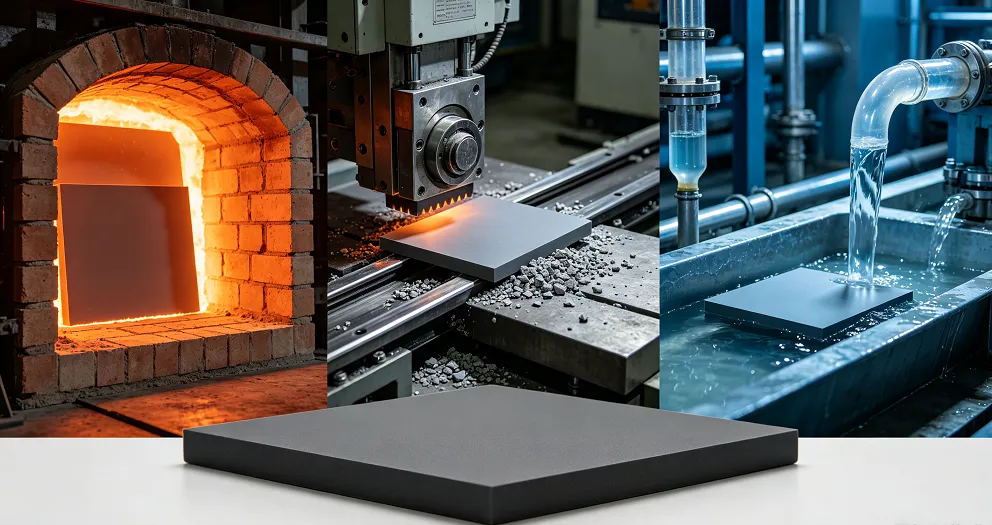
Applications of Silicon Nitride Ceramic
1. Automotive Engine Components
Silicon nitride ceramics are widely used in automotive and transportation applications because of their high strength, thermal stability, and resistance to thermal shock. Typical components include turbocharger rotors, engine parts, glow plugs, and high-temperature wear components. Compared with traditional metal components, silicon nitride provides lower density and better high-temperature performance. This allows improved efficiency, faster response, and longer service life under demanding operating conditions.
2. Ceramic Bearings and Mechanical Parts
One of the most successful industrial applications of silicon nitride is ceramic bearing technology. Silicon nitride bearing balls provide lower friction, higher rotational speed capability, and improved corrosion resistance compared with conventional steel bearings. Because of their low density, ceramic balls generate lower centrifugal forces during high-speed operation. Their excellent hardness and wear resistance also reduce surface degradation, extending bearing lifetime in precision mechanical systems. Applications include aerospace equipment, machine tools, vacuum systems, and high-speed rotating machinery.
3. Semiconductor Processing Equipment
Modern semiconductor manufacturing requires ceramic materials with high purity, dimensional stability, and resistance to thermal cycling. Silicon nitride components are used in wafer handling systems, semiconductor fixtures, insulation parts, and high-temperature processing equipment. Their mechanical reliability and electrical insulation properties make them suitable for environments involving plasma, vacuum, and repeated heating cycles.
4. High Temperature Furnace Components
Silicon nitride ceramics are used in furnace components requiring high-temperature strength and resistance to thermal shock. Examples include support structures, rollers, tubes, and protective components. Compared with traditional refractory materials, silicon nitride provides improved mechanical stability and lower thermal expansion, allowing reliable operation under repeated thermal stress.
5. Cutting Tools and Wear Components
Due to its hardness and thermal stability, silicon nitride is also used in cutting tools and wear-resistant components. Silicon nitride cutting tools can maintain performance at elevated temperatures generated during high-speed machining. Its chemical stability and resistance to thermal cracking make it suitable for machining difficult materials such as cast iron and superalloys.
Company Profile
JianXun Advanced Ceramic Technology is a professional manufacturer specializing in high-performance ceramic components, including Silicon Nitride Ceramic, alumina ceramics, silicon carbide ceramics, boron nitride ceramics, aluminum nitride ceramics, mullite ceramics, quartz ceramics, and customized precision ceramic parts. The company provides advanced ceramic solutions for semiconductor equipment, automotive components, precision mechanical systems, high-temperature processing, and industrial applications requiring superior mechanical and thermal performance.
JianXun focuses on ceramic material selection, precision forming, advanced sintering technology, machining accuracy, and customized component development. Through strict control of raw materials, microstructure, density, dimensional tolerance, and surface quality, JianXun delivers reliable ceramic products designed for demanding mechanical, thermal, and chemical environments.
Payment Terms: T/T, PayPal, Credit Card, Western Union, etc.
Shipment Terms: By air, by sea, by express, or according to customer request.
Storage Conditions: Silicon nitride ceramic components should be stored in a clean and dry environment, protected from mechanical impact, contamination, and sudden temperature changes before installation.
FAQs About Silicon Nitride Ceramic
1. Why is Silicon Nitride Ceramic considered a high-performance structural ceramic?
Silicon Nitride Ceramic is considered a high-performance structural ceramic because it combines properties that are rarely achieved simultaneously in traditional ceramics, including high strength, fracture toughness, thermal shock resistance, wear resistance, and high-temperature stability. Its unique elongated grain microstructure helps prevent rapid crack propagation, allowing it to withstand mechanical stress and impact conditions better than many conventional ceramics. Unlike brittle oxide ceramics that may fail suddenly under thermal or mechanical loading, silicon nitride provides improved reliability in dynamic applications. This combination makes it suitable for bearings, engine components, semiconductor equipment, and other applications where ceramic components must operate under severe mechanical conditions.
2. What makes Silicon Nitride Ceramic more resistant to thermal shock than Alumina Ceramic?
Silicon nitride ceramic demonstrates better thermal shock resistance than alumina ceramic mainly because of its lower thermal expansion coefficient, higher fracture toughness, and stronger resistance to crack propagation. When a ceramic component experiences rapid temperature changes, thermal stress develops due to uneven expansion and contraction. Alumina has excellent hardness and chemical stability, but its lower fracture toughness makes it more sensitive to thermal stress. Silicon nitride can absorb and redistribute thermal stress more effectively through its reinforced grain structure. Therefore, it is preferred for applications involving rapid heating and cooling cycles, such as engine components, furnace parts, and thermal processing equipment.
3. How does the microstructure of Silicon Nitride Ceramic influence mechanical performance?
The microstructure of silicon nitride plays a critical role in determining strength, toughness, and reliability. During advanced sintering processes, elongated β-Si₃N₄ grains develop within the ceramic matrix. These grains can deflect cracks, bridge fracture surfaces, and absorb fracture energy, improving toughness compared with simpler ceramic structures. Grain size distribution, porosity level, secondary phases, and grain boundary chemistry all influence final performance. Therefore, controlling microstructure is one of the most important manufacturing factors when producing silicon nitride components for high-stress industrial applications.
4. Why is Silicon Nitride Ceramic widely used in bearings and high-speed mechanical systems?
Silicon nitride ceramic is widely used in bearings because it provides lower density, higher hardness, better wear resistance, and improved corrosion resistance compared with traditional steel materials. Lower density reduces centrifugal force during high-speed rotation, allowing ceramic bearings to operate at higher speeds with reduced mechanical stress. The smooth surface characteristics of silicon nitride also reduce friction and minimize wear during long-term operation. These advantages make silicon nitride bearings suitable for aerospace systems, precision machinery, vacuum equipment, and high-speed industrial applications where reliability and low maintenance are critical.
5. How should engineers select the correct Silicon Nitride Ceramic grade for industrial applications?
Engineers should select silicon nitride ceramic grades based on operating temperature, mechanical load, impact conditions, thermal cycling requirements, chemical environment, dimensional tolerance, and expected service lifetime. Different manufacturing processes create different performance characteristics. For example, hot-pressed silicon nitride may provide excellent strength and density, while gas-pressure sintered silicon nitride may offer improved toughness and reliability for complex components. Engineers should evaluate not only material properties but also component geometry, surface finish, and actual operating conditions. Providing detailed application information allows manufacturers to recommend the most suitable silicon nitride composition and processing method.