Advanced Technical Ceramics, Precision Alumina, Silicon Carbide, Crucible Parts



Release Paper

Overview
Boron Nitride Release Paper is a high-performance ceramic-based separation material manufactured from boron nitride (BN), primarily consisting of hexagonal boron nitride (h-BN), and engineered for high-temperature applications requiring reliable release, anti-sticking performance, thermal stability, and contamination control. Unlike conventional organic release films or graphite-based separators, BN release paper maintains its structural integrity under extreme thermal conditions while providing excellent non-wetting characteristics toward many molten metals, ceramic powders, and high-temperature compounds. The unique layered crystal structure of h-BN gives the material a low surface energy, allowing processed components to separate more easily after heating, sintering, melting, or thermal treatment. From an engineering perspective, Boron Nitride Release Paper is not simply a disposable separator layer. It functions as a precision interface material that controls the interaction between two surfaces during high-temperature processing. Its performance depends on BN purity, density, thickness uniformity, surface roughness, flexibility, thermal expansion behavior, atmosphere compatibility, and contact pressure. In applications such as ceramic sintering, crystal growth, semiconductor processing, and powder metallurgy, an unsuitable release material may cause sticking, contamination, surface defects, dimensional deformation, or difficulties during component removal. Therefore, engineers must evaluate not only the maximum temperature capability but also the chemical compatibility between BN and the processed material, the thermal cycle profile, the required surface quality, and the expected number of processing cycles.
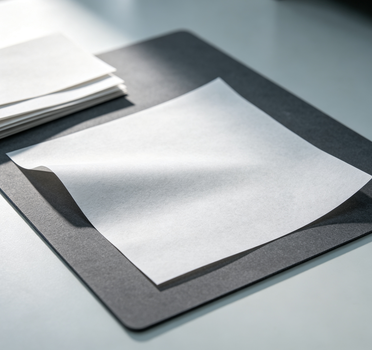
Classification and Key Characteristics of Boron Nitride Release Paper
1. Excellent Non-Wetting and Release Performance
The most important characteristic of Boron Nitride Release Paper is its ability to reduce adhesion between high-temperature materials and processing surfaces. The layered structure of hexagonal BN creates weak interlayer bonding, producing a naturally lubricious and low-friction surface. This allows components, powders, and molten materials to separate more easily after thermal processing. From an engineering viewpoint, release performance is determined by more than the presence of BN itself. Surface roughness, material purity, processing temperature, contact pressure, atmosphere, and interaction time all influence whether sticking occurs. A smooth and high-purity BN paper surface can significantly reduce material transfer and improve product consistency, while contaminated or damaged surfaces may reduce release effectiveness. Therefore, the release behavior should be evaluated under actual production conditions rather than laboratory temperature tests alone.
2. High-Temperature Stability
Boron Nitride Release Paper is designed for applications where conventional polymer-based release films cannot survive. BN maintains its ceramic structure at extremely high temperatures, especially under vacuum and inert atmospheres, making it suitable for repeated thermal processing cycles. However, engineers should understand that the practical operating temperature depends strongly on atmosphere. In nitrogen, argon, or vacuum environments, high-purity BN can withstand temperatures approaching 2000°C under suitable conditions. In oxidizing environments, oxidation becomes the limiting factor, and the usable temperature range may be significantly reduced. Therefore, temperature selection should always consider oxygen concentration, heating duration, thermal cycling frequency, and contact conditions.
3. Thermal Shock Resistance and Dimensional Stability
The low coefficient of thermal expansion of BN gives Boron Nitride Release Paper excellent resistance to thermal stress during rapid heating and cooling. In many high-temperature processes, the release layer experiences repeated temperature changes that can generate expansion mismatch between the processed material, furnace fixture, and separator material. Compared with many traditional ceramics, BN experiences lower dimensional changes during thermal cycling, reducing the possibility of cracking, curling, or loss of contact uniformity. This characteristic is particularly important in precision ceramic sintering and semiconductor manufacturing, where even small dimensional changes in the release layer may affect surface quality or component geometry.
4. High Purity and Low Contamination Characteristics
For advanced manufacturing processes, contamination control is often as important as thermal performance. Boron Nitride Release Paper provides a clean ceramic interface that can reduce unwanted chemical transfer between the processed component and the supporting fixture. High-purity BN contains minimal metallic impurities and does not introduce carbon contamination commonly associated with graphite-based release materials. This makes BN paper suitable for applications requiring controlled material composition, smooth surfaces, and reduced impurity diffusion. Engineers should nevertheless consider the purity grade, manufacturing process, binder content, surface cleanliness, and possible particle generation when using BN paper in sensitive environments.
5. Electrical Insulation Capability
Unlike graphite-based release materials, Boron Nitride Release Paper provides electrical insulation while maintaining excellent thermal stability. This characteristic allows BN paper to function not only as a release layer but also as an insulating interface in electrically heated systems. High-purity BN typically exhibits electrical resistivity above 10¹³ Ω·cm, making it useful in applications where electrical isolation between components is required. In thermal processing equipment using resistance heating, electrodes, or electrically active fixtures, BN release paper can prevent unintended electrical contact while maintaining separation between materials.
6. Flexible Thin Ceramic Interface
Although BN is a ceramic material, Boron Nitride Release Paper provides a thin and lightweight interface that can be cut, layered, wrapped, or shaped according to different processing requirements. Compared with rigid BN plates, paper-type BN products can better adapt to irregular surfaces and complex fixture geometries. However, flexibility should not be confused with polymer-like mechanical strength. BN paper remains a brittle ceramic material and may be damaged by excessive bending, sharp edges, tensile stress, or improper handling. Engineers should consider minimum bending radius, installation method, compression force, and thermal expansion behavior during component design.
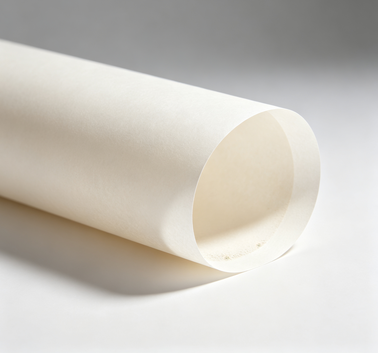
Typical Specifications of Boron Nitride Release Paper
The following specifications represent typical engineering values for high-performance BN release paper. Actual performance depends on BN purity, manufacturing method, density, thickness, and application environment.
| Property | Typical Specification |
|---|---|
| Material | Hexagonal Boron Nitride (h-BN) |
| BN Purity | ≥99% |
| Density | 0.8–1.8 g/cm³ |
| Thickness | 0.1–5 mm Customized |
| Thermal Conductivity | 30–60 W/m·K |
| Coefficient of Thermal Expansion | 1–2 × 10⁻⁶/K |
| Electrical Resistivity | >10¹³ Ω·cm |
| Maximum Working Temperature | Up to 2000°C in inert/vacuum atmosphere |
| Color | White to light gray |
| Surface Condition | Smooth / Customized |
| Flexibility | Thin flexible ceramic sheet structure |
| Chemical Stability | Excellent under inert conditions |
| Cutting Method | Customized |
The engineering selection of Boron Nitride Release Paper should consider the complete thermal and mechanical environment rather than selecting thickness only based on convenience. A thinner BN paper layer reduces thermal resistance and minimizes dimensional influence on the assembly, but it may provide less mechanical protection and lower tolerance against surface defects. A thicker layer improves separation capability but may influence heat transfer and component positioning. For precision processing, thickness uniformity, surface flatness, particle generation, and edge quality are important parameters. In semiconductor or advanced ceramic manufacturing, even small variations in the release layer may influence product surface finish, dimensional accuracy, and contamination level. Therefore, BN paper should be selected according to the actual process requirement, not simply according to temperature capability.
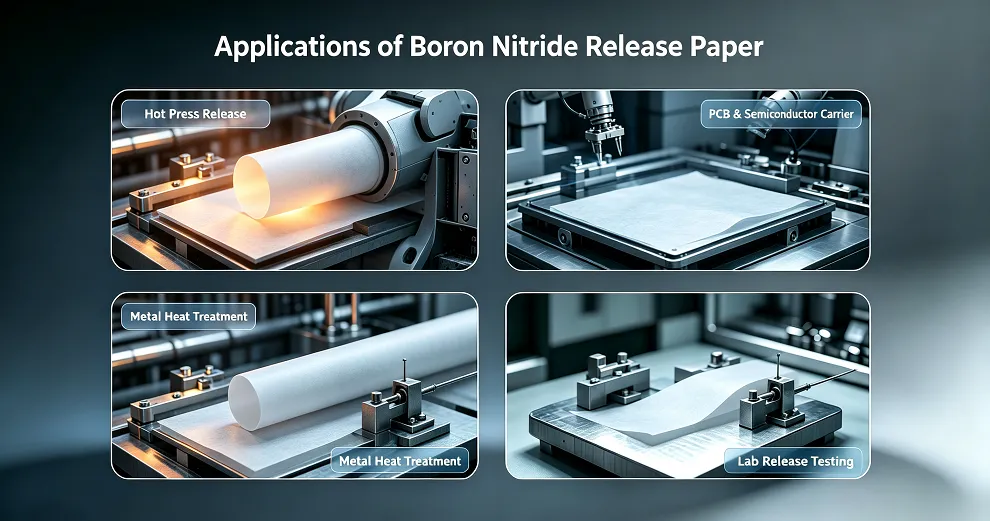
Applications of Boron Nitride Release Paper
1. Ceramic Sintering and Powder Processing
Boron Nitride Release Paper is widely used in ceramic sintering processes where preventing adhesion between ceramic components and furnace setters is essential. During high-temperature sintering, ceramic powders undergo densification and may form strong bonding with supporting surfaces if no suitable release layer is applied. BN paper creates a low-adhesion interface that allows sintered components to be removed more easily while minimizing surface damage. It is particularly valuable for advanced ceramics such as aluminum nitride, silicon nitride, alumina, and other high-value ceramic materials where surface quality and dimensional accuracy are critical. Engineers should evaluate sintering temperature, atmosphere, powder composition, shrinkage behavior, and contact pressure when selecting the appropriate BN paper grade.
2. Semiconductor and Electronic Material Processing
In semiconductor manufacturing and electronic ceramic processing, Boron Nitride Release Paper provides a clean, high-temperature separation layer between components, substrates, and processing fixtures. Semiconductor-related processes often require extremely low contamination levels because small impurities can affect material properties and device performance. BN paper offers advantages over graphite-based separators because it provides electrical insulation and lower risk of carbon contamination. For these applications, engineers typically consider BN purity, particle generation, surface roughness, thickness tolerance, and compatibility with vacuum or inert processing environments.
3. Crystal Growth and High-Purity Material Manufacturing
Boron Nitride Release Paper is used in selected crystal growth processes where stable separation between the growing material and support components is required. The low wettability of BN reduces unwanted adhesion and helps protect the surface quality of high-value crystals. During crystal growth, temperature gradients and chemical interactions can significantly influence product quality. BN paper helps create a controlled interface while maintaining stability during long thermal cycles. Engineers should evaluate crystal composition, growth atmosphere, temperature profile, and possible chemical interaction between BN and the growing material.
4. Powder Metallurgy and Metal Processing
In powder metallurgy and high-temperature metal processing, Boron Nitride Release Paper can serve as a protective separator between metallic materials and furnace fixtures. Its low wettability helps reduce sticking between molten or semi-molten materials and supporting surfaces. Compared with conventional ceramic separators, BN provides better release performance in many applications because of its unique surface chemistry. However, compatibility depends on the specific metal, alloy composition, temperature, atmosphere, and exposure duration. Engineers should verify whether the molten material reacts with BN under actual processing conditions.
5. Hot Pressing and High-Temperature Forming Processes
During hot pressing and high-temperature forming, Boron Nitride Release Paper can be positioned between dies, molds, powders, and finished components to prevent bonding and simplify demolding. Its thin structure allows efficient heat transfer while maintaining separation between surfaces. The effectiveness of BN paper depends on pressure distribution, temperature uniformity, surface condition, and material compatibility. Excessive pressure or mechanical damage during loading may reduce the release performance, so proper handling and fixture design are essential.
6. Vacuum Furnace and Inert Atmosphere Applications
Vacuum furnaces and inert-atmosphere systems often require release materials that do not introduce contamination or degrade during long thermal cycles. Boron Nitride Release Paper is suitable for these environments because of its inorganic composition, high-temperature stability, and low chemical reactivity. For vacuum applications, engineers should evaluate outgassing characteristics, material purity, surface cleanliness, and particle control. The correct BN paper grade can improve process reliability by reducing sticking, contamination, and maintenance requirements.
Engineering Considerations for Boron Nitride Release Paper Design
When designing with Boron Nitride Release Paper, engineers should consider the material as a functional interface layer rather than a simple protective sheet. The first consideration is thermal behavior: although BN has excellent thermal stability, the paper thickness influences heat transfer between the processed component and the support structure. Excessive thickness may create unwanted temperature differences, while insufficient thickness may not provide adequate separation. The second consideration is mechanical handling. BN paper has ceramic characteristics and can be damaged by tearing, folding, sharp edges, or excessive compression. Installation procedures should avoid concentrated stress and ensure uniform contact pressure. The third consideration is chemical compatibility. BN performs well against many materials, but molten metals, reactive gases, and oxidizing environments may influence long-term stability. Engineers should evaluate the actual process chemistry rather than relying only on general BN resistance data. The fourth consideration is contamination control. For high-purity manufacturing, surface cleanliness, particle generation, binder content, and manufacturing residues should be controlled carefully. A properly selected BN release paper can improve production yield by reducing sticking defects, surface contamination, and component damage during removal.
Company Profile
JianXun Advanced Ceramic Technology is a professional manufacturer specializing in high-performance ceramic products, including Boron Nitride Release Paper, boron nitride ceramics, alumina ceramics, silicon carbide ceramics, silicon nitride ceramics, aluminum nitride ceramics, mullite ceramics, quartz ceramics, and customized precision ceramic components. The company focuses on finished ceramic products with controlled material composition, density, mechanical properties, thermal performance, dimensional accuracy, surface quality, and customized geometries for demanding industrial applications.
Payment Terms: T/T, PayPal, Credit Card, Western Union, etc.
Shipment Terms: By air, by sea, by express, or according to customer request.
Storage Conditions: Store Boron Nitride Release Paper in a clean, dry environment away from moisture, oil contamination, dust, and mechanical pressure. Keep sheets flat and properly protected to prevent folding, cracking, surface damage, or deformation before use.
FAQs About Boron Nitride Release Paper
1. Why is Boron Nitride Release Paper preferred over graphite release materials in high-temperature processing?
Boron Nitride Release Paper is often selected instead of graphite-based release materials when electrical insulation, low contamination, and clean processing conditions are required. Graphite provides good thermal performance and lubrication characteristics, but it introduces carbon, which may contaminate sensitive ceramic, semiconductor, or crystal-growth processes. BN provides a chemically cleaner interface with excellent non-wetting behavior and electrical insulation. However, the correct choice depends on the process requirements, because graphite and BN have different advantages depending on atmosphere, temperature, and material compatibility.
2. How does Boron Nitride Release Paper prevent sticking during sintering?
The release mechanism of Boron Nitride Release Paper is based on the low surface energy and layered crystal structure of hexagonal BN. These characteristics reduce adhesion between the processed material and the supporting surface, allowing easier separation after heating. The effectiveness depends on BN purity, surface condition, processing temperature, pressure, and interaction time. In precision sintering applications, maintaining a clean and uniform BN surface is essential because contamination or mechanical damage can reduce release performance.
3. Can Boron Nitride Release Paper be reused?
The possibility of reuse depends on the processing temperature, mechanical stress, chemical exposure, and surface condition after each cycle. In some controlled thermal processes, BN paper can withstand multiple cycles if it maintains sufficient thickness, structural integrity, and surface cleanliness. However, applications involving aggressive chemical reactions, severe deformation, or heavy contamination may require replacement after each cycle. Engineers should evaluate the cost-benefit relationship between reuse and process reliability.
4. What thickness of Boron Nitride Release Paper should engineers select?
The appropriate thickness depends on the required separation distance, thermal resistance, mechanical protection, surface condition of the contacting components, and processing temperature. A thin BN paper layer improves heat transfer and minimizes dimensional influence, while a thicker layer provides greater separation and tolerance against surface irregularities. Engineers should select thickness according to the complete process requirement rather than choosing the thickest available option, because excessive thickness may affect thermal uniformity and component positioning.
5. What factors determine the service life of Boron Nitride Release Paper?
The service life of Boron Nitride Release Paper is determined by temperature, atmosphere, thermal cycling frequency, mechanical handling, chemical compatibility, contact pressure, and contamination level. High-temperature oxidation, surface wear, cracking, and material transfer are common factors that reduce performance. To maximize service life, engineers should select the appropriate BN purity, control the thermal profile, avoid mechanical damage during installation, and ensure compatibility between BN and the processed material.