Advanced Technical Ceramics, Precision Alumina, Silicon Carbide, Crucible Parts



Separation Ring
Overview
Boron Nitride Separation Ring is a precision ceramic component manufactured primarily from high-purity hexagonal boron nitride (h-BN), designed to provide reliable separation, electrical insulation, thermal isolation, and surface protection in demanding high-temperature processing environments. With a typical density of approximately 2.25 g/cm³, thermal conductivity in the range of 15–30 W/m·K, low coefficient of thermal expansion, excellent electrical insulation, and strong resistance to many molten materials and chemical environments, the Boron Nitride Separation Ring is particularly suitable where conventional alumina or metallic components may introduce excessive thermal stress, unwanted adhesion, or electrical conduction. Its ring-shaped geometry allows controlled spacing between components while maintaining dimensional stability during repeated heating and cooling cycles. For engineering applications, performance depends not only on BN purity but also on ring thickness, inner and outer diameter, flatness, surface finish, mounting conditions, operating atmosphere, thermal gradients, and contact pressure.

Classification and Key Characteristics of Boron Nitride Separation Ring
1. High-Temperature Separation and Isolation
The primary function of a Boron Nitride Separation Ring is to maintain a controlled physical gap between adjacent components while preventing direct contact, sticking, or unwanted material transfer. The h-BN surface has low wettability toward many molten materials, which helps reduce adhesion during thermal processing. This characteristic is particularly valuable when the ring is used between ceramic parts, heating components, substrates, molds, or processing fixtures where clean separation is required after high-temperature operation.
2. Excellent Electrical Insulation
High-purity BN is electrically insulating and can maintain high resistivity over a broad temperature range when the surrounding atmosphere and operating conditions are properly controlled. A Boron Nitride Separation Ring can therefore perform both mechanical spacing and electrical isolation functions within high-temperature assemblies. This combination is useful when conductive metallic spacers could create an undesirable electrical path or when a conventional insulating ceramic would introduce excessive thermal expansion or thermal stress.
3. Low Thermal Expansion
One of the important engineering characteristics of Boron Nitride Separation Ring is its low coefficient of thermal expansion. Compared with many conventional structural ceramics and metals, h-BN experiences relatively limited dimensional change during temperature fluctuations, reducing the risk of excessive contact stress between the ring and mating components. This is particularly important in assemblies exposed to repeated thermal cycling, where differential expansion can gradually produce cracking, deformation, loosening, or dimensional instability.
4. Controlled Thermal Management
BN provides useful thermal management characteristics, although its thermal conductivity varies significantly with material grade, density, crystallographic orientation, and manufacturing process. The relatively low thermal conductivity range of approximately 15–30 W/m·K commonly associated with certain BN separation-ring grades can help establish thermal isolation between adjacent components. In applications requiring greater heat spreading, other BN grades with higher thermal conductivity may be selected according to the required thermal path and operating temperature.
5. Low Wettability and Non-Sticking Surface
The surface characteristics of h-BN are particularly valuable in high-temperature processing because many molten materials exhibit relatively low wetting and adhesion on BN surfaces. A Boron Nitride Separation Ring can therefore act as a separation interface that minimizes sticking and facilitates component removal after thermal treatment. Surface roughness, contamination, material purity, and the chemical composition of the processed material should nevertheless be considered because wetting behavior is application-dependent rather than universally identical.
6. Precision Ring Geometry
The ring geometry allows BN to provide a defined separation distance while maintaining concentricity and positional stability between mating components. Inner diameter, outer diameter, thickness, flatness, concentricity, and edge geometry can be customized according to the assembly. For a Boron Nitride Separation Ring, dimensional accuracy is especially important when the component simultaneously functions as an electrical insulator, thermal barrier, positioning element, or process-contact surface.

Typical Specifications of Boron Nitride Separation Ring
The following values represent typical engineering ranges for high-purity BN separation rings. Actual specifications can be customized according to material grade, manufacturing process, geometry, and application requirements.
| Property | Typical Specification |
|---|---|
| Material | Hexagonal Boron Nitride (h-BN) |
| BN Purity | ≥99% |
| Density | Approx. 2.25 g/cm³ |
| Thermal Conductivity | 15–30 W/m·K |
| Coefficient of Thermal Expansion | Low, typically around 1–2 × 10⁻⁶/K |
| Electrical Resistivity | >10¹³ Ω·cm |
| Flexural Strength | Approx. 50–100 MPa |
| Compressive Strength | Approx. 100–300 MPa |
| Maximum Temperature | Up to approximately 1800°C under suitable inert/vacuum conditions |
| Inner Diameter | Customized |
| Outer Diameter | Customized |
| Thickness | Customized |
| Flatness | Customized according to application |
| Surface Finish | Machined or customized |
| Color | White to light gray |
The specification of a Boron Nitride Separation Ring should be based on the complete operating environment rather than maximum temperature alone. For example, a thin ring may provide excellent dimensional control but have lower resistance to local mechanical loading, while a thicker ring can improve structural stability but increase the thermal resistance of the interface. The inner and outer diameters must also account for thermal expansion of adjacent components, particularly when the ring is installed between metallic parts. Flatness and surface roughness influence contact pressure distribution, while chamfered edges can reduce stress concentration and handling damage. Where the ring is used in vacuum or high-purity processing, material purity and surface cleanliness can be just as important as mechanical dimensions.
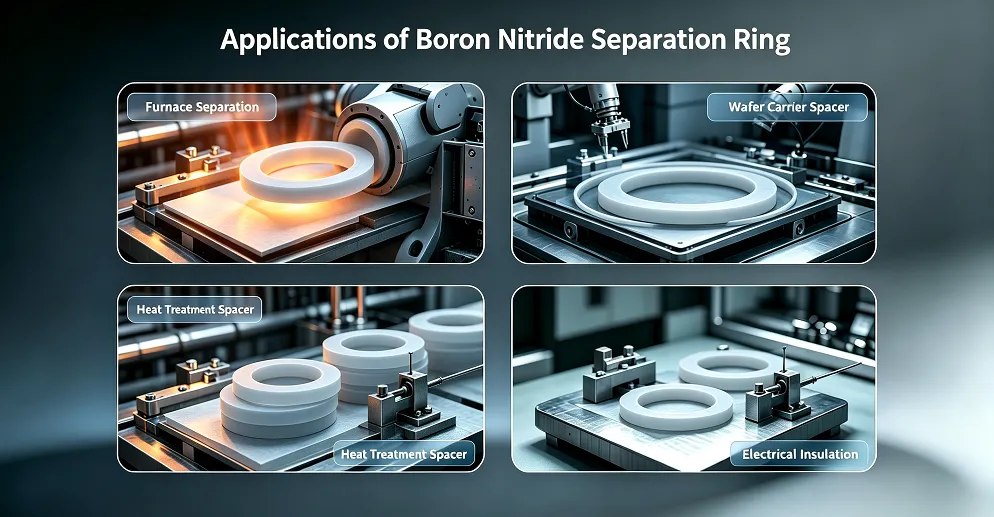
Applications of Boron Nitride Separation Ring
1. High-Temperature Ceramic Processing
A Boron Nitride Separation Ring can be used between ceramic components during high-temperature sintering, thermal treatment, and controlled-atmosphere processing. Its low wettability helps minimize adhesion between the ring and adjacent processed components, while its low thermal expansion helps maintain dimensional stability during heating and cooling. The ring can therefore function as a reusable separation and positioning component where clean interfaces are required.
2. Semiconductor and Electronic Component Processing
In semiconductor-related thermal processing, contamination control and dimensional stability are critical. A Boron Nitride Separation Ring can provide electrical isolation and controlled spacing around substrates, fixtures, or other precision components while reducing the possibility of unwanted sticking at elevated temperatures. High-purity BN grades can be selected when low particle generation and controlled material composition are important process requirements.
3. High-Temperature Furnace Fixtures
The combination of thermal stability, electrical insulation, and low wettability makes Boron Nitride Separation Ring suitable for selected furnace fixtures and thermal-processing assemblies. The ring can separate adjacent structural components, establish a controlled gap, or electrically isolate parts that operate at elevated temperatures. Proper fixture design should consider thermal gradients, mechanical loading, atmosphere, and the expansion characteristics of the surrounding materials.
4. Electrical Isolation Components
Where two components must remain physically separated while also being electrically isolated, a BN ring can perform both functions simultaneously. The high electrical resistivity of Boron Nitride Separation Ring helps prevent unwanted current paths, while its ceramic structure remains stable under appropriate high-temperature conditions. This makes the geometry useful in high-temperature electrical assemblies, sensor fixtures, and specialized insulating structures.
5. Molten Material Processing
BN's low wettability toward many molten materials allows a Boron Nitride Separation Ring to serve as a protective or separation interface in selected melting and thermal-processing applications. By reducing adhesion, the ring can make component removal easier and help maintain a cleaner contact surface. However, compatibility must be evaluated against the specific molten composition, temperature, atmosphere, exposure time, and surface condition because certain aggressive materials can react with or degrade BN.
6. Crystal Growth and High-Purity Thermal Processing
High-purity BN components are used in selected crystal-growth and high-temperature processing environments where chemical stability, electrical insulation, and contamination control are important. A Boron Nitride Separation Ring can maintain controlled spacing between processing components while limiting unwanted interaction between mating surfaces. The selected BN grade should be evaluated for impurity levels, outgassing behavior, dimensional stability, and compatibility with the specific processing atmosphere.
Engineering Considerations for Boron Nitride Separation Ring Design
The design of a Boron Nitride Separation Ring should begin with the actual interface conditions rather than simply selecting a standard ring based on diameter. Engineers should evaluate inner and outer diameter tolerances, ring thickness, flatness, concentricity, contact pressure, thermal expansion mismatch, temperature distribution, and the mechanical support provided by adjacent components. Because BN is a brittle ceramic, excessive point loading, impact, sharp corners, and uneven clamping should be avoided, particularly for thin rings. If the ring is installed between metal components, the difference in coefficient of thermal expansion can create significant radial or axial stress during heating, so appropriate clearance should be incorporated into the design. Surface finish is also important when the ring contacts precision ceramic or semiconductor components because excessive roughness can produce localized pressure concentrations or particle generation. Finally, the operating atmosphere must be considered carefully: BN can provide excellent high-temperature performance in inert or vacuum environments, whereas prolonged exposure to oxidizing atmospheres at elevated temperatures can cause oxidation and surface degradation.
Company Profile
JianXun Advanced Ceramic Technology is a professional manufacturer specializing in high-performance ceramic products, including Boron Nitride Separation Ring, alumina ceramics, boron nitride ceramics, silicon carbide ceramics, silicon nitride ceramics, aluminum nitride ceramics, mullite ceramics, quartz ceramics, and customized precision ceramic components. The company focuses on finished ceramic products with controlled material composition, density, mechanical properties, thermal performance, dimensional accuracy, surface quality, and customized geometries for demanding industrial applications.
Payment Terms: T/T, PayPal, Credit Card, Western Union, etc.
Shipment Terms: By air, by sea, by express, or according to customer request.
Storage Conditions: Store Boron Nitride Separation Ring in a clean, dry environment and protect it from moisture, contamination, impact, and excessive mechanical loading. Precision-machined rings should remain properly packaged until installation to protect their surfaces and edges.
FAQs About Boron Nitride Separation Ring
1. Why is boron nitride suitable for separation rings used in high-temperature processing?
A: A Boron Nitride Separation Ring combines several properties that are difficult to obtain simultaneously in conventional spacer materials, including electrical insulation, low thermal expansion, thermal stability, chemical resistance, and low wettability. Its h-BN surface can reduce adhesion to many molten or processed materials, while its low coefficient of thermal expansion helps limit dimensional changes during thermal cycling. This combination allows the ring to maintain a controlled separation distance while reducing the risk of sticking and excessive thermal stress between mating components. Nevertheless, the suitability of BN depends on the actual temperature, atmosphere, chemical environment, contact pressure, and processed material, so application-specific compatibility testing may be required.
2. Why should the inner diameter and outer diameter of a boron nitride separation ring be designed according to the complete assembly?
A: The dimensions of a Boron Nitride Separation Ring directly influence mechanical stress, thermal expansion clearance, alignment, and contact pressure within the assembly. If the clearance is too small, differential expansion between BN and surrounding metal or ceramic components can generate excessive compressive or radial stress during heating; if the clearance is too large, the ring may lose positional stability or allow unwanted movement. The ring dimensions must therefore be evaluated together with the thermal expansion coefficients, operating temperature, tolerances, mounting method, and dimensional changes of all mating components. For precision thermal-processing equipment, controlling diameter tolerance, concentricity, flatness, and thickness can be essential for achieving repeatable performance.
3. What factors determine the service temperature of a boron nitride separation ring?
A: The practical service temperature of a Boron Nitride Separation Ring is determined by more than the intrinsic thermal stability of BN. Atmosphere is particularly important because h-BN can withstand very high temperatures under suitable inert or vacuum conditions but can undergo oxidation in air at elevated temperatures. Material purity, density, microstructure, exposure time, thermal cycling frequency, mechanical loading, and contact with reactive materials can also influence service life. Therefore, a stated maximum temperature should be interpreted as a material capability under defined conditions rather than a universal continuous operating temperature.
4. How does surface finish affect the performance of a boron nitride separation ring?
A: Surface finish influences contact pressure, friction, adhesion, particle generation, and the ability of the Boron Nitride Separation Ring to maintain stable contact with adjacent components. An excessively rough surface can create localized stress concentrations and mechanical interference, while an inappropriate finishing process may introduce surface defects or contamination. For applications involving precision ceramic parts or high-purity processing, controlled machining and cleaning are therefore important. The optimum surface finish should be selected according to whether the ring primarily functions as a spacer, electrical insulator, separation layer, positioning component, or process-contact surface.
5. How can a boron nitride separation ring be customized for precision industrial equipment?
A: A Boron Nitride Separation Ring can be customized in terms of inner diameter, outer diameter, thickness, flatness, concentricity, chamfer geometry, surface finish, and dimensional tolerances according to the equipment design. Material grade and BN purity can also be selected based on requirements for temperature, electrical insulation, chemical compatibility, contamination control, and mechanical stability. During customization, the complete assembly should be evaluated because ring performance depends on the interaction between the BN component and its mating materials. Providing operating temperature, atmosphere, load conditions, mating-component materials, required dimensions, and tolerance requirements allows the ring geometry and material specification to be optimized more accurately.