Advanced Technical Ceramics, Precision Alumina, Silicon Carbide, Crucible Parts



Roller Rods

Overview
Silicon Carbide Roller Rods are high-performance ceramic rollers engineered for continuous high-temperature conveying, supporting, and transporting operations in industrial kilns and thermal processing equipment. Manufactured primarily from silicon carbide, these roller rods combine high-temperature mechanical stability, low thermal expansion, excellent thermal conductivity, strong wear resistance, and good chemical durability. Unlike metallic rollers, SiC ceramic rollers maintain their structural integrity at temperatures where many metals experience rapid strength loss, oxidation, deformation, or creep. This makes Silicon Carbide Roller Rods particularly valuable in continuous roller kilns, ceramic firing systems, powder processing equipment, and other thermal treatment lines where the roller must simultaneously support mechanical loads and operate within a severe thermal environment. From an engineering perspective, a roller rod is not simply a cylindrical refractory component. Its performance depends on the interaction between material properties, roller diameter, wall thickness, span length, rotational speed, supported load, bearing configuration, furnace temperature, thermal gradient, and installation accuracy. A roller may have excellent material strength but still fail prematurely if its diameter is undersized, the span is excessive, or the support system introduces concentrated stress. The combination of ceramic brittleness and high operating temperature makes mechanical design particularly important. Silicon Carbide Roller Rods must therefore be selected according to both material performance and the complete mechanical operating envelope. Silicon carbide is especially attractive for roller applications because of its relatively low coefficient of thermal expansion and high thermal conductivity. During rapid heating and cooling, heat can move through the roller more efficiently, reducing temperature differences between the surface and core. This helps minimize thermal stress and contributes to excellent thermal shock resistance. At the same time, the low thermal expansion of SiC reduces dimensional movement as the roller passes through different temperature zones. These characteristics are important for maintaining product alignment and stable conveying performance during continuous production. Different manufacturing technologies can be used to produce silicon carbide roller rods, including reaction bonding, recrystallization, pressureless sintering, and other specialized ceramic processing routes. Each method produces a different microstructure and therefore different combinations of density, strength, porosity, thermal conductivity, oxidation resistance, and maximum service temperature. For example, Silicon Carbide Roller Rods designed for extremely high-temperature applications may require a different grade from rollers optimized for mechanical strength, dimensional precision, or economical large-scale production. Engineers should therefore evaluate the manufacturing route and microstructure together with the nominal SiC content and temperature rating.
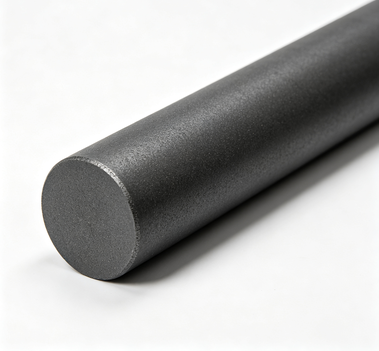
Classification and Key Characteristics of Silicon Carbide Roller Rods
1. High-Temperature Mechanical Strength
The primary function of Silicon Carbide Roller Rods is to support and transport products while operating at elevated temperatures. Silicon carbide retains a high level of stiffness and structural stability at temperatures where conventional metals may soften or creep significantly. This allows SiC rollers to support ceramic products, slabs, tiles, setters, and other loads without excessive deformation. For roller kiln applications, high-temperature strength is particularly important because the roller is subjected to both static and dynamic loads. The weight of the transported product creates bending stress, while rotation introduces additional mechanical loading. Temperature can further modify the mechanical behavior of the material. Therefore, engineers should evaluate hot flexural strength rather than relying solely on room-temperature strength data. The roller diameter and unsupported span are equally important. Increasing the roller diameter can significantly improve bending resistance, while reducing the unsupported length can reduce deflection. Properly designed Silicon Carbide Roller Rods can therefore provide stable load support over long operating cycles while maintaining the dimensional accuracy required for continuous material transportation.
2. Excellent Thermal Shock Resistance
Thermal shock is one of the most common causes of ceramic component failure in industrial furnaces. Silicon Carbide Roller Rods are particularly effective in this environment because SiC combines relatively low thermal expansion with high thermal conductivity. When a roller enters a hot furnace zone, the outer surface heats more rapidly than the interior. This temperature difference creates thermal stress. If the stress exceeds the material's fracture resistance, cracking can occur. High thermal conductivity allows heat to distribute more rapidly through the roller, while the low coefficient of thermal expansion reduces the strain generated by temperature changes. This combination enables SiC rollers to tolerate repeated heating and cooling cycles better than many conventional refractory materials. However, thermal shock resistance is strongly affected by roller geometry, surface defects, heating rate, cooling rate, and support conditions. A roller with a damaged edge or machining defect can become a crack initiation point even when the underlying material has excellent thermal shock properties.
3. High Thermal Conductivity and Efficient Heat Transfer
Another major advantage of Silicon Carbide Roller Rods is their high thermal conductivity compared with many traditional refractory ceramics. This property enables the roller to transfer heat efficiently across its cross-section and helps reduce localized temperature differences. In continuous roller kilns, the roller itself becomes part of the thermal environment. Excessive thermal resistance can produce temperature differences between different sections of the roller, while high thermal conductivity promotes more uniform temperature distribution. This is particularly useful during rapid firing cycles where the roller is continuously exposed to changing thermal conditions. High thermal conductivity can also reduce the time required for the roller to reach thermal equilibrium after startup. However, engineers should remember that thermal conductivity varies with material grade, porosity, temperature, and microstructure. Therefore, the actual thermal behavior of Silicon Carbide Roller Rods should be evaluated using grade-specific technical data rather than a generic SiC value.
4. Low Thermal Expansion and Dimensional Stability
Dimensional stability is critical for rollers because even small changes in straightness, diameter, or alignment can affect product transportation. Silicon Carbide Roller Rods have a relatively low coefficient of thermal expansion, typically around 4–5 × 10⁻⁶/K, allowing them to maintain more stable dimensions during temperature fluctuations. Low thermal expansion reduces changes in roller length and diameter when the kiln temperature changes. This helps maintain consistent spacing between rollers and reduces the risk of interference with adjacent components. It also reduces thermal stress generated by differential expansion between the roller and its supporting structure. For precision conveying systems, however, material expansion is only one part of the problem. Engineers must also account for temperature distribution along the roller, bearing clearance, shaft design, furnace structure, and installation alignment. The excellent dimensional stability of Silicon Carbide Roller Rods can only be fully utilized when the complete roller system is designed around the thermal expansion characteristics of the ceramic.
5. Excellent Wear Resistance
The high hardness of silicon carbide provides Silicon Carbide Roller Rods with excellent resistance to surface wear and abrasion. During continuous operation, the roller surface can experience friction against ceramic products, setters, support components, or particles generated during firing. If the roller surface wears unevenly, its diameter and surface profile can change, potentially causing variations in conveying speed or product alignment. SiC's high hardness helps maintain surface geometry over extended operating periods. Wear resistance is especially important in high-throughput production because replacing rollers requires furnace downtime and can interrupt the production process. Nevertheless, ceramic rollers should not be exposed to unnecessary impact or rough handling. Their hardness provides excellent abrasion resistance, but their brittle nature means impact damage, edge chipping, and localized mechanical shock remain important failure risks.
6. Strong Chemical and Oxidation Resistance
Silicon Carbide Roller Rods provide good resistance to many aggressive gases, vapors, powders, and chemical environments encountered during thermal processing. This chemical stability allows them to operate in conditions where metallic rollers may suffer from oxidation, corrosion, or surface degradation. In oxidizing atmospheres, silicon carbide can form a protective silica-based surface layer that slows further oxidation under suitable conditions. In other furnace atmospheres, the reaction behavior may differ significantly, so the exact gas composition must be considered during material selection. For applications involving alkali vapors, volatile compounds, molten materials, or chemically aggressive process residues, engineers should assess the actual chemical compatibility rather than assuming universal corrosion resistance. The composition of the transported product can also affect roller lifetime if material deposits accumulate on the roller surface.

Typical Specifications of Silicon Carbide Roller Rods
The following values represent typical engineering specifications for industrial SiC roller rods. Actual properties depend on the manufacturing process, SiC content, density, porosity, diameter, geometry, and application conditions.
| Property | Typical Specification |
|---|---|
| Product | Silicon Carbide Roller Rods |
| Material | Silicon Carbide (SiC) |
| SiC Content | Typically ≥85% depending on grade |
| Density | 2.6–3.1 g/cm³ |
| Flexural Strength | ≥150 MPa depending on grade |
| Compressive Strength | Typically ≥1000 MPa |
| Thermal Conductivity | Approx. 20–120 W/m·K |
| Coefficient of Thermal Expansion | Approx. 4.0–5.0 ×10⁻⁶/K |
| Maximum Service Temperature | Up to approximately 1650°C depending on grade and atmosphere |
| Hardness | High, typically Mohs 9–9.5 |
| Thermal Shock Resistance | Excellent |
| Wear Resistance | Excellent |
| Chemical Resistance | Excellent |
| Water Absorption | Very low |
| Roller Structure | Solid or hollow/customized |
| Cross-Section | Round |
| Surface | Smooth, ground, or customized |
| Diameter | Customized according to application |
| Length | Customized according to kiln design |
| End Configuration | Standard, machined, threaded, or customized |
| Application | Roller kilns and high-temperature conveying systems |
The most important parameters when selecting Silicon Carbide Roller Rods are not necessarily the highest values in the specification sheet. A roller system must be evaluated as a mechanical structure. For example, flexural strength, diameter, unsupported span, and applied load determine bending stress and deflection. Thermal conductivity and thermal expansion influence temperature gradients and dimensional changes. Density and porosity influence mechanical performance, thermal conductivity, and oxidation behavior. Meanwhile, manufacturing technology determines the microstructure and therefore the balance between strength, thermal shock resistance, and high-temperature stability. For this reason, engineers should provide the manufacturer with roller diameter, total length, effective working length, operating temperature, kiln atmosphere, product weight, roller spacing, rotation speed, and support conditions when requesting a customized Silicon Carbide Roller Rods solution.
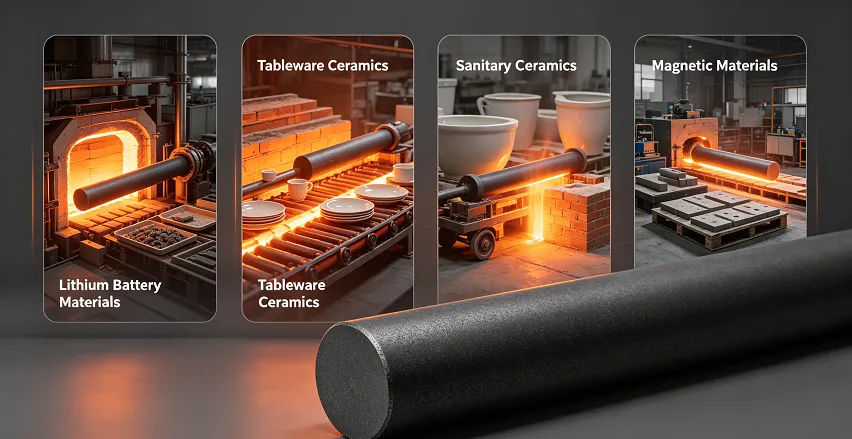
Applications of Silicon Carbide Roller Rods
1. Continuous Roller Kilns for Ceramic Tile Firing
Silicon Carbide Roller Rods are widely used in continuous roller kilns for transporting ceramic tiles, slabs, and other flat ceramic products through different temperature zones. The roller must maintain consistent rotation and support the product without excessive bending or thermal deformation. SiC provides excellent thermal shock resistance and dimensional stability, allowing rollers to operate through repeated heating and cooling cycles. Its high hardness also helps resist surface wear caused by continuous contact with ceramic products. Because roller alignment directly affects product movement, the straightness and diameter consistency of the rod are important manufacturing requirements. For large-format tiles, engineers should pay particular attention to span length and load distribution because the increased product size can substantially increase bending stress. Proper roller diameter and support spacing are therefore essential for preventing excessive deflection.
2. Advanced Ceramic Firing and Sintering Equipment
In advanced ceramic manufacturing, Silicon Carbide Roller Rods can provide reliable transportation and support during high-temperature firing and sintering processes. Ceramic components may require carefully controlled temperature profiles, and the rollers must maintain stable geometry while passing through multiple thermal zones. The high thermal conductivity of SiC allows efficient heat transfer, while its low thermal expansion helps maintain roller dimensions during temperature changes. This is particularly important when the processed components have strict dimensional tolerances. Material purity may also become important when producing high-value technical ceramics. Engineers should evaluate the possibility of contamination from roller surfaces, deposits, or reactions with process materials and select the appropriate SiC grade and surface finish accordingly.
3. High-Temperature Powder and Material Processing
Silicon Carbide Roller Rods can also be used in continuous thermal processing systems for powders, inorganic materials, and other products requiring controlled high-temperature treatment. In these systems, rollers may support trays, setters, carriers, or flat processing structures. The ability of SiC to withstand high temperatures while maintaining stiffness allows continuous movement through heated zones without the severe deformation associated with conventional metallic components. Its wear resistance is also valuable when the supported carriers repeatedly contact the roller surface. Engineers should consider the mass of the carrier, contact pressure, rotational speed, and thermal profile when selecting the roller dimensions. Where powders generate corrosive vapors or deposits, chemical compatibility should also be assessed.
4. Kiln Furniture Support Systems
In some furnace configurations, Silicon Carbide Roller Rods serve as structural supports for kiln furniture, setters, plates, or ceramic carriers. The roller must withstand the combined weight of the support structure and processed products while operating at elevated temperatures. SiC's high stiffness helps reduce bending under load, while its thermal shock resistance supports repeated firing cycles. The low thermal expansion also reduces changes in roller geometry as the furnace transitions between operating and ambient temperatures. The support system should be designed to distribute loads evenly. Concentrated contact between a heavy setter and a ceramic roller can create local stress, so engineers should evaluate contact geometry and ensure that the load remains within the allowable working range.
5. Continuous Thermal Treatment Systems
Silicon Carbide Roller Rods are suitable for continuous thermal treatment equipment where products must travel through controlled heating, soaking, and cooling zones. Such systems may require the rollers to operate continuously for extended periods without significant dimensional changes. The combination of high-temperature strength, thermal conductivity, low thermal expansion, and wear resistance makes SiC particularly suitable for these demanding conditions. Stable roller geometry helps maintain consistent conveying speed and product positioning throughout the thermal cycle. For continuous operation, engineers should additionally consider roller runout, straightness, bearing temperature, end-shaft configuration, and rotational synchronization. A technically excellent ceramic material cannot compensate for an improperly designed mechanical drive system.
6. High-Temperature Conveying of Flat Ceramic Products
For flat ceramic products such as tiles, slabs, plates, and ceramic sheets, Silicon Carbide Roller Rods provide a durable conveying surface capable of operating inside high-temperature zones. The roller surface must maintain adequate hardness and dimensional stability because even small surface irregularities can influence product movement. SiC's excellent wear resistance helps maintain the roller profile during extended operation. Its thermal stability allows the same roller to operate through significant temperature changes without excessive deformation. When transporting delicate or precision ceramic products, surface roughness and roller straightness should be controlled carefully. Excessive surface defects can create localized contact stress or friction that damages the product being conveyed.
7. High-Temperature Industrial Furnace Equipment
Silicon Carbide Roller Rods can be incorporated into various industrial furnace systems where materials must be mechanically transported under elevated temperatures. Their applications extend beyond ceramic kilns to specialized thermal-processing equipment requiring high-temperature structural rollers. The major engineering advantage is the ability to combine load-bearing capability with thermal shock resistance and chemical stability. SiC rollers can operate in environments where metallic components would require cooling systems or would suffer rapid oxidation. However, the suitability of a particular SiC grade depends on the furnace atmosphere and operating temperature. Engineers should confirm material compatibility with oxygen concentration, process gases, volatile compounds, and expected thermal cycling before finalizing the roller specification.
8. Customized Ceramic Roller Systems
Customized Silicon Carbide Roller Rods are often required when standard roller dimensions cannot satisfy the load, temperature, speed, or furnace geometry requirements. Manufacturers can produce rollers with customized diameters, lengths, wall structures, surface finishes, and end configurations. Customization should begin with engineering calculations rather than simply selecting the largest available diameter. The required roller dimensions depend on load, span, allowable deflection, rotation speed, thermal conditions, and support structure. Hollow designs may reduce weight and thermal inertia, while solid designs may provide different stiffness and manufacturing characteristics. For demanding applications, providing detailed operating data to the ceramic manufacturer allows the material grade and geometry to be optimized together. This is generally more effective than selecting a standard Silicon Carbide Roller Rods product based only on temperature rating.
Engineering Considerations for Silicon Carbide Roller Rods Design
The design of Silicon Carbide Roller Rods should begin with bending stress and deflection calculations because the roller functions as a rotating ceramic beam rather than simply a refractory support. Engineers should define the total load, load distribution, effective span, roller diameter, support locations, and allowable deflection before determining the required material grade. The maximum tensile stress is particularly important because SiC is strong in compression but relatively brittle and sensitive to tensile defects. Surface scratches, edge damage, machining marks, and handling impacts can become crack initiation sites under cyclic loading. Thermal conditions must then be integrated into the mechanical design. The roller may experience significant temperature differences along its length or between the exposed central section and cooler ends, creating thermal gradients and differential expansion. Bearing and drive systems must therefore accommodate thermal expansion without imposing excessive axial or radial stress. Rotation speed, runout, concentricity, and surface finish are also important because dynamic imbalance can generate additional loads. For Silicon Carbide Roller Rods operating at high temperatures, engineers should additionally evaluate furnace atmosphere, oxidation, chemical deposits, and the possibility of reaction with processed materials. Installation and handling are equally critical: ceramic rollers should be lifted and supported correctly, never dropped or subjected to concentrated impact, and should be allowed to reach thermal equilibrium according to the furnace manufacturer's startup procedure.
Company Profile
JianXun Advanced Ceramic Technology is a professional manufacturer specializing in high-performance ceramic products, including Silicon Carbide Roller Rods, recrystallized silicon carbide ceramics, reaction-bonded silicon carbide ceramics, pressureless-sintered silicon carbide ceramics, silicon carbide plates, kiln furniture, nozzles, grinding balls, seal rings, alumina ceramics, boron nitride ceramics, aluminum nitride ceramics, silicon nitride ceramics, mullite ceramics, quartz ceramics, and customized precision ceramic components.
The company focuses on finished ceramic products with controlled material composition, density, mechanical properties, thermal performance, dimensional accuracy, surface quality, and customized geometries for demanding industrial applications.
Payment Terms: T/T, PayPal, Credit Card, Western Union, etc.
Shipment Terms: By air, by sea, by express, or according to customer request.
Storage Conditions: Store Silicon Carbide Roller Rods horizontally on properly supported surfaces in a clean, dry environment. Avoid direct impact, concentrated loading, moisture contamination, and contact with hard objects that may scratch or chip the ceramic surface. Long rollers should be adequately supported along their length during storage and transportation.
FAQs About Silicon Carbide Roller Rods
Q1: What are Silicon Carbide Roller Rods and why are they used in roller kilns?
Answer: Silicon Carbide Roller Rods are cylindrical ceramic rollers manufactured primarily from silicon carbide and designed to transport or support products inside high-temperature thermal processing equipment. They are used in roller kilns because SiC combines high-temperature mechanical stability, excellent thermal shock resistance, low thermal expansion, high thermal conductivity, and strong wear resistance. These properties allow the roller to maintain its geometry while continuously supporting products at elevated temperatures. Compared with metallic rollers, SiC rollers can operate at substantially higher temperatures without the same degree of softening, oxidation, or creep. However, roller performance depends strongly on diameter, span, load, temperature, rotation speed, and support conditions, so material selection and mechanical design must be considered together.
Q2: How do engineers determine the correct diameter and length of Silicon Carbide Roller Rods?
Answer: The correct dimensions of Silicon Carbide Roller Rods should be determined from the applied load, unsupported span, allowable deflection, operating temperature, rotation speed, and kiln geometry. A larger diameter generally increases bending stiffness and reduces deflection, while a shorter unsupported span reduces bending stress. Engineers must also distinguish between the total roller length and the effective working span because the supported sections outside the hot zone may have different thermal and mechanical conditions. Product weight should be evaluated together with roller spacing and load distribution rather than treated as a simple point load. For customized rollers, manufacturers should receive the complete kiln drawing or key parameters so that diameter, length, wall thickness, and end configuration can be selected based on actual operating conditions.
Q3: Why do Silicon Carbide Roller Rods have good thermal shock resistance?
Answer: Silicon Carbide Roller Rods have excellent thermal shock resistance because silicon carbide combines relatively low thermal expansion with high thermal conductivity and good mechanical stability. When the roller experiences a rapid temperature change, its surface and internal regions can reach different temperatures, creating thermal stress. High thermal conductivity helps distribute heat through the material more quickly, while the low coefficient of thermal expansion limits the amount of dimensional strain produced by the temperature change. This reduces the probability of thermal-shock cracking compared with materials having higher thermal expansion and lower thermal conductivity. Nevertheless, rapid cooling, uneven heating, mechanical constraints, and surface defects can still produce cracking, so proper furnace startup and shutdown procedures remain essential.
Q4: What causes Silicon Carbide Roller Rods to break during operation?
Answer: Failure of Silicon Carbide Roller Rods can result from excessive bending stress, thermal shock, impact damage, surface defects, improper installation, excessive load, or chemical degradation. Because SiC is a brittle ceramic, a small surface crack or chipped edge can act as a stress concentrator. When the roller is subsequently subjected to bending or thermal cycling, the defect may propagate and cause sudden fracture. Excessive span length and uneven product loading can also increase tensile stress on the lower side of the roller. Thermal gradients between the hot central section and cooler ends can create additional stress if the roller is improperly constrained. Therefore, preventing mechanical damage during transportation and installation is just as important as selecting a high-quality SiC material.
Q5: Why are Silicon Carbide Roller Rods better than metal rollers for high-temperature applications?
Answer: Silicon Carbide Roller Rods are advantageous over many metallic rollers when the operating temperature is sufficiently high because SiC maintains excellent stiffness, hardness, and dimensional stability while metals can experience softening, creep, oxidation, and significant strength reduction. SiC also provides high thermal conductivity and low thermal expansion, allowing stable operation through repeated temperature changes. Its excellent wear and chemical resistance further improve performance when the roller is exposed to abrasive ceramic products or aggressive furnace atmospheres. However, metal rollers can provide advantages in impact tolerance, toughness, and lower-temperature mechanical applications. Therefore, the choice should be based on the actual temperature, load, thermal cycling, mechanical shock, and required service life rather than assuming ceramic rollers are universally superior.