Advanced Technical Ceramics, Precision Alumina, Silicon Carbide, Crucible Parts



Gasket

Overview
Boron Nitride Gasket is a high-performance ceramic sealing and insulating component manufactured primarily from hexagonal boron nitride (h-BN) and designed for demanding environments involving high temperature, electrical isolation, chemical exposure, and repeated thermal cycling. Unlike conventional polymer, rubber, graphite, or metallic gaskets, a BN gasket can maintain its structural and insulating function at temperatures far beyond the practical range of most organic sealing materials. Its low thermal expansion, high electrical resistivity, chemical stability, and low wettability make it particularly valuable where conventional gasket materials may contaminate the process, react with surrounding materials, or lose dimensional stability. From an engineering perspective, a Boron Nitride Gasket should not be evaluated simply according to its maximum temperature. Its sealing performance depends on gasket geometry, compressive loading, surface flatness, thermal expansion mismatch, porosity, material density, surface finish, atmosphere, and the chemical compatibility of the BN with the process medium. Boron nitride is a ceramic rather than a ductile metal, so the gasket must be designed to operate primarily under controlled compression without excessive bending, impact, or tensile stress. For demanding high-temperature assemblies, the interface design is often as important as the material itself. A high-quality Boron Nitride Gasket can provide a combination of electrical resistivity above 10¹³ Ω·cm, low thermal expansion, thermal stability approaching 2800°C under suitable inert or vacuum conditions, and excellent resistance to many molten materials and chemical environments. These properties make BN gaskets particularly useful as insulating seals, separation components, and high-temperature interface elements in advanced thermal-processing and precision industrial equipment.

Classification and Key Characteristics of Boron Nitride Gasket
1. Hexagonal Boron Nitride Structure and Low-Density Ceramic Matrix
The performance of a Boron Nitride Gasket originates from the layered crystal structure of hexagonal boron nitride. Boron and nitrogen atoms form strongly bonded planar layers, while the interaction between adjacent layers is comparatively weak. This anisotropic structure gives h-BN its characteristic lubricity, low friction, machinability, and relatively low thermal expansion. For gasket applications, the microstructure must be controlled carefully. Excessive open porosity can increase gas permeability and reduce mechanical strength, while an excessively brittle or highly stressed structure can make thin gasket geometries difficult to handle. Density around 2.26 g/cm³ is typical for dense h-BN, although the actual value depends on manufacturing technology and grade. The selected density should therefore correspond to the required mechanical strength, thermal behavior, and sealing environment.
2. High-Temperature Stability Under Controlled Atmospheres
One of the major advantages of a Boron Nitride Gasket is its ability to remain stable at extremely high temperatures in vacuum or inert atmospheres. BN can withstand temperatures approaching 2800°C under suitable non-oxidizing conditions, making it attractive for specialized high-temperature assemblies. However, the atmosphere must always be considered when specifying the material. Boron nitride is susceptible to oxidation at elevated temperatures in oxygen-containing environments, and its practical service temperature in air is therefore substantially lower than its inert-atmosphere temperature capability. Engineers should specify the maximum temperature together with atmosphere composition, oxygen partial pressure, exposure duration, and thermal-cycle conditions.
3. Excellent Electrical Insulation
Unlike graphite, which has a similar layered structure but is electrically conductive, h-BN is an excellent electrical insulator. A Boron Nitride Gasket can therefore provide mechanical separation and electrical isolation simultaneously. Typical electrical resistivity can exceed 10¹³ Ω·cm, depending on purity, density, temperature, and measurement conditions. This property is valuable when the gasket is positioned between electrically active components or when a high-temperature interface must prevent current leakage. At elevated temperatures, electrical resistivity generally changes, so engineers designing high-temperature electrical assemblies should evaluate dielectric performance at the actual operating temperature rather than relying solely on room-temperature data.
4. Low Thermal Expansion and Thermal Cycling Resistance
Boron nitride has a low coefficient of thermal expansion compared with many metals and conventional ceramics. This characteristic helps reduce thermal stress when the gasket is repeatedly heated and cooled. For a Boron Nitride Gasket, low thermal expansion is especially important because the gasket is usually constrained between two mating surfaces. If the gasket and surrounding components expand at significantly different rates, compressive load can increase or decrease during operation. Excessive expansion mismatch may result in crushing, leakage, deformation, or cracking. Consequently, gasket design should consider the thermal expansion of the complete assembly rather than treating the BN component as an isolated part.
5. Chemical Stability and Low Wettability
The chemical stability and low wettability of BN are particularly useful in high-temperature sealing applications. Many molten metals, glass-like materials, and ceramic compounds exhibit limited adhesion to BN surfaces, which can help prevent sticking and facilitate component separation after thermal processing. A Boron Nitride Gasket can therefore serve not only as a sealing element but also as a chemically resistant separation interface. Its low reactivity can reduce unwanted material transfer and contamination, which is particularly important in high-purity processing. Nevertheless, chemical resistance should be verified against the specific process chemistry. Strong oxidizing conditions, certain molten compounds, and reactive gases may interact with BN at elevated temperatures.
6. Precision Machinability and Customized Geometry
Although sintered technical ceramics are generally difficult to machine, hexagonal boron nitride is comparatively easy to machine because of its layered crystal structure and relatively low hardness. This allows Boron Nitride Gasket components to be produced in thin sections and customized geometries. Typical configurations include flat gaskets, annular rings, stepped seals, washers, insulating spacers, and custom profiles. Inner diameter, outer diameter, thickness, groove geometry, surface finish, and dimensional tolerances can all be adapted to the mating assembly. For precision sealing, flatness and parallelism are particularly important because uneven contact pressure can create localized leakage paths or excessive mechanical stress.

Typical Specifications of Boron Nitride Gasket
The following values represent typical engineering specifications for high-performance h-BN gasket components. Actual properties vary according to BN purity, density, manufacturing process, geometry, and operating conditions.
| Property | Typical Specification |
|---|---|
| Product | Boron Nitride Gasket |
| Material | Hexagonal Boron Nitride (h-BN) |
| BN Purity | ≥99% |
| Density | Approximately 2.20–2.26 g/cm³ |
| Flexural Strength | Approximately 50–100 MPa |
| Compressive Strength | Approximately 100–300 MPa |
| Hardness | Relatively low compared with alumina and SiC |
| Thermal Conductivity | Approximately 15–30 W/m·K |
| Coefficient of Thermal Expansion | Approximately 1–2 × 10⁻⁶/K |
| Electrical Resistivity | >10¹³ Ω·cm |
| Maximum Temperature in Inert/Vacuum Atmosphere | Up to approximately 2800°C |
| Maximum Temperature in Oxidizing Atmosphere | Significantly lower; application dependent |
| Surface Finish | As-machined or precision finished |
| Water Absorption | Low to moderate depending on porosity |
| Inner Diameter | Customized |
| Outer Diameter | Customized |
| Thickness | Customized |
| Dimensional Tolerance | Customized |
These values should be treated as typical reference values rather than universal specifications. In particular, the 2800°C temperature figure applies only under appropriate non-oxidizing conditions and should not be interpreted as a continuous operating temperature in air. For gasket design, compressive behavior is generally more relevant than flexural strength. The component should be sized so that the required sealing load is achieved without excessive local stress. The surface condition of the mating components is equally important because a rigid ceramic gasket cannot compensate for severe surface waviness or large machining defects in the surrounding components. The gasket thickness should also be selected carefully. Increasing thickness can improve tolerance to surface irregularities in some designs, but it also increases deformation and thermal expansion effects. Thin BN gaskets provide lower thermal mass and a shorter interface distance, but they require better control of surface flatness and handling.
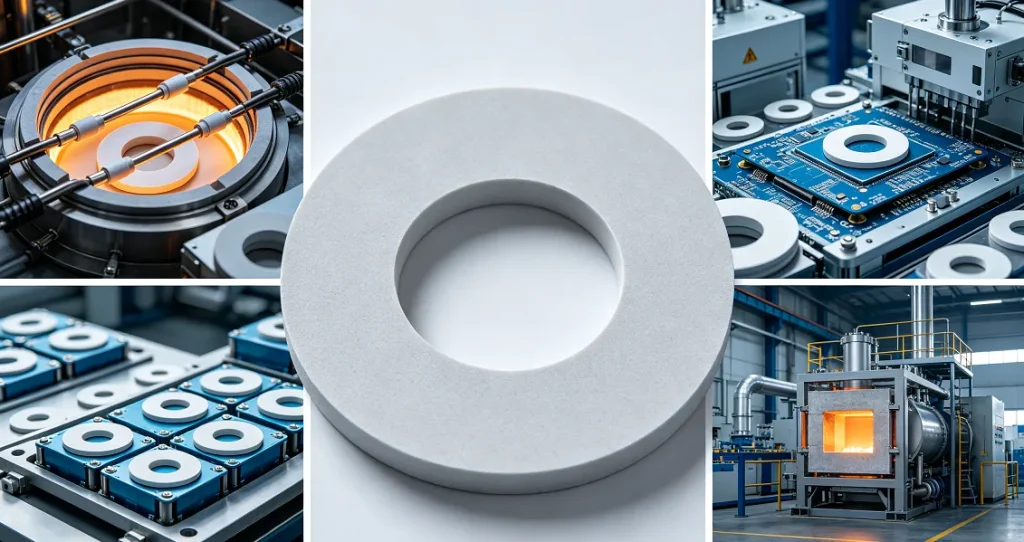
Applications of Boron Nitride Gasket
1. High-Temperature Furnace and Thermal Processing Equipment
A Boron Nitride Gasket can be used as a sealing or insulating interface in high-temperature furnace assemblies where conventional elastomeric gaskets are completely unsuitable. BN can maintain its ceramic structure under extreme temperatures while providing electrical insulation and resistance to many process materials. The gasket may be positioned between furnace components, ceramic structures, electrodes, covers, or process chambers depending on the system design. Engineers should pay particular attention to thermal expansion because the gasket may be mechanically constrained as the surrounding furnace components heat and cool.
2. Electrical Insulation in High-Temperature Assemblies
BN gaskets can simultaneously provide physical separation and electrical insulation. This makes them useful where a conventional metallic washer or conductive gasket would create an unwanted electrical path. The high electrical resistivity of Boron Nitride Gasket material is particularly valuable in high-temperature equipment where polymeric insulating materials would degrade. The required thickness should be determined from the voltage, creepage distance, temperature, surface contamination, and mechanical loading of the assembly.
3. Semiconductor and High-Purity Processing Equipment
High-purity BN can be selected for specialized semiconductor and electronic material processing systems where contamination control is critical. The chemically stable ceramic surface can reduce unwanted interaction between the gasket and adjacent components. The low wettability of BN is also advantageous when process materials may soften, melt, or deposit during thermal processing. Instead of strongly adhering to the gasket surface, many materials can be separated more easily after processing. For high-purity applications, engineers should specify not only BN purity but also machining quality, surface cleanliness, particle generation, packaging, and handling procedures.
4. Molten Material and High-Temperature Material Processing
The low-wetting characteristics of boron nitride make Boron Nitride Gasket components suitable for selected molten-material processing environments. BN can act as a separation or interface component where sticking to conventional ceramic materials would cause operational problems. The actual compatibility depends on the molten material, temperature, atmosphere, exposure time, and BN grade. Some molten compounds can react with or penetrate ceramic materials under severe conditions, so application-specific compatibility testing is recommended for critical systems.
5. Vacuum and Inert-Atmosphere Equipment
Vacuum and inert-gas systems provide particularly favorable conditions for BN because oxidation is minimized. A Boron Nitride Gasket can function as a high-temperature insulating and interface component where extreme temperature and low contamination are required. In vacuum equipment, engineers should additionally consider outgassing, surface cleanliness, porosity, and the potential for trapped contaminants. Dense, high-purity BN with a controlled surface finish is generally preferable when vacuum cleanliness is important.
Engineering Considerations for Boron Nitride Gasket Design
The first design consideration is sealing load. BN is a rigid ceramic and does not behave like an elastomeric gasket that can undergo large elastic deformation. The mating surfaces should therefore be sufficiently flat and parallel, while the applied compression should be distributed uniformly around the gasket. The second consideration is thermal expansion mismatch. If the BN gasket is installed between metals or other ceramics, engineers should calculate the dimensional changes of every component across the operating temperature range. Excessive differential expansion can alter the contact pressure and potentially damage the gasket. The third consideration is atmosphere. A BN gasket designed for vacuum or inert gas service cannot automatically be assigned the same temperature rating in air. Oxidation behavior must be incorporated into the material selection and operating envelope. The fourth consideration is thickness and geometry. Thin gaskets reduce thermal mass but require better surface quality and handling. Complex profiles may improve sealing performance in a specific assembly, but sharp corners and narrow sections should be avoided where they create stress concentrations or handling difficulties. Finally, installation is critical. The gasket should be aligned concentrically, protected from impact, and compressed according to the assembly's calculated load requirements. Excessive bolt torque or uneven tightening can create localized stress and fracture a ceramic gasket even when the nominal material strength is sufficient.
Company Profile
JianXun Advanced Ceramic Technology is a professional manufacturer specializing in high-performance ceramic products, including Boron Nitride Gasket, boron nitride firing plates, BN setter plates, BN crucibles, alumina ceramics, silicon carbide ceramics, silicon nitride ceramics, aluminum nitride ceramics, mullite ceramics, quartz ceramics, and customized precision ceramic components. The company focuses on finished ceramic products with controlled material composition, density, thermal performance, mechanical properties, dimensional accuracy, surface quality, and customized geometries for demanding industrial applications.
Payment Terms: T/T, PayPal, Credit Card, Western Union, etc.
Shipment Terms: By air, by sea, by express, or according to customer request.
Storage Conditions: Store Boron Nitride Gasket in a clean, dry, and protected environment. Keep gaskets flat and avoid bending, impact, compression, or contamination of the sealing surfaces. Precision-machined surfaces should remain protected until installation.
FAQs About Boron Nitride Gasket
1. Why is boron nitride suitable for high-temperature gasket applications?
Boron nitride is suitable because it combines high-temperature stability, low thermal expansion, electrical insulation, chemical resistance, and low wettability in a single ceramic material. Unlike polymer gaskets, BN does not soften or decompose at relatively low temperatures. Unlike metallic gaskets, it provides electrical insulation and does not introduce a conductive path between components. Its low coefficient of thermal expansion also helps reduce dimensional changes during thermal cycling. However, BN is a rigid ceramic rather than a deformable elastomer, so the sealing assembly must provide adequate surface flatness and controlled compression. The gasket geometry, material density, operating atmosphere, and thermal expansion of the mating components should therefore be evaluated together.
2. What is the maximum operating temperature of a Boron Nitride Gasket?
The maximum temperature depends strongly on the surrounding atmosphere. Under vacuum or inert conditions, high-purity boron nitride can remain stable at temperatures approaching 2800°C. This value should not be interpreted as a universal continuous operating temperature because the actual limit also depends on exposure duration, thermal cycling, mechanical load, BN grade, and component geometry. In oxidizing atmospheres, the practical temperature limit is substantially lower because BN can undergo oxidation at elevated temperatures. Engineers should therefore specify temperature together with atmosphere and service duration. For a real application, the appropriate temperature rating should be established from the complete operating environment rather than from the theoretical thermal stability of bulk BN.
3. How should the compression load of a Boron Nitride Gasket be determined?
The required compression load depends on the gasket geometry, mating-surface condition, pressure differential, temperature, and sealing mechanism. Because BN is relatively rigid and brittle, excessive compression can cause cracking or localized crushing, while insufficient compression can create leakage paths. The mating surfaces should ideally be flat and parallel so that the load is distributed uniformly across the gasket. Engineers should also account for thermal expansion because compression can change substantially when the assembly reaches operating temperature. For critical sealing applications, finite-element stress analysis or controlled compression testing can be used to determine whether the selected gasket thickness and geometry provide adequate contact pressure without exceeding the ceramic's mechanical limits.
4. How does a Boron Nitride Gasket compare with graphite or alumina gaskets?
The three materials provide different combinations of properties. Graphite generally offers excellent high-temperature capability and compressibility but is electrically conductive and may be unsuitable where electrical isolation is required. Alumina provides higher hardness and mechanical strength than BN but can have greater interaction or adhesion with certain processed materials and generally has a higher thermal expansion coefficient. A Boron Nitride Gasket provides electrical insulation, low thermal expansion, good thermal shock resistance, and low wettability, making it particularly attractive for high-temperature interfaces where contamination and release performance are important. The correct choice depends on atmosphere, mechanical load, temperature, chemical environment, electrical requirements, and the required sealing mechanism.
5. Can Boron Nitride Gaskets be customized for precision sealing and insulation applications?
Yes. Boron Nitride Gasket components can be customized in inner diameter, outer diameter, thickness, groove geometry, holes, steps, chamfers, surface finish, and overall profile. h-BN is comparatively machinable because of its layered crystal structure, allowing manufacturers to produce complex shapes and thin sections that would be more difficult to achieve with many dense technical ceramics. For precision applications, engineers should provide a technical drawing containing dimensional tolerances, flatness, parallelism, surface roughness, and the critical mating dimensions. Operating temperature, atmosphere, pressure, electrical requirements, and process-medium information should also be provided because these factors determine whether the selected BN grade and gasket geometry are appropriate.