Advanced Technical Ceramics, Precision Alumina, Silicon Carbide, Crucible Parts



White Ring Paper

Overview
Boron Nitride White Ring Paper is a lightweight, high-purity ceramic paper primarily manufactured from hexagonal boron nitride (h-BN), combining electrical insulation, low thermal expansion, thermal stability, chemical resistance, and low surface wettability in a thin, flexible format. Unlike conventional ceramic rings or rigid BN components, this specialized BN paper can be processed into ring-shaped geometries to provide controlled separation, insulation, release, or surface protection between components exposed to elevated temperatures. The white appearance is characteristic of high-purity BN-based material, while the paper-like structure allows the Boron Nitride White Ring Paper to accommodate customized diameters, thicknesses, and profiles for precision thermal-processing assemblies. Its performance is governed not only by BN purity but also by paper density, thickness, fiber or platelet structure, compression behavior, surface condition, thermal gradients, operating atmosphere, and contact pressure. For demanding applications, the component should therefore be selected according to the complete thermal, electrical, chemical, and mechanical conditions rather than temperature capability alone.

Classification and Key Characteristics of Boron Nitride White Ring Paper
1. High-Purity Boron Nitride Composition
The primary material in Boron Nitride White Ring Paper is high-purity hexagonal boron nitride, which provides the combination of thermal, electrical, and chemical characteristics required for advanced ceramic processing. High material purity is particularly important when the ring paper is positioned directly against substrates, powders, semiconductor components, or other high-value processed materials. Controlled composition helps reduce unwanted contamination and supports stable performance during repeated high-temperature processing cycles.
2. Excellent Electrical Insulation
BN is an inherently electrically insulating ceramic with high electrical resistivity. When used as a ring-shaped insulating layer, Boron Nitride White Ring Paper can prevent direct electrical contact between adjacent components while simultaneously maintaining physical separation. Its thin profile is useful where conventional rigid ceramic rings would occupy excessive space or introduce higher mechanical loading into the assembly.
3. Low Thermal Expansion
Hexagonal BN has a relatively low coefficient of thermal expansion, helping the Boron Nitride White Ring Paper maintain dimensional stability during heating and cooling. This characteristic can reduce stress caused by thermal expansion mismatch between the BN paper and surrounding ceramic or metallic components. In repeated thermal cycles, however, the compression and recovery behavior of the paper structure must also be considered because the dimensional response of a thin porous ceramic material differs from that of dense BN.
4. Thermal Stability and Insulation
The Boron Nitride White Ring Paper provides a useful combination of thermal stability and thermal insulation in applications where a thin separation layer is required. Its relatively low density and paper-like structure can reduce direct heat transfer across the contact interface compared with dense ceramic components. The actual thermal resistance depends strongly on thickness, density, compression, contact area, and temperature, so the bulk thermal conductivity of BN should not be treated as the sole indicator of installed thermal performance.
5. Low Wettability and Release Characteristics
One of the most useful characteristics of Boron Nitride White Ring Paper is the low wettability of h-BN toward many molten and processed materials. This can reduce sticking between the ring paper and adjacent surfaces during high-temperature operations. As a result, BN paper can serve as a release or separation interface where clean removal and reduced material adhesion are important.
6. Lightweight and Flexible Geometry
Compared with rigid BN ceramic components, Boron Nitride White Ring Paper offers much lower mass and greater geometric flexibility. It can be manufactured or processed into thin ring-shaped structures with customized inner diameter, outer diameter, and thickness. This makes the material particularly useful when the available installation space is limited or when a compliant separation layer is required between two precision components.

Typical Specifications of Boron Nitride White Ring Paper
The following values represent typical engineering ranges for high-purity BN paper products. Actual specifications can be customized according to thickness, density, processing method, and application requirements.
| Property | Typical Specification |
|---|---|
| Material | Hexagonal Boron Nitride (h-BN) |
| BN Purity | ≥99% |
| Density | Approx. 1.8–2.2 g/cm³ |
| Thermal Conductivity | Approx. 30–70 W/m·K |
| Electrical Resistivity | >10¹³ Ω·cm |
| Coefficient of Thermal Expansion | Approx. 1–2 × 10⁻⁶/K |
| Flexural Strength | Approx. 50–100 MPa* |
| Dielectric Constant | Approx. 3.5–4.5 |
| Maximum Temperature | Up to approximately 2000°C under suitable inert/vacuum conditions |
| Ring Thickness | Customized |
| Inner Diameter | Customized |
| Outer Diameter | Customized |
| Surface | Smooth white to light gray |
| Geometry | Ring, annular sheet, customized profile |
Mechanical properties depend strongly on paper density, thickness, orientation, and test method. For Boron Nitride White Ring Paper, thickness is one of the most important design parameters because it directly affects electrical isolation, thermal resistance, compression, and dimensional stability. A very thin ring can provide minimal interface thickness and precise separation but may be more susceptible to tearing or deformation during installation. Increasing thickness can improve handling and thermal isolation but may change the overall assembly dimensions and contact pressure. Inner and outer diameter tolerances should also be matched with the surrounding components, particularly when the ring paper is used for concentric positioning or thermal-processing fixtures.
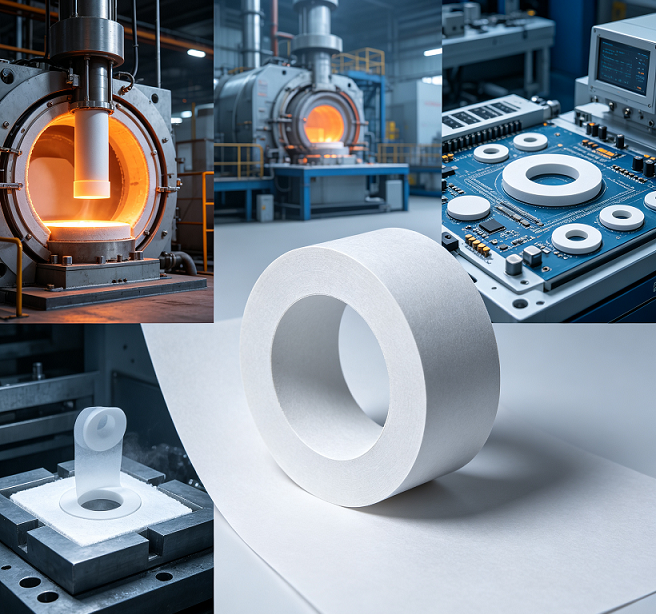
Applications of Boron Nitride White Ring Paper
1. High-Temperature Electrical Insulation
A major application of Boron Nitride White Ring Paper is electrical isolation between components operating under elevated-temperature conditions. Its high electrical resistivity allows the ring to interrupt unwanted current paths while maintaining a very thin separation layer between adjacent components. The annular geometry can be positioned around electrodes, conductive supports, sensor assemblies, heating components, or other electrically active parts where conventional polymer insulation would lose stability. Compared with thicker rigid ceramic insulators, BN ring paper requires less installation space and can accommodate compact assembly designs. Engineers should consider dielectric requirements, operating temperature, surface contamination, clearance distance, and mechanical compression when specifying the material.
2. Ceramic Sintering and Thermal Processing
Boron Nitride White Ring Paper can function as a separation and interface-control layer during ceramic sintering, heat treatment, calcination, and other high-temperature processing operations. The low wettability of h-BN helps reduce adhesion between processed ceramic components and surrounding fixtures, which can simplify unloading and minimize surface damage after thermal treatment. The ring configuration is particularly useful when separation is required only around a specific perimeter rather than across an entire contact surface. Its low thermal expansion also helps reduce dimensional changes during repeated heating and cooling. For practical use, engineers should evaluate contact pressure, heating rate, atmosphere, ring thickness, and compatibility with the processed ceramic composition.
3. Semiconductor and Electronic Processing
High-purity Boron Nitride White Ring Paper is suitable for selected semiconductor and electronic processing environments where electrical insulation, thermal stability, and contamination control must be maintained simultaneously. The ring can be installed around substrates, process fixtures, electrical interfaces, or support structures to establish a controlled insulating boundary without introducing a thick rigid component. High-purity BN is especially useful when metallic contamination or organic residues could affect the processed material. In semiconductor-related applications, engineers should evaluate BN purity, particle generation, surface cleanliness, outgassing behavior, dimensional stability, and compatibility with the process atmosphere to ensure that the ring does not become a secondary contamination source.
4. High-Temperature Release Applications
The naturally low wettability of hexagonal boron nitride makes Boron Nitride White Ring Paper useful as a release interface in selected high-temperature manufacturing processes. When placed between a processed material and a supporting fixture, the BN surface can reduce direct adhesion and facilitate component removal after heating. This is valuable when mechanical separation could damage delicate surfaces or alter dimensional accuracy. The ring-paper structure also allows engineers to place the release layer only where separation is required, reducing unnecessary material coverage. However, release performance depends strongly on the processed material, temperature, surface pressure, atmosphere, and exposure time, so compatibility should be evaluated for each process.
5. Furnace and Thermal-Processing Fixtures
Boron Nitride White Ring Paper can be incorporated into furnace fixtures as a lightweight separation, insulation, or protective component between adjacent parts. Its electrical insulation can prevent unintended conductive contact, while its thermal characteristics help establish a controlled interface between components with different thermal functions. The low mass of BN paper is advantageous where the fixture must minimize additional thermal capacity or where installation space is restricted. In repeated furnace cycles, however, the ring must withstand handling, compression, thermal gradients, and dimensional changes without excessive deformation. Engineers should therefore select thickness and density according to the actual fixture load and thermal profile rather than treating all BN paper grades as interchangeable.
6. Crystal Growth and High-Purity Processing
High-purity BN components are widely considered for specialized crystal-growth and other high-purity thermal-processing environments because of their chemical stability, electrical insulation, and low wettability. Boron Nitride White Ring Paper can provide a thin separation or protective interface around crucibles, substrates, supports, and process fixtures where conventional materials may introduce unwanted contamination or adhesion. Its ring geometry is useful when only a localized annular region requires protection. For high-purity processing, material selection should extend beyond nominal BN purity and include surface cleanliness, impurity levels, particle generation, outgassing, thermal stability, and compatibility with the specific crystal-growth environment.
7. High-Temperature Component Separation
A Boron Nitride White Ring Paper can be used as a controlled spacer between ceramic, graphite, metal, or other high-temperature components when direct contact needs to be avoided. The ring establishes a defined interface while reducing the possibility of mechanical sticking, electrical conduction, or unwanted material transfer between mating surfaces. Because BN has a relatively low coefficient of thermal expansion, the separation layer can remain dimensionally stable during temperature changes when properly designed. Engineers should pay particular attention to the compression behavior of the paper, especially in assemblies subjected to clamping forces, because excessive compression can reduce thickness and change the designed separation distance.
8. Thermal Isolation and Heat-Flow Control
In applications where heat transfer between neighboring components needs to be reduced, Boron Nitride White Ring Paper can serve as a thin thermal isolation layer. Its paper-like structure and controlled density can introduce additional thermal resistance at the interface, helping engineers manage localized heat flow without using a thick rigid ceramic spacer. This can be useful around sensors, heating assemblies, substrates, and precision thermal fixtures where excessive heat transfer could create temperature gradients or affect dimensional stability. The actual thermal resistance depends on thickness, density, compression, contact area, and interface conditions, so engineers should evaluate the installed thermal resistance rather than relying only on nominal material conductivity.
Engineering Considerations for Boron Nitride White Ring Paper
The design of Boron Nitride White Ring Paper should consider its behavior as a thin porous ceramic structure rather than treating it like a conventional dense BN ring. Thickness, density, compression, handling strength, dimensional tolerance, and surface condition all influence the installed performance of the component. Excessive clamping pressure can locally compress or damage the paper, while insufficient contact may allow movement or reduce the effectiveness of the separation interface. Thermal expansion mismatch between the BN paper and surrounding components should also be evaluated, particularly when the ring is tightly constrained. For electrical applications, engineers should consider dielectric requirements, creepage distance, operating temperature, and possible surface contamination. For release applications, compatibility with the processed material and atmosphere is critical because BN's low wettability is not identical for every molten or reactive material. Finally, the operating atmosphere must be carefully controlled: h-BN provides excellent high-temperature performance in suitable inert or vacuum environments, while prolonged exposure to oxidizing conditions at elevated temperatures can cause surface oxidation and material degradation.
Company Profile
JianXun Advanced Ceramic Technology is a professional manufacturer specializing in high-performance ceramic products, including Boron Nitride White Ring Paper, alumina ceramics, boron nitride ceramics, silicon carbide ceramics, silicon nitride ceramics, aluminum nitride ceramics, mullite ceramics, quartz ceramics, and customized precision ceramic components. The company focuses on finished ceramic products with controlled material composition, density, mechanical properties, thermal performance, dimensional accuracy, surface quality, and customized geometries for demanding industrial applications.
Payment Terms: T/T, PayPal, Credit Card, Western Union, etc.
Shipment Terms: By air, by sea, by express, or according to customer request.
Storage Conditions: Store Boron Nitride White Ring Paper in a clean, dry, dust-free environment and protect it from moisture, contamination, compression, bending, and mechanical impact. Keep the product flat and properly packaged until installation to preserve its original geometry.
FAQs About Boron Nitride White Ring Paper
1. Why is boron nitride used to manufacture white ring paper for high-temperature applications?
A: Boron Nitride White Ring Paper combines the thermal stability, electrical insulation, low thermal expansion, and low wettability of h-BN with the lightweight and adaptable geometry of a paper-like ceramic structure. This combination allows the material to function as a thin separation, insulation, or release interface without requiring a thick rigid ceramic component. The low wettability of BN can also reduce adhesion to many processed materials during high-temperature operations, while its low thermal expansion helps limit dimensional changes during thermal cycling. The actual performance, however, depends on BN purity, density, thickness, atmosphere, compression, and contact conditions.
2. Why is ring-shaped BN paper advantageous compared with a conventional flat BN sheet?
A: A ring-shaped Boron Nitride White Ring Paper can provide localized insulation, separation, or surface protection precisely around a defined component interface rather than covering an entire surface. This geometry can reduce unnecessary material usage while maintaining a controlled annular gap or insulating boundary around substrates, fixtures, supports, or other components. The ring profile also allows engineers to integrate thermal or electrical isolation into compact assemblies where a complete sheet would interfere with surrounding structures. Dimensional accuracy of the inner and outer diameters is therefore particularly important when the ring must maintain concentric positioning.
3. What determines the high-temperature performance of boron nitride white ring paper?
A: The practical temperature capability of Boron Nitride White Ring Paper depends on BN purity, density, thickness, atmosphere, heating rate, exposure time, mechanical loading, and thermal cycling conditions. Although high-purity BN can withstand very high temperatures under suitable inert or vacuum conditions, prolonged exposure to oxidizing atmospheres can cause oxidation at elevated temperatures. The paper structure can also respond differently from dense BN because porosity and compression influence thermal transport and dimensional stability. Therefore, the maximum temperature should always be specified together with the operating atmosphere and actual application conditions.
4. How should the thickness of boron nitride white ring paper be selected?
A: The thickness of Boron Nitride White Ring Paper should be selected according to the required electrical insulation, thermal resistance, mechanical handling strength, compression, and available installation space. A thinner ring can minimize assembly dimensions and provide precise spacing but may be more vulnerable to tearing, deformation, or handling damage. A thicker ring can provide greater physical separation and thermal resistance but may change the contact pressure and dimensional relationship between mating components. For precision applications, thickness tolerance should be considered together with inner diameter, outer diameter, flatness, and compression behavior.
5. How can boron nitride white ring paper be customized for industrial equipment?
A: Boron Nitride White Ring Paper can be customized according to inner diameter, outer diameter, thickness, ring width, dimensional tolerances, surface requirements, and overall geometry. Material purity and density can also be selected based on thermal, electrical, chemical, and contamination-control requirements. When developing a customized ring, engineers should provide the operating temperature, atmosphere, contact materials, mechanical loading, electrical requirements, and required dimensions so that the paper structure can be matched to the actual operating environment. This approach is particularly important when the ring functions simultaneously as a thermal barrier, electrical insulator, release layer, and precision spacer.