Advanced Technical Ceramics, Precision Alumina, Silicon Carbide, Crucible Parts



Recrystallized Silicon Carbide

Overview
Recrystallized Silicon Carbide (RSiC) is a high-performance non-oxide ceramic material manufactured through a high-temperature recrystallization process using high-purity silicon carbide powder without traditional sintering additives. Unlike pressureless-sintered SiC or reaction-bonded SiC, RSiC is densified through an evaporation-condensation mechanism at temperatures typically above 2000°C, where SiC particles form strong crystalline bonds while maintaining an interconnected porous microstructure. This unique manufacturing method allows the material to achieve exceptional high-temperature stability, chemical resistance, thermal shock resistance, and dimensional reliability. From an engineering perspective, the performance of Recrystallized Silicon Carbide is determined not only by silicon carbide content but also by grain morphology, pore distribution, recrystallization degree, density, surface condition, and manufacturing consistency. The absence of liquid-phase sintering additives prevents the formation of glassy grain boundaries, resulting in excellent purity and stable properties under extreme thermal conditions. This characteristic makes RSiC particularly valuable in applications where contamination control, thermal cycling resistance, and long-term structural stability are critical. Compared with conventional ceramic materials, Recrystallized Silicon Carbide provides a rare combination of low thermal expansion, high thermal conductivity, high-temperature mechanical strength, oxidation resistance, and excellent creep resistance. These characteristics enable RSiC components to maintain dimensional accuracy during repeated heating and cooling cycles, which is essential for high-temperature kiln structures, semiconductor processing equipment, thermal exchange systems, and precision furnace components. A typical RSiC ceramic can achieve a silicon carbide content above 98%, density around 2.6–2.8 g/cm³, thermal conductivity approximately 100 W/m·K at room temperature, flexural strength around 80–100 MPa, and continuous operating temperatures exceeding 1600°C in oxidizing environments depending on design and atmosphere conditions.
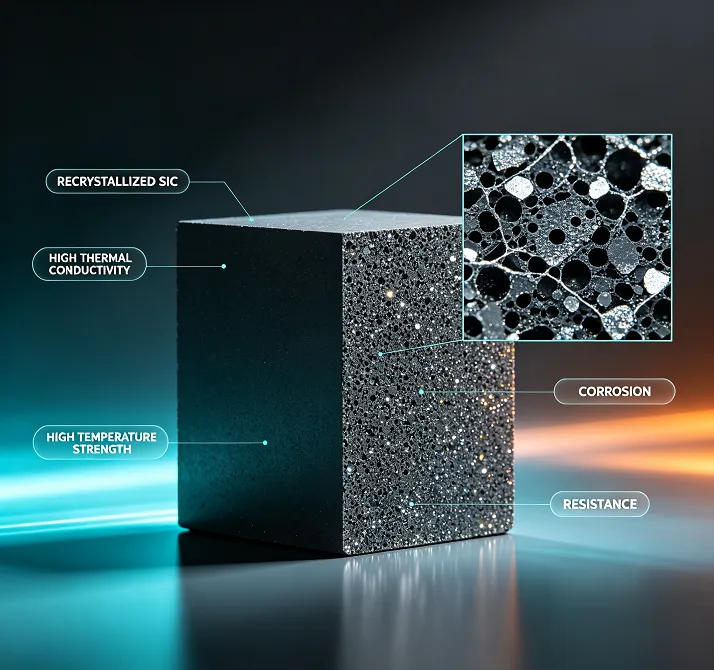
Classification and Key Characteristics of Recrystallized Silicon Carbide
1. High-Purity SiC Composition and Additive-Free Structure
The fundamental advantage of Recrystallized Silicon Carbide comes from its high-purity material system. During manufacturing, pure SiC powder is shaped and heated under controlled conditions without adding conventional sintering aids such as boron, carbon additives, or oxide-based liquid phases. At extremely high temperatures, silicon carbide undergoes sublimation and condensation, allowing SiC grains to grow and bond together directly. This additive-free structure provides several engineering advantages. First, the absence of secondary phases improves chemical stability because there are fewer impurity-rich grain boundaries that may react with aggressive gases or molten materials. Second, the material maintains excellent high-temperature strength because the bonding structure remains stable even under prolonged thermal exposure. For semiconductor, crystal growth, and high-purity furnace applications, this characteristic significantly reduces the risk of contamination from ceramic components. The purity of RSiC also contributes to its excellent oxidation behavior. Although SiC naturally forms a protective SiO₂ layer during oxidation, the absence of low-melting impurities helps maintain the integrity of this protective layer at elevated temperatures.
2. Excellent High-Temperature Structural Stability
One of the most important characteristics of Recrystallized Silicon Carbide is its ability to maintain mechanical integrity under extreme temperatures. Unlike many metals that lose strength rapidly when heated, RSiC retains high stiffness and structural stability due to its strong covalent Si-C bonding. In high-temperature furnace applications, components such as kiln shelves, beams, rollers, and supports experience continuous thermal loading and mechanical stress. Ordinary refractory materials may deform, creep, or experience dimensional changes over time. RSiC, however, maintains excellent shape stability because of its stable crystalline structure and low thermal expansion coefficient. For engineers, the maximum operating temperature should not be evaluated only by melting point. The actual service temperature depends on atmosphere, load condition, component geometry, thermal cycling frequency, and oxidation exposure. Proper design of support structures and thermal gradients is essential to maximize service life.
3. Superior Thermal Shock Resistance
Thermal shock resistance is one of the most valuable properties of Recrystallized Silicon Carbide. During industrial thermal processes, ceramic components often experience rapid temperature changes during heating, cooling, loading, and unloading cycles. Materials with high thermal expansion or poor thermal conductivity may develop internal stresses that lead to cracking. RSiC performs exceptionally well under these conditions because of its combination of low coefficient of thermal expansion, high thermal conductivity, and controlled porous structure. Heat can transfer rapidly through the material, reducing temperature differences between the surface and interior. At the same time, the relatively low thermal expansion reduces stress accumulation during temperature fluctuations. This makes RSiC suitable for applications involving frequent thermal cycling, where maintaining mechanical reliability over thousands of cycles is more important than achieving maximum theoretical density.
4. High Thermal Conductivity and Heat Transfer Capability
Compared with many oxide ceramics, Recrystallized Silicon Carbide has significantly higher thermal conductivity. This property allows efficient heat transfer and more uniform temperature distribution in thermal-processing equipment. In kiln furniture applications, high thermal conductivity improves heating efficiency by allowing heat to transfer more effectively between heating zones and processed products. This can reduce temperature gradients and improve firing consistency. In heat exchanger systems, RSiC enables efficient thermal exchange while maintaining corrosion resistance and high-temperature durability. However, thermal conductivity depends on temperature, porosity, grain structure, and material purity. Engineers should evaluate the complete thermal system rather than selecting materials only based on room-temperature conductivity values.
5. Excellent Chemical and Oxidation Resistance
The chemical stability of Recrystallized Silicon Carbide makes it suitable for harsh industrial environments where conventional ceramics or metals may degrade. SiC exhibits excellent resistance to many acids, corrosive gases, molten materials, and high-temperature chemical exposure. When exposed to oxygen-containing environments, SiC forms a protective silicon oxide layer that slows further oxidation. This self-protective mechanism helps extend component lifetime during high-temperature operation. However, oxidation resistance depends on temperature, atmosphere composition, exposure time, and surface condition. For applications involving aggressive chemicals, engineers should analyze the compatibility between RSiC and the specific process environment rather than relying only on general corrosion resistance data.
6. Dimensional Stability and Precision Performance
The manufacturing process of Recrystallized Silicon Carbide provides excellent dimensional stability because the material experiences minimal shrinkage during recrystallization. Unlike many sintered ceramics that undergo significant densification shrinkage, RSiC maintains relatively stable dimensions after firing. This characteristic is especially important for large structural components, precision furnace parts, and semiconductor processing fixtures. Reduced dimensional change allows engineers to design components with predictable tolerances and stable positioning during operation. For precision applications, additional machining processes such as diamond grinding may be applied to achieve specific dimensions, surface roughness, and assembly requirements.
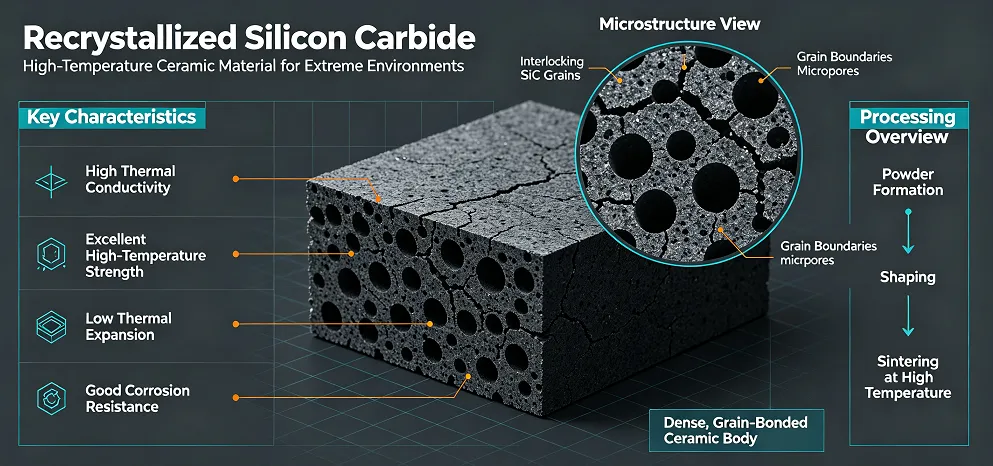
Typical Specifications of Recrystallized Silicon Carbide
The following specifications represent typical engineering values for high-performance RSiC ceramic products. Actual properties depend on manufacturing process, component geometry, porosity, and application requirements.
| Property | Typical Specification |
|---|---|
| Material | Recrystallized Silicon Carbide (RSiC) |
| Silicon Carbide Content | ≥98% |
| Density | 2.6–2.8 g/cm³ |
| Porosity | Approximately 10–20% |
| Flexural Strength (Room Temperature) | 80–100 MPa |
| Flexural Strength (High Temperature) | 90–110 MPa |
| Thermal Conductivity | Approximately 100 W/m·K |
| Coefficient of Thermal Expansion | 4–5 ×10⁻⁶/K |
| Maximum Working Temperature | 1600°C+ in air |
| Inert Atmosphere Temperature Capability | Up to approximately 2000°C |
| Elastic Modulus | Around 280 GPa |
| Chemical Resistance | Excellent |
| Electrical Properties | Semiconductor behavior |
| Manufacturing Method | High-temperature recrystallization |
The specification selection of Recrystallized Silicon Carbide should consider operating atmosphere, mechanical loading, thermal cycling frequency, component size, and required lifetime. A kiln support beam and a semiconductor wafer processing fixture may both use RSiC but require completely different structural designs and surface requirements.
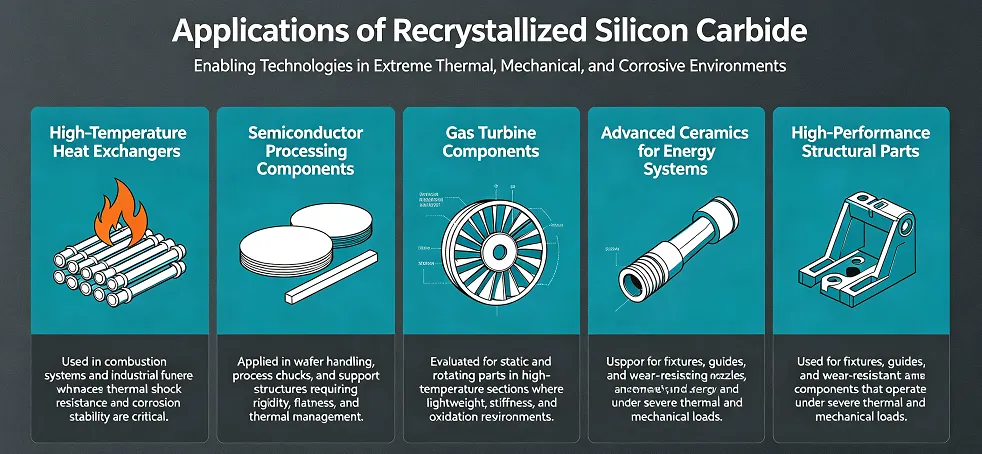
Applications of Recrystallized Silicon Carbide
1. High-Temperature Kiln Furniture
The largest industrial application of Recrystallized Silicon Carbide is high-temperature kiln furniture, including shelves, beams, rollers, supports, setters, and saggers. In ceramic firing processes, kiln furniture must withstand repeated heating cycles while supporting heavy loads without deformation. RSiC provides significant advantages because of its low thermal expansion, excellent thermal conductivity, and high-temperature mechanical stability. Its lightweight structure compared with traditional refractory materials can reduce the thermal mass of kiln systems, improving energy efficiency and increasing usable furnace capacity. For advanced ceramic, electronic ceramic, and lithium battery material production, stable kiln furniture performance directly influences product consistency and production efficiency.
2. Semiconductor and Electronic Processing Equipment
High-purity Recrystallized Silicon Carbide is used in semiconductor manufacturing equipment where thermal stability, contamination control, and dimensional precision are required. Components such as wafer supports, boats, furnace fixtures, and processing carriers benefit from RSiC’s purity and resistance to thermal deformation. During semiconductor processes such as oxidation, diffusion, and high-temperature treatment, even small contamination levels can influence product quality. The additive-free structure of RSiC helps minimize unwanted chemical interactions and particle generation. Engineers must carefully consider surface finish, cleanliness requirements, thermal expansion matching, and process atmosphere when selecting RSiC components for semiconductor systems.
3. Thermal Processing Tubes and Furnace Components
Recrystallized Silicon Carbide tubes and structural components are widely used in high-temperature furnace environments because they combine mechanical strength with excellent heat transfer performance. Compared with traditional oxide ceramic tubes, RSiC components can provide better resistance to thermal shock and higher operating temperatures. They are suitable for applications involving rapid heating cycles, protective tubes, heating elements, and furnace internals. The component design should consider tube thickness, thermal gradients, support conditions, and atmosphere compatibility to avoid mechanical stress during operation.
4. Heat Exchangers and Thermal Management Systems
The high thermal conductivity and corrosion resistance of Recrystallized Silicon Carbide make it suitable for advanced heat exchanger applications. RSiC can efficiently transfer heat while maintaining stability in chemically aggressive environments. Compared with metallic heat exchangers, SiC-based systems provide better resistance to oxidation and high-temperature corrosion. This makes them attractive for demanding thermal management processes involving hot gases, corrosive fluids, or extreme temperature conditions. The design of RSiC heat exchangers requires careful evaluation of pressure requirements, sealing methods, thermal gradients, and mechanical support.
5. Burner Nozzles and High-Temperature Flow Components
RSiC burner components benefit from excellent oxidation resistance, thermal shock resistance, and long-term dimensional stability. Burner nozzles made from Recrystallized Silicon Carbide can withstand repeated ignition cycles and high-temperature gas flow. The material’s corrosion resistance helps maintain nozzle geometry over extended operation, improving combustion stability and reducing maintenance frequency. For these applications, engineers should evaluate gas composition, flow velocity, operating temperature, and mechanical impact conditions.
6. Advanced Porous Ceramic Applications
Because RSiC naturally maintains controlled porosity after recrystallization, it can be engineered for porous ceramic applications such as filtration, gas distribution, and high-temperature separation systems. The interconnected pore structure provides permeability while maintaining excellent thermal stability and chemical resistance. This combination allows RSiC porous structures to operate in environments where polymeric filters or conventional ceramics cannot survive.
The pore size distribution, permeability, mechanical strength, and contamination requirements should be optimized according to the specific application.
Engineering Considerations for Recrystallized Silicon Carbide Design
When designing components using Recrystallized Silicon Carbide, engineers should evaluate the entire operating environment rather than focusing on a single material parameter. The first consideration is thermal loading. Although RSiC has excellent thermal shock resistance, extremely uneven heating or cooling can still generate internal stress. Mechanical support design is equally important because ceramic materials have high compressive strength but limited tolerance to tensile stress and impact loading. Sharp corners, concentrated loads, improper mounting, and excessive clamping forces should be avoided. Atmosphere selection is another critical factor. RSiC performs exceptionally well in inert environments and controlled atmospheres, while long-term exposure to high-temperature oxidation conditions requires careful evaluation of temperature limits and protective oxide behavior. Surface quality and dimensional tolerance should also be considered for precision applications. Proper machining, cleaning, handling, and installation procedures are essential to prevent surface defects from becoming crack initiation points.
Company Profile
JianXun Advanced Ceramic Technology is a professional manufacturer specializing in high-performance ceramic products, including Recrystallized Silicon Carbide, pressureless-sintered silicon carbide ceramics, reaction-bonded silicon carbide ceramics, silicon carbide tubes, silicon carbide plates, silicon carbide kiln furniture, alumina ceramics, boron nitride ceramics, aluminum nitride ceramics, silicon nitride ceramics, mullite ceramics, quartz ceramics, and customized precision ceramic components.
The company focuses on finished ceramic products with controlled composition, density, mechanical properties, thermal performance, dimensional accuracy, and customized engineering solutions for demanding industrial applications.
Payment Terms: T/T, PayPal, Credit Card, Western Union, etc.
Shipment Terms: By air, by sea, by express, or according to customer request.
Storage Conditions: Store Recrystallized Silicon Carbide components in a dry, clean environment and protect them from mechanical impact, contamination, and sudden temperature changes. Precision surfaces should be properly protected before installation.
FAQs About Recrystallized Silicon Carbide
1. Why is Recrystallized Silicon Carbide preferred for high-temperature kiln furniture applications?
Answer: Recrystallized Silicon Carbide is preferred for kiln furniture because it provides an excellent balance between thermal stability, mechanical strength, lightweight structure, and thermal shock resistance. During ceramic firing, kiln components experience repeated heating and cooling cycles, mechanical loading, and exposure to aggressive atmospheres. Traditional refractory materials may suffer from deformation, creep, or cracking after long-term operation. RSiC maintains dimensional stability because its strong Si-C bonding structure remains stable at elevated temperatures. In addition, its high thermal conductivity allows faster heat transfer and more uniform temperature distribution, improving firing efficiency and reducing thermal stress within the kiln system.
2. How does Recrystallized Silicon Carbide differ from pressureless-sintered Silicon Carbide?
Answer: The primary difference lies in the manufacturing mechanism and microstructure. Recrystallized Silicon Carbide is produced without sintering additives through high-temperature recrystallization, resulting in a high-purity porous structure with excellent thermal stability and chemical resistance. Pressureless-sintered SiC usually contains sintering additives that promote densification and achieve higher density and strength. Therefore, pressureless SiC is often selected for applications requiring maximum mechanical strength and wear resistance, while RSiC is preferred where purity, thermal shock resistance, dimensional stability, and high-temperature performance are more important.
3. What factors determine the service life of Recrystallized Silicon Carbide components?
Answer: The service life of Recrystallized Silicon Carbide components depends on operating temperature, atmosphere, thermal cycling frequency, mechanical loading, component design, surface condition, and installation method. Even though RSiC has excellent high-temperature performance, improper support structures, concentrated stress, rapid temperature changes, or chemical incompatibility can reduce lifetime. Engineers should evaluate the complete operating environment, including heating and cooling rates, load distribution, contact points, and maintenance conditions, rather than selecting the material only according to temperature capability.
4. Can Recrystallized Silicon Carbide be customized into complex shapes?
Answer: Yes. Recrystallized Silicon Carbide can be manufactured into customized components such as beams, plates, tubes, rollers, supports, saggers, burner nozzles, and precision furnace fixtures. Since the recrystallization process produces minimal dimensional shrinkage, engineers can achieve relatively stable component geometry after firing. However, because RSiC is extremely hard and brittle, machining complex shapes requires specialized diamond processing techniques. Customers should provide detailed drawings, dimensional tolerances, operating conditions, and mechanical requirements during the design stage.
5. Why does Recrystallized Silicon Carbide have excellent thermal shock resistance?
Answer: The excellent thermal shock resistance of Recrystallized Silicon Carbide results from the combination of low thermal expansion, high thermal conductivity, and controlled porous microstructure. When a ceramic component experiences rapid temperature changes, thermal stress develops because different regions expand or contract at different rates. Materials with high expansion coefficients or poor heat transfer capability are more likely to crack. RSiC reduces this risk by distributing heat efficiently and minimizing internal temperature differences, allowing it to withstand repeated thermal cycling in demanding industrial environments.