Advanced Technical Ceramics, Precision Alumina, Silicon Carbide, Crucible Parts



Refractory Bricks
Overview of Silicon Carbide Refractory Bricks
Silicon Carbide Refractory Bricks are high-performance non-oxide ceramic refractory materials manufactured primarily from silicon carbide (SiC), engineered to withstand extreme thermal, mechanical, and chemical environments in high-temperature industrial equipment. Unlike traditional oxide-based refractory bricks, SiC refractory bricks utilize the strong covalent bonding structure of silicon carbide, providing excellent thermal conductivity, high-temperature strength, oxidation resistance, wear resistance, and corrosion resistance. These characteristics make them particularly suitable for demanding thermal processing systems where conventional refractory materials may experience rapid degradation, deformation, or thermal shock failure. From an engineering perspective, the performance of Silicon Carbide Refractory Bricks is determined by multiple factors, including SiC content, bulk density, porosity, grain structure, bonding phase, manufacturing process, surface quality, and operating atmosphere. A high SiC content alone does not guarantee superior performance because the final service behavior depends strongly on the relationship between microstructure and operating conditions. Engineers must evaluate thermal gradients, mechanical loading, chemical exposure, furnace atmosphere, and service temperature before selecting the appropriate SiC refractory grade. Compared with alumina, mullite, and other conventional refractory materials, Silicon Carbide Refractory Bricks provide significantly higher thermal conductivity and better resistance to thermal shock. Their ability to transfer heat efficiently reduces temperature differences inside the brick structure, minimizing internal thermal stress during rapid heating and cooling cycles. This makes them valuable in applications where furnace efficiency, energy consumption, and long-term structural stability are critical design considerations. In practical industrial applications, Silicon Carbide Refractory Bricks are commonly manufactured through reaction bonding, nitride bonding, oxide bonding, or recrystallization processes. Each manufacturing route produces different microstructures and performance characteristics. For example, reaction-bonded SiC bricks provide excellent dimensional stability, while nitride-bonded SiC bricks offer improved oxidation resistance and high-temperature mechanical strength. Therefore, material selection should always be based on the complete process environment rather than a single performance parameter.

Classification and Key Characteristics of Silicon Carbide Refractory Bricks
1. High Silicon Carbide Content and Stable Ceramic Structure
The fundamental advantage of Silicon Carbide Refractory Bricks comes from the inherent properties of silicon carbide. SiC is a covalently bonded ceramic with extremely strong atomic bonding, giving it excellent hardness, thermal stability, and resistance to mechanical degradation. During manufacturing, carefully controlled particle size distribution and sintering or bonding processes create a dense refractory structure capable of maintaining performance under prolonged high-temperature exposure. The SiC content, typically ranging from approximately 70% to over 90% depending on the product grade, directly influences thermal conductivity, corrosion resistance, and mechanical strength. Higher SiC content generally improves thermal performance and chemical stability, but the final properties also depend on the bonding system and porosity control. For furnace engineers, evaluating only the chemical composition is insufficient. The pore structure, bonding phase, grain distribution, and manufacturing consistency determine how the brick responds to thermal cycling, molten material contact, and mechanical loading during actual operation.
2. Exceptional High-Temperature Strength and Structural Stability
One of the primary reasons for using Silicon Carbide Refractory Bricks is their ability to maintain structural integrity at elevated temperatures. Unlike many oxide refractories that gradually soften or creep under high thermal loads, SiC maintains excellent mechanical stability due to its strong covalent bonding. In industrial furnaces, refractory bricks experience continuous exposure to heat, mechanical stress, and chemical attack. The ability to maintain shape and strength directly affects furnace efficiency and maintenance frequency. SiC bricks can withstand repeated thermal exposure while maintaining dimensional accuracy, reducing problems such as deformation, cracking, and premature lining failure. However, actual high-temperature performance depends on furnace atmosphere, temperature profile, load conditions, and chemical environment. Engineers should consider whether the brick operates in oxidizing, reducing, carburizing, or inert atmospheres because different environments influence SiC oxidation behavior.
3. Excellent Thermal Conductivity and Heat Transfer Capability
A major engineering advantage of Silicon Carbide Refractory Bricks is their high thermal conductivity compared with conventional refractory ceramics. This allows heat to transfer efficiently through furnace linings, reducing localized temperature differences and improving thermal uniformity. In applications such as furnace walls, kiln structures, and heat-treatment equipment, improved heat transfer can increase energy efficiency and shorten heating cycles. Reduced thermal gradients also help minimize thermal stress, which is a major cause of refractory cracking during rapid temperature changes. Nevertheless, high thermal conductivity is not always the only design objective. Engineers must balance heat transfer requirements with insulation performance, furnace energy design, operating temperature, and heat loss considerations.
4. Superior Thermal Shock Resistance
Thermal shock resistance is one of the most important properties of Silicon Carbide Refractory Bricks. Industrial furnaces often experience frequent heating and cooling cycles, where refractory materials are subjected to sudden temperature variations. The combination of low thermal expansion coefficient, high thermal conductivity, and strong mechanical bonding allows SiC bricks to tolerate rapid temperature changes better than many traditional refractory materials. Heat can dissipate quickly through the brick structure, reducing temperature differences between the surface and interior. This property is especially valuable in intermittent firing processes, batch furnaces, and equipment requiring frequent startup and shutdown operations. Proper furnace design, controlled heating rates, and correct installation methods further improve thermal shock performance.
5. Outstanding Wear Resistance and Mechanical Durability
The extremely high hardness of silicon carbide provides excellent resistance to abrasion, erosion, and mechanical wear. Silicon Carbide Refractory Bricks are therefore suitable for environments where refractory linings are exposed to particle impact, high-speed gas flow, molten material movement, or mechanical friction. Compared with softer refractory materials, SiC bricks maintain their surface integrity for longer periods, reducing maintenance requirements and extending furnace lining lifetime. This is particularly important in industrial processes where downtime caused by refractory replacement can significantly affect production efficiency. The actual wear resistance depends on brick density, porosity, surface condition, operating temperature, and the characteristics of the abrasive medium.
6. Strong Chemical Corrosion Resistance
Chemical corrosion is one of the major failure mechanisms of refractory materials. Silicon Carbide Refractory Bricks demonstrate excellent resistance against many corrosive substances, including slags, molten metals, acidic gases, and chemical vapors. The dense SiC structure limits penetration of corrosive materials, while the stable silicon carbide phase provides resistance against many aggressive environments. In selected applications, a protective silicon oxide layer formed during oxidation can further improve resistance by slowing additional oxidation. However, SiC compatibility must always be evaluated according to the exact chemical environment. Strong oxidizing atmospheres, alkaline slags, molten oxides, and high-temperature oxygen exposure may influence long-term performance.

Typical Specifications of Silicon Carbide Refractory Bricks
The following values represent typical engineering specifications. Actual performance depends on composition, bonding technology, manufacturing process, and application conditions.
| Property | Typical Specification |
|---|---|
| Material | Silicon Carbide (SiC) |
| SiC Content | 70–95% |
| Density | 2.5–3.0 g/cm³ |
| Apparent Porosity | 10–20% |
| Flexural Strength | 80–200 MPa |
| Compressive Strength | 200–600 MPa |
| Thermal Conductivity | 10–120 W/m·K |
| Coefficient of Thermal Expansion | 4–5 ×10⁻⁶/K |
| Maximum Working Temperature | 1600°C+ |
| Hardness | Approximately Mohs 9–9.5 |
| Corrosion Resistance | Excellent |
| Thermal Shock Resistance | Excellent |
| Manufacturing Methods | Reaction bonded, nitride bonded, oxide bonded, recrystallized |
The selection of Silicon Carbide Refractory Bricks should consider the complete operating environment, including furnace atmosphere, heat cycle, mechanical stress, chemical exposure, and expected service life. A brick optimized for high thermal conductivity may not always be suitable for a highly corrosive environment, and a highly dense brick may require different installation considerations compared with porous thermal insulation materials.
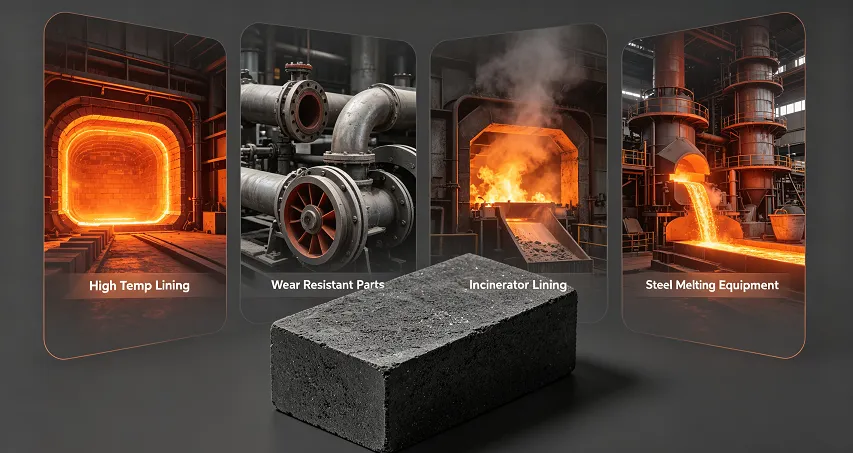
Applications of Silicon Carbide Refractory Bricks
1. High-Temperature Industrial Furnaces
Silicon Carbide Refractory Bricks are widely used in high-temperature furnaces where excellent thermal stability and corrosion resistance are required. They can be applied in furnace walls, bottoms, combustion zones, heat-transfer areas, and structural lining components. Their high thermal conductivity improves heat distribution, while their mechanical strength allows long-term operation under thermal stress. In continuous furnace systems, SiC bricks help maintain stable operating conditions and reduce downtime caused by refractory damage. Engineers must consider furnace temperature, atmosphere, lining structure, and thermal expansion differences during installation to achieve maximum service life.
2. Ceramic and Powder Processing Kilns
In ceramic manufacturing, kiln materials must withstand repeated thermal cycles and contact with ceramic powders or fired products. Silicon Carbide Refractory Bricks provide excellent resistance to thermal fatigue and chemical interaction, making them suitable for kiln structures and supporting systems. Their high thermal conductivity helps achieve uniform temperature distribution, which can improve firing consistency and reduce energy consumption. The low thermal expansion also reduces cracking during repeated heating and cooling cycles. For advanced ceramic processing, material purity and contamination control should be evaluated carefully because refractory interaction may influence final product quality.
3. Metallurgical Furnace Linings
Metallurgical processes often involve molten materials, high temperatures, and aggressive chemical environments. Silicon Carbide Refractory Bricks are used in selected metallurgical furnace applications because of their resistance to corrosion, erosion, and thermal shock. Their high mechanical strength helps withstand impact from charging materials and mechanical operations. Their corrosion resistance also helps extend lining lifetime when exposed to molten metals or slags. The specific SiC grade should be selected according to molten material composition, operating temperature, and furnace atmosphere.
4. Heat Treatment and Thermal Processing Equipment
Heat-treatment equipment requires refractory materials that can maintain stable dimensions during repeated temperature changes. Silicon Carbide Refractory Bricks are suitable for furnace structures exposed to rapid heating, cooling, and continuous thermal cycling. Their excellent thermal response allows efficient heat transfer and reduces thermal stress accumulation. This makes them valuable in processes requiring precise temperature control and consistent thermal performance. Proper design should include thermal expansion allowance, support structure, and cooling conditions.
5. Chemical Processing and Corrosive Industrial Environments
Certain chemical processing systems require refractory materials capable of resisting aggressive gases and chemical attack. Silicon Carbide Refractory Bricks can provide long-term stability in selected corrosive environments due to their chemical resistance and dense ceramic structure. They are particularly useful where metallic materials would suffer from oxidation, corrosion, or rapid degradation. However, compatibility testing remains essential because chemical resistance depends strongly on temperature and chemical composition.
Engineering Considerations for Silicon Carbide Refractory Brick Design
When designing with Silicon Carbide Refractory Bricks, engineers should evaluate thermal, mechanical, and chemical conditions simultaneously. The first consideration is operating temperature and atmosphere because SiC oxidation behavior changes significantly depending on oxygen concentration and exposure duration. Mechanical loading should also be carefully analyzed. Although SiC provides excellent compressive strength, excessive impact, tensile stress, or improper installation can cause cracking. Brick arrangement, expansion joints, mortar selection, and support structure directly influence refractory performance. Thermal expansion management is another critical factor. Although SiC has relatively low thermal expansion, differences between the brick, furnace shell, and supporting structures can generate stress during heating cycles. Finally, installation quality plays a major role in service life. Proper alignment, controlled joint thickness, protection from mechanical damage, and correct startup procedures are essential to achieving the designed performance of SiC refractory linings.
Company Profile
JianXun Advanced Ceramic Technology is a professional manufacturer specializing in high-performance ceramic products, including Silicon Carbide Refractory Bricks, recrystallized silicon carbide ceramics, reaction-bonded silicon carbide ceramics, pressureless-sintered silicon carbide ceramics, silicon carbide tubes, plates, rollers, nozzles, grinding balls, alumina ceramics, boron nitride ceramics, aluminum nitride ceramics, silicon nitride ceramics, mullite ceramics, quartz ceramics, and customized precision ceramic components.
The company focuses on finished ceramic products with controlled composition, density, mechanical properties, thermal performance, dimensional accuracy, and customized engineering solutions for demanding industrial applications.
Payment Terms: T/T, PayPal, Credit Card, Western Union, etc.
Shipment Terms: By air, by sea, by express, or according to customer request.
Storage Conditions: Store Silicon Carbide Refractory Bricks in a dry and clean environment. Protect bricks from mechanical impact, moisture contamination, and sudden temperature changes before installation. Avoid dropping or stacking improperly to prevent edge damage and surface cracks.
FAQs About Silicon Carbide Refractory Bricks
1. Why are Silicon Carbide Refractory Bricks preferred for high-temperature furnace applications?
Answer: Silicon Carbide Refractory Bricks are preferred because they provide a combination of high-temperature strength, thermal shock resistance, thermal conductivity, wear resistance, and corrosion resistance that many traditional refractory materials cannot achieve simultaneously. In furnace applications, refractory materials must survive continuous exposure to heat, chemical gases, mechanical loading, and repeated thermal cycling. SiC maintains structural stability because of its strong covalent bonding structure, allowing furnace linings to operate for longer periods with reduced deformation and cracking. Engineers should still select the correct SiC grade according to atmosphere, temperature, chemical exposure, and mechanical requirements.
2. What is the difference between Silicon Carbide Refractory Bricks and traditional alumina refractory bricks?
Answer: The main difference is the material structure and thermal performance. Silicon Carbide Refractory Bricks generally provide higher thermal conductivity, better thermal shock resistance, and stronger wear resistance compared with alumina refractory bricks. Alumina bricks offer excellent chemical stability and are widely used in many general high-temperature applications, but their lower thermal conductivity may result in greater thermal stress during rapid temperature changes. SiC bricks are often selected when rapid heat transfer, resistance to thermal cycling, and mechanical durability are more important design requirements.
3. How should engineers select the correct Silicon Carbide Refractory Brick grade?
Answer: Engineers should consider operating temperature, furnace atmosphere, chemical exposure, mechanical loading, thermal cycling frequency, required service life, and installation conditions. Different manufacturing methods, including reaction bonding, nitride bonding, oxide bonding, and recrystallization, produce different performance characteristics. A highly dense SiC brick may provide excellent wear resistance, while a different grade may offer better thermal shock resistance or oxidation performance. The correct selection requires evaluating the complete operating environment rather than choosing a material only according to SiC content or maximum temperature rating.
4. Why do Silicon Carbide Refractory Bricks crack during furnace operation?
Answer: Cracking usually occurs because of thermal stress, mechanical impact, improper installation, chemical attack, or excessive temperature gradients. Although Silicon Carbide Refractory Bricks have excellent thermal shock resistance, no ceramic material can completely eliminate stress caused by uncontrolled operating conditions. Rapid heating, uneven cooling, rigid installation, insufficient expansion allowance, or mechanical loading beyond design limits can initiate cracks. Proper furnace design, controlled startup procedures, suitable brick arrangement, and correct material selection can significantly improve service reliability.
5. What information is required when purchasing Silicon Carbide Refractory Bricks?
Answer: Engineers should provide detailed information including operating temperature, furnace type, atmosphere condition, contact materials, mechanical loading, brick dimensions, required service lifetime, and thermal cycling conditions. Additional information such as chemical exposure, installation method, and previous failure problems can help manufacturers recommend the most suitable SiC grade. Since Silicon Carbide Refractory Bricks are available in multiple compositions and bonding systems, accurate process information is essential for achieving the best balance between performance, reliability, and cost.