Advanced Technical Ceramics, Precision Alumina, Silicon Carbide, Crucible Parts



Rod

Overview
Boron Nitride Rod is a precision-engineered ceramic component primarily manufactured from high-purity hexagonal boron nitride (h-BN), combining high electrical resistivity, low thermal expansion, good thermal conductivity, chemical stability, low wettability, and excellent performance under high-temperature conditions. Unlike conventional metallic rods, BN rods provide electrical isolation while maintaining dimensional stability in thermal environments where polymers and many organic insulation materials cannot survive. Unlike many dense oxide ceramics, h-BN also offers comparatively favorable machinability, allowing the rod to be manufactured into controlled diameters, lengths, stepped geometries, threaded sections, holes, and other customized structures. From an engineering perspective, the function of a Boron Nitride Rod depends heavily on its geometry and installation conditions. A rod used as an electrical insulator, support, spacer, electrode insulator, guide, or high-temperature fixture must be evaluated according to temperature, atmosphere, compressive and bending loads, thermal gradients, dimensional tolerances, surface finish, and the coefficient of thermal expansion of mating components. The material's theoretical temperature capability should therefore never be treated as the sole criterion for determining service reliability.
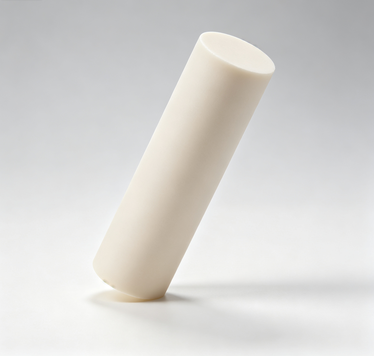
Classification and Key Characteristics of Boron Nitride Rod
1. Excellent Electrical Insulation
The primary advantage of Boron Nitride Rod in many industrial systems is its ability to provide electrical insulation without sacrificing high-temperature capability. High-purity BN generally exhibits electrical resistivity above 10¹³ Ω·cm, allowing rods to isolate conductive elements from surrounding structures or from one another. This makes BN particularly useful in high-temperature electrical assemblies where polymeric insulation would soften, decompose, or outgas. However, engineers should distinguish between bulk resistivity and actual insulation performance in service. Temperature, applied voltage, rod diameter, surface contamination, humidity, cracks, and conductive deposits can all influence leakage current and dielectric reliability. The rod geometry should therefore be designed with an appropriate insulation distance and sufficient margin for the actual operating environment.
2. High-Temperature Stability
Boron Nitride Rod can maintain useful structural and electrical properties at extremely high temperatures when used under suitable vacuum or inert-atmosphere conditions. This makes it valuable for furnace fixtures, high-temperature supports, electrical isolation structures, and thermal-processing components. However, the operating atmosphere is a fundamental design parameter because BN can oxidize when exposed to oxygen at elevated temperatures. Consequently, a material specification such as “2000°C” should not be interpreted as a universal continuous service temperature. Engineers should evaluate temperature, oxygen partial pressure, exposure duration, thermal cycling, and mechanical loading together when defining the practical operating limit of a BN rod.
3. Low Thermal Expansion
The low coefficient of thermal expansion of BN helps Boron Nitride Rod maintain dimensional stability during heating and cooling. This is especially useful when a rod is used to maintain a controlled gap, support a component, or position an electrical conductor inside a high-temperature assembly. Low expansion can reduce thermal stress between the BN rod and adjacent ceramic components, although the effect of metallic mating components must be considered separately because many metals expand substantially more than BN. If the rod is installed with a tight interference fit, differential thermal expansion can generate significant radial stress during heating. A controlled clearance or compliant mounting method is often more reliable than rigidly constraining the ceramic.
4. Thermal Conductivity and Heat Management
Although Boron Nitride Rod is an excellent electrical insulator, BN can also provide useful thermal conductivity, allowing heat to be transferred through the rod rather than being completely trapped around an electrically isolated component. This combination is valuable when an insulating support must simultaneously control the temperature of an electrode, sensor, conductor, or processing fixture. The actual heat-transfer behavior depends on rod diameter, length, crystal orientation, density, contact resistance, and temperature. Engineers should therefore calculate the thermal resistance of the complete rod assembly rather than assuming that the nominal bulk thermal conductivity directly represents system-level performance.
5. Chemical Stability and Low Wettability
High-purity BN demonstrates good chemical stability toward many materials and relatively low wettability toward numerous molten substances, giving Boron Nitride Rod advantages in selected high-temperature processing environments. This characteristic can reduce adhesion, material transfer, and chemical interaction at the rod surface. Such properties are useful when a ceramic support or guide must operate near molten or reactive process materials. Nevertheless, BN is not chemically inert under every condition. Oxidizing gases, reactive vapors, molten oxides, and certain process chemistries can affect BN at high temperature, so engineers should evaluate compatibility according to the actual medium, temperature, atmosphere, and exposure duration.
6. Precision Machinability and Customized Geometry
Compared with many conventional technical ceramics, Boron Nitride Rod offers favorable machinability, which enables the production of precise cylindrical components and customized geometries. Rods can be engineered with controlled diameters, lengths, stepped sections, grooves, holes, threads, chamfers, and other functional features where required. This is important because the mechanical behavior of a ceramic rod is strongly influenced by surface flaws and geometric stress concentration. Sharp shoulders, deep grooves, abrupt diameter transitions, and damaged edges can act as crack-initiation sites. For demanding applications, the machining process, dimensional tolerance, surface finish, and edge treatment should therefore be specified as part of the component design.
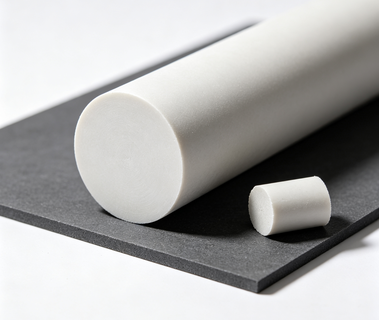
Typical Specifications of Boron Nitride Rod
The following values represent typical engineering ranges for high-purity BN rods. Actual specifications vary according to material grade, manufacturing process, density, crystal orientation, dimensions, and application requirements.
| Property | Typical Value |
|---|---|
| Material | Hexagonal Boron Nitride (h-BN) |
| BN Purity | ≥99% |
| Density | 1.8–2.2 g/cm³ |
| Electrical Resistivity | >10¹³ Ω·cm |
| Thermal Conductivity | 50–120 W/m·K* |
| Coefficient of Thermal Expansion | 1–2 × 10⁻⁶/K |
| Flexural Strength | 50–100 MPa |
| Compressive Strength | 100–300 MPa |
| Dielectric Constant | Approx. 3.5–4.5 |
| Maximum Temperature | Up to 2000°C+ in inert/vacuum conditions* |
| Diameter | Customized |
| Length | Customized |
| Surface Finish | Customized |
| Straightness | Customized |
| Chamfer / Edge Geometry | Customized |
| Color | White to light gray |
Actual performance depends on BN grade, density, orientation, atmosphere, temperature, and test method. For Boron Nitride Rod selection, dimensional accuracy is closely related to functional performance. Diameter determines the available electrical insulation distance and mechanical load-bearing area, while length affects bending stiffness and thermal-gradient behavior. A long, slender rod is more sensitive to bending and lateral vibration than a short, thick rod, even when both are manufactured from the same BN grade. Surface finish is also important because ceramic strength is controlled by defects and surface flaws; a deep machining mark can become a local stress concentrator under bending or thermal cycling. Engineers should therefore define diameter tolerance, straightness, surface condition, edge treatment, and mounting method together with the material properties.
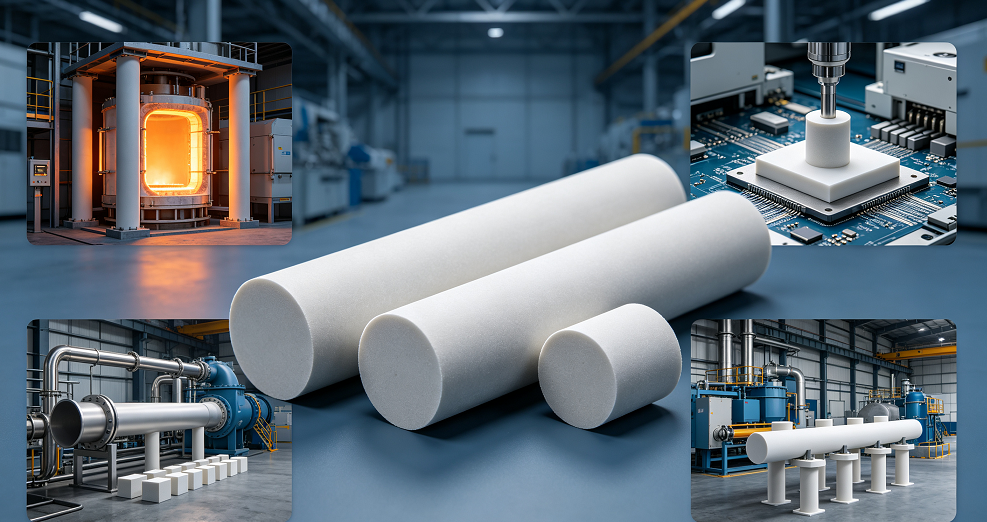
Applications of Boron Nitride Rod
1. High-Temperature Electrical Insulation
Boron Nitride Rod is widely used as an electrically insulating support or spacer around conductive components operating at elevated temperatures. It can separate electrodes, conductive rods, electrical terminals, heater-related components, or sensor elements from surrounding structures while maintaining dimensional stability during thermal cycling. The major engineering advantage is the combination of electrical insulation and high-temperature resistance without relying on organic materials. For reliable operation, engineers should calculate the required insulation distance, dielectric margin, surface leakage path, and temperature-dependent electrical resistance. The rod should also be protected from conductive process deposits because surface contamination can reduce effective insulation even when the BN material itself remains highly resistive.
2. High-Temperature Furnace Fixtures and Supports
In furnace systems, Boron Nitride Rod can function as a support, spacer, guide, positioning element, or electrically isolated structural component. BN's low thermal expansion and thermal-shock resistance help the rod tolerate repeated heating and cooling without the dimensional changes associated with many metallic support materials. Its low density can also reduce the thermal mass of the fixture compared with some dense ceramic alternatives. When designing furnace fixtures, engineers should consider the rod's unsupported length, bending load, thermal gradient, atmosphere, and connection method. The mounting arrangement should avoid excessive mechanical constraint because thermal expansion of surrounding components can transfer stress into the brittle ceramic.
3. Thermocouple and Sensor Assemblies
Boron Nitride Rod can be used as an insulating or structural element in selected thermocouple and high-temperature sensor assemblies. The rod can maintain separation between conductive sensing elements while remaining stable near high-temperature process zones. Its thermal conductivity can also influence how heat reaches the sensing element, which means the rod can affect response time and measurement characteristics. Engineers should therefore evaluate the rod diameter, length, thermal conductivity, and contact arrangement when designing temperature-sensing systems. Excessive thermal conduction through the support may produce measurement error if the support transfers heat toward cooler structural components.
4. High-Temperature Electrical Feedthroughs
In high-temperature electrical feedthrough assemblies, Boron Nitride Rod can serve as an insulating body around conductive pins or rods passing through a heated chamber or process zone. The ceramic creates physical separation between the conductor and the surrounding structure while maintaining stability under elevated temperatures. Feedthrough design requires careful attention to dielectric clearance, creepage distance, thermal expansion, mechanical retention, and electrical discharge behavior. A tight mechanical fit may appear desirable at room temperature but can generate excessive stress during heating when the conductor and BN expand at different rates. Controlled tolerances and appropriate retention methods are therefore essential.
5. Semiconductor and High-Purity Processing Equipment
High-purity Boron Nitride Rod is suitable for selected semiconductor and advanced-material processing equipment where electrical insulation, thermal stability, and contamination control are required simultaneously. BN provides an inorganic, electrically insulating structure that can withstand high temperatures under controlled atmospheres without introducing conventional polymeric insulation materials. For these applications, purity, particle generation, surface roughness, dimensional tolerance, and vacuum compatibility may be as important as mechanical strength. Engineers should also consider whether the rod will contact process gases, deposited films, molten materials, or other ceramics because surface interactions can change during prolonged high-temperature operation.
6. High-Temperature Mechanical Spacers and Guides
Boron Nitride Rod can function as a spacer, guide, alignment element, or standoff where low thermal expansion and electrical insulation are required. The low friction characteristics of h-BN can be beneficial in selected sliding or positioning applications, while the ceramic structure provides stability at temperatures beyond the useful range of many polymer components. However, engineers should carefully evaluate contact stress because BN is not intended to behave like a ductile metal shaft. Localized point contact, impact, excessive bending, and sharp mating edges can initiate cracks. Properly designed contact geometry and distributed loading are therefore essential for reliable operation.
7. Molten Material and Thermal Processing Components
Because of its low wettability toward many molten materials, Boron Nitride Rod can be used as a support, separator, guide, or protective component in selected high-temperature material-processing systems. Reduced wetting can limit material adhesion and make post-process removal easier, particularly where the BN surface contacts molten or semi-molten material. However, the actual behavior depends strongly on material composition and temperature. Engineers should evaluate wetting, chemical reaction, thermal expansion, erosion, and contamination simultaneously because a molten material that does not strongly adhere to BN may still chemically attack the surface under certain process conditions.
Engineering Considerations for Boron Nitride Rod Design
When designing a Boron Nitride Rod, engineers should first establish whether the component is primarily carrying compression, providing electrical insulation, transferring heat, positioning another component, or performing several of these functions simultaneously. The rod diameter should be selected according to both the required electrical insulation distance and mechanical stress, while unsupported length must be considered because slender rods are significantly more sensitive to bending and vibration. Thermal expansion is another critical factor, particularly when the BN rod is installed inside or against a metal structure; the difference between the expansion of BN and the mating material can generate substantial contact stress if clearance is insufficient. Surface quality should also be treated as a structural parameter because ceramic fracture frequently initiates at surface defects, machining marks, chips, or sharp edges subjected to tensile stress. In high-temperature systems, the temperature gradient across the rod can be more important than the average temperature, especially where one end is actively heated and the other is mechanically constrained. Atmosphere must also be specified because the practical temperature capability of BN decreases in oxidizing environments. For vacuum and high-purity applications, engineers should additionally control material purity, outgassing, particle generation, and surface contamination. A reliable Boron Nitride Rod is therefore designed around the complete thermal-electrical-mechanical system rather than selected solely by diameter and maximum temperature.
Company Profile
JianXun Advanced Ceramic Technology is a professional manufacturer specializing in high-performance ceramic products, including Boron Nitride Rod, boron nitride ceramics, alumina ceramics, silicon carbide ceramics, silicon nitride ceramics, aluminum nitride ceramics, mullite ceramics, quartz ceramics, and customized precision ceramic components. The company focuses on finished ceramic products with controlled material composition, density, mechanical properties, thermal performance, dimensional accuracy, surface quality, and customized geometries for demanding industrial applications.
Payment Terms: T/T, PayPal, Credit Card, Western Union, etc.
Shipment Terms: By air, by sea, by express, or according to customer request.
Storage Conditions: Store Boron Nitride Rod in a clean, dry environment away from moisture, impact, dust, oil, and conductive contamination. Rods should be properly supported along their length during storage to prevent bending, edge damage, and accidental impact.
FAQs About Boron Nitride Rod
1. What are the main advantages of Boron Nitride Rod over conventional ceramic rods?
Boron Nitride Rod combines electrical insulation, high-temperature stability, low thermal expansion, useful thermal conductivity, chemical stability, and comparatively favorable machinability. This combination makes it particularly attractive when a rod must simultaneously provide electrical isolation and dimensional stability in a high-temperature environment. Conventional oxide ceramics may provide higher hardness or mechanical strength, but BN offers advantages in thermal shock, non-wetting behavior, and machinability. The appropriate choice ultimately depends on whether the application prioritizes mechanical strength, thermal management, electrical insulation, chemical compatibility, or a combination of these properties.
2. Can Boron Nitride Rod be used as a structural support?
Yes, but the structural loading must be carefully defined. Boron Nitride Rod performs well under appropriate compressive loading but is more vulnerable to tensile stress, bending, impact, and stress concentrations than ductile metallic rods. For a long or slender rod, bending stress and buckling may become more important than the nominal compressive strength of the BN material. Engineers should therefore calculate the load based on rod diameter, unsupported length, mounting conditions, temperature, and safety factor rather than assuming that the material's compressive strength alone determines the allowable load.
3. What temperature can a Boron Nitride Rod withstand?
High-purity BN can withstand temperatures approaching or exceeding 2000°C under suitable vacuum or inert-atmosphere conditions, but the actual service temperature depends on the grade, atmosphere, exposure time, thermal gradient, and mechanical loading. In oxidizing environments, BN oxidation can substantially reduce the practical temperature limit. Therefore, a Boron Nitride Rod intended for continuous service should be rated according to the complete operating environment rather than a theoretical maximum temperature obtained under ideal laboratory conditions.
4. How should engineers design the clearance between a Boron Nitride Rod and a metal component?
Clearance should be determined from the thermal expansion of both the BN rod and the metal component over the complete operating temperature range. A room-temperature fit that appears precise may become an interference condition when the metal expands more rapidly than BN, generating radial pressure and potentially cracking the ceramic. Excessive clearance, however, can allow unwanted movement, vibration, or misalignment. Engineers should therefore calculate the minimum and maximum operating clearances and select a mounting method that accommodates differential expansion without sacrificing positional stability.
5. Can Boron Nitride Rod be customized according to application requirements?
Yes. Boron Nitride Rod can be manufactured with customized diameters, lengths, tolerances, surface finishes, chamfers, grooves, holes, stepped sections, and other geometries depending on the production process and application requirements. Customization is particularly valuable when the rod must fit a precision electrical, thermal, or mechanical assembly. Engineers should provide the complete dimensional drawing together with temperature, atmosphere, loading, electrical requirements, and surface-quality requirements because geometry and operating conditions determine whether a customized BN rod will provide reliable long-term performance.
6. Why is boron nitride preferred for electrical insulation in high-temperature environments?
Boron Nitride Rod is preferred because it combines high electrical resistivity with low dielectric loss, low thermal expansion, and stable insulating performance at elevated temperatures. Unlike many conventional electrical insulators, h-BN maintains its electrical insulation capability while also providing relatively high thermal conductivity, allowing heat generated near electrical components to be dissipated rather than concentrated locally. Its low coefficient of thermal expansion reduces dimensional changes and thermally induced stress during repeated heating and cooling cycles, which is particularly important for ceramic supports, sensor assemblies, furnace fixtures, and high-temperature electrical feedthroughs. However, the actual insulation performance depends on temperature, atmosphere, geometry, surface condition, and electrical field strength, so the Boron Nitride Rod should be specified according to the complete operating environment rather than temperature alone.
7. Why does the design of a boron nitride rod require careful consideration of diameter, wall thickness, and mounting conditions?
The mechanical behavior of Boron Nitride Rod is strongly influenced by geometry because boron nitride is a brittle ceramic with excellent compression resistance but limited tolerance to tensile stress, impact, and concentrated loading. A rod with an excessive length-to-diameter ratio may experience bending or deflection, while sharp edges, undersized mounting clearances, or rigid metal fixtures can introduce localized tensile stress when the assembly undergoes thermal expansion. Differential thermal expansion between the BN rod and surrounding metal or ceramic components can further increase stress during thermal cycling. Therefore, diameter, unsupported length, end geometry, surface finish, clearance, fastening method, and thermal expansion mismatch should all be considered during Boron Nitride Rod design to reduce cracking and ensure stable long-term performance.