Advanced Technical Ceramics, Precision Alumina, Silicon Carbide, Crucible Parts



Wrapping Paper

Overview
Boron Nitride Wrapping Paper is a flexible, high-purity ceramic paper primarily manufactured from hexagonal boron nitride (h-BN), engineered to provide thermal protection, electrical insulation, surface separation, and low-adhesion performance in demanding high-temperature environments. Unlike rigid boron nitride components, BN wrapping paper can conform to cylindrical, curved, or irregular surfaces and can be cut, wrapped, folded, or formed according to the geometry of the assembly. Its combination of high electrical resistivity, low coefficient of thermal expansion, chemical stability, low wettability, and resistance to elevated temperatures makes Boron Nitride Wrapping Paper suitable for protecting sensitive ceramic surfaces, insulating high-temperature components, separating contacting materials, and reducing adhesion during thermal processing. The flexible paper structure also enables engineers to establish localized thermal barriers or protective interfaces without significantly increasing the overall weight and dimensions of the assembly. When properly selected, it can accommodate thermal cycling and maintain a relatively stable interface between components with different thermal expansion characteristics, helping to reduce direct contact, surface damage, and unwanted material transfer. In high-temperature processing, the low wettability of h-BN can further reduce the tendency of molten or softened materials to adhere to the protected surface, making the paper useful as a release and separation layer. The actual performance of the material depends on BN purity, paper density, thickness, structural integrity, compression, bending radius, operating atmosphere, heating rate, exposure temperature, and contact conditions. Therefore, engineers should select Boron Nitride Wrapping Paper according to the complete thermal-mechanical and chemical environment rather than relying solely on its nominal maximum temperature.
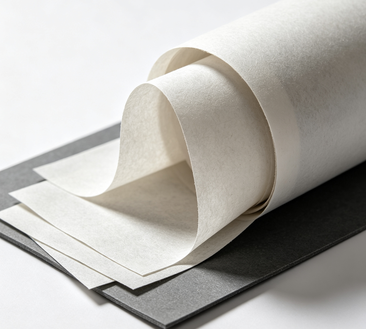
Classification and Key Characteristics of Boron Nitride Wrapping Paper
1. Flexible High-Temperature Ceramic Structure
The main advantage of Boron Nitride Wrapping Paper over conventional rigid BN ceramics is its flexible and lightweight structure. The paper can be cut into strips, sheets, rings, or customized profiles and wrapped around components that cannot easily be protected with machined ceramic parts. This flexibility simplifies installation in confined assemblies and allows engineers to create localized thermal or electrical barriers without significantly increasing component dimensions.
2. High Electrical Resistivity
Hexagonal boron nitride is an electrically insulating ceramic with high electrical resistivity, making Boron Nitride Wrapping Paper suitable for insulating conductive components exposed to elevated temperatures. The paper can be wrapped around electrical supports, heating-related components, sensor structures, or conductive interfaces to reduce unwanted electrical contact. Insulation performance depends on paper thickness, temperature, surface contamination, mechanical compression, and the actual electrical field, so these parameters should be evaluated during component design.
3. Low Thermal Expansion
The low coefficient of thermal expansion of h-BN helps Boron Nitride Wrapping Paper maintain relatively stable dimensions during heating and cooling. This is particularly useful when the paper is wrapped around ceramic or metal components that experience repeated temperature changes. A low-expansion material can reduce excessive dimensional mismatch at the interface, although the flexibility and compressibility of the paper structure must also be considered when calculating the actual behavior of a wrapped assembly.
4. High-Temperature Stability
High-purity BN exhibits excellent thermal stability under suitable inert or vacuum conditions, allowing Boron Nitride Wrapping Paper to operate in high-temperature processing environments where conventional organic insulation or polymer films would rapidly degrade. The practical service temperature is nevertheless influenced by atmosphere, heating rate, exposure time, density, impurities, and mechanical loading. In particular, prolonged exposure to oxidizing conditions at elevated temperatures can cause BN oxidation, so the operating atmosphere must be considered when establishing a realistic service limit.
5. Low Wettability and Non-Sticking Surface
The low surface wettability of h-BN toward many molten and processed materials gives Boron Nitride Wrapping Paper useful release and separation characteristics. When wrapped around a component or placed between materials, the BN surface can reduce adhesion and make post-process removal easier. This characteristic is valuable in thermal processing where sticking between a workpiece and fixture could damage the surface or complicate unloading. The degree of non-wetting behavior varies with material composition, temperature, atmosphere, surface roughness, and contact pressure.
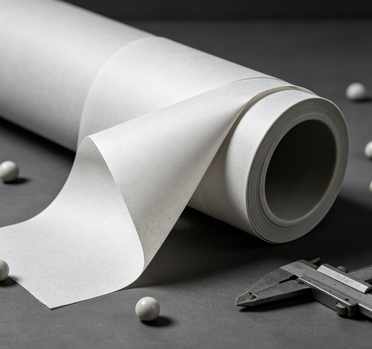
Typical Specifications of Boron Nitride Wrapping Paper
The following values represent typical engineering ranges for high-purity BN wrapping paper. Actual specifications can vary according to paper density, manufacturing process, thickness, and application.
| Property | Typical Specification |
|---|---|
| Material | Hexagonal Boron Nitride (h-BN) |
| BN Purity | ≥99% |
| Density | Approx. 1.8–2.2 g/cm³ |
| Thermal Conductivity | Approx. 30–70 W/m·K |
| Electrical Resistivity | >10¹³ Ω·cm |
| Coefficient of Thermal Expansion | Approx. 1–2 × 10⁻⁶/K |
| Flexural Strength | Approx. 50–100 MPa* |
| Dielectric Constant | Approx. 3.5–4.5 |
| Maximum Temperature | Up to approximately 2000°C under suitable inert/vacuum conditions |
| Thickness | Customized |
| Width | Customized |
| Length | Customized |
| Surface | Smooth white to light gray |
| Form | Roll, sheet, strip, customized wrapping profile |
Mechanical performance depends strongly on paper density, thickness, structure, orientation, and test method. For Boron Nitride Wrapping Paper, thickness should be selected according to the required insulation level, thermal resistance, flexibility, and mechanical handling strength. Thin paper is easier to wrap around small-radius components and creates minimal dimensional interference, but it may provide lower mechanical durability and electrical insulation distance. Thicker paper can improve protection and insulation but may require a larger bending radius and create greater overlap or installation clearance. Engineers should also consider whether the wrapping will be applied with overlap, direct contact, adhesive-free fastening, or mechanical retention because these installation methods can significantly influence thermal contact and long-term stability.
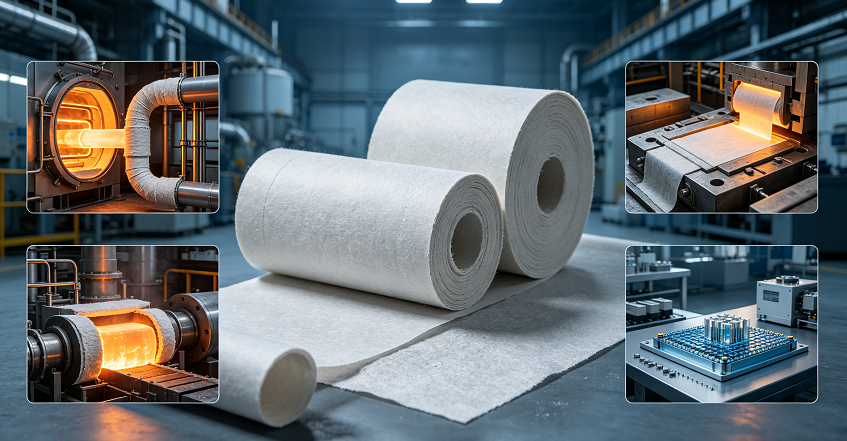
Applications of Boron Nitride Wrapping Paper
1. High-Temperature Electrical Insulation
A major application of Boron Nitride Wrapping Paper is electrical insulation around conductive components operating in elevated-temperature environments. The flexible ceramic structure allows the material to be wrapped around wires, conductive supports, electrodes, sensor components, or other geometries where rigid insulation is difficult to install. Its high electrical resistivity helps prevent unintended current paths while its thermal stability allows it to remain functional under suitable high-temperature conditions. Engineers should determine the required thickness based on voltage, temperature, clearance, surface condition, and dielectric requirements rather than selecting thickness only according to mechanical dimensions.
2. Protection of Ceramic and Graphite Components
Boron Nitride Wrapping Paper can be wrapped around ceramic, graphite, or other high-temperature components to create a protective interface between the component and its surroundings. The BN layer can reduce direct mechanical contact, minimize surface contamination, and provide a low-wettability surface during thermal processing. This is especially useful when the protected component has a sensitive surface that could be scratched, contaminated, or bonded to a fixture during heating. The wrapping method, overlap region, applied pressure, and thermal expansion of the underlying component should be considered to prevent displacement or localized stress.
3. High-Temperature Furnace Components
In furnace assemblies, Boron Nitride Wrapping Paper can be used as a flexible insulating and separation layer around selected supports, fixtures, and process components. Its low thermal expansion and electrical insulation characteristics make it useful when components must remain electrically isolated while being exposed to elevated temperatures. The paper can also act as a sacrificial or replaceable protective interface in areas where repeated contact could otherwise damage rigid ceramic surfaces. Furnace atmosphere, heating rate, mechanical retention, and exposure duration should be evaluated because these factors determine the practical service life of the wrapping paper.
4. Ceramic Sintering and Thermal Treatment
During ceramic sintering and thermal treatment, Boron Nitride Wrapping Paper can provide a controlled separation layer between the processed component and furnace fixtures. Its low wettability can reduce adhesion, while its flexible structure allows it to follow curved or irregular component surfaces. This can help simplify unloading and reduce surface damage caused by direct contact with rigid fixtures. For repeated processing cycles, engineers should evaluate whether the paper experiences compression, tearing, shrinkage, surface degradation, or contamination and determine an appropriate replacement interval.
5. High-Temperature Release and Separation
The low wettability of h-BN makes Boron Nitride Wrapping Paper useful as a release layer where processed materials tend to adhere to surrounding fixtures at high temperature. The wrapping format allows the release surface to be placed only around the area requiring protection, reducing unnecessary material coverage. After thermal treatment, the low-adhesion BN surface can facilitate separation and reduce the mechanical force required for component removal. Release performance depends on the specific processed material and should be evaluated against temperature, atmosphere, pressure, surface roughness, and exposure duration.
6. Semiconductor and High-Purity Processing
High-purity Boron Nitride Wrapping Paper can be considered for selected semiconductor and high-purity thermal-processing environments where electrical insulation and contamination control are important. It can provide localized protection around process fixtures, supports, and components without introducing organic binders or polymeric insulation into the high-temperature region, depending on the specific product formulation. For sensitive processes, engineers should verify BN purity, residual impurities, surface cleanliness, particle generation, and outgassing behavior. The wrapping material should also be handled carefully to prevent fibers, particles, or installation debris from entering the process chamber.
7. Crystal Growth Equipment
BN is widely valued in specialized high-temperature crystal-growth environments because of its thermal stability, chemical characteristics, electrical insulation, and low wettability. Boron Nitride Wrapping Paper can be used as a localized protective or separation layer around selected fixtures, supports, or process interfaces where a flexible material is more practical than a machined BN component. Its low contamination potential can be advantageous for high-purity processing, but the material grade, surface cleanliness, and compatibility with the crystal-growth chemistry must be carefully controlled.
8. Thermal Isolation Between Components
Boron Nitride Wrapping Paper can introduce a controlled thermal interface between adjacent components when direct heat transfer needs to be reduced or redirected. The paper's density and thickness can be selected to modify the thermal resistance of the interface while maintaining a compact assembly. This can be useful around temperature-sensitive components, high-temperature supports, sensor assemblies, and thermal-processing fixtures. The actual thermal resistance depends on compression, contact area, paper structure, temperature, and interface conditions, so engineers should characterize the installed configuration rather than relying solely on nominal bulk thermal conductivity.
9. Protective Wrapping for High-Temperature Sensors
The flexible geometry of Boron Nitride Wrapping Paper allows it to protect selected sensor components, supports, and electrical interfaces exposed to high-temperature conditions. The BN layer can provide electrical insulation while reducing direct contact between the sensor assembly and surrounding materials. Its chemical stability and low wettability can also help protect the sensor from selected process materials. When used around precision sensors, however, engineers must balance protection with thermal response because excessive thickness can slow heat transfer and influence the sensor's temperature measurement characteristics.
Engineering Considerations for Boron Nitride Wrapping Paper
The engineering design of Boron Nitride Wrapping Paper should account for both the intrinsic properties of h-BN and the mechanical behavior introduced by the paper structure and wrapping configuration. Thickness, density, bending radius, overlap length, compression, fastening method, and contact pressure all influence the final performance of the wrapped assembly. Excessive bending around a small-radius component can damage the paper structure, while excessive clamping can compress the material and change the designed insulation or thermal resistance. When the wrapping is installed around a metal component, the difference in thermal expansion should be considered because radial expansion can generate compression or cause the paper to shift during heating. For electrical insulation, engineers should evaluate voltage, dielectric requirements, surface contamination, creepage distance, and temperature-dependent electrical behavior. For release and protective applications, chemical compatibility and wettability should be assessed against the actual processed material. The operating atmosphere is equally important because BN performs particularly well under suitable inert or vacuum conditions but can oxidize during prolonged exposure to elevated-temperature oxidizing environments.
Company Profile
JianXun Advanced Ceramic Technology is a professional manufacturer specializing in high-performance ceramic products, including Boron Nitride Wrapping Paper, alumina ceramics, boron nitride ceramics, silicon carbide ceramics, silicon nitride ceramics, aluminum nitride ceramics, mullite ceramics, quartz ceramics, and customized precision ceramic components. The company focuses on finished ceramic products with controlled material composition, density, mechanical properties, thermal performance, dimensional accuracy, surface quality, and customized geometries for demanding industrial applications.
Payment Terms: T/T, PayPal, Credit Card, Western Union, etc.
Shipment Terms: By air, by sea, by express, or according to customer request.
Storage Conditions: Store Boron Nitride Wrapping Paper in a clean, dry, dust-free environment and protect it from moisture, bending, compression, and mechanical impact. Keep rolls or sheets properly packaged and avoid excessive stacking pressure to preserve the original structure and dimensions.
FAQs About Boron Nitride Wrapping Paper
1. Why is boron nitride suitable for wrapping components exposed to high temperatures?
A: Boron Nitride Wrapping Paper combines the high-temperature stability, electrical insulation, low thermal expansion, chemical stability, and low wettability of h-BN with a flexible paper-like structure. This allows it to conform to cylindrical and irregular components while providing protection and separation that would be difficult to achieve with rigid ceramic parts. The BN surface can also reduce adhesion to many processed materials, which is valuable in thermal treatment and high-temperature release applications. Its actual performance depends on paper density, thickness, atmosphere, temperature, mechanical loading, and the specific material being processed.
2. Why is flexible boron nitride paper preferable to a rigid ceramic component in some applications?
A: The flexibility of Boron Nitride Wrapping Paper allows engineers to protect curved, elongated, or geometrically complex components without designing a dedicated machined ceramic enclosure. The material can be cut to length, wrapped around the target surface, and adapted to confined installation spaces while adding relatively little mass. This also makes replacement and maintenance simpler in applications where the protective layer is periodically consumed or damaged. However, flexible BN paper is not mechanically equivalent to dense BN ceramics, so applications involving high structural loads or severe abrasion may require a rigid ceramic component instead.
3. How does the wrapping method affect the performance of boron nitride wrapping paper?
A: The installation configuration can significantly influence the performance of Boron Nitride Wrapping Paper because overlap, compression, bending radius, contact pressure, and mechanical retention determine the final thermal and electrical properties of the assembly. An excessive overlap can create a locally thicker region with different heat-transfer characteristics, while insufficient overlap may expose the protected component during thermal cycling. Excessive tension or clamping can damage the paper structure, whereas insufficient retention may allow the material to move or wrinkle. For precision applications, the wrapping procedure should therefore be treated as part of the component design rather than as a simple installation step.
4. What thickness of boron nitride wrapping paper should be selected for high-temperature insulation?
A: The appropriate thickness of Boron Nitride Wrapping Paper depends on the required electrical insulation, thermal isolation, flexibility, mechanical durability, and available installation clearance. Thin grades are generally easier to wrap around small-radius components and minimize dimensional interference, while thicker grades can provide greater separation and physical protection. However, increasing thickness can reduce flexibility and increase the bending radius required for installation. Engineers should therefore determine thickness based on the complete electrical and thermal requirements, including operating voltage, temperature, contact conditions, and expected thermal cycling.
5. Can boron nitride wrapping paper be used repeatedly in high-temperature processing?
A: Boron Nitride Wrapping Paper may be reusable in certain controlled applications, but its service life depends on temperature, atmosphere, handling, compression, contamination, thermal cycling, and the severity of the process environment. Repeated bending, installation, and removal can gradually damage the paper structure even when the BN itself remains chemically stable. Exposure to aggressive or oxidizing environments can also shorten service life. For critical applications, engineers should inspect the material for cracking, thinning, deformation, contamination, and loss of structural integrity before each reuse cycle and establish a replacement interval based on actual process conditions.