Advanced Technical Ceramics, Precision Alumina, Silicon Carbide, Crucible Parts



Ring

Overview
Alumina Ring is a precision ceramic component manufactured from aluminum oxide (Al₂O₃) and engineered for applications requiring high hardness, compressive strength, electrical insulation, chemical resistance, and dimensional stability. Compared with conventional metallic rings, alumina ceramic rings can maintain their hardness and structural integrity under elevated temperatures while offering excellent resistance to wear and many corrosive environments.
From an engineering perspective, an Alumina Ring is more than a simple annular ceramic part. Its performance depends on the relationship between material purity, density, grain structure, geometry, surface finish, dimensional tolerance, thermal expansion, and the loads imposed during operation. The inner diameter, outer diameter, wall thickness, flatness, concentricity, and surface roughness can all influence whether the ring performs reliably in a precision assembly.
High-performance alumina is particularly attractive where a component must combine mechanical rigidity with electrical insulation. With typical hardness around HV 1500–1700 and compressive strength around 2000 MPa, alumina rings can provide strong resistance to deformation and surface wear. Their coefficient of thermal expansion is also relatively low, helping maintain dimensional stability as operating temperature changes.

Classification and Key Characteristics of Alumina Ring
1. High-Purity Alumina and Controlled Ceramic Microstructure
The fundamental performance of an Alumina Ring is determined by its Al₂O₃ content and resulting microstructure. High-purity alumina grades are selected when the application requires excellent electrical insulation, chemical stability, wear resistance, and high-temperature performance. During sintering, alumina particles develop a dense crystalline structure. Controlling grain growth and residual porosity is important because excessive pores can reduce mechanical strength and create localized stress concentrations. For precision rings, a dense and uniform microstructure also helps achieve consistent machining and dimensional stability. Different alumina grades can therefore produce significantly different performance even when their nominal composition appears similar. Engineers should evaluate density, hardness, flexural strength, porosity, thermal properties, and electrical characteristics together when selecting the material.
2. High Hardness and Excellent Wear Resistance
One of the defining properties of an Alumina Ring is its high hardness. Typical high-performance alumina can reach approximately HV 1500–1700, making it considerably harder than many conventional engineering metals and providing strong resistance to scratching, abrasion, and surface deformation. This characteristic is particularly valuable for rings exposed to repeated contact, sliding, particle contamination, or dimensional requirements. However, hardness alone does not determine wear life. The surface roughness of the ring, mating material, contact pressure, lubrication condition, particle size, and alignment all influence the actual tribological behavior. For precision applications, grinding and polishing can be used to control the working surface. A carefully finished alumina ring can provide much more stable contact behavior than an as-fired component with relatively high surface roughness.
3. High Compressive Strength and Structural Rigidity
Alumina has excellent compressive strength, with high-quality ceramic grades capable of reaching approximately 2000 MPa or more. This makes an Alumina Ring suitable for assemblies in which the component must withstand high compressive loading without significant permanent deformation. The annular geometry also requires careful consideration of stress concentration. Sharp internal corners, thin sections, uneven clamping forces, and localized loading can create tensile stresses that are much more critical to ceramics than compressive stresses. Proper radius design and uniform loading are therefore essential. For this reason, engineers should avoid evaluating alumina rings using compressive strength alone. The actual design should consider the complete stress distribution, especially around the inner diameter, outer diameter, grooves, chamfers, and transition regions.
4. Excellent Electrical Insulation
Dense alumina is widely used as an electrical insulating ceramic because of its high electrical resistivity and stable dielectric behavior. An Alumina Ring can therefore provide mechanical support or separation while simultaneously preventing unwanted electrical conduction between adjacent components. This combination is particularly useful in electrical assemblies, electronic equipment, high-temperature fixtures, and precision insulating structures. Higher-purity alumina generally provides excellent insulation, although surface contamination, moisture, temperature, and the surrounding environment can influence actual insulation performance. When the ring is used as an electrical insulator, engineers should specify not only bulk resistivity but also surface condition, creepage distance, dimensional accuracy, dielectric requirements, and operating temperature.
5. Thermal Stability and Controlled Thermal Expansion
Alumina maintains its structural properties at temperatures far above the service range of most polymeric components and many conventional engineering materials. Its coefficient of thermal expansion is typically around 7.6 × 10⁻⁶/K, allowing engineers to predict dimensional changes as temperature varies. This relatively controlled thermal expansion is valuable for precision rings installed between components with different thermal expansion coefficients. However, thermal compatibility must be evaluated for the entire assembly. If the mating material expands substantially more than alumina, thermal stress can develop at the interface. Thermal shock should also be considered separately. High-temperature stability does not mean unlimited resistance to rapid temperature changes. Large temperature gradients across a ceramic ring can generate internal stresses, particularly when the ring has a large diameter, thin wall, or significant difference in temperature between its inner and outer surfaces.

Typical Specifications of Alumina Ring
The following values represent typical specifications for high-performance alumina ceramic rings. Actual values can be customized according to alumina purity, manufacturing process, geometry, surface finish, and application requirements.
| Property | Typical Specification |
|---|---|
| Product | Alumina Ring |
| Material | Aluminum Oxide (Al₂O₃) |
| Alumina Purity | 95–99.99% |
| Density | 3.6–3.9 g/cm³ |
| Hardness | HV 1500–1700 |
| Compressive Strength | ≥2000 MPa |
| Flexural Strength | Approximately 300–450 MPa |
| Thermal Conductivity | Approximately 20–35 W/m·K |
| Coefficient of Thermal Expansion | 7.6 × 10⁻⁶/K |
| Electrical Resistivity | Typically >10¹² Ω·cm |
| Water Absorption | Near zero for dense grades |
| Maximum Working Temperature | Up to approximately 1600–1800°C depending on grade and atmosphere |
| Surface Finish | As-fired, ground, or polished |
| Dimensional Tolerance | Customized |
| Geometry | Standard or customized annular designs |
For an Alumina Ring, geometry can be as important as material selection. A ring with a large outer diameter and relatively thin wall may respond differently to thermal and mechanical loading than a compact, thick-walled ring made from the same ceramic grade. Dimensional accuracy should therefore be specified according to the actual assembly requirements. Important parameters may include inner diameter, outer diameter, thickness, concentricity, roundness, flatness, parallelism, and surface roughness. Where the ring functions as a sealing, spacing, insulating, or positioning element, these parameters can directly affect system performance. Surface finish should also be selected according to the contact mechanism. Ground surfaces can provide good dimensional control for general mechanical applications, while polished surfaces may be preferable where low surface roughness and controlled contact are required.
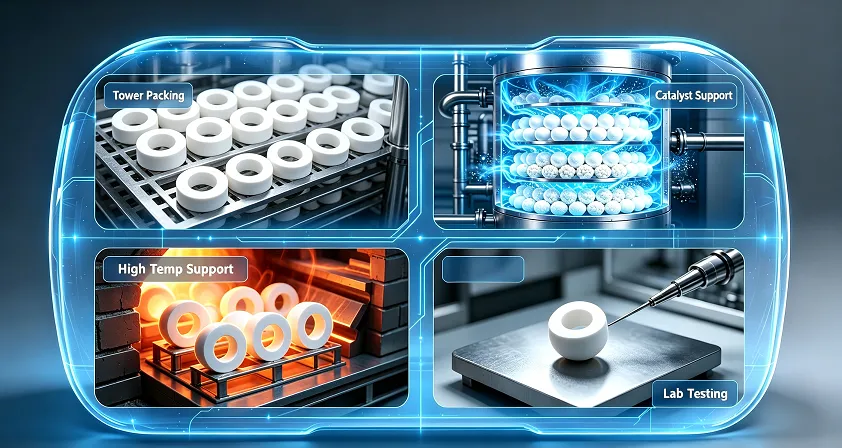
Applications of Alumina Ring
1. Electrical Insulation and High-Voltage Assemblies
An Alumina Ring can serve as an insulating spacer, support, or separation component in electrical equipment where mechanical strength and electrical isolation are required simultaneously. Unlike polymer insulation, alumina can maintain its rigidity and insulating properties under elevated temperatures. Its high resistivity and low moisture absorption make dense alumina particularly useful for precision electrical structures, provided that the surface remains clean and the electrical design accounts for temperature and contamination.
2. Semiconductor and Electronic Equipment
Precision alumina rings are used in various semiconductor and electronic processing assemblies where dimensional stability, cleanliness, electrical insulation, and thermal resistance are important. The ceramic can act as a structural or insulating interface between components while tolerating elevated temperatures. For demanding semiconductor-related applications, engineers may additionally specify high-purity alumina, controlled surface roughness, low particle generation, tight dimensional tolerances, and carefully controlled machining processes.
3. Wear-Resistant Mechanical Assemblies
The high hardness of an Alumina Ring makes it suitable for selected mechanical assemblies where conventional metal rings may experience excessive wear, scratching, or dimensional degradation. The design must account for contact stress and alignment because ceramics perform best when the applied load is well distributed. If the ring is subjected to sliding contact, the mating material and surface finish should be evaluated together rather than selecting the ceramic solely according to its hardness.
4. High-Temperature Furnace and Thermal Processing Equipment
Alumina rings can be used as insulating, supporting, positioning, or separating components in high-temperature equipment. Their high-temperature stability allows them to retain their shape and mechanical function under conditions where polymeric or low-temperature ceramic materials would fail. In thermal systems, engineers should calculate the dimensional change caused by temperature and examine the thermal expansion of adjacent materials. This is particularly important for tightly fitted rings because differential thermal expansion can create excessive radial or axial stress.
5. Chemical and Corrosion-Resistant Equipment
Dense alumina provides strong resistance to many chemical environments and can be used for ring-shaped components exposed to corrosive gases, liquids, or process residues. Chemical compatibility still depends on the exact medium and operating conditions. Temperature, concentration, exposure time, impurities, and pressure can all influence degradation. For this reason, material qualification should be based on the actual chemical environment rather than assuming that alumina is resistant to every chemical.
Engineering Considerations for Alumina Ring Design
The first design parameter is the load path. If the ring is primarily compressed axially, alumina's high compressive strength can be effectively utilized. If the ring experiences bending, impact, uneven clamping, or tensile loading, the design becomes more demanding because ceramic fracture is strongly influenced by local tensile stress and surface defects. The second consideration is the relationship between wall thickness and diameter. Thin ceramic sections are more sensitive to machining damage, handling forces, and thermal gradients. Sharp corners should generally be avoided, and suitable chamfers or radii can reduce stress concentrations around the inner and outer edges. The third consideration is thermal expansion. When an Alumina Ring is installed between metallic components, engineers should calculate the dimensional changes of both the ceramic and metal across the entire operating temperature range. A clearance that is appropriate at room temperature may become excessive or insufficient during operation. Finally, surface quality must be matched to the application. Grinding can provide precise dimensional control, while polishing can produce a smoother functional surface. However, excessive machining or inappropriate grinding conditions can introduce surface defects that reduce the effective strength of the ceramic component.
Company Profile
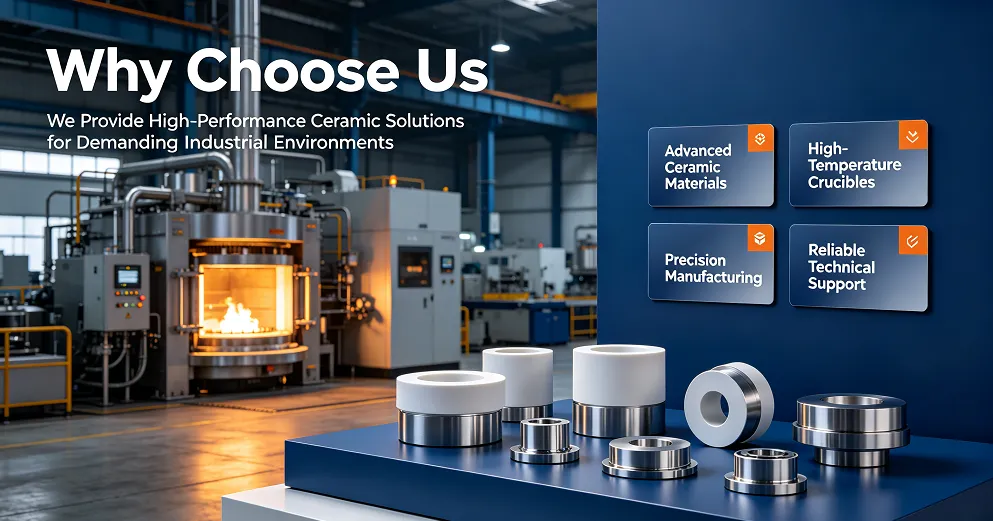
JianXun Advanced Ceramic Technology is a professional manufacturer specializing in high-performance ceramic products, including Alumina Ring, alumina tubes, alumina discs, alumina plungers, refractory bricks, boron nitride ceramics, silicon carbide ceramics, silicon nitride ceramics, aluminum nitride ceramics, mullite ceramics, quartz ceramics, and customized precision ceramic components. The company focuses on finished ceramic products with controlled material composition, density, mechanical properties, thermal performance, dimensional accuracy, and customized geometries for demanding industrial applications.
Payment Terms: T/T, PayPal, Credit Card, Western Union, etc.
Shipment Terms: By air, by sea, by express, or according to customer request.
Storage Conditions: Store Alumina Ring components in a clean, dry, dust-free environment. Keep precision-machined surfaces protected from impact, moisture, and hard particles. During storage and transportation, use suitable cushioning and individual separation where necessary to prevent edge chipping or surface damage.
FAQs About Alumina Ring
1. Why is alumina a good material for precision ceramic rings?
Alumina provides a combination of properties that is difficult to obtain from conventional materials in a single component. Its high hardness provides strong resistance to abrasive wear, while its high compressive strength allows it to withstand substantial compressive loading without permanent deformation. At the same time, dense alumina provides excellent electrical insulation, chemical stability, and high-temperature resistance. These characteristics make an Alumina Ring suitable for applications where the component must maintain both mechanical and electrical performance under demanding conditions. However, the ring must be designed according to the actual stress state because alumina is brittle and significantly less tolerant of impact or tensile stress than ductile metals.
2. How should the dimensions of an Alumina Ring be specified for a precision assembly?
The dimensional specification should reflect the actual mechanical function of the ring rather than relying only on nominal inner and outer diameters. Engineers may need to control inner diameter, outer diameter, thickness, roundness, concentricity, flatness, parallelism, and surface roughness. For a sliding or positioning application, diameter tolerance and clearance are particularly important. For an insulating or spacing application, thickness tolerance and parallelism may have greater influence on assembly accuracy. If the ring operates at high temperature, thermal expansion must also be incorporated into the dimensional calculation. Providing the complete mating-component geometry and operating temperature range allows the ceramic manufacturer to recommend an appropriate tolerance and machining process.
3. What causes an Alumina Ring to crack during installation?
Installation-related cracking is often caused by concentrated mechanical stress rather than insufficient nominal material strength. Uneven clamping, excessive interference fit, impact from metallic tools, sharp mating edges, or contamination trapped between contact surfaces can create localized tensile stresses in the ceramic. The inner and outer edges are particularly sensitive because geometric discontinuities can amplify local stress. Thermal installation procedures can also create problems if the ceramic and mating component have significantly different thermal expansion coefficients. To reduce the risk of failure, engineers should use controlled assembly forces, avoid point loading, provide appropriate edge geometry, and calculate interference or clearance based on both room-temperature and operating-temperature dimensions.
4. How does temperature affect the performance of an Alumina Ring?
Temperature affects an Alumina Ring primarily through thermal expansion, mechanical property changes, electrical behavior, and thermal gradients. Alumina maintains excellent structural stability at elevated temperatures, but its dimensions still change according to its coefficient of thermal expansion. If the ring is constrained by another material, differential expansion can generate significant interface stress. Rapid temperature changes can be even more critical because the inner and outer regions may reach different temperatures, creating thermal gradients and transient stresses. Engineers should therefore distinguish between continuous high-temperature service and thermal-shock conditions. The actual temperature rating should be evaluated together with atmosphere, heating rate, cooling rate, geometry, and mechanical constraints.
5. Can an Alumina Ring be customized for tight tolerances and complex geometries?
Yes. Alumina rings can be manufactured with customized inner and outer diameters, thicknesses, grooves, holes, chamfers, radii, stepped profiles, and other application-specific geometries. Because alumina is extremely hard after sintering, final precision machining commonly requires diamond-based grinding or other specialized ceramic-processing techniques. The achievable tolerance depends on the geometry, dimensions, ceramic grade, machining process, and production volume. Engineers should provide detailed drawings that specify critical dimensions, geometric tolerances, surface roughness, and functional contact surfaces. For complex components, it is also useful to identify which dimensions are functionally critical so that the manufacturing process can prioritize the most important characteristics.