Advanced Technical Ceramics, Precision Alumina, Silicon Carbide, Crucible Parts



Quartz Ceramic
Overview
Quartz Ceramic is an advanced ceramic material primarily based on high-purity silicon dioxide (SiO₂), engineered for applications requiring excellent thermal stability, chemical resistance, electrical insulation, and controlled behavior under high-temperature conditions. Unlike conventional glass, quartz ceramic components are manufactured and processed to achieve specific dimensional, thermal, and purity requirements, making them suitable for demanding industrial and laboratory environments.
From an engineering perspective, the value of Quartz Ceramic comes from the combination of high-purity silica chemistry and its characteristic low thermal expansion. This low expansion behavior allows quartz-based components to tolerate rapid temperature changes with significantly lower thermal stress than many conventional ceramic materials. For processes involving repeated heating and cooling, this characteristic can be more important than simply selecting a material with the highest possible maximum service temperature.
The performance of quartz ceramic is strongly related to its SiO₂ purity, hydroxyl content, microstructure, manufacturing method, surface condition, and component geometry. Trace metallic impurities can become particularly important in semiconductor and high-purity processing because they may diffuse into processed materials or affect surface contamination levels. Therefore, quartz ceramic selection should consider not only thermal performance but also chemical purity and the requirements of the process environment.
Quartz-based ceramic components are commonly used in semiconductor manufacturing, photovoltaic processing, laboratory equipment, high-temperature furnaces, chemical processing, and optical or analytical systems. Typical products include quartz crucibles, tubes, boats, plates, rings, liners, holders, and customized furnace components. The appropriate product geometry and material grade should be determined according to operating temperature, atmosphere, thermal cycling, mechanical loading, and contamination requirements.

Classification and Key Characteristics of Quartz Ceramic
Quartz ceramic products can be classified according to purity, manufacturing process, structural form, and application requirements. In industrial practice, high-purity fused silica is particularly important because it provides a combination of low thermal expansion, excellent optical and electrical properties, and good resistance to many chemical environments.
1. High-Purity Quartz Ceramic
High-purity quartz ceramic is designed for applications where contamination control is a major engineering requirement. The SiO₂ content can be controlled to very high levels, while metallic impurities such as Fe, Na, K, Ca, and Al are minimized. This characteristic is particularly important in semiconductor and photovoltaic processing. Even small concentrations of unwanted elements can become process contaminants at elevated temperatures, particularly when the ceramic component is exposed to silicon, silicon compounds, or other high-purity materials. For these applications, engineers typically evaluate not only SiO₂ purity but also trace-element concentration, surface cleanliness, hydroxyl content, and process history. A nominally high-purity material may still be unsuitable if its surface has been contaminated during machining, cleaning, packaging, or previous thermal exposure.
2. Fused Quartz Ceramic
Fused quartz is produced by melting high-purity silica and forming it into a dense, homogeneous material. The resulting structure has very low thermal expansion and excellent resistance to thermal shock. This makes fused quartz particularly useful for components exposed to rapid temperature changes. A quartz tube, for example, may experience substantial temperature gradients between its heated and unheated sections during furnace operation. Its low coefficient of thermal expansion helps reduce the stresses generated by these gradients. Fused quartz also provides excellent electrical insulation and maintains useful dielectric properties over a broad temperature range, which makes it suitable for electrical and semiconductor processing equipment.
3. Transparent and Opaque Quartz Ceramic
Quartz materials can also be distinguished according to optical appearance and internal structure. Transparent fused quartz is manufactured with a low concentration of scattering defects and is commonly used where optical transmission is required. Opaque quartz contains controlled microstructural features that increase infrared absorption and reduce optical transmission. For industrial furnace applications, opaque quartz may provide advantages in thermal radiation management, while transparent quartz is often preferred for processes requiring visual observation, optical measurement, or UV transmission. The selection between transparent and opaque grades should therefore be based on actual process requirements rather than appearance alone.
4. Quartz Ceramic for Thermal Processing
Quartz ceramic used in thermal processing is engineered primarily around thermal shock resistance, dimensional stability, chemical compatibility, and contamination control. Typical components include furnace tubes, boats, crucibles, liners, carriers, and support structures. In these applications, component geometry is as important as material composition because sharp corners, sudden changes in wall thickness, and local stress concentrations can increase the probability of cracking during thermal cycling. For this reason, engineers should consider both material properties and component design when specifying quartz ceramic parts.

Typical Specifications of Quartz Ceramic
The properties of quartz ceramic vary according to purity, manufacturing method, thermal history, and product geometry. The following values represent typical ranges for high-purity quartz or fused silica components and should be treated as engineering reference values rather than universal specifications.
| Property | Typical Value |
|---|---|
| Main Chemical Composition | SiO₂ |
| SiO₂ Purity | ≥99.9%, up to 99.99%+ depending on grade |
| Density | Approximately 2.20 g/cm³ |
| Maximum Continuous Service Temperature | Approximately 1000-1100°C |
| Short-Term Temperature Capability | Approximately 1200-1300°C, depending on grade and conditions |
| Thermal Conductivity | Approximately 1.3-1.5 W/m·K |
| Coefficient of Thermal Expansion | Approximately 0.5 ×10⁻⁶/K |
| Softening Point | Approximately 1665°C |
| Electrical Resistivity | Very high, typically >10¹⁸ Ω·cm at room temperature |
| Dielectric Strength | Typically high, grade and frequency dependent |
| Main Engineering Characteristics | Low thermal expansion, thermal shock resistance, chemical purity, electrical insulation |
The density of Quartz Ceramic is typically around 2.20 g/cm³, which is substantially lower than that of dense alumina ceramics. However, density should not be evaluated independently. In quartz components, the low thermal expansion coefficient is often the more decisive engineering parameter because it directly influences thermal stress during rapid heating and cooling.
The coefficient of thermal expansion of fused silica is exceptionally low compared with most engineering ceramics. This allows properly designed quartz components to tolerate severe thermal cycling with relatively limited dimensional change. Nevertheless, low thermal expansion does not make quartz immune to thermal shock. Large temperature gradients, mechanical damage, surface defects, and improper furnace operation can still initiate cracks.
Temperature specifications also require careful interpretation. The softening point of quartz is considerably higher than its recommended continuous operating temperature. Engineers should distinguish between the temperature at which a material begins to soften and the temperature at which a component can reliably operate for extended periods under a specific load and atmosphere.
Applications of Quartz Ceramic
1. Semiconductor Manufacturing
Semiconductor manufacturing is one of the most demanding applications for high-purity quartz ceramic because contamination control is directly connected to device yield and process reliability. Quartz tubes, boats, rings, pedestals, liners, and other components are used in thermal processing equipment where materials may be exposed to elevated temperatures and controlled atmospheres. The low metallic impurity level of high-purity quartz helps minimize contamination during processes such as diffusion, oxidation, annealing, and other thermal treatments. Quartz is particularly valuable because it combines chemical stability, electrical insulation, and low thermal expansion. However, semiconductor-grade quartz components must be carefully cleaned, handled, and packaged because surface contamination can be introduced after manufacturing even when the bulk material has extremely high purity.
2. Photovoltaic and Silicon Processing
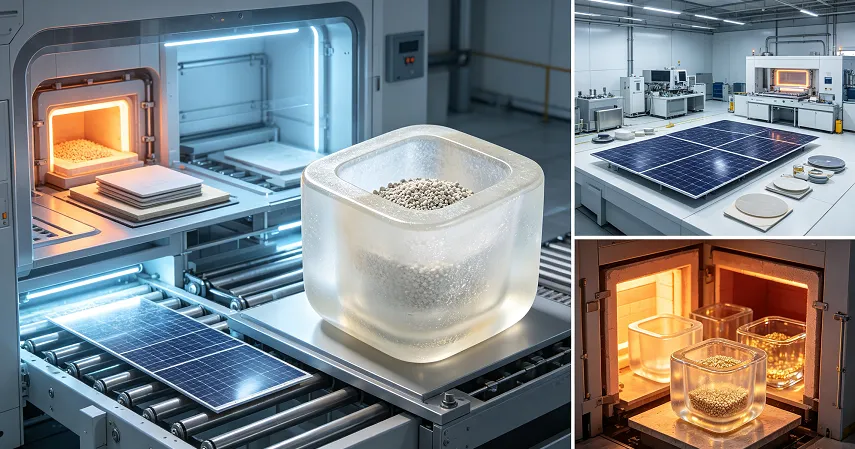
Quartz crucibles and boats are widely associated with silicon-based photovoltaic and semiconductor manufacturing. In these applications, the ceramic component may be exposed to molten silicon or high-temperature silicon processing environments. The crucible must maintain dimensional integrity while minimizing undesirable interaction with the processed material. Surface condition, purity, thermal history, and structural uniformity can therefore influence process performance. For silicon-related applications, engineers must evaluate the complete material interaction rather than selecting quartz solely because of its high-temperature capability.
3. High-Temperature Furnace Tubes
Quartz furnace tubes are widely used in laboratory and industrial thermal processing systems. Their low thermal expansion provides excellent resistance to thermal shock, particularly when the furnace experiences repeated heating and cooling cycles. The tube geometry must be designed according to furnace dimensions, operating temperature, gas flow, pressure, and thermal gradient. Wall thickness is also important because increasing thickness may improve mechanical robustness while simultaneously increasing thermal gradients during rapid temperature changes. In applications requiring frequent thermal cycling, proper heating and cooling profiles are essential for extending quartz tube service life.
4. Laboratory and Analytical Equipment
Quartz ceramic components are commonly used in laboratory crucibles, sample holders, combustion tubes, reaction vessels, and thermal analysis equipment. The combination of chemical resistance, high purity, and thermal stability allows quartz to be used for controlled laboratory experiments where interaction between the container and sample must be minimized. For analytical applications, engineers and researchers should also consider whether the sample chemistry is compatible with silica at the intended temperature because certain alkaline or highly reactive materials can attack SiO₂.
5. Chemical Processing
Quartz ceramic offers good resistance to many acids and chemical environments, making it useful for specialized chemical processing equipment. However, quartz should not be considered universally chemically inert. Strong alkaline environments, certain fluoride-containing chemicals, and specific high-temperature reactive compounds can attack silica. Chemical compatibility should therefore be evaluated against the actual concentration, temperature, exposure duration, and process atmosphere.
Company Profile
JianXun Advanced Ceramic Technology is a professional manufacturer specializing in high-performance ceramic components, including Quartz Ceramic, alumina ceramics, boron nitride ceramics, silicon carbide ceramics, aluminum nitride ceramics, mullite ceramics, and customized precision ceramic parts. The company focuses on providing engineered ceramic solutions for semiconductor processing, high-temperature furnaces, laboratory equipment, thermal treatment systems, and other industrial applications requiring controlled ceramic performance.
JianXun provides customized ceramic components according to material grade, dimensional requirements, operating temperature, atmosphere, surface finish, and application conditions. The manufacturing process emphasizes material selection, precision forming, machining accuracy, dimensional control, and quality inspection to ensure that ceramic components meet the requirements of demanding thermal and chemical environments.
Payment Terms: T/T, PayPal, Credit Card, Western Union, etc.
Shipment Terms: By air, by sea, by express, or according to customer request.
Storage Conditions: Quartz ceramic components should be stored in a clean, dry environment and protected from mechanical impact, surface contamination, and abrupt temperature changes. High-purity quartz products should remain properly packaged until installation to minimize particulate and metallic contamination.
FAQs About Quartz Ceramic
1. What makes Quartz Ceramic suitable for high-temperature thermal processing?
The primary engineering advantage of Quartz Ceramic in thermal processing is its extremely low coefficient of thermal expansion combined with good chemical stability and electrical insulation. When a quartz component is exposed to rapid heating or cooling, its dimensional change is relatively small compared with many conventional ceramic materials, reducing the thermal stresses generated by temperature gradients. This makes quartz particularly suitable for furnace tubes, crucibles, boats, and other components subjected to repeated thermal cycling. However, thermal shock resistance depends on component geometry, wall thickness, surface condition, and heating rate, so the material specification should always be evaluated together with the furnace operating profile.
2. How does Quartz Ceramic compare with Alumina Ceramic for furnace applications?
Quartz and alumina serve different engineering requirements. Alumina generally provides higher hardness, mechanical strength, and maximum temperature capability, making it suitable for applications involving mechanical loading or prolonged exposure to very high temperatures. Quartz, in contrast, has a much lower coefficient of thermal expansion and therefore provides outstanding resistance to thermal shock. Quartz also offers excellent high-purity characteristics and chemical stability in many process environments. Engineers should therefore select between quartz and alumina according to the combination of temperature, mechanical load, thermal cycling rate, chemical environment, and contamination requirements rather than simply comparing maximum service temperatures.
3. What factors determine the service life of a Quartz Ceramic component?
The service life of a quartz component is influenced by thermal cycling, operating temperature, temperature gradients, mechanical loading, surface defects, chemical exposure, and handling practices. Repeated heating and cooling can gradually enlarge microscopic surface defects, while mechanical impacts can introduce scratches or cracks that later become failure initiation points. Chemical attack can also change the surface condition and accelerate degradation under subsequent thermal cycles. For this reason, proper furnace temperature control, gradual thermal transitions where necessary, careful installation, appropriate cleaning procedures, and protection against mechanical damage are important for maximizing component lifetime.
4. Can Quartz Ceramic components be customized according to furnace and process requirements?
Yes. Quartz ceramic components can be manufactured in customized geometries, including tubes, crucibles, boats, plates, rings, liners, holders, and other precision components. Engineers can specify dimensions such as outer diameter, inner diameter, length, wall thickness, opening geometry, holes, slots, and other structural features. For high-temperature applications, customization should also consider thermal gradients and stress concentration because complex geometries can affect thermal shock performance. Providing detailed drawings, operating temperatures, furnace configuration, atmosphere, pressure, thermal cycling frequency, and processed materials allows the manufacturer to recommend an appropriate quartz grade and component design.
5. What information should engineers provide when ordering high-purity Quartz Ceramic components?
Engineers should provide the component drawing or dimensional requirements together with the actual operating conditions. Important information includes maximum and continuous operating temperature, heating and cooling rate, furnace atmosphere, pressure or vacuum level, processed material, required SiO₂ purity, acceptable trace-element levels, surface finish, dimensional tolerances, and expected service life. For semiconductor and photovoltaic applications, contamination requirements should be specified in greater detail because metallic impurities, particles, and surface residues can directly affect process quality. If an existing component has experienced cracking, deformation, contamination, or chemical attack, photographs and failure information can also help the manufacturer determine whether the root cause is related to material selection, geometry, thermal cycling, or process conditions.