Advanced Technical Ceramics, Precision Alumina, Silicon Carbide, Crucible Parts



Crucible

Al₂O₃ Ceramic Saggers Alumina Saggers for 1700℃ High Temperature Battery

MgAl₂O₄ Spinel Saggers Magnesium Aluminum Spinel Saggers

Reaction Sintered Silicon Carbide Saggers

Nickel Crucible Box High Purity N6 Nickel Crucible
Overview
An advanced ceramic crucible is a precision-engineered ceramic component designed to withstand extreme thermal, chemical, and mechanical environments during high-temperature processing. Unlike conventional ceramic containers, advanced ceramic crucibles are manufactured from high-performance materials such as alumina (Al₂O₃), boron nitride (BN), silicon carbide (SiC), aluminum nitride (AlN), and zirconia (ZrO₂), where the microstructure, purity level, density, and surface characteristics are carefully controlled to meet demanding industrial requirements.
In high-temperature manufacturing processes, the crucible is not simply a vessel for containing molten materials or powders. It directly influences process stability, material purity, heating efficiency, and final product quality. A poorly selected crucible material may cause chemical contamination, unwanted reactions, thermal cracking, or premature failure, resulting in production interruption and increased operating costs.
For engineers, the selection of an advanced ceramic crucible requires a comprehensive evaluation of operating temperature, furnace atmosphere, processed material characteristics, thermal cycling conditions, and required service life. The correct material choice is determined not only by maximum temperature capability but also by the interaction between the crucible and the processed material.
For example, alumina ceramic crucibles are widely selected for general high-temperature applications due to their chemical stability and electrical insulation properties, while boron nitride crucibles are preferred in applications requiring low wettability and minimal contamination. Silicon carbide crucibles are commonly considered when rapid heat transfer and thermal efficiency are critical.
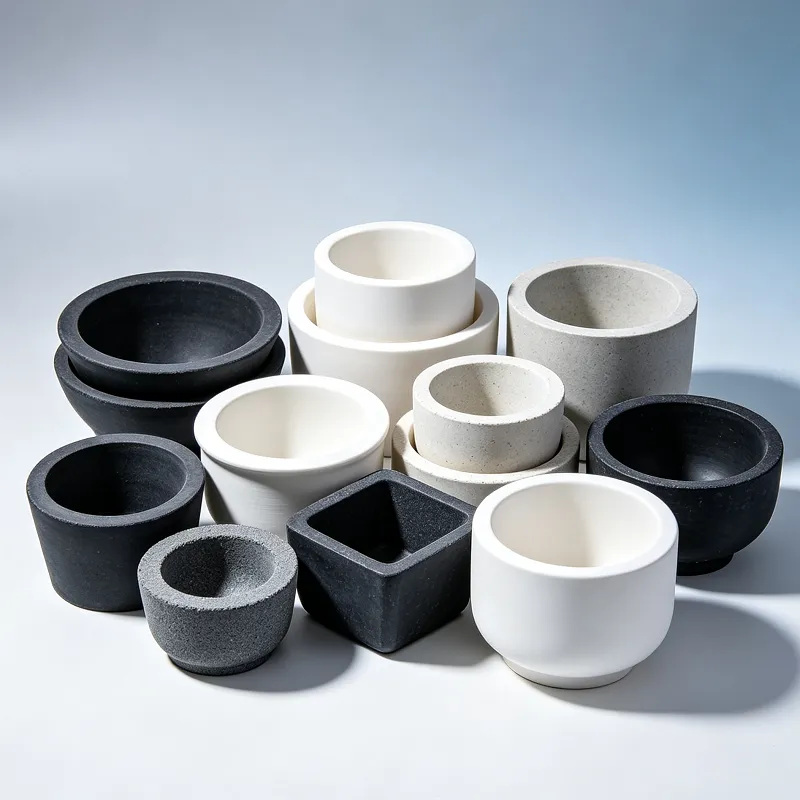
Classification and Key Characteristics of Advanced Ceramic Crucibles
Advanced ceramic crucibles can generally be classified according to ceramic material systems. Each ceramic family provides different advantages based on its crystal structure, bonding characteristics, thermal conductivity, and chemical stability.
1. Alumina Ceramic Crucible (Al₂O₃)
Alumina is one of the most established ceramic materials used for crucible manufacturing. Its popularity comes from a balanced combination of high-temperature stability, corrosion resistance, mechanical strength, and electrical insulation. High-purity alumina crucibles, especially grades above 99% Al₂O₃, are widely used where contamination control is important. The dense ceramic structure reduces material diffusion and minimizes reactions with many metals, oxides, and chemical compounds. From an engineering perspective, alumina is generally selected when the process requires reliable performance under oxidizing atmospheres and long-term thermal exposure.
2. Boron Nitride Ceramic Crucible (BN)
Boron nitride crucibles represent a specialized solution for applications requiring chemical inertness, non-wetting behavior, and thermal shock resistance. The layered hexagonal structure of BN provides graphite-like lubrication characteristics while maintaining ceramic stability. This unique structure allows molten materials to have reduced adhesion on the crucible surface, which improves material release and reduces contamination during high-temperature processing. BN crucibles are particularly valuable in semiconductor processing, crystal growth, powder sintering, and vacuum applications where material purity is a critical factor. High-purity BN crucibles can operate at temperatures approaching 2000°C under inert atmosphere conditions while maintaining excellent dimensional stability.
3. Silicon Carbide Ceramic Crucible (SiC)
Silicon carbide crucibles are designed for applications requiring high thermal conductivity, wear resistance, and structural strength at elevated temperatures. Compared with oxide ceramics, SiC has significantly higher thermal conductivity, allowing faster heat transfer and more uniform temperature distribution. This characteristic is especially important in melting and thermal processing systems where temperature gradients can affect product quality. The excellent mechanical strength and corrosion resistance of SiC also make it suitable for demanding industrial furnace environments.
4. Aluminum Nitride Ceramic Crucible (AlN)
Aluminum nitride is a specialized advanced ceramic combining high thermal conductivity with electrical insulation. Its thermal expansion coefficient is close to silicon and other semiconductor materials, making AlN attractive for precision thermal processing applications. In semiconductor and electronic manufacturing environments, AlN crucibles help achieve controlled heating conditions while reducing thermal stress caused by mismatch between materials.
5. Zirconia Ceramic Crucible (ZrO₂)
Zirconia provides higher fracture toughness compared with many traditional ceramics. This characteristic makes zirconia suitable for applications where mechanical reliability and resistance to thermal impact are important. Although zirconia has lower thermal conductivity than SiC or AlN, its toughness and high-temperature stability make it useful in specialized melting and laboratory applications.
Typical Specifications of Advanced Ceramic Crucibles
The actual performance of a ceramic crucible depends on material purity, manufacturing process, grain structure, density, and surface finish. The following table summarizes typical engineering parameters for common advanced ceramic crucible materials.
| Material | Purity | Maximum Working Temperature | Thermal Conductivity | Thermal Expansion Coefficient | Main Engineering Advantage |
|---|---|---|---|---|---|
| Alumina (Al₂O₃) | 95%-99.99% | 1600-1800°C | 20-35 W/m·K | 7-8 ×10⁻⁶/K | Chemical stability and electrical insulation |
| Boron Nitride (BN) | ≥99% | 1800-2100°C (inert atmosphere) | 35-60 W/m·K | 1.5-2.0 ×10⁻⁶/K | Low wettability and excellent thermal shock resistance |
| Silicon Carbide (SiC) | Engineering grade | 1600°C+ | 80-150 W/m·K | 4-5 ×10⁻⁶/K | High thermal conductivity and mechanical strength |
| Aluminum Nitride (AlN) | ≥99% | 1700°C+ | 170-230 W/m·K | 4-5 ×10⁻⁶/K | Superior thermal management |
| Zirconia (ZrO₂) | ≥95% | 2000°C+ | 2-3 W/m·K | 10 ×10⁻⁶/K | High toughness and impact resistance |
The specification selection should always consider the complete operating environment rather than a single parameter such as temperature rating. For example, a BN crucible may outperform alumina in contamination-sensitive processes despite having lower mechanical strength, because its non-wetting surface reduces interaction with processed materials.
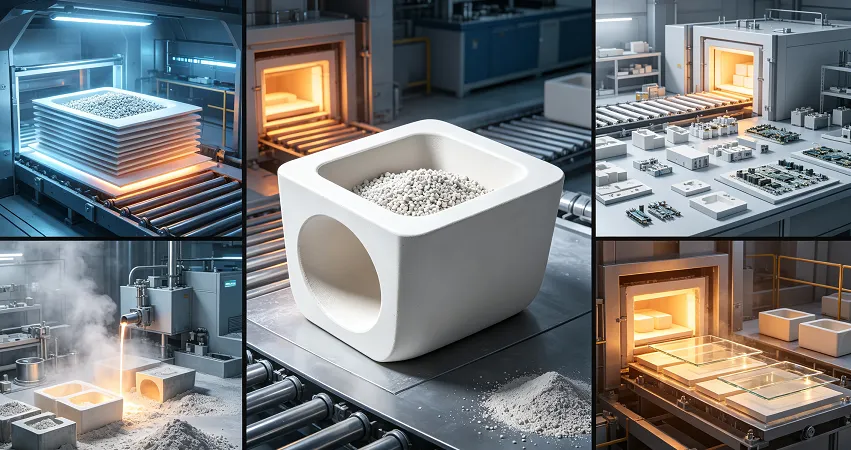
Applications of Advanced Ceramic Crucibles
1. Semiconductor and Electronic Material Processing
The semiconductor industry requires crucibles with extremely low contamination levels and stable performance under vacuum or controlled atmospheres. Advanced ceramic crucibles are used in processes such as crystal growth, evaporation coating, substrate sintering, and high-temperature material synthesis. BN and PBN crucibles are particularly suitable for semiconductor-related applications because of their high purity, low chemical reactivity, and excellent dimensional stability during repeated thermal cycles.
2. Powder Metallurgy and Advanced Material Sintering
During powder sintering, the crucible must maintain a stable environment while avoiding chemical reactions with the powder materials. BN crucibles are commonly selected for sintering advanced ceramics such as aluminum nitride and silicon nitride because their low wettability reduces adhesion between the processed material and crucible surface. This improves product removal and minimizes contamination.
3. Metal Melting and High-Temperature Metallurgy
Metal processing applications require crucibles that can resist molten metal corrosion, thermal shock, and repeated heating cycles. SiC and alumina crucibles are frequently used in metallurgy due to their mechanical strength and resistance to high-temperature degradation. The material choice depends on the processed alloy, atmosphere condition, melting temperature, and required production cycle.
4. Laboratory Research and Analytical Testing
In research laboratories, ceramic crucibles are used for thermal analysis, material testing, chemical synthesis, and high-temperature experiments. High-purity alumina and zirconia crucibles are commonly selected because they provide predictable performance and stable chemical behavior across a wide range of testing conditions.
Company Profile
JianXun Advanced Ceramic Technology is a professional manufacturer specializing in high-performance ceramic components, including advanced ceramic crucibles, ceramic tubes, plates, rings, and customized precision ceramic parts. With expertise in alumina, boron nitride, silicon carbide, aluminum nitride, and other advanced ceramic materials, JianXun provides engineering solutions for high-temperature processing, semiconductor manufacturing, powder metallurgy, and industrial thermal applications.
The company focuses on material selection, precision manufacturing, dimensional control, and customized ceramic solutions according to customer process requirements. Through strict quality management and advanced ceramic processing technology, JianXun supports global customers requiring reliable performance under demanding thermal and chemical conditions.
Payment Terms: T/T, PayPal, Credit Card, Western Union, etc.
Shipment Terms: By air, by sea, by express, or according to customer request.
Storage Conditions: Advanced ceramic crucibles should be stored in a dry environment, protected from mechanical impact, moisture contamination, and sudden temperature changes before use.
FAQs About Advanced Ceramic Crucibles
1. How should engineers select the correct ceramic crucible material?
Engineers should select a ceramic crucible based on the complete operating environment rather than maximum service temperature alone. The primary factors include processing temperature, furnace atmosphere, processed material, chemical compatibility, thermal conductivity, thermal expansion coefficient, thermal cycling frequency, required purity, crucible geometry, and expected service life. For example, high-purity alumina is commonly selected when chemical stability, oxidation resistance, and electrical insulation are important, while boron nitride is more suitable for applications requiring low wettability, easy material release, and high thermal shock resistance. Silicon carbide may be preferred when high thermal conductivity and rapid heat transfer are required, whereas aluminum nitride is considered when both high thermal conductivity and electrical insulation are critical. Engineers should also evaluate the interaction between the crucible and the processed material at the actual operating temperature because a ceramic that is stable in one environment may react with, dissolve into, or become wetted by another material. Therefore, material selection should be based on the complete process window, including temperature profile, atmosphere, heating and cooling rate, chemical exposure, and contamination requirements.
2. What is the difference between alumina and boron nitride crucibles?
Alumina and boron nitride provide fundamentally different combinations of thermal, chemical, and mechanical properties. Alumina has relatively high hardness, good mechanical strength, excellent electrical insulation, and strong resistance to oxidation, making it a practical choice for general high-temperature processing and applications involving oxidizing atmospheres. Boron nitride, particularly hexagonal boron nitride, has a layered crystal structure that provides low friction and low wettability, allowing many molten or sintered materials to separate more easily from the crucible surface. BN also has a relatively low coefficient of thermal expansion, which contributes to good thermal shock resistance during rapid temperature changes. However, BN must be evaluated carefully for oxidizing environments because its high-temperature performance is strongly dependent on atmosphere. From an engineering perspective, alumina is generally selected when mechanical robustness and chemical stability are priorities, while BN becomes more attractive when material release, contamination control, thermal cycling, or non-wetting behavior is more important.
3. Can advanced ceramic crucibles be customized according to specific dimensions and process requirements?
Yes. Advanced ceramic crucibles can be manufactured according to specific dimensional and process requirements, including outside diameter, inside diameter, height, wall thickness, bottom geometry, opening configuration, tolerances, surface finish, and material grade. Customization is particularly important because crucible geometry directly influences thermal gradients, mechanical stress distribution, material loading capacity, and heat transfer during operation. For thin-wall crucibles, for example, reducing wall thickness can improve thermal response but may also increase sensitivity to mechanical handling and thermal shock. The design therefore needs to balance dimensional requirements with the material's mechanical and thermal properties. Depending on the ceramic system, manufacturing methods may include pressing, slip casting, isostatic pressing, injection molding, machining, or specialized sintering processes. When requesting a custom crucible, engineers should provide the operating temperature, atmosphere, processed material, furnace configuration, dimensional drawing, tolerance requirements, heating and cooling profile, and expected service conditions so that the ceramic grade and manufacturing process can be selected appropriately.
4. Why do ceramic crucibles crack during high-temperature operation?
Cracking is usually associated with thermal stress, mechanical stress, manufacturing defects, or incompatibility between the crucible design and the operating conditions. Ceramic materials have limited fracture toughness compared with metals, so temperature gradients across the crucible wall can generate significant internal stresses during rapid heating or cooling. Localized heating, uneven furnace temperature, direct flame exposure, or placing a cold crucible into an excessively hot furnace can create thermal gradients that exceed the material's ability to accommodate expansion. Cracks may also originate from mechanical damage, sharp corners, excessive wall-thickness variation, improper installation, or impact during handling. In addition, chemical corrosion or infiltration of molten material can weaken the ceramic structure and accelerate crack propagation during subsequent thermal cycles. Engineers can reduce failure risk by selecting a ceramic with an appropriate thermal expansion coefficient and thermal shock resistance, optimizing crucible geometry, controlling heating and cooling rates, ensuring uniform furnace temperature, and avoiding mechanical damage before and during installation.
5. What information should engineers provide when requesting a quotation for an advanced ceramic crucible?
For an accurate quotation and material recommendation, engineers should provide as much information as possible about the actual operating conditions rather than only specifying the crucible dimensions. The most important information includes the ceramic material or processed substance, maximum and continuous operating temperature, furnace atmosphere, vacuum level if applicable, heating and cooling rate, thermal cycling frequency, crucible dimensions, required dimensional tolerances, wall thickness, surface finish, and expected service life. It is also important to identify whether the process involves molten metal, chemical compounds, ceramic powders, semiconductor materials, or other reactive substances because chemical compatibility and wettability can significantly affect crucible performance. If contamination is a concern, the required ceramic purity and acceptable impurity levels should also be specified. A technical drawing, operating profile, photographs of an existing crucible, or information about previous failure modes can further improve the material selection process. With these parameters, the manufacturer can evaluate the appropriate ceramic composition, density, manufacturing method, geometry, and finishing requirements instead of simply supplying a standard crucible based on size alone.