Advanced Technical Ceramics, Precision Alumina, Silicon Carbide, Crucible Parts



Reaction-bonded Silicon Carbide

Overview
Reaction-Bonded Silicon Carbide (RBSC), also known as reaction-sintered silicon carbide or siliconized silicon carbide, is a dense SiC-based ceramic manufactured through a reactive infiltration process rather than conventional pressureless densification. In a typical process, a porous preform containing silicon carbide and a carbon source is first formed into the desired geometry; molten silicon is then infiltrated into the interconnected pore structure, where it reacts with carbon to generate additional SiC and fills the remaining pores with silicon. The resulting microstructure is therefore fundamentally different from monolithic pressureless-sintered SiC: it normally consists of interconnected SiC together with a residual silicon phase, with the exact phase proportions controlled by the initial powder formulation, carbon content, pore structure, infiltration conditions, and reaction kinetics. This manufacturing principle gives Reaction-Bonded Silicon Carbide a particularly important engineering advantage: relatively large, thin-walled, and geometrically complicated components can often be produced with limited dimensional shrinkage compared with conventional sintered ceramics. The process can provide near-net-shape forming, relatively short densification cycles, and good dimensional control, making it attractive for customized industrial ceramic components. At the same time, the residual silicon phase is one of the most important factors engineers must understand. Silicon has a substantially lower melting point and different mechanical, thermal, and expansion characteristics from SiC, so increasing residual silicon can reduce high-temperature capability and alter mechanical and thermal behavior. Consequently, Reaction-Bonded Silicon Carbide should not simply be described as “high-temperature SiC.” It is better understood as a multiphase ceramic whose performance is determined by SiC connectivity, free-silicon content, pore structure, microstructural uniformity, surface condition, component geometry, and operating atmosphere. For applications requiring complex geometry, large dimensions, controlled shrinkage, high wear resistance, and strong chemical stability, RBSC can offer a very different and sometimes more economical design route than pressureless-sintered SiC.

Classification and Key Characteristics of Reaction-Bonded Silicon Carbide
1. Near-Net-Shape Manufacturing with Low Dimensional Shrinkage
One of the most important advantages of Reaction-Bonded Silicon Carbide is its ability to produce complex geometries with relatively low dimensional change during reactive infiltration. Conventional pressureless-sintered ceramics normally undergo substantial shrinkage during densification, requiring careful dimensional compensation and sometimes extensive post-sintering machining. RBSC instead starts with a porous SiC/C preform whose interconnected pore network allows molten silicon to infiltrate the body and react with carbon. Because the principal densification mechanism is infiltration and reaction rather than large-scale solid-state particle rearrangement, dimensional shrinkage can be significantly lower. This makes the process particularly useful for long tubes, thin plates, intricate channels, large structural parts, rings, nozzles, rollers, and customized components where maintaining geometry is difficult with conventional sintering. Research has specifically identified near-net-shape forming as one of the major advantages of RBSC, together with relatively short processing time and lower processing temperature than many conventional dense-SiC routes. From an engineering perspective, this advantage becomes more significant as component size and geometric complexity increase, because reducing post-sintering diamond machining can substantially simplify manufacturing.
2. High Density and Strong SiC Ceramic Skeleton
The mechanical performance of Reaction-Bonded Silicon Carbide depends heavily on the formation of a continuous or highly interconnected SiC skeleton. During infiltration, molten silicon reacts with the carbon-containing portion of the preform to form new SiC, which bridges and reinforces the original SiC particles. The resulting microstructure can achieve high overall density while retaining the hardness, wear resistance, and chemical stability associated with SiC. However, density alone does not fully describe RBSC quality. The distribution of SiC, residual silicon, residual carbon, and microscopic pores can have a major influence on flexural strength, elastic modulus, thermal conductivity, and fracture behavior. Studies have shown that increasing carbon density in the starting preform can reduce residual silicon, while excessive carbon or poorly controlled carbon distribution can instead produce residual carbon and pores. This means the preform is not simply a temporary shape; its density distribution and pore architecture directly determine the final microstructure. For demanding Reaction-Bonded Silicon Carbide components, uniform preform density is therefore essential to avoid local variations in infiltration, phase composition, and mechanical performance.
3. Excellent Hardness, Wear Resistance, and Abrasion Resistance
The SiC phase gives Reaction-Bonded Silicon Carbide excellent hardness and resistance to abrasive wear, making it suitable for components exposed to particles, powders, slurries, and repeated sliding contact. Silicon carbide is substantially harder than most conventional metals, and the interconnected ceramic skeleton can maintain its surface integrity under severe abrasive conditions. This makes RBSC attractive for wear plates, liners, nozzles, rollers, bushings, flow components, grinding-related parts, and other industrial products where dimensional loss must be controlled. However, the wear behavior of RBSC is not necessarily identical to that of pressureless-sintered SiC because the residual silicon phase has lower hardness than the SiC phase. Under certain contact conditions, the silicon-rich regions can become preferential wear sites, particularly if abrasive particles repeatedly attack the multiphase surface. Therefore, the SiC-to-Si ratio, surface microstructure, opposing material, particle hardness, particle velocity, lubrication, and contact pressure should all be considered. Properly engineered Reaction-Bonded Silicon Carbide can provide excellent wear resistance while offering manufacturing advantages that may be difficult to achieve with fully sintered SiC.
4. Good Thermal Conductivity and Thermal Shock Performance
The combination of SiC's high thermal conductivity and relatively low coefficient of thermal expansion gives Reaction-Bonded Silicon Carbide useful thermal stability in many industrial heating and cooling cycles. Efficient heat transfer reduces localized temperature gradients, while the low expansion of the SiC phase limits the amount of dimensional strain generated during temperature changes. This combination can make RBSC suitable for furnace fixtures, kiln components, heat-treatment supports, rollers, plates, tubes, and other components exposed to repeated thermal cycling. However, engineers must distinguish the thermal behavior of the SiC skeleton from that of the residual silicon phase. Because silicon has different thermal and mechanical properties from SiC, its amount and distribution influence the effective thermal conductivity, expansion behavior, and high-temperature mechanical stability of the composite. Research on RBSC consistently identifies residual silicon as an important factor controlling hot properties. Therefore, a material with excellent room-temperature thermal conductivity should not automatically be assumed to have identical performance at temperatures approaching or exceeding the melting point of the residual silicon phase.
5. Excellent Chemical Stability and Oxidation Resistance
The SiC phase provides Reaction-Bonded Silicon Carbide with strong resistance to many corrosive and chemically aggressive environments, making it useful for chemical processing, fluid handling, abrasive slurry systems, and high-temperature industrial equipment. In oxidizing atmospheres, SiC can form a silica-based surface layer that provides a degree of protection against further oxidation, although oxidation behavior depends on temperature, atmosphere, exposure time, surface condition, and material composition. The residual silicon phase introduces another important consideration because silicon can oxidize and react differently from SiC. Therefore, chemical compatibility should be evaluated based on the complete RBSC microstructure rather than treating the component as pure SiC. In liquid environments, the actual chemical resistance also depends on the process medium, concentration, temperature, flow velocity, and exposure duration. For Reaction-Bonded Silicon Carbide used in corrosive or abrasive equipment, engineers should evaluate both chemical attack and mechanical erosion because a material can be chemically stable while still suffering significant wear from high-velocity particles.
6. Large-Size and Complex-Geometry Manufacturing Capability
Another major advantage of Reaction-Bonded Silicon Carbide is its ability to manufacture relatively large components and geometrically complicated structures without relying entirely on extremely high-temperature pressureless densification. The reactive infiltration route can accommodate intricate preform geometries, including channels, holes, thin sections, ribs, and customized profiles, provided that the preform has sufficient permeability for molten silicon infiltration. This capability is particularly valuable when the component would otherwise require extensive machining from a dense SiC billet. The manufacturing process has also been studied for complex-shaped RBSC structures produced through additive or indirect forming methods, demonstrating the flexibility of the preform-plus-infiltration concept. Nevertheless, complexity must be balanced against infiltration physics. Extremely narrow channels, isolated pores, large changes in wall thickness, or poorly connected pore networks can interfere with silicon flow and create local variations in residual silicon or unreacted carbon. The best Reaction-Bonded Silicon Carbide designs therefore consider manufacturability from the preform stage rather than adding complex geometry after material production.

Typical Specifications of Reaction-Bonded Silicon Carbide
The following values represent typical engineering ranges for reaction-bonded SiC. Actual properties can vary substantially according to SiC particle size, carbon content, preform density, residual silicon fraction, infiltration conditions, and final microstructure.
| Property | Typical Specification |
|---|---|
| Product | Reaction-Bonded Silicon Carbide |
| Abbreviation | RBSC / RBSiC |
| Material System | SiC + residual Si, with possible minor residual carbon/additives |
| SiC Content | Typically 70–90+ vol.% depending on formulation |
| Residual Silicon | Commonly several to tens of vol.% depending on process |
| Density | Approx. 2.9–3.15 g/cm³ |
| Flexural Strength | Approx. 200–400 MPa |
| Compressive Strength | Typically ≥1500–2000 MPa |
| Hardness | Typically high, depending on SiC/Si ratio |
| Elastic Modulus | Approx. 330–450 GPa |
| Thermal Conductivity | Approx. 100–200 W/m·K, grade dependent |
| Coefficient of Thermal Expansion | Approx. 3.5–4.5 ×10⁻⁶/K |
| Fracture Toughness | Approx. 3–5 MPa·m¹/² |
| Maximum Practical Service Temperature | Typically limited by residual Si and atmosphere |
| Silicon Melting Point | Approx. 1414°C |
| Wear Resistance | Excellent |
| Chemical Resistance | Excellent to many media |
| Thermal Shock Resistance | Excellent |
| Water Absorption | Very low |
| Typical Color | Black to dark gray |
| Manufacturing Route | Porous preform + molten silicon infiltration |
| Shape | Plates, tubes, rollers, rings, nozzles, beams, complex parts |
| Dimensional Change | Relatively low compared with conventional sintered ceramics |
| Surface Finish | As-infiltrated, ground, lapped, or polished |
| Customization | Geometry, dimensions, wall thickness, holes, surface finish |
The most important point in this table is the residual silicon content. Unlike pressureless-sintered SiC, Reaction-Bonded Silicon Carbide is normally a multiphase material rather than a nearly single-phase SiC ceramic. Published studies report residual silicon contents ranging broadly, and demonstrate that reducing the silicon fraction can move mechanical properties closer to those associated with dense sintered SiC. The exact value depends strongly on the initial carbon content and preform pore structure. Increasing carbon density can consume more molten silicon through the Si+C→SiC reaction, but excessive carbon can also interfere with infiltration and generate residual carbon or pores. This creates an important optimization problem: the goal is not simply “maximum carbon” or “minimum silicon,” but a balanced preform structure that permits complete infiltration while producing the desired SiC connectivity and residual-phase distribution. For applications above approximately 1400°C, this distinction becomes especially important because elemental silicon melts at about 1414°C. Therefore, a generic RBSC “maximum temperature” should never be treated as equivalent to the maximum temperature of pure SiC.
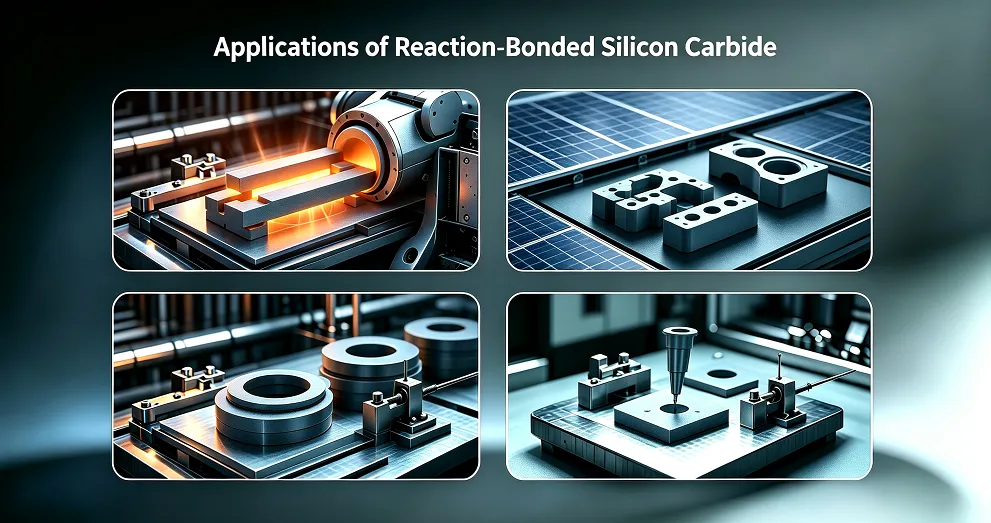
Applications of Reaction-Bonded Silicon Carbide
1. Silicon Carbide Kiln Furniture and Furnace Supports
Reaction-Bonded Silicon Carbide is well suited to kiln furniture and furnace-support components where low deformation, thermal shock resistance, wear resistance, and relatively complex geometry are required. Plates, beams, supports, setters, brackets, and customized fixtures can be manufactured using RBSC because the reaction-infiltration process can produce large components with relatively low dimensional change. This can be particularly valuable when the furnace design requires thin sections or large spans that would be difficult or expensive to produce from fully sintered SiC. The material's high thermal conductivity also helps distribute heat and reduce localized temperature gradients during repeated firing cycles. However, the residual silicon phase must be considered when selecting the operating temperature. For applications approaching the melting point of silicon, alternative SiC grades may be more appropriate. Engineers should also consider load distribution, span length, section thickness, furnace atmosphere, thermal cycling rate, and contact with the processed ceramic. Properly selected Reaction-Bonded Silicon Carbide can provide a practical balance between thermal performance, structural stability, manufacturing complexity, and cost.
2. SiC Rollers for High-Temperature Processing
Industrial rollers require a combination of high stiffness, dimensional stability, thermal shock resistance, and resistance to surface wear. Reaction-Bonded Silicon Carbide can be formed into long cylindrical rollers with controlled dimensions and relatively low processing shrinkage, making it attractive for continuous high-temperature production systems. The high stiffness of the SiC skeleton helps resist bending under load, while its thermal conductivity supports rapid heat distribution when the roller repeatedly enters and exits hot zones. The ceramic surface also resists wear from contact with transported products. However, roller design requires careful analysis of diameter, wall thickness, span, support points, rotational speed, thermal gradient, and bending stress because ceramics are much less tolerant of tensile stress than metals. Residual silicon additionally limits the appropriate service temperature compared with high-purity pressureless-sintered SiC. When these factors are properly controlled, Reaction-Bonded Silicon Carbide provides an efficient route for producing long, dimensionally stable ceramic rollers for demanding thermal-processing equipment.
3. Abrasion-Resistant Liners and Wear Components
Reaction-Bonded Silicon Carbide provides strong resistance to abrasive particles and can be used for selected liners, wear plates, chute components, flow channels, and protective inserts. Its SiC-rich structure can withstand repeated contact with hard particles far better than many conventional metals and polymers, particularly where the operating temperature or chemical environment makes polymeric materials unsuitable. The near-net-shape manufacturing capability also allows RBSC liners to be produced with customized channels, mounting holes, and curved surfaces, reducing the amount of post-processing required. The actual wear mechanism must nevertheless be considered carefully. High-velocity particles can cause erosive wear, while coarse particles under pressure can create impact damage. Residual silicon may also wear differently from SiC, so microstructural uniformity is important for long-term dimensional stability. For Reaction-Bonded Silicon Carbide wear components, engineers should specify particle hardness, size, concentration, impact velocity, temperature, and impact angle in addition to the nominal material grade.
4. High-Temperature Nozzles and Flow-Control Components
The hardness, chemical resistance, thermal stability, and near-net-shape capability of Reaction-Bonded Silicon Carbide make it suitable for selected industrial nozzles and flow-control components. Nozzles used with abrasive gases, powders, slurries, or high-temperature process streams can experience severe internal erosion, and SiC provides substantially better resistance to many of these mechanisms than conventional metals. RBSC can also be formed into tapered passages, customized outlets, venturi geometries, and other internal profiles that control flow velocity and pressure drop. Dimensional accuracy of the internal passage is critical because small changes in diameter can alter flow rate and spray distribution. Engineers should also analyze wall thickness and mounting stress because thin ceramic sections are sensitive to mechanical shock. For high-temperature service, the residual silicon content must be checked carefully because the presence of elemental silicon can restrict the usable temperature range. With the appropriate grade and geometry, Reaction-Bonded Silicon Carbide can provide durable flow-control components for abrasive and chemically demanding industrial processes.
5. Precision Structural Components and Complex Ceramic Parts
The near-net-shape capability of Reaction-Bonded Silicon Carbide makes it particularly attractive for customized structural ceramic components that would be difficult to manufacture economically through conventional sintering. Complex plates, brackets, tubes, support frames, housings, mirrors, channels, and other engineered structures can be produced by first creating a porous SiC/C preform and then infiltrating it with molten silicon. Research has demonstrated RBSC fabrication for complex-shaped structures and large components, including applications requiring dimensional stability and high specific stiffness. For precision components, however, the final surface often requires diamond grinding or polishing because the as-infiltrated surface may not provide the required dimensional tolerance or roughness. Designers should also avoid unnecessarily sharp corners and large variations in wall thickness because these features can influence preform density, infiltration behavior, and stress concentration. The real advantage of Reaction-Bonded Silicon Carbide is therefore not simply its material properties, but the combination of those properties with a manufacturing process capable of producing difficult geometries.
6. Chemical Processing and Corrosive Fluid Components
Reaction-Bonded Silicon Carbide can be used in selected chemical-processing components where corrosion resistance must be combined with abrasion resistance and dimensional stability. Potential products include liners, tubes, nozzles, sealing components, pump-related parts, and specialized flow-control structures exposed to aggressive fluids or particle-containing liquids. The SiC phase provides strong chemical stability, while the dense structure limits fluid penetration. At the same time, the high hardness of SiC helps resist particle erosion when the process stream contains suspended solids. The limitation is that residual silicon can respond differently from SiC under particular chemical and thermal conditions, so material compatibility must be verified against the exact process medium. Engineers should evaluate pH, concentration, temperature, pressure, flow velocity, particle content, and exposure duration rather than relying on a general statement that RBSC is “corrosion resistant.” Properly selected Reaction-Bonded Silicon Carbide can provide a durable solution where corrosion and abrasion occur simultaneously.
7. Heat-Transfer and Thermal-Processing Components
The relatively high thermal conductivity of SiC makes Reaction-Bonded Silicon Carbide attractive for certain heat-transfer and thermal-processing structures where rapid temperature equalization is important. Components can be designed as plates, tubes, supports, heat-radiating structures, or customized thermal fixtures depending on the process requirements. The material can distribute heat more efficiently than many conventional refractory ceramics, reducing localized thermal gradients and helping maintain more uniform process conditions. However, thermal conductivity varies with the amount and distribution of SiC and residual silicon, so engineers should use grade-specific data rather than assuming that every RBSC product has the same thermal performance. Temperature must also remain within the appropriate range for the residual silicon phase. For applications requiring operation above the silicon melting range, pressureless-sintered or other high-temperature SiC grades may be more appropriate. Reaction-Bonded Silicon Carbide is therefore particularly valuable where moderate-to-high-temperature thermal stability, complex geometry, and efficient heat transfer are required simultaneously.
8. Customized Large-Format Ceramic Structures
Large-format ceramic structures are one of the areas where Reaction-Bonded Silicon Carbide can demonstrate a significant manufacturing advantage. Producing a large, complex SiC component through conventional high-temperature sintering can involve substantial shrinkage, specialized furnace capacity, difficult machining, and high production cost. RBSC instead allows a relatively large porous preform to be manufactured first, followed by liquid silicon infiltration and reaction. This approach has been investigated for large and complex structures, including optical-grade SiC components where dimensional stability and high stiffness are important. For industrial products, the same principle can be applied to large plates, frames, support structures, thermal-processing fixtures, and customized housings. The challenge is achieving uniform preform density and complete infiltration across the entire cross-section. Local variations can create different SiC/Si ratios and therefore different mechanical or thermal properties. Reaction-Bonded Silicon Carbide is therefore especially attractive for large components when manufacturing uniformity is controlled carefully from preform preparation through final infiltration.
Engineering Considerations for Reaction-Bonded Silicon Carbide Design
When designing Reaction-Bonded Silicon Carbide, engineers should start with the microstructure rather than treating RBSC as a simple substitute for pressureless-sintered SiC. The manufacturing sequence begins with a porous SiC/C preform, so particle-size distribution, SiC loading, carbon content, pore connectivity, green density, binder burnout, and preform uniformity directly influence the final material. Molten silicon must be able to penetrate the interconnected pore network; therefore, excessively dense regions or blocked capillaries can prevent complete infiltration and create residual porosity. At the same time, excessive carbon can reduce residual silicon but may interfere with infiltration or leave residual carbon if the reaction is incomplete. Published work has shown that carbon density is one of the key parameters controlling residual silicon and final RBSC performance. Component geometry must also be evaluated carefully: large differences in wall thickness, narrow channels, blind cavities, sharp corners, and complex internal structures can affect preform density and silicon flow. After infiltration, precision surfaces may require diamond machining, but unnecessary machining should be avoided because dense SiC is extremely hard. Most importantly, service temperature must be selected according to the residual silicon fraction and operating atmosphere. Since silicon melts at approximately 1414°C, an RBSC component containing substantial free silicon should not be assigned the same high-temperature rating as a high-purity pressureless-sintered SiC component. This distinction is critical when selecting Reaction-Bonded Silicon Carbide for furnace, kiln, thermal-processing, and precision mechanical applications.
Company Profile
JianXun Advanced Ceramic Technology is a professional manufacturer specializing in high-performance ceramic products, including Reaction-Bonded Silicon Carbide, alumina ceramics, boron nitride ceramics, silicon carbide ceramics, silicon nitride ceramics, aluminum nitride ceramics, mullite ceramics, quartz ceramics, and customized precision ceramic components. The company focuses on finished ceramic products with controlled material composition, density, mechanical properties, thermal performance, dimensional accuracy, surface quality, and customized geometries for demanding industrial applications.
Payment Terms: T/T, PayPal, Credit Card, Western Union, etc.
Shipment Terms: By air, by sea, by express, or according to customer request.
Storage Conditions: Store Reaction-Bonded Silicon Carbide components in a clean, dry, dust-free environment and protect them from impact, contamination, and mechanical damage. Precision-machined and polished surfaces should remain protected until installation, particularly where scratches or local defects could affect sealing, dimensional accuracy, or mechanical performance.
FAQs About Reaction-Bonded Silicon Carbide
Q1: What is Reaction-Bonded Silicon Carbide and how is it manufactured?
A: Reaction-Bonded Silicon Carbide is a multiphase ceramic produced by infiltrating molten silicon into a porous preform containing silicon carbide and carbon. During infiltration, the molten silicon reacts with carbon to form additional SiC, while the remaining silicon fills pores that cannot be converted into SiC. The final microstructure therefore normally contains an interconnected SiC skeleton together with residual silicon and, depending on process control, potentially small amounts of residual carbon or other phases. The process is fundamentally different from pressureless sintering because densification is achieved primarily through liquid infiltration and reaction rather than extensive solid-state shrinkage. This manufacturing mechanism provides relatively low dimensional change and makes complex or large components easier to produce. The exact properties depend strongly on preform density, carbon content, SiC particle distribution, infiltration conditions, and the resulting SiC-to-silicon ratio.
Q2: Why does Reaction-Bonded Silicon Carbide have lower high-temperature capability than some pressureless-sintered SiC grades?
A: The main reason is the residual silicon phase in Reaction-Bonded Silicon Carbide. Conventional RBSC normally contains a measurable amount of elemental silicon after infiltration, and silicon melts at approximately 1414°C. This does not mean that the entire RBSC component suddenly fails at that temperature, because the interconnected SiC skeleton continues to provide structural support, but the mechanical and dimensional behavior can change significantly as the silicon phase approaches its melting range. Residual silicon can also influence high-temperature strength, elastic modulus, thermal conductivity, and thermal expansion. Research has repeatedly identified free silicon as a key limitation on the hot performance of reaction-bonded SiC. Therefore, applications requiring sustained temperatures well above the silicon melting range generally require careful material selection and may favor low-free-silicon or alternative dense-SiC grades.
Q3: Why is Reaction-Bonded Silicon Carbide suitable for complex and large ceramic components?
A: The major advantage is the relatively low dimensional change associated with liquid silicon infiltration compared with conventional high-temperature sintering. The component is first formed as a porous SiC/C preform, which can incorporate relatively complicated external and internal geometries, and molten silicon subsequently fills the interconnected pore network and reacts with carbon. Because the final densification does not rely on the same degree of solid-state shrinkage as pressureless sintering, the finished component can retain its designed geometry more closely. This makes Reaction-Bonded Silicon Carbide attractive for large plates, rollers, tubes, structural supports, channels, nozzles, and customized complex components. Research has specifically identified near-net-shape capability as a major advantage of the RBSC process. However, complex geometry must still be designed around infiltration requirements, because blocked or poorly connected pores can produce incomplete silicon penetration.
Q4: Why is carbon content so important when manufacturing Reaction-Bonded Silicon Carbide?
A: Carbon controls how much molten silicon can be consumed during the reaction that forms new SiC, so it directly influences the final residual silicon fraction and microstructure of Reaction-Bonded Silicon Carbide. Increasing the available carbon can reduce the amount of free silicon, which may improve certain mechanical and high-temperature properties. However, the relationship is not simply linear. Excessive carbon or unfavorable pore structure can restrict molten silicon infiltration, leaving unreacted carbon or pores that reduce mechanical performance. Research has shown that carbon density in the preform is a major factor controlling residual silicon, while other studies demonstrate that excessive carbon can eventually produce nonuniform microstructures and weaken the material. The engineering objective is therefore to optimize carbon content, pore connectivity, SiC particle packing, and infiltration conditions simultaneously rather than simply maximizing carbon addition.
Q5: How should engineers choose between Reaction-Bonded Silicon Carbide and Pressureless-Sintered Silicon Carbide?
A: The choice should begin with geometry, operating temperature, mechanical requirements, and manufacturing economics. Reaction-Bonded Silicon Carbide is particularly attractive when the component is large, geometrically complex, requires relatively low dimensional shrinkage, or would otherwise require extensive post-sintering machining. Pressureless-sintered SiC generally provides a more SiC-dominant microstructure and can offer superior high-temperature capability because it does not depend on a substantial free-silicon phase. However, its manufacturing route can involve significant shrinkage and higher sintering temperatures, making complex or large components more challenging. RBSC therefore often provides an excellent balance of manufacturability, dimensional stability, wear resistance, and thermal performance, while pressureless-sintered SiC is usually favored when maximum high-temperature capability, high purity, or minimized residual silicon is the primary requirement. The correct decision should be made from the actual failure mechanism and operating envelope rather than from material names alone.