Advanced Technical Ceramics, Precision Alumina, Silicon Carbide, Crucible Parts



Target Material
Overview
Boron Nitride Target Material is a high-purity ceramic target manufactured primarily from hexagonal boron nitride (h-BN), engineered for physical vapor deposition and other advanced thin-film processing environments where chemical purity, thermal stability, electrical insulation, and controlled material composition are critical. With a typical BN purity of ≥99.9%, density around 2.2 g/cm³, thermal conductivity of approximately 140 W/m·K, electrical resistivity above 10¹³ Ω·cm, and high-temperature capability under suitable controlled atmospheres, Boron Nitride Target Material provides a stable source material for depositing boron nitride-based functional coatings and thin films. Compared with conventional metallic targets, BN ceramic targets require different considerations for thermal stress, brittleness, bonding, machining, and target utilization because the material has relatively low fracture toughness and limited tolerance to localized mechanical or thermal shock. Target dimensions, purity, density, porosity, crystallographic structure, surface finish, backing configuration, sputtering power, cooling efficiency, and deposition atmosphere should therefore be evaluated together when specifying a Boron Nitride Target Material for industrial thin-film equipment.

Classification and Key Characteristics of Boron Nitride Target Material
1. High-Purity BN Composition
High material purity is one of the most important characteristics of Boron Nitride Target Material because trace metallic or non-metallic impurities can influence plasma behavior, film composition, electrical properties, optical characteristics, and contamination levels during deposition. High-purity h-BN targets with BN purity of ≥99.9% are suitable for applications where controlling deposited-film composition is essential. The actual purity requirement should be established according to the substrate, deposition technology, target power, and final film specifications.
2. Excellent Electrical Insulation
Hexagonal boron nitride is inherently electrically insulating, with electrical resistivity commonly exceeding 10¹³ Ω·cm for high-purity grades. This characteristic differentiates Boron Nitride Target Material from conductive metallic sputtering targets and influences the selection of RF or other deposition configurations. Stable electrical behavior is particularly important when the target is used to produce insulating BN-based films, protective coatings, dielectric layers, or other functional thin films.
3. High Thermal Conductivity
Although BN is electrically insulating, its thermal conductivity can be comparatively high, with typical target values around 140 W/m·K depending on grade and microstructure. This combination of electrical insulation and thermal transport is one of the defining characteristics of Boron Nitride Target Material. Efficient heat dissipation can help reduce localized temperature accumulation during deposition, but target cooling, bonding quality, target thickness, and thermal contact resistance remain important because ceramic targets can experience cracking when temperature gradients become excessive.
4. High-Temperature Stability
High-purity BN offers excellent thermal stability under suitable inert or vacuum conditions and can tolerate temperatures approaching 2000°C or above depending on grade and atmosphere. For Boron Nitride Target Material, however, the practical operating temperature of the target is determined by the deposition system rather than the material's theoretical temperature capability alone. Plasma power density, cooling configuration, target thickness, backing plate design, and thermal cycling can create localized stresses well below the intrinsic high-temperature limit of BN.
5. Low Density and Controlled Microstructure
With a typical density of approximately 2.2 g/cm³, BN is significantly lighter than many metallic target materials. For Boron Nitride Target Material, density is also an important indicator of target microstructure and porosity. Excessive open or closed porosity can affect mechanical integrity, thermal conductivity, gas release, sputtering stability, and target utilization. Therefore, target density should be evaluated together with purity, grain structure, porosity, surface condition, and manufacturing process.
6. Chemical Stability
High-purity h-BN demonstrates good chemical stability against many environments and maintains its structural characteristics under suitable processing conditions. This makes Boron Nitride Target Material useful where the deposited film or target must maintain controlled chemical composition during plasma exposure. Nevertheless, compatibility should always be evaluated against the actual reactive gases, substrate materials, plasma chemistry, temperature, and deposition duration because aggressive chemical environments can alter target surfaces or deposited-film composition.

Typical Specifications of Boron Nitride Target Material
The following values represent typical specifications for high-purity hexagonal BN target material. Exact values can be customized according to target geometry, manufacturing process, deposition equipment, and application requirements.
| Property | Typical Specification |
|---|---|
| Material | Hexagonal Boron Nitride (h-BN) |
| BN Purity | ≥99.9% |
| Density | Approx. 2.2 g/cm³ |
| Thermal Conductivity | Approx. 140 W/m·K |
| Electrical Resistivity | >10¹³ Ω·cm |
| Coefficient of Thermal Expansion | Approx. 1–2 × 10⁻⁶/K |
| Flexural Strength | Approx. 50–100 MPa |
| Compressive Strength | Approx. 100–300 MPa |
| Maximum Temperature | Up to approximately 2000°C under suitable inert/vacuum conditions |
| Target Shape | Round, rectangular, customized geometry |
| Target Diameter / Length | Customized |
| Target Thickness | Customized |
| Surface Finish | Precision machined |
| Backing Plate | Customized according to deposition system |
| Color | White to light gray |
For Boron Nitride Target Material, geometric accuracy is important because target dimensions determine the available sputtering area, mounting compatibility, plasma distribution, and target utilization. Thickness should be selected according to the deposition system and expected erosion profile rather than simply maximizing material volume. Flatness and surface finish are also important because uneven target surfaces can influence plasma distribution and create localized thermal or electrical loading. For larger BN targets, the bonding interface between the ceramic target and backing plate deserves particular attention because differences in thermal expansion can generate tensile stress during deposition and cooling. A mechanically stable and thermally efficient target assembly can significantly reduce the risk of premature cracking.
Applications of Boron Nitride Target Material
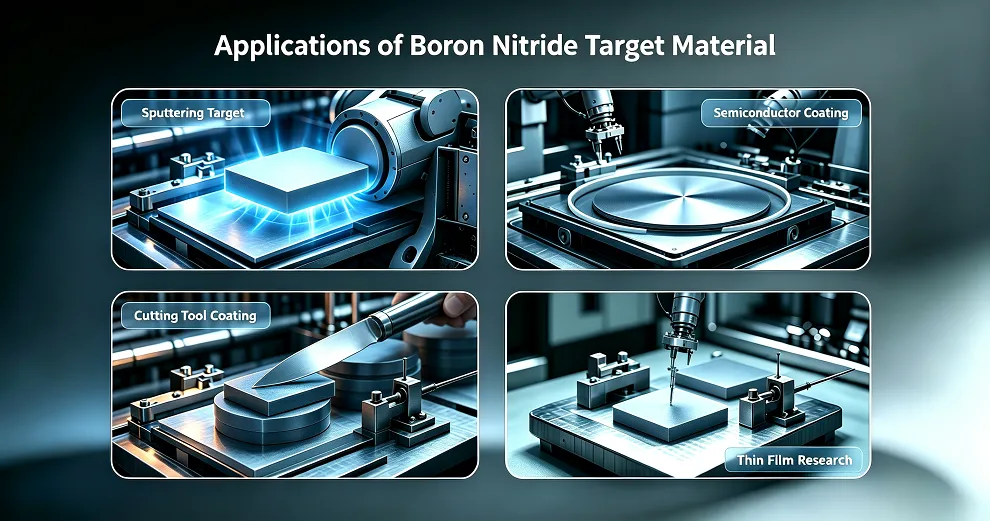
1. BN Thin-Film Deposition
A primary application of Boron Nitride Target Material is the production of boron nitride-based thin films through physical vapor deposition and related processes. The target provides a controlled source of boron and nitrogen-containing material for forming functional coatings on suitable substrates. Deposition parameters such as RF power, pressure, substrate temperature, gas composition, bias voltage, and target-to-substrate distance must be optimized according to the required film structure and properties.
2. Semiconductor and Electronic Thin Films
High-purity BN targets can be used in selected semiconductor and electronic processing environments where insulating, thermally stable, or chemically resistant thin films are required. Boron Nitride Target Material can contribute to the formation of dielectric or protective layers while maintaining a controlled impurity profile. In high-purity processing, target purity, outgassing behavior, particulate generation, and target bonding quality can directly influence deposition cleanliness.
3. Electrical Insulating Coatings
Because BN has high electrical resistivity, Boron Nitride Target Material can be used to produce insulating coatings for selected electronic and electrical components. The deposited film can provide electrical isolation while also offering useful thermal and chemical characteristics. Film thickness uniformity, defect density, adhesion, surface roughness, and dielectric performance should be controlled according to the electrical requirements of the final component.
4. Thermal Management and Protective Films
BN-based coatings can provide a combination of electrical insulation and thermal performance, making them attractive for selected thermal-management applications. Boron Nitride Target Material can be used to deposit protective or functional layers where electrical isolation is required without completely sacrificing heat transfer characteristics. The actual thermal conductivity of the deposited film can differ substantially from bulk BN because film density, crystallographic orientation, grain boundaries, defects, and deposition conditions strongly influence heat transport.
5. Wear and Surface Protection
BN-based thin films can be considered for selected surface-protection applications where low friction, chemical stability, thermal stability, or release characteristics are required. When Boron Nitride Target Material is used for coating deposition, the resulting film properties depend heavily on deposition energy, substrate temperature, film structure, thickness, and adhesion. Coating performance should therefore be evaluated at the film-system level rather than assumed directly from the properties of bulk BN target material.
6. Optical and Functional Coatings
High-purity BN targets may also be used in specialized functional coating processes where controlled optical, electrical, thermal, or chemical properties are required. The ability to control target composition and deposition parameters allows engineers to tailor film thickness and microstructure for specific applications. For advanced functional coatings, characterization of the deposited film—including composition, crystallinity, roughness, adhesion, and electrical behavior—is essential for confirming process performance.
Engineering Considerations for Boron Nitride Target Material Design
The design and selection of Boron Nitride Target Material should consider the complete sputtering system rather than target purity and dimensions alone. BN is a brittle ceramic, so excessive mechanical stress during machining, transportation, clamping, and installation can initiate microscopic defects that later develop into cracks during plasma operation. Thermal management is equally important because even a high-thermal-conductivity BN target can experience damaging temperature gradients when the cooling interface is inadequate or the power density is excessive. The backing plate, bonding layer, target thickness, mounting method, cooling channels, and coefficient of thermal expansion of adjacent materials should therefore be considered as one thermal-mechanical system. From a deposition perspective, RF power, chamber pressure, reactive gas composition, substrate temperature, target-to-substrate distance, erosion profile, and plasma uniformity all influence target utilization and film quality. For high-purity applications, engineers should additionally evaluate target density, porosity, impurity levels, surface cleanliness, outgassing, particulate generation, and packaging to minimize contamination during deposition.
Company Profile
JianXun Advanced Ceramic Technology is a professional manufacturer specializing in high-performance ceramic products, including Boron Nitride Target Material, alumina ceramics, boron nitride ceramics, silicon carbide ceramics, silicon nitride ceramics, aluminum nitride ceramics, mullite ceramics, quartz ceramics, and customized precision ceramic components. The company focuses on finished ceramic products with controlled material composition, density, mechanical properties, thermal performance, dimensional accuracy, surface quality, and customized geometries for demanding industrial applications.
Payment Terms: T/T, PayPal, Credit Card, Western Union, etc.
Shipment Terms: By air, by sea, by express, or according to customer request.
Storage Conditions: Store Boron Nitride Target Material in a clean, dry, dust-free environment and keep it protected from impact, moisture, contamination, and excessive mechanical loading. Precision-machined target surfaces should remain packaged until installation.
FAQs About Boron Nitride Target Material
1. Why is high-purity boron nitride important for sputtering target applications?
A: High purity is critical because impurities within Boron Nitride Target Material can be transferred into the deposited film during sputtering and may alter its electrical, optical, chemical, or thermal properties. Metallic impurities can be particularly problematic in semiconductor and high-purity coating processes because even low concentrations may affect device performance or introduce unwanted contamination. A high-purity h-BN target with controlled density and microstructure provides a more predictable source material for deposition and helps improve process consistency. However, the required purity level should be determined according to the film specification and the sensitivity of the specific deposition process rather than selecting the highest nominal purity automatically.
2. Why does boron nitride require different sputtering considerations from conductive metal targets?
A: Boron Nitride Target Material is electrically insulating, so its interaction with the plasma and power supply differs fundamentally from conventional conductive metal targets. RF sputtering or other suitable configurations are commonly considered for insulating ceramic targets because charge accumulation can interfere with stable plasma operation under inappropriate conditions. In addition, BN has ceramic brittleness and relatively low fracture tolerance compared with metals, making thermal gradients, target bonding, mechanical clamping, and local power density particularly important. Successful BN deposition therefore requires simultaneous optimization of the electrical, thermal, mechanical, and plasma conditions rather than simply transferring parameters from a metallic target.
3. What factors determine the service life of boron nitride target material?
A: The service life of Boron Nitride Target Material depends on target density, thickness, purity, bonding quality, cooling efficiency, sputtering power, erosion rate, plasma distribution, and thermal cycling. A target may reach premature failure if localized heating produces thermal stress faster than heat can be removed through the backing assembly. Non-uniform erosion can also reduce usable target volume even when significant material remains in low-erosion regions. Proper target geometry, uniform cooling, controlled power density, and monitoring of the erosion profile are therefore important for maximizing target utilization and maintaining stable deposition conditions.
4. How does target density affect the performance of boron nitride target material?
A: The density of Boron Nitride Target Material provides important information about its internal structure because excessive porosity can reduce mechanical strength and alter thermal transport. Porous regions may also influence gas release, plasma stability, target erosion, and particulate generation during deposition. A target with controlled density and uniform microstructure generally provides more predictable thermal and mechanical behavior under plasma loading. For demanding deposition applications, density should therefore be evaluated together with purity, porosity, crystallographic structure, thermal conductivity, and mechanical integrity rather than treated as an isolated specification.
5. How should a boron nitride target be bonded to a backing plate?
A: The bonding system for Boron Nitride Target Material must provide efficient heat transfer while accommodating the thermal expansion difference between the BN ceramic and backing plate. Poor bonding or excessive thermal expansion mismatch can create localized stress concentrations, resulting in debonding or cracking during repeated sputtering cycles. The bonding layer should therefore provide uniform thermal contact and sufficient mechanical compliance while remaining compatible with the vacuum and temperature conditions of the deposition system. For large-area targets, the bonding design becomes especially important because thermal gradients and accumulated stress increase with target size and power loading.