Advanced Technical Ceramics, Precision Alumina, Silicon Carbide, Crucible Parts



Precision Balls
Overview
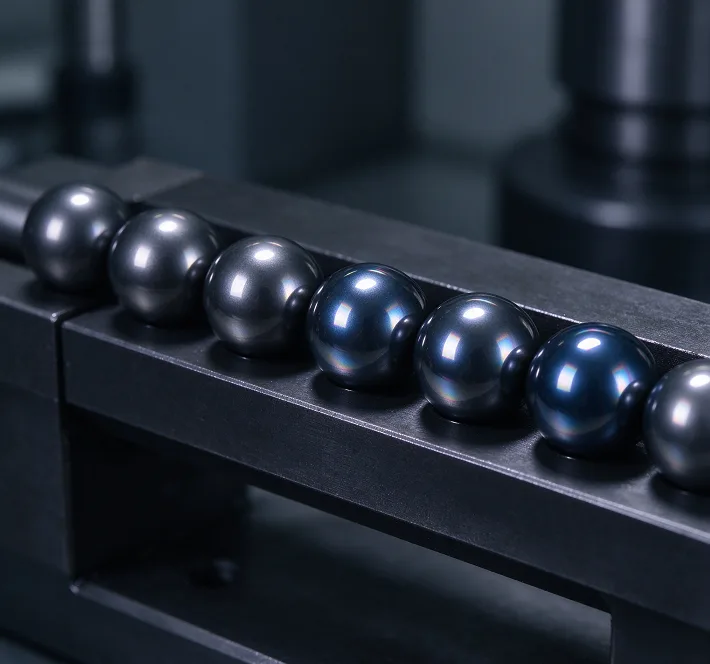
Silicon Carbide Precision Balls are high-performance spherical ceramic components manufactured from high-purity silicon carbide and engineered for applications requiring controlled dimensions, excellent wear resistance, low contamination, and stable performance under demanding mechanical, thermal, and chemical conditions. Unlike conventional steel or glass balls, Silicon Carbide Precision Balls combine very high hardness with low thermal expansion, high thermal conductivity, strong chemical stability, and excellent resistance to abrasive wear, making them particularly suitable where dimensional consistency and long-term surface integrity are more important than simply achieving high initial hardness. The spherical geometry is produced and finished to controlled tolerances so that the balls can function as grinding media, precision bearing elements, check-ball components, mixing or milling media, and other specialized ceramic parts. Their performance is strongly influenced by SiC purity, density, grain structure, sintering technology, surface finish, sphericity, diameter tolerance, and internal defect control. For precision applications, the quality of the finished surface is especially important because scratches, pits, pores, or localized dimensional deviations can create concentrated contact stresses and accelerate fatigue or wear. Silicon Carbide Precision Balls are therefore selected not only according to nominal diameter and hardness, but also according to the actual contact load, operating temperature, chemical environment, required dimensional tolerance, rotational speed, grinding conditions, and acceptable contamination level.

Classification and Key Characteristics of Silicon Carbide Precision Balls
1. High Hardness and Excellent Wear Resistance
The extremely high hardness of silicon carbide provides Silicon Carbide Precision Balls with outstanding resistance to abrasive wear, surface scratching, and dimensional degradation. This characteristic is particularly valuable when the balls are exposed to hard powders, mineral particles, ceramic slurries, or repeated mechanical contact. In grinding and milling systems, the ball surface continuously experiences impact, rolling, sliding, and compression, so a softer grinding medium can gradually lose material and change its diameter during operation. Silicon carbide substantially reduces this dimensional loss under suitable processing conditions, helping maintain more consistent grinding behavior over extended operating periods. For precision applications, this stability is important because even small changes in ball diameter can influence contact pressure, milling efficiency, packing behavior, or mechanical clearance. The high hardness of Silicon Carbide Precision Balls also reduces the risk of surface damage when they contact other hard ceramic components, although the operating system must still be designed to avoid excessive impact loading or sharp mechanical shocks.
2. Controlled Sphericity and Dimensional Accuracy
The primary distinction between ordinary ceramic balls and Silicon Carbide Precision Balls is the degree of control applied to their geometry and finished surface. Precision grinding and polishing can produce highly consistent spherical dimensions, controlled diameter tolerances, and improved surface smoothness, depending on the required grade. Accurate sphericity helps distribute contact forces more uniformly when the ball operates between mating surfaces, reducing localized stress concentrations caused by geometric irregularities. In grinding systems, consistent diameter also contributes to more predictable media packing and particle-size reduction. For bearing or valve-related applications, dimensional accuracy becomes even more important because clearance, contact area, and running behavior depend directly on ball geometry. Engineers should therefore specify diameter tolerance, roundness or sphericity, surface roughness, and inspection method rather than simply requesting a nominal ball diameter. Silicon Carbide Precision Balls can be manufactured in different diameter ranges and precision grades according to the application, with customized dimensional requirements available for specialized assemblies.
3. High Compressive Strength and Mechanical Stability
Silicon carbide has excellent resistance to compressive loading, allowing Silicon Carbide Precision Balls to maintain their structural integrity under substantial contact forces. A spherical ceramic component is often subjected to highly concentrated loads because the actual contact area between two hard surfaces can be very small. If the material contains excessive porosity, inclusions, cracks, or poorly controlled microstructure, these stresses can initiate localized damage and eventually lead to catastrophic fracture. High-density silicon carbide grades minimize such internal weaknesses and provide improved mechanical reliability. This makes precision SiC balls attractive for applications involving repeated compression, rolling contact, or high mechanical pressure. However, engineers should remember that high compressive strength does not mean unlimited impact resistance. Silicon carbide remains a brittle ceramic, and tensile stresses generated by impact, edge contact, mounting errors, or sudden thermal gradients can still cause fracture. Proper load distribution, controlled contact geometry, and careful handling are therefore essential when designing assemblies using Silicon Carbide Precision Balls.
4. Excellent Thermal Conductivity and Thermal Stability
Silicon carbide has substantially higher thermal conductivity than many conventional engineering ceramics, allowing Silicon Carbide Precision Balls to dissipate localized heat more effectively under suitable conditions. This characteristic can be useful in high-speed mechanical contact, thermal processing, or grinding operations where friction and repeated mechanical interaction generate heat at the contact surface. Efficient heat transfer can reduce localized temperature accumulation and help maintain more stable dimensional behavior during operation. Silicon carbide also has a relatively low coefficient of thermal expansion, meaning that its dimensions change less with temperature compared with many metals. This is particularly advantageous where dimensional precision must be maintained across temperature changes. Nevertheless, the actual thermal performance depends strongly on the SiC grade, density, microstructure, temperature, and surrounding environment. Silicon Carbide Precision Balls should therefore be evaluated according to the complete thermal cycle rather than selected solely from a room-temperature thermal conductivity value.
5. Strong Chemical and Corrosion Resistance
Dense silicon carbide offers excellent resistance to many acids, alkalis, solvents, molten materials, and chemically aggressive environments, making Silicon Carbide Precision Balls suitable for processing systems where conventional metallic balls could corrode or introduce unwanted contaminants. Chemical resistance is especially valuable in wet grinding, slurry processing, chemical powder preparation, and high-purity manufacturing because gradual surface dissolution or corrosion can alter the ball geometry and contaminate the processed material. The relatively inert nature of SiC helps maintain surface integrity under many demanding chemical conditions, although compatibility must always be evaluated against the actual process medium, temperature, concentration, and exposure time. Some molten substances, highly oxidizing environments, or specific chemical combinations can behave differently at elevated temperature. Selecting Silicon Carbide Precision Balls therefore requires consideration of both the ceramic composition and the process chemistry instead of assuming universal corrosion resistance.
6. Low Contamination for High-Purity Processing
One of the most important advantages of Silicon Carbide Precision Balls in advanced powder processing is their ability to reduce metallic contamination compared with conventional steel grinding media. During prolonged grinding, metallic media can release wear debris into the powder or slurry, potentially changing chemical composition, electrical properties, optical characteristics, or sintering behavior. High-purity SiC media can significantly reduce this source of contamination when the material system is properly selected and maintained. This makes precision silicon carbide balls particularly attractive for advanced ceramics, electronic materials, semiconductor-related powders, specialty chemicals, and other processes where contamination control is critical. The actual contamination level depends not only on the purity of the SiC but also on ball wear, grinding equipment, liners, process water or solvents, and handling procedures. For high-purity applications, engineers should define allowable impurity levels and perform compatibility testing rather than relying only on a generic “high-purity” designation.

Typical Specifications of Silicon Carbide Precision Balls
The following values represent typical engineering ranges for dense silicon carbide precision balls. Actual specifications can be customized according to material grade, manufacturing process, dimensional tolerance, surface finish, and application requirements.
| Property | Typical Specification |
|---|---|
| Product | Silicon Carbide Precision Balls |
| Material | Silicon Carbide (SiC) |
| SiC Content | Typically ≥99% for high-purity grades |
| Density | 3.10–3.20 g/cm³ |
| Hardness | HRA ≥90 |
| Flexural Strength | Typically ≥300 MPa, depending on grade |
| Compressive Strength | ≥2000 MPa |
| Thermal Conductivity | 80–120 W/m·K |
| Coefficient of Thermal Expansion | Approx. 4.0–4.8 × 10⁻⁶/K |
| Maximum Service Temperature | Up to approx. 1380°C, depending on grade and atmosphere |
| Water Absorption | Very low |
| Wear Resistance | Excellent |
| Chemical Resistance | Excellent |
| Thermal Shock Resistance | Excellent |
| Shape | Precision spherical |
| Diameter | Customized according to application |
| Diameter Tolerance | Customized precision grade |
| Sphericity / Roundness | Controlled according to application |
| Surface Finish | Ground or polished |
| Color | Black to dark gray |
| Customization | Diameter, tolerance, surface finish, grade, packaging |
From an engineering standpoint, the most important parameters are not necessarily the highest numerical values in the table. For Silicon Carbide Precision Balls, diameter tolerance, sphericity, surface roughness, density, internal defect level, and fracture resistance can have a greater influence on actual performance than nominal hardness alone. For grinding applications, ball diameter should be selected according to the feed-particle size, desired final particle size, mill geometry, slurry viscosity, and required energy input. Smaller balls provide a larger number of contact points and can be advantageous for fine particle processing, while larger balls generally provide greater impact energy. For precision mechanical applications, dimensional tolerance and surface finish become dominant factors because even small geometric deviations can change contact stress distribution. High-density grades are generally preferred when mechanical strength and wear resistance are critical, while the specific sintering route and microstructure should be considered when comparing different SiC products with similar chemical composition.
Applications of Silicon Carbide Precision Balls
1. Advanced Ceramic Powder Grinding
Silicon Carbide Precision Balls are highly suitable for grinding advanced ceramic powders where high hardness, wear resistance, and contamination control are required simultaneously. Ceramic powders such as alumina, zirconia, silicon carbide, silicon nitride, and other hard inorganic materials can rapidly wear conventional steel media, especially during prolonged wet or dry milling. SiC grinding media provide a hard, chemically stable contact surface that can withstand repeated particle impacts while minimizing metallic wear debris. Ball diameter should be selected according to the required particle-size reduction, mill chamber volume, powder loading, and milling speed. For ultra-fine processing, a combination of smaller precision balls and controlled milling conditions can increase the number of particle-media contacts and improve grinding efficiency. The low contamination characteristic of Silicon Carbide Precision Balls is particularly valuable when the final ceramic powder must maintain tightly controlled composition before pressing, sintering, or other downstream processing.
2. High-Purity Electronic and Semiconductor Material Processing
In electronic-material processing, even trace contamination from grinding media can influence the performance or reliability of the final material. Silicon Carbide Precision Balls can be used in selected high-purity powder preparation processes where metallic contamination must be minimized and mechanical wear must remain low. Their high hardness helps maintain media geometry during prolonged processing, while their chemical stability provides compatibility with many process liquids and inorganic materials. Applications may include preparation of ceramic powders, specialty electronic compounds, functional fillers, and other high-purity inorganic materials. The correct grade should be selected according to the required impurity profile, because “99% SiC” and ultra-high-purity SiC are not equivalent from a contamination-control perspective. Engineers should also consider the composition of the milling chamber and liner, since contamination can originate from multiple components rather than the grinding media alone. With an appropriately controlled system, Silicon Carbide Precision Balls can contribute to more stable and reproducible high-purity powder processing.
3. Precision Bearing and Rolling-Contact Components
The combination of high hardness, low thermal expansion, chemical stability, and low density makes Silicon Carbide Precision Balls technically attractive for specialized rolling-contact applications. When used as ceramic balls in precision bearing systems, they can provide stable dimensional behavior and reduced centrifugal loading compared with heavier metallic balls, particularly at elevated rotational speeds. The low coefficient of thermal expansion can also help maintain predictable internal clearances as operating temperature changes. However, bearing applications require much tighter control of sphericity, diameter variation, surface roughness, and internal defects than ordinary grinding-media applications. The mating raceway material and lubrication system must also be compatible with the ceramic ball surface. Engineers should therefore specify the required precision grade and inspection criteria rather than selecting media-grade SiC balls for a precision bearing assembly. Under properly designed conditions, Silicon Carbide Precision Balls can provide long-term dimensional stability and reliable rolling contact in demanding precision mechanisms.
4. Chemical and Abrasive Slurry Processing
Silicon Carbide Precision Balls can be used in wet grinding and slurry-processing systems where both abrasive particles and chemically aggressive liquids are present. In these environments, metallic media may suffer from corrosion and simultaneously introduce metal ions or wear particles into the slurry. Dense SiC offers a combination of high hardness and chemical resistance that helps maintain the integrity of the grinding media during prolonged exposure. This is particularly useful when processing mineral powders, ceramic suspensions, specialty inorganic compounds, or other abrasive materials in water-based or solvent-based systems. Ball diameter, slurry viscosity, milling speed, and solids concentration must be considered together because excessive collision energy can cause unnecessary media wear even when the material itself has excellent wear resistance. The use of Silicon Carbide Precision Balls can therefore improve media durability and contamination control, but optimal performance still depends on correct process parameter selection.
5. Fine Grinding of Hard Minerals and Inorganic Materials
Hard minerals and inorganic powders can require significant mechanical energy for particle-size reduction, creating severe wear conditions inside milling equipment. Silicon Carbide Precision Balls are well suited to these applications because their high hardness allows them to resist abrasion from hard feed materials while maintaining a relatively stable spherical geometry. This is beneficial when consistent grinding conditions are required over long production cycles. The spherical shape provides repeated impact and shear interactions between the media and particles, while different ball diameters can be selected to adjust the balance between impact energy and contact frequency. For coarse feed material, larger balls may be appropriate during initial size reduction, while smaller media can be used for subsequent fine grinding. When processing valuable or high-purity inorganic powders, the low metallic contamination potential of Silicon Carbide Precision Balls can provide an additional advantage over conventional steel media.
6. Specialized Valve, Metering, and Fluid-Control Components
Precision ceramic balls can also function as moving sealing or flow-control elements in specialized valve and metering assemblies. Silicon Carbide Precision Balls provide excellent hardness and chemical resistance where the ball repeatedly contacts a seat while exposed to abrasive or corrosive media. Their dimensional stability helps maintain predictable contact geometry, while their resistance to wear can reduce changes in sealing behavior over time. These properties are particularly useful when fluid streams contain fine particles that could rapidly damage softer materials. However, successful valve applications require careful matching between ball diameter, seat geometry, surface finish, pressure differential, flow velocity, and chemical environment. Because silicon carbide is brittle, impact during assembly and excessive point loading must also be controlled. When properly engineered, Silicon Carbide Precision Balls can provide a durable ceramic alternative for specialized fluid-control components operating under severe wear or corrosion conditions.
Engineering Considerations for Silicon Carbide Precision Ball Selection
When specifying Silicon Carbide Precision Balls, engineers should evaluate the complete operating system rather than focusing only on SiC purity or hardness. For grinding applications, the most important variables include ball diameter, particle size, mill speed, filling ratio, slurry concentration, grinding time, chamber material, and desired final particle size; these parameters determine the collision energy and wear rate of the media. For mechanical applications, diameter tolerance, sphericity, surface roughness, contact stress, preload, rotational speed, lubrication, and mating-material compatibility become more important. Because SiC is a brittle ceramic, sharp impact, excessive point loading, edge contact, or assembly damage can create microscopic defects that later develop into fracture under repeated loading. Thermal applications require additional consideration of temperature gradients, heating and cooling rates, oxidation conditions, and differences in thermal expansion between the ball and surrounding components. Engineers should also consider the manufacturing route because pressureless sintered, reaction-bonded, hot-pressed, and other SiC grades can exhibit different density, microstructure, strength, thermal conductivity, and wear characteristics. For high-precision applications, dimensional inspection and surface-quality requirements should be defined before production so that the finished Silicon Carbide Precision Balls match the actual mechanical or processing requirements.
Company Profile
JianXun Advanced Ceramic Technology is a professional manufacturer specializing in high-performance ceramic products, including Silicon Carbide Precision Balls, alumina ceramics, boron nitride ceramics, silicon carbide ceramics, silicon nitride ceramics, aluminum nitride ceramics, mullite ceramics, quartz ceramics, and customized precision ceramic components. The company focuses on finished ceramic products with controlled material composition, density, mechanical properties, thermal performance, dimensional accuracy, surface quality, and customized geometries for demanding industrial applications.
Payment Terms: T/T, PayPal, Credit Card, Western Union, etc.
Shipment Terms: By air, by sea, by express, or according to customer request.
Storage Conditions: Store Silicon Carbide Precision Balls in a clean, dry, dust-free environment and protect them from direct impact, contamination, and contact with hard foreign objects. Precision balls should remain in their protective packaging until installation or use to minimize surface damage and handling-related defects.
FAQs About Silicon Carbide Precision Balls
Q1: Why are Silicon Carbide Precision Balls suitable for high-wear grinding applications?
A: Silicon Carbide Precision Balls combine very high hardness, high compressive strength, and strong resistance to abrasive wear, allowing them to withstand repeated contact with hard powders and particles without rapidly losing their surface geometry. During milling, the media experience continuous impact, rolling, sliding, and compression, and conventional materials can gradually wear and release debris into the processed material. Dense SiC reduces this wear under suitable operating conditions and can therefore provide more stable grinding performance over longer processing cycles. The actual service life depends on ball diameter, media loading, milling speed, feed hardness, slurry chemistry, mill-liner material, and collision intensity, so application-specific testing remains important.
Q2: Why choose Silicon Carbide Precision Balls instead of steel grinding balls?
A: The primary reasons are high hardness, low metallic contamination, chemical resistance, low thermal expansion, and excellent wear performance. Steel balls can be highly effective for many conventional milling applications, but they may release iron or other metallic wear particles during prolonged grinding, which can be undesirable for high-purity ceramic or electronic materials. Silicon Carbide Precision Balls provide a non-metallic grinding medium with excellent resistance to many abrasive and chemically demanding conditions. They are especially attractive when contamination control is important, although the total system—including the mill chamber, liner, seals, and process liquid—must also be evaluated because contamination can originate from other components.
Q3: How should the diameter of Silicon Carbide Precision Balls be selected?
A: Ball diameter should be selected according to feed-particle size, target particle size, mill configuration, material hardness, slurry viscosity, and required grinding energy. Larger Silicon Carbide Precision Balls generally provide higher individual impact energy and can be useful for coarse or difficult-to-break particles, while smaller balls provide more contact points and can be advantageous for fine grinding and narrow particle-size distributions. In some processes, using multiple ball sizes can improve grinding efficiency by combining different impact and shear mechanisms. The optimal diameter cannot therefore be determined from the material alone; it should be established from the complete milling process and validated through controlled trials.
Q4: Can Silicon Carbide Precision Balls be used in wet grinding systems?
A: Yes, dense Silicon Carbide Precision Balls can be used in many wet grinding and slurry-processing applications because silicon carbide offers strong resistance to abrasion and good chemical stability. This makes the material suitable for processing abrasive ceramic powders, minerals, inorganic compounds, and other materials in water-based or compatible solvent systems. However, chemical compatibility should be evaluated at the actual concentration and operating temperature, particularly when strong oxidizing or highly reactive media are involved. Slurry viscosity, solids loading, ball size, milling speed, and chamber design also affect wear and grinding efficiency, so wet-grinding performance should be evaluated as a complete process rather than based solely on the ball material.
Q5: What factors determine the service life of Silicon Carbide Precision Balls?
A: The service life of Silicon Carbide Precision Balls depends on much more than nominal SiC hardness. Important factors include material density, microstructure, internal defects, ball diameter, surface finish, operating load, impact intensity, rotational speed, feed-particle hardness, chemical environment, temperature, and the condition of the surrounding equipment. Excessive impact or misalignment can generate tensile stresses in the ceramic and initiate microscopic cracks even when the material has excellent compressive strength. For precision mechanical applications, scratches and surface defects are particularly important because they can become stress-concentration sites under repeated contact. Selecting the correct SiC grade, controlling operating conditions, and protecting the balls from impact during handling and installation are therefore essential for achieving long service life.