Advanced Technical Ceramics, Precision Alumina, Silicon Carbide, Crucible Parts



Silicon Nitride-bonded Silicon Carbide

Overview
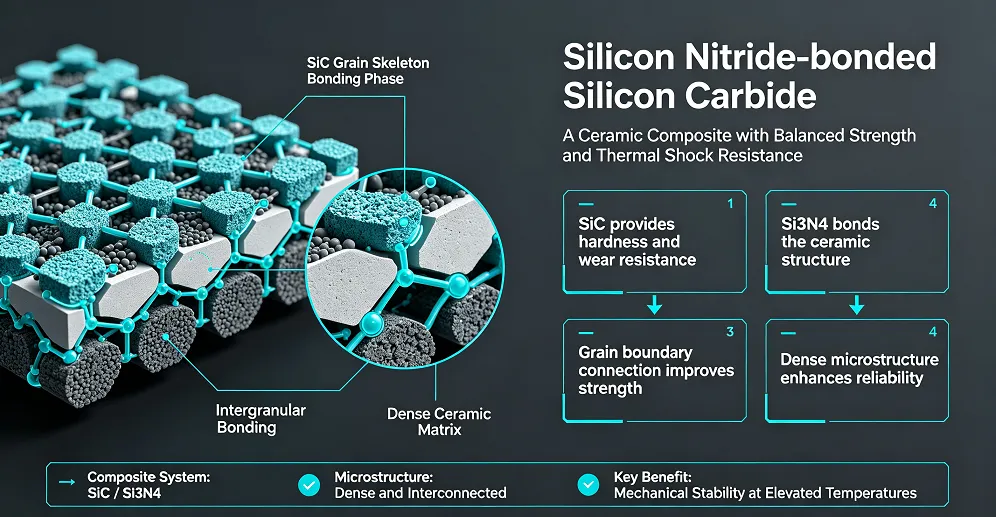
Silicon Nitride-Bonded Silicon Carbide is a high-performance composite ceramic engineered by combining a silicon carbide structural phase with a silicon nitride bonding phase, creating a material system that balances the excellent thermal, mechanical, and chemical properties of SiC with the high-temperature structural stability of Si₃N₄. Unlike conventional oxide-bonded refractory ceramics, this material uses silicon nitride as the bonding phase between SiC particles, producing a relatively dense and strongly interconnected ceramic structure with excellent resistance to thermal shock, oxidation, abrasion, and chemical attack. The SiC phase provides high hardness, high thermal conductivity, low thermal expansion, and strong wear resistance, while the Si₃N₄ bonding phase helps maintain structural integrity at elevated temperatures and improves the stability of the SiC particle network. This combination makes Overview
Silicon Nitride-Bonded Silicon Carbide is a high-performance composite ceramic engineered by combining a silicon carbide structural phase with a silicon nitride bonding phase, creating a material system that balances the excellent thermal, mechanical, and chemical properties of SiC with the high-temperature structural stability of Si₃N₄. Unlike conventional oxide-bonded refractory ceramics, this material uses silicon nitride as the bonding phase between SiC particles, producing a relatively dense and strongly interconnected ceramic structure with excellent resistance to thermal shock, oxidation, abrasion, and chemical attack. The SiC phase provides high hardness, high thermal conductivity, low thermal expansion, and strong wear resistance, while the Si₃N₄ bonding phase helps maintain structural integrity at elevated temperatures and improves the stability of the SiC particle network. This combination makes Silicon Nitride-Bonded Silicon Carbide particularly valuable for kiln furniture, furnace components, burner components, protective structures, refractory supports, heat-treatment equipment, and other applications where repeated thermal cycling and mechanical loading can cause conventional refractory materials to crack, deform, or wear rapidly. One of its major engineering advantages is its relatively low thermal expansion combined with good thermal conductivity, which helps reduce thermal gradients and associated thermal stresses during rapid heating and cooling. The material also exhibits excellent resistance to molten materials, corrosive process atmospheres, and abrasive particles under suitable operating conditions. However, the performance of a silicon nitride-bonded SiC component depends strongly on SiC particle size distribution, Si₃N₄ bonding content, porosity, manufacturing process, microstructure, surface condition, operating atmosphere, and component geometry. Engineers should therefore distinguish between the nominal properties of the constituent materials and the actual performance of the finished component. For high-temperature equipment, factors such as load-bearing temperature, oxidation environment, thermal cycling frequency, contact stress, and chemical compatibility should be considered when selecting Silicon Nitride-Bonded Silicon Carbide.
Classification and Key Characteristics of Silicon Nitride-Bonded Silicon Carbide
1. High-Temperature Structural Stability
Silicon Nitride-Bonded Silicon Carbide provides excellent structural stability under demanding high-temperature conditions because its SiC skeleton and Si₃N₄ bonding phase form a strong interconnected ceramic structure. The material can retain useful mechanical strength at temperatures where many conventional refractory materials begin to soften, creep, or experience substantial dimensional changes. This makes it suitable for components that must support loads or maintain precise geometry during repeated firing and thermal treatment cycles. The actual load-bearing capability depends on temperature, atmosphere, component geometry, porosity, and applied stress, so the room-temperature strength value should never be treated as the allowable working stress at elevated temperature. In kiln furniture and furnace structures, the ability to maintain geometry over repeated cycles is particularly important because even small amounts of deformation can change product positioning, airflow, thermal distribution, or mechanical clearance. Properly designed silicon nitride-bonded SiC therefore provides a useful combination of structural rigidity and high-temperature durability.
2. Excellent Thermal Shock Resistance
One of the defining characteristics of Silicon Nitride-Bonded Silicon Carbide is its ability to withstand repeated temperature changes with relatively low risk of catastrophic thermal cracking when properly designed and operated. Silicon carbide has high thermal conductivity and a low coefficient of thermal expansion, allowing heat to move through the component efficiently while limiting the amount of dimensional change caused by temperature variations. The silicon nitride bonding phase further contributes to the integrity of the composite microstructure. This combination is particularly useful in kiln furniture and furnace components that experience rapid heating and cooling, intermittent operation, or frequent production cycles. Thermal shock resistance is nevertheless strongly affected by component thickness, shape, wall section, internal holes, corners, surface defects, and mounting constraints. A large thick component with sharp geometric transitions can develop substantially higher thermal stresses than a thin component with uniform geometry. For this reason, thermal shock performance should always be considered together with component design and actual heating and cooling rates.
3. High Thermal Conductivity and Efficient Heat Transfer
The high thermal conductivity of the SiC phase allows Silicon Nitride-Bonded Silicon Carbide components to transfer heat efficiently through their structure. This property can help reduce localized temperature differences and improve thermal uniformity within furnace and kiln assemblies. In ceramic firing applications, excessive temperature gradients can cause uneven sintering, warpage, dimensional variation, or residual stress in the processed products. A thermally conductive kiln component can help distribute heat more evenly, although the overall furnace design, gas flow, heating-element arrangement, loading density, and product geometry remain important. Compared with many low-conductivity refractory materials, Si3N4-bonded SiC can respond more quickly to changes in furnace temperature because heat propagates efficiently through the ceramic structure. Engineers should also consider the trade-off between thermal conductivity and insulation requirements: a material designed for efficient heat transfer may not be appropriate where the component's primary purpose is thermal insulation.
4. Low Thermal Expansion and Dimensional Stability
The relatively low coefficient of thermal expansion of Silicon Nitride-Bonded Silicon Carbide helps minimize dimensional changes during heating and cooling. This characteristic is particularly valuable for kiln furniture, support plates, setters, beams, and other components that must remain geometrically stable over many thermal cycles. Excessive thermal expansion can generate mechanical interference between components, change support conditions, or introduce stress at mounting interfaces. Low expansion also helps reduce thermal stress when temperature gradients occur across a component. However, the overall dimensional stability of a finished product depends not only on CTE but also on manufacturing shrinkage, porosity, residual stresses, oxidation, creep, and mechanical loading. For precision furnace components, engineers should therefore evaluate long-term dimensional stability at the actual operating temperature rather than relying solely on the nominal room-temperature CTE.
5. Strong Wear and Abrasion Resistance
The SiC phase gives Silicon Nitride-Bonded Silicon Carbide excellent resistance to mechanical wear and abrasion. This is especially important when components are exposed to repeated contact with ceramic products, refractory surfaces, powders, particles, or mechanical loading during furnace operation. High hardness helps prevent rapid surface damage, while the bonded microstructure maintains the structural integrity of the component. Applications involving sliding contact, particle movement, or repeated loading can therefore benefit from the material's high wear resistance. However, wear behavior depends on the contact pressure, particle hardness, particle concentration, sliding speed, surface roughness, and temperature. If a component is subjected to repeated impact rather than gradual abrasive contact, its brittleness must also be considered. Good wear resistance does not mean that the material is immune to chipping or fracture under uncontrolled mechanical impact.
6. Excellent Resistance to Chemical Attack and Process Atmospheres
Silicon Nitride-Bonded Silicon Carbide provides strong resistance to many chemical environments encountered in high-temperature industrial processing. The SiC phase is chemically stable under many conditions, while the silicon nitride bonding structure provides a refractory ceramic matrix with good resistance to thermal and chemical degradation. This makes the material suitable for environments containing corrosive gases, process vapors, ceramic compounds, and other aggressive species. The actual chemical resistance depends strongly on temperature and atmosphere. Oxidizing environments can gradually modify silicon-containing surfaces at elevated temperatures, while molten phases or specific reactive compounds may attack the material more aggressively than expected from room-temperature chemical compatibility data. Therefore, engineers should evaluate the exact process chemistry, temperature, atmosphere, exposure duration, and presence of molten materials before selecting the grade. For long-life applications, the corrosion mechanism should be considered together with thermal cycling and mechanical loading.
Typical Specifications of Silicon Nitride-Bonded Silicon Carbide
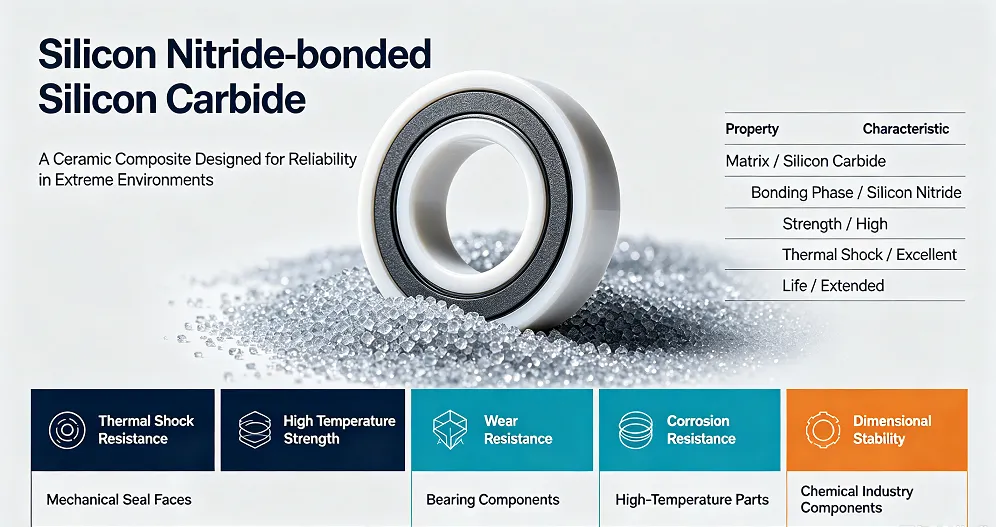
The following values represent typical engineering ranges and should be confirmed according to the specific manufacturing grade and component design.
| Property | Typical Specification |
|---|---|
| Product | Silicon Nitride-Bonded Silicon Carbide |
| Material System | SiC + Si₃N₄ bonding phase |
| SiC Content | Typically 70–90% depending on grade |
| Si₃N₄ Content | Typically 10–30% depending on formulation |
| Density | Approx. 2.5–2.8 g/cm³ |
| Apparent Porosity | Typically 10–20% |
| Flexural Strength | Approx. 100–250 MPa |
| Compressive Strength | Typically ≥500–1000 MPa |
| Hardness | High, depending on SiC content and microstructure |
| Thermal Conductivity | Approx. 15–30 W/m·K |
| CTE | Approx. 3.5–4.5 × 10⁻⁶/K |
| Maximum Service Temperature | Approximately 1400–1600°C depending on atmosphere and grade |
| Thermal Shock Resistance | Excellent |
| Wear Resistance | Excellent |
| Chemical Resistance | Excellent under suitable conditions |
| Oxidation Resistance | Good to excellent depending on temperature and atmosphere |
| Water Absorption | Low |
| Manufacturing Form | Plates, beams, tubes, rollers, supports, kiln furniture, custom components |
| Surface | As-fired, ground, machined, or customized |
| Dimensions | Customized according to drawing and application |
The above specifications should be treated as representative rather than universal values because silicon nitride-bonded SiC is a family of engineered composite ceramics rather than a single standardized composition. Increasing SiC content can influence thermal conductivity, hardness, and refractory behavior, while changing the Si₃N₄ bonding phase can alter strength, porosity, oxidation response, and thermal performance. Component geometry also has a major influence on practical service life. For example, a thin kiln setter may experience very different thermal stresses from a thick structural beam even when both are manufactured from the same material grade. Engineers should therefore specify the required density, composition, operating temperature, load, atmosphere, thermal cycling profile, dimensions, and surface requirements when ordering Silicon Nitride-Bonded Silicon Carbide products.
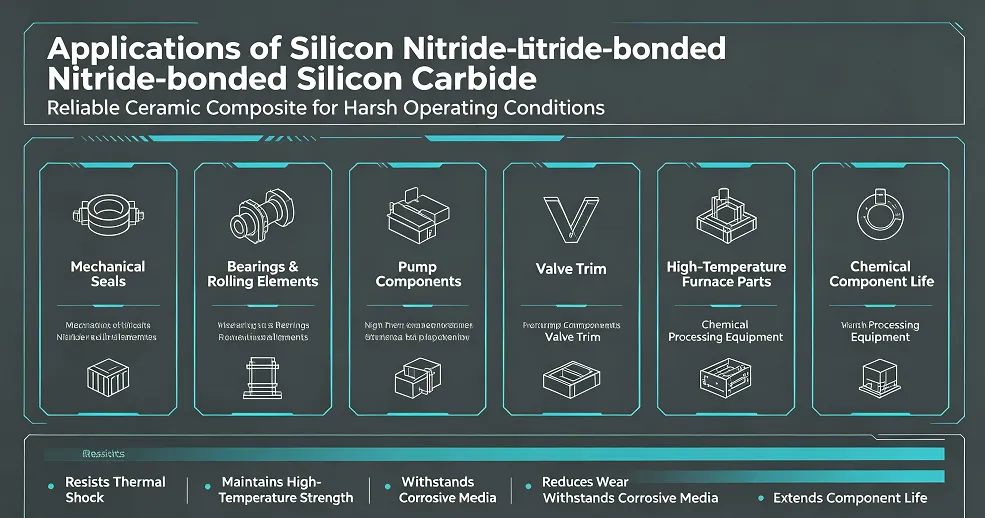
Applications of Silicon Nitride-Bonded Silicon Carbide
1. Ceramic Kiln Furniture and Firing Supports
Silicon Nitride-Bonded Silicon Carbide is widely suited to kiln furniture because ceramic firing equipment requires components that can withstand high temperatures, repeated thermal cycling, mechanical loading, and contact with ceramic products. Setters, support beams, plates, posts, and other kiln furniture components must remain sufficiently rigid during firing while resisting warpage and thermal shock. The low thermal expansion and high thermal conductivity of Si3N4-bonded SiC help reduce thermal stress during heating and cooling, while the hard SiC phase provides strong resistance to wear caused by repeated handling and contact. The material can also maintain useful structural properties through many firing cycles under suitable conditions, reducing the frequency of replacement. When designing kiln furniture, engineers should consider the span, load distribution, support points, component thickness, firing temperature, heating rate, cooling rate, and kiln atmosphere. These factors determine whether a component remains stable or gradually develops deformation and cracking.
2. Silicon Carbide Kiln Beams and Structural Supports
Large kiln beams and structural supports are exposed to bending loads in addition to thermal stresses, making material selection particularly important. Silicon Nitride-Bonded Silicon Carbide can provide a useful combination of low density, high-temperature strength, low thermal expansion, and thermal shock resistance for these applications. A beam must support the required load without excessive deflection, while its geometry must remain stable through repeated firing cycles. Compared with conventional dense refractory materials, the relatively low density of Si3N4-bonded SiC can help reduce the dead weight carried by the furnace structure. The material's thermal stability also helps minimize dimensional changes that could alter support conditions during heating. Engineers should calculate bending stress and deflection based on the beam's span, cross-section, support configuration, applied load, and temperature-dependent strength. Handling during installation is equally important because long ceramic beams are vulnerable to impact and bending damage before entering service.
3. High-Temperature Rollers and Furnace Conveying Components
Continuous kiln systems require rollers and conveying components capable of operating for long periods at elevated temperatures while maintaining dimensional stability. Silicon Nitride-Bonded Silicon Carbide can be used for selected high-temperature rollers because of its thermal shock resistance, wear resistance, and relatively low thermal expansion. During continuous operation, the roller must withstand the weight of ceramic products while rotating or supporting them through repeated thermal zones. Excessive thermal deformation or surface wear can produce runout, product movement, uneven loading, or process instability. The SiC phase provides a hard surface with good resistance to mechanical wear, while the Si₃N₄ bonding structure supports overall structural integrity. Engineers should consider roller diameter, wall thickness, span, rotational speed, bearing arrangement, product load, temperature distribution, and atmosphere. Surface geometry is particularly important because even small changes in roller straightness or roundness can affect product alignment in continuous firing systems.
4. Furnace Liners, Supports, and High-Temperature Structural Components
Industrial furnaces require structural ceramic components that can maintain mechanical integrity under prolonged thermal exposure. Silicon Nitride-Bonded Silicon Carbide can be manufactured into plates, supports, tubes, beams, and other custom structures for high-temperature furnace assemblies. Its thermal conductivity allows heat to move through the material effectively, while its low thermal expansion reduces dimensional changes during temperature fluctuations. The material can also tolerate repeated heating and cooling better than many conventional brittle refractory systems when the geometry and operating conditions are properly controlled. Such components may serve as supports, protective structures, spacers, or load-bearing elements depending on the furnace design. Engineers should distinguish between components exposed directly to flame or reactive gases and those located within a controlled process atmosphere because oxidation and chemical interaction can differ substantially. Long-term creep, mechanical load, and thermal cycling should also be evaluated for continuously operated equipment.
5. High-Temperature Chemical and Process Equipment
The chemical stability of Silicon Nitride-Bonded Silicon Carbide makes it useful for selected process equipment exposed to corrosive gases, vapors, powders, and high-temperature chemical environments. Components such as protective tubes, support structures, trays, and specialized process fixtures can benefit from the material's resistance to wear and chemical attack. In high-temperature chemical processing, a component must often resist several degradation mechanisms simultaneously: thermal stress, chemical corrosion, abrasion, oxidation, and mechanical loading. A material that performs well against only one of these mechanisms may still fail prematurely. Si3N4-bonded SiC provides a balanced property set, but the actual process chemistry must be evaluated carefully. Engineers should provide the composition of the process atmosphere, operating temperature, exposure time, pressure, presence of liquid or molten phases, and mechanical loading when determining material suitability.
6. Refractory Components for Powder and Material Processing
Powder-processing equipment can expose refractory components to continuous abrasion from moving particles and repeated thermal cycling. Silicon Nitride-Bonded Silicon Carbide combines high hardness with strong thermal stability, making it appropriate for selected trays, liners, supports, setters, and other components used in high-temperature powder treatment. The SiC phase resists abrasive contact while the low expansion of the composite reduces dimensional changes during repeated heating. This can be particularly important when powder or ceramic products must remain positioned accurately throughout a thermal treatment process. Surface condition should be considered because rough or damaged areas can accumulate powders and create localized deposits. Component geometry should also minimize sharp internal corners where thermal stress can concentrate. For long-term service, engineers should evaluate particle hardness, loading rate, furnace temperature, atmosphere, cleaning method, and the expected number of thermal cycles.
7. Ceramic Sintering and Heat-Treatment Fixtures
During ceramic sintering, furnace fixtures can experience prolonged exposure to high temperature combined with direct contact with powders or finished ceramic components. Silicon Nitride-Bonded Silicon Carbide can provide stable support and separation surfaces where resistance to thermal shock, deformation, and chemical interaction is required. The material's low thermal expansion can reduce dimensional movement during sintering, helping maintain the relative position of components. Its high thermal conductivity can also influence heat distribution around the fixture and processed parts. For advanced ceramic production, the fixture material should not introduce unacceptable contamination or react with the ceramic powder at processing temperature. Engineers should therefore evaluate chemical compatibility, surface cleanliness, material purity, and possible interaction with the specific ceramic composition. The choice of surface finish may also affect product release and powder adhesion after repeated firing cycles.
8. Customized High-Temperature Ceramic Components
One of the major advantages of Silicon Nitride-Bonded Silicon Carbide is its suitability for engineered components rather than only standard refractory shapes. Manufacturers can produce customized plates, tubes, beams, rollers, supports, setters, burner-related components, and complex structural parts according to application drawings. Customization is particularly useful when the equipment requires specific mounting holes, slots, thicknesses, support surfaces, or dimensional tolerances. However, complex geometry must be designed with ceramic manufacturing and thermal-stress behavior in mind. Sharp corners, abrupt thickness transitions, narrow sections, and large unsupported spans can increase the probability of cracking or deformation. Engineers should therefore provide not only a drawing but also operating temperature, thermal cycling conditions, mechanical load, atmosphere, chemical exposure, and expected service life. This information allows the material composition and geometry to be optimized together rather than treating the ceramic component as a simple replacement part.
Engineering Considerations for Silicon Nitride-Bonded Silicon Carbide
When designing Silicon Nitride-Bonded Silicon Carbide components, the first consideration should be the relationship between composition, microstructure, temperature, and mechanical loading. This material is a composite rather than a single-phase SiC ceramic, so the amount and distribution of the silicon nitride bonding phase can significantly influence density, porosity, thermal conductivity, strength, oxidation behavior, and high-temperature performance. Engineers should then evaluate the actual temperature profile rather than only the maximum furnace temperature, because repeated heating and cooling can generate fatigue-like thermal damage over many cycles. Component thickness and geometry are particularly important because large temperature differences across thick sections generate higher thermal stresses. Mechanical loading should be analyzed at operating temperature, especially for beams, rollers, plates, and supports where bending and creep may become more important than simple compressive strength. The furnace atmosphere must also be considered because oxidation behavior differs between air, inert atmospheres, reducing environments, and vacuum conditions. Chemical compatibility is equally important when the component contacts molten phases, alkaline compounds, glassy materials, ceramic powders, or corrosive process gases. Finally, handling and installation should be carefully controlled because ceramic components can be damaged by impact, point loading, and improper support before they ever reach operating temperature. The best performance is achieved when material grade, geometry, machining, support configuration, operating atmosphere, thermal cycle, and applied load are designed as one integrated system.
Company Profile
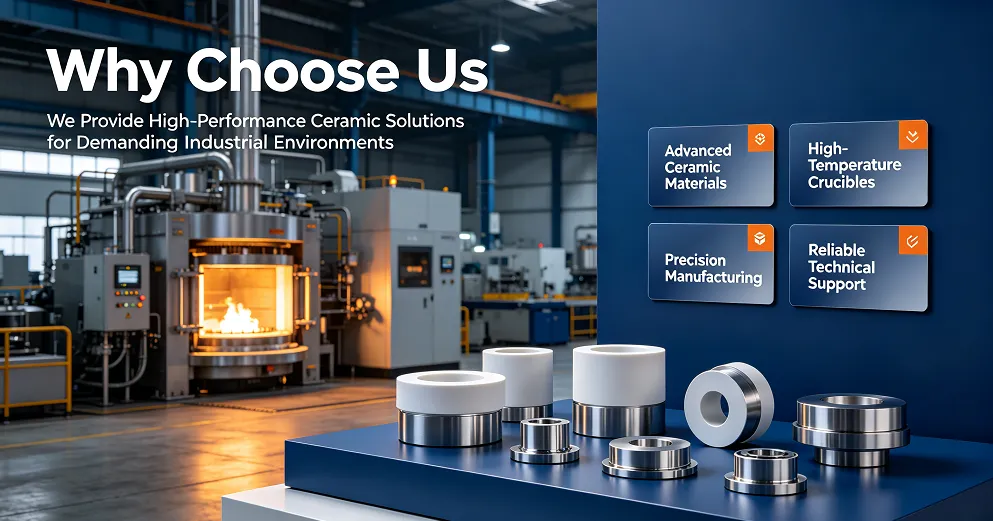
JianXun Advanced Ceramic Technology is a professional manufacturer specializing in high-performance ceramic products, including Silicon Nitride-Bonded Silicon Carbide, alumina ceramics, boron nitride ceramics, silicon carbide ceramics, silicon nitride ceramics, aluminum nitride ceramics, mullite ceramics, quartz ceramics, and customized precision ceramic components. The company focuses on finished ceramic products with controlled material composition, density, mechanical properties, thermal performance, dimensional accuracy, surface quality, and customized geometries for demanding industrial applications.
Payment Terms: T/T, PayPal, Credit Card, Western Union, etc.
Shipment Terms: By air, by sea, by express, or according to customer request.
Storage Conditions: Store products in a clean, dry, and well-protected environment. Avoid impact, excessive moisture, contamination, and concentrated mechanical loading during storage and handling. Large ceramic components should be supported appropriately to prevent bending or accidental damage.
FAQs About Silicon Nitride-Bonded Silicon Carbide
Q1: What is Silicon Nitride-Bonded Silicon Carbide and how is it different from conventional SiC ceramics?
A: Silicon Nitride-Bonded Silicon Carbide is a composite ceramic in which silicon carbide particles or grains form the main structural phase and silicon nitride forms the bonding network between them. This differs from dense pressureless-sintered SiC, where the SiC grains are consolidated through a sintering process and additives may be used to achieve densification. The silicon nitride bonding structure gives the composite a useful combination of thermal shock resistance, high-temperature stability, low thermal expansion, and mechanical integrity, while the SiC phase contributes hardness, wear resistance, thermal conductivity, and chemical stability. The two materials therefore should not be considered interchangeable. The best choice depends on operating temperature, mechanical loading, thermal cycling, atmosphere, chemical exposure, density requirements, and component geometry.
Q2: Why does Silicon Nitride-Bonded Silicon Carbide have excellent thermal shock resistance?
A: The material benefits from the combination of relatively low thermal expansion and good thermal conductivity. Low expansion limits the amount of dimensional change generated by a temperature increase, while thermal conductivity allows heat to move through the component more efficiently and reduces severe localized temperature differences. Together, these characteristics can reduce thermal stresses during rapid heating and cooling. Silicon Nitride-Bonded Silicon Carbide is therefore particularly useful in kiln furniture and furnace components subjected to repeated thermal cycles. However, thermal shock resistance is strongly dependent on component geometry, thickness, surface condition, support conditions, and heating or cooling rate. A poorly designed thick component can still crack despite the inherently good thermal shock characteristics of the material.
Q3: How should the operating temperature of Silicon Nitride-Bonded Silicon Carbide be determined?
A: The allowable operating temperature should be determined from the specific material grade and actual service environment rather than from a single nominal temperature value. Engineers should consider the furnace atmosphere, exposure duration, applied mechanical load, thermal cycling frequency, component dimensions, oxidation conditions, and chemical interaction with surrounding materials. A component operating under continuous mechanical loading at high temperature may have a lower practical service limit than an unloaded component exposed to the same temperature. Silicon Nitride-Bonded Silicon Carbide should therefore be selected using temperature-dependent mechanical and chemical performance data whenever possible. The actual process temperature profile, including heating and cooling rates, should also be provided to the ceramic manufacturer for critical applications.
Q4: Why can Silicon Nitride-Bonded Silicon Carbide components crack during installation or operation?
A: Although the material has excellent high-temperature strength and thermal shock resistance, it remains a ceramic and therefore has limited tolerance for impact, tensile stress, and concentrated mechanical loading. Cracks may originate from handling damage, sharp corners, machining defects, excessive tightening, uneven support, thermal gradients, or mechanical overload. During operation, differential expansion between the ceramic component and surrounding metal structures can also create stresses if the component is constrained. Silicon Nitride-Bonded Silicon Carbide should therefore be installed with appropriate clearance and support, avoiding point contact and excessive interference. For large plates, beams, and rollers, the support configuration should distribute loads uniformly and account for thermal expansion during operation.
Q5: How should engineers choose Silicon Nitride-Bonded Silicon Carbide for kiln furniture or furnace components?
A: Selection should begin with the actual operating conditions rather than simply choosing the highest-strength grade. Engineers should provide the operating temperature, atmosphere, heating and cooling cycle, component dimensions, load, support span, contact materials, chemical exposure, expected number of cycles, and required service life. For kiln furniture, weight, deflection, thermal expansion, thermal shock, and product contamination are often important considerations, while structural furnace components may place greater emphasis on high-temperature strength, creep resistance, and dimensional stability. The required Silicon Nitride-Bonded Silicon Carbide grade should then be matched to the specific combination of thermal, mechanical, and chemical requirements. Customized geometry can further improve performance by reducing stress concentrations, optimizing wall thickness, controlling unsupported spans, and improving heat distribution. particularly valuable for kiln furniture, furnace components, burner components, protective structures, refractory supports, heat-treatment equipment, and other applications where repeated thermal cycling and mechanical loading can cause conventional refractory materials to crack, deform, or wear rapidly. One of its major engineering advantages is its relatively low thermal expansion combined with good thermal conductivity, which helps reduce thermal gradients and associated thermal stresses during rapid heating and cooling. The material also exhibits excellent resistance to molten materials, corrosive process atmospheres, and abrasive particles under suitable operating conditions. However, the performance of a silicon nitride-bonded SiC component depends strongly on SiC particle size distribution, Si₃N₄ bonding content, porosity, manufacturing process, microstructure, surface condition, operating atmosphere, and component geometry. Engineers should therefore distinguish between the nominal properties of the constituent materials and the actual performance of the finished component. For high-temperature equipment, factors such as load-bearing temperature, oxidation environment, thermal cycling frequency, contact stress, and chemical compatibility should be considered when selecting Silicon Nitride-Bonded Silicon Carbide.