Advanced Technical Ceramics, Precision Alumina, Silicon Carbide, Crucible Parts



Medical & Analytical Instruments
Advanced Ceramic Components for Medical & Analytical Instruments
Medical and analytical instruments rely on precise, stable, and durable components to maintain consistent performance. From diagnostic analyzers and laboratory automation systems to fluid handling equipment and spectroscopy instruments, advanced technical ceramics provide a combination of properties that conventional metals and polymers may not offer in demanding operating environments.
At JianXuan, we provide precision ceramic components for equipment manufacturers seeking wear resistance, electrical insulation, chemical stability, and dimensional accuracy. Materials such as alumina (Al₂O₃), zirconia (ZrO₂), silicon nitride (Si₃N₄), and silicon carbide (SiC) can be selected according to the mechanical, thermal, electrical, and chemical requirements of individual instrument designs.
Our ceramic solutions support applications ranging from precision plungers and valve components to insulating tubes, spacers, sample supports, and custom structural parts. By combining appropriate material selection with component-specific manufacturing requirements, technical ceramics can contribute to longer service intervals, reliable instrument operation, and consistent measurement conditions.
Recommended Ceramic Materials
Material selection for medical and analytical instruments depends on the function of the component, operating temperature, electrical requirements, mechanical load, chemical exposure, and dimensional stability.
For general insulating and structural components, Alumina Ceramic is often the first material considered. Its combination of electrical insulation, hardness, mechanical strength, and chemical stability makes it suitable for insulating sleeves, sensor supports, ceramic rings, tubes, discs, spacers, and precision structural parts.
Where heat must be transferred efficiently without electrical conduction, Aluminum Nitride Ceramic provides significantly higher thermal conductivity and is suitable for thermal spreaders, insulating supports, and temperature-sensitive electronic assemblies.
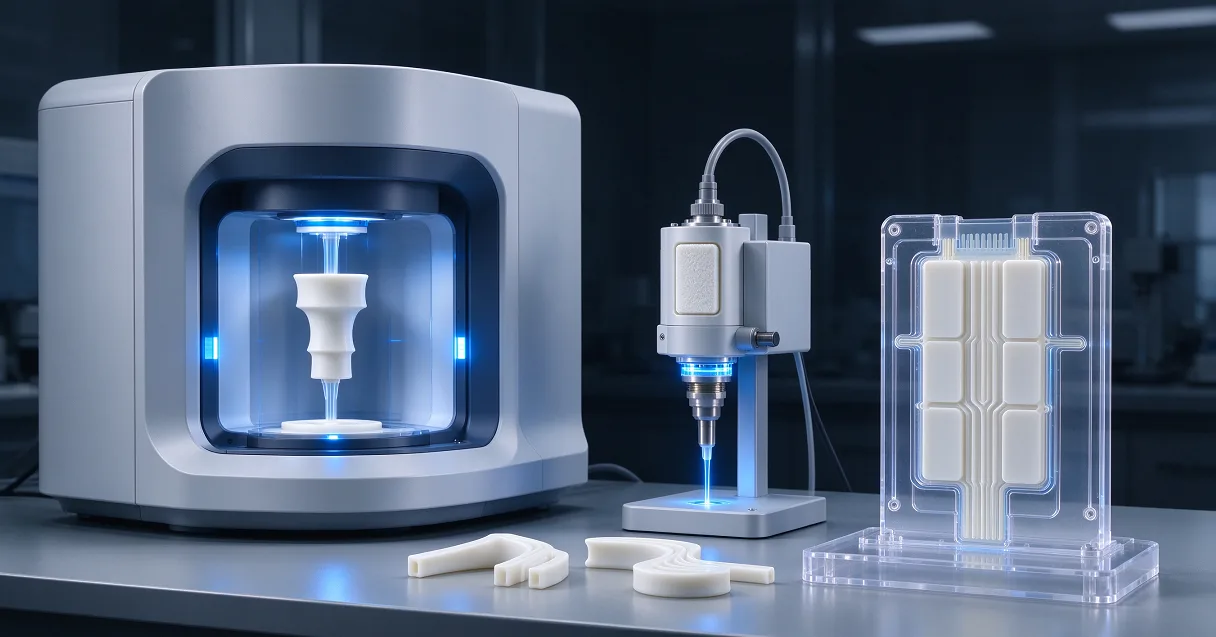
For components exposed to mechanical load, friction, or repeated thermal cycling, Silicon Nitride Ceramic offers high strength and good thermal shock resistance. Silicon Carbide Ceramic is more suitable where high hardness, wear resistance, corrosion resistance, and thermal performance are required.
Boron Nitride Ceramic is useful for high-temperature electrical insulation and complex machined parts, particularly where thermal stability and machinability are important.
Typical Material Properties
| Material | Density | Thermal Conductivity | Typical Engineering Advantage |
|---|---|---|---|
| Alumina (Al₂O₃) | 3.6–3.95 g/cm³ | 20–35 W/m·K | Electrical insulation, hardness, chemical stability |
| Aluminum Nitride (AlN) | 3.2–3.3 g/cm³ | 170–230 W/m·K | High thermal conductivity with electrical insulation |
| Silicon Nitride (Si₃N₄) | 3.1–3.3 g/cm³ | 15–30 W/m·K | Strength, wear resistance, thermal shock resistance |
| Silicon Carbide (SiC) | 3.0–3.2 g/cm³ | 80–200 W/m·K | High hardness, corrosion and wear resistance |
| Boron Nitride (BN) | 1.8–2.2 g/cm³ | 30–200 W/m·K* | Machinability, insulation, thermal stability |
Ceramic Components in Medical & Analytical Instruments
Advanced ceramics are commonly used where a component must maintain dimensional accuracy while providing electrical insulation, wear resistance, chemical stability, or controlled heat transfer.
In sensor assemblies, diagnostic instruments, and laboratory electronics, ceramic components are often used to electrically isolate conductive parts while maintaining precise positioning. For example, alumina ceramic tubes can provide both structural support and electrical insulation around electrodes, wires, heating elements, or sensor assemblies. Alumina rings and discs can also be used as insulating spacers, locating components, or support surfaces.
Thermal management is another important requirement in compact analytical systems. Electronics, detectors, heaters, and measurement modules can generate localized heat that affects measurement stability and component life. In these applications, aluminum nitride components can transfer heat away from the active area while maintaining electrical isolation.
For pumps, valves, fluid-control assemblies, and moving instrument components, dimensional change caused by wear can reduce measurement repeatability. Alumina provides good performance for general wear components, while silicon nitride and silicon carbide are better suited to higher loads, abrasive media, or more severe operating conditions.
Ceramics are also used in sample preparation and high-temperature analytical systems. Components such as sample supports, insulating fixtures, crucibles, and thermal-processing parts must remain stable during repeated heating and cooling. Material selection in these systems depends on temperature, atmosphere, chemical contact, and required thermal response.
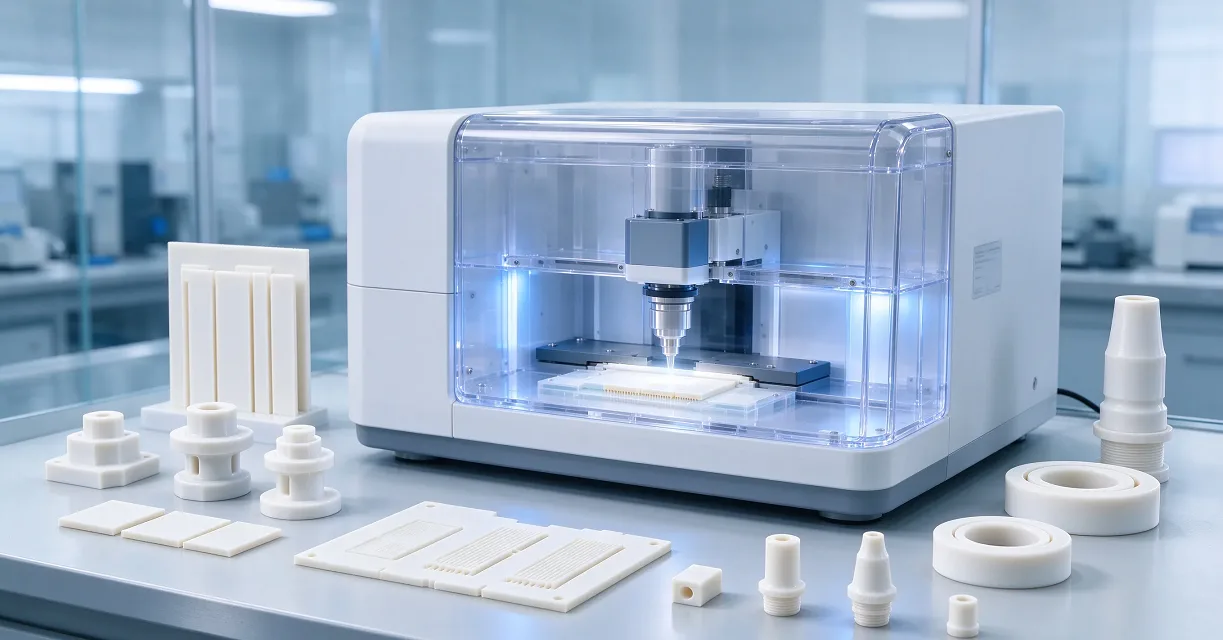
Custom Ceramic Components for Precision Instrument Design
Many ceramic parts used in medical and analytical equipment are application-specific rather than standard components. Geometry, tolerances, surface finish, and material properties often need to be matched to the surrounding sensor, fluid system, thermal assembly, or mechanical structure.
We manufacture custom ceramic tubes, rings, discs, sleeves, plates, bushings, sensor supports, insulating components, and other precision parts according to customer drawings or operating requirements. Depending on the ceramic and geometry, grinding, drilling, lapping, and polishing can be used to achieve the required dimensional accuracy and surface condition.
For example, an electrical insulating component may prioritize dielectric performance and dimensional stability, making alumina a practical option. A support positioned close to a heat-generating sensor may require aluminum nitride instead. A sliding guide or valve component may place greater importance on wear resistance and therefore use silicon nitride or silicon carbide.
The following parameters should normally be evaluated during component design:
| Design Parameter | Engineering Consideration |
|---|---|
| Operating temperature | Continuous temperature and thermal cycling |
| Electrical properties | Insulation resistance and dielectric requirements |
| Thermal behavior | Heat transfer, thermal expansion, thermal shock |
| Mechanical load | Compression, bending, impact, or contact stress |
| Chemical environment | Liquids, gases, reagents, and cleaning media |
| Tolerance | Assembly, alignment, sealing, and positioning accuracy |
| Surface finish | Friction, sealing, cleanliness, or contact performance |
For custom parts, evaluating these requirements together usually produces a more reliable solution than selecting a ceramic from one property alone.
FAQs
1. How should ceramic materials be selected for medical and analytical instrument components?
Ceramic selection should start from the actual function of the component and the dominant failure risk in service. For electrical insulation and general structural support, alumina is usually the first material evaluated because it provides a balanced combination of dielectric strength, hardness, chemical stability, and dimensional reliability. If the component must transfer heat while remaining electrically insulating, aluminum nitride is generally more appropriate. Silicon nitride is better suited to parts exposed to mechanical loading, thermal cycling, or impact-related stress, while silicon carbide is preferred for severe wear, abrasive media, or chemically aggressive environments. The final decision should also consider geometry, operating temperature, assembly method, surface condition, and expected service life.
2. What tolerances are practical for precision ceramic parts?
The achievable tolerance depends on material, part size, wall thickness, geometry, and whether the dimension is controlled in the as-sintered condition or by post-sintering machining. Tight tolerances are possible on critical features through grinding, lapping, or polishing, but they should be applied only where they directly affect alignment, sealing, positioning, or functional performance. Features such as locating diameters, mating faces, sealing surfaces, concentric bores, and sensor alignment interfaces often justify tighter control, while non-critical dimensions can usually remain at standard ceramic manufacturing tolerances. A practical tolerance strategy improves manufacturability and reduces unnecessary machining cost without compromising instrument performance.
3. How should thermal expansion be handled in ceramic-to-metal assemblies?
Thermal expansion mismatch must be considered whenever ceramic components are assembled with stainless steel, aluminum, copper, or other metallic materials. During heating and cooling, the different coefficients of thermal expansion can create tensile, compressive, or shear stresses at the interface, which may lead to cracking if the ceramic is rigidly constrained. Good designs typically allow some compliance through controlled clearances, spring loading, compliant interlayers, suitable joint geometry, or appropriate material pairing. For assemblies exposed to repeated thermal cycling, the thermal expansion behavior of the complete assembly should be evaluated together with mounting pressure, component thickness, and temperature gradient.
4. Which ceramic materials are suitable for rapid temperature changes?
Thermal shock performance depends not only on the material itself but also on thermal conductivity, coefficient of thermal expansion, mechanical strength, component thickness, and heating or cooling rate. Silicon nitride is often a strong choice for applications that combine rapid temperature changes with mechanical loading because of its strength and thermal shock resistance. Silicon carbide also performs well in demanding thermal environments, especially when wear or corrosion resistance is required at the same time. Boron nitride can be useful for high-temperature insulating parts where mechanical loading is relatively low, while alumina can perform reliably when thermal gradients and heating rates are properly controlled.
5. How should chemical compatibility be evaluated for ceramic components?
Chemical compatibility should be assessed using the actual process conditions rather than general corrosion-resistance data alone. The chemical composition, concentration, temperature, pressure, exposure time, and whether the component is under mechanical load can all influence long-term performance. For example, a ceramic that is stable in a reagent at room temperature may behave differently at elevated temperature or under continuous exposure. Surface finish and material grade may also affect fluid interaction and contamination risk. For pump parts, valve components, sample-handling systems, and wetted analytical components, chemical resistance should therefore be evaluated together with wear, sealing, dimensional stability, and cleanliness requirements.
6. What should engineers consider when designing thin-wall ceramic tubes or sleeves?
Thin-wall ceramic parts require careful control of wall thickness, unsupported length, diameter ratio, edge geometry, and assembly stress because ceramics are sensitive to localized tensile loading. Sharp transitions, aggressive press fits, and point clamping should be avoided, especially near thin sections or machined openings. Uniform wall thickness and smooth transitions help reduce stress concentration, while suitable radii and chamfers can improve mechanical reliability. For insulating tubes and sleeves used around electrodes, sensors, or heating elements, the design should also account for thermal expansion, concentricity, and installation method so that assembly forces do not introduce unnecessary stress into the ceramic.
7. Can advanced ceramics be used for sealing, sliding, or wear interfaces?
Yes, but the material should be selected together with the counterface, contact pressure, surface finish, lubrication condition, operating speed, and process medium. Alumina is commonly used for general wear and sealing applications because of its hardness, chemical stability, and dimensional consistency. Silicon carbide is suitable for more severe abrasive, corrosive, or high-speed conditions, while silicon nitride may be preferred when higher mechanical reliability and fracture resistance are important. In precision analytical equipment, surface finish and flatness can be just as important as the bulk material properties because they directly influence friction, leakage, and repeatability.