Advanced Technical Ceramics, Precision Alumina, Silicon Carbide, Crucible Parts
 Technology Co., Ltd.(Luoyang) Technology Co., Ltd.科技品牌标志.webp)


Aerospace & Industrial Furnace High-Temp Components
Understanding the Demands of Aerospace & Industrial Furnace Systems
In aerospace thermal systems and industrial furnace applications, component reliability is essential for maintaining process stability, operational efficiency, and long-term equipment performance. High-temperature components must withstand extreme heat, repeated thermal cycling, corrosive atmospheres, and mechanical stress. These demanding conditions can cause thermal deformation, cracking, oxidation, and premature failure, leading to costly downtime and maintenance. Selecting the right advanced ceramic material requires careful consideration of operating temperature, thermal expansion, mechanical loads, chemical compatibility, and dimensional stability. High-performance ceramics such as alumina (Al₂O₃), zirconia (ZrO₂), silicon carbide (SiC), and silicon nitride (Si₃N₄) offer specialized thermal, mechanical, and chemical properties to address these engineering challenges.
At Professional Ceramic, we provide high-performance ceramic components and custom-engineered solutions for aerospace-related equipment, vacuum furnaces, heat treatment systems, and industrial thermal processing applications. Our products include ceramic tubes, protective sleeves, insulators, structural supports, furnace fixtures, rings, plates, rods, and precision-machined components. Based on your operating conditions, technical drawings, material specifications, and dimensional requirements, we help identify suitable ceramic materials and component designs to improve equipment reliability, reduce maintenance requirements, and extend service life. Whether developing new equipment or replacing critical components, Professional Ceramic delivers tailored high-temperature ceramic solutions for demanding engineering applications.
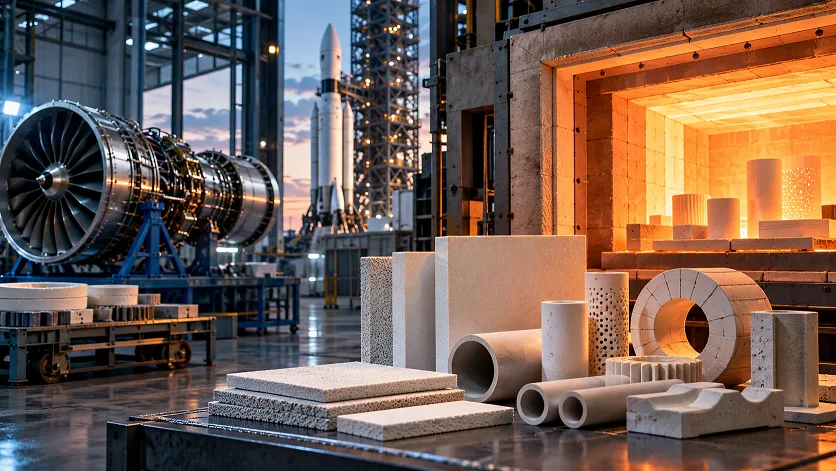
The performance of ceramic components in high-temperature environments is governed by the interaction of thermal, mechanical, and chemical factors. Prolonged exposure to elevated temperatures can accelerate creep deformation, grain growth, and changes in material properties, while repeated thermal cycling generates temperature gradients and internal stresses that may initiate microcracks and eventually lead to structural failure. In addition, differences in thermal expansion between ceramic and metallic components can create localized stress concentrations, particularly in tightly constrained assemblies. Furnace atmosphere, operating pressure, heating and cooling rates, and sustained mechanical loads further influence material degradation and service life. Therefore, evaluating these interconnected factors is essential when selecting ceramic materials for aerospace thermal systems and industrial furnace applications.
Engineering Ceramics for Extreme Thermal & Mechanical Conditions
Aerospace thermal systems and industrial furnaces expose critical components to extreme temperatures, repeated thermal cycling, aggressive atmospheres, and demanding mechanical loads. Under these conditions, even minor material degradation or dimensional changes can compromise equipment reliability, processing accuracy, and operational safety. At Professional Ceramic, we understand the key failure mechanisms affecting high-temperature ceramic components and provide application-specific material solutions designed to address these engineering challenges.
Extreme Temperatures & Thermal Degradation: Prolonged exposure to elevated temperatures can cause creep, microstructural changes, and progressive loss of mechanical strength. Selecting ceramic materials with suitable thermal stability and high-temperature mechanical properties is essential for maintaining component integrity during continuous operation.
Thermal Shock & Expansion Mismatch: Rapid heating and cooling generate thermal gradients and internal stresses, while differences in thermal expansion between assembled materials can lead to cracking or premature failure. Careful material selection and component design help reduce thermal stress and improve reliability under repeated thermal cycling.
Chemical Corrosion & Atmosphere Compatibility: Oxidizing, reducing, vacuum, and chemically aggressive environments can affect ceramic performance through different degradation mechanisms. Evaluating material compatibility with process gases, contaminants, and operating temperatures is critical to preventing corrosion, contamination, and accelerated component deterioration.
Mechanical Stress & Dimensional Stability: Structural supports, furnace fixtures, and precision ceramic components may experience sustained loads, vibration, and thermal expansion constraints. High-temperature strength, creep resistance, and dimensional tolerances must be carefully considered to maintain structural stability and reliable equipment operation.
Advanced Ceramic Materials for High-Temperature Applications
The selection of ceramic materials for aerospace thermal systems and industrial furnaces must be based on the specific operating conditions of each component rather than temperature resistance alone. Furnace atmosphere, thermal cycling frequency, mechanical loading, heat transfer requirements, and dimensional constraints all influence material suitability. A ceramic that performs reliably as an electrical insulator may not be the best choice for a load-bearing furnace fixture or a component exposed to rapid temperature changes. Understanding these differences is essential for selecting materials that provide stable and predictable performance throughout the intended service life.
High-Purity Alumina (Al₂O₃): Alumina ceramics are widely used in high-temperature furnace equipment because of their excellent electrical insulation, oxidation resistance, chemical stability, and mechanical hardness. High-purity grades are particularly suitable for ceramic tubes, thermocouple protection tubes, electrical insulators, furnace supports, and components where low contamination and dimensional stability are important. However, thermal gradients and constrained mounting conditions must be considered because alumina’s relatively high elastic modulus and moderate thermal conductivity can increase susceptibility to thermal shock.
Zirconia (ZrO₂): Stabilized zirconia ceramics provide high fracture toughness, wear resistance, and relatively low thermal conductivity compared with many dense structural ceramics. These characteristics make zirconia suitable for selected high-temperature insulating components, wear-resistant parts, and precision mechanical applications. Its suitability for sustained high-temperature loading depends strongly on the stabilizer system, phase stability, and operating environment. Engineers must consider thermal expansion, long-term phase behavior, and temperature-dependent mechanical properties before specifying zirconia for furnace assemblies.
Silicon Carbide (SiC): Silicon carbide combines high thermal conductivity, excellent hardness, low thermal expansion, and strong resistance to wear. These properties make suitable SiC grades particularly valuable for furnace beams, radiant tubes, heating element supports, kiln furniture, and thermally loaded structural components. Its relatively high thermal conductivity helps reduce internal temperature gradients, while its low thermal expansion contributes to thermal shock resistance. However, oxidation behavior, chemical compatibility, and maximum service temperature vary significantly with SiC grade and furnace atmosphere.
Silicon Nitride (Si₃N₄): Silicon nitride is distinguished by its high mechanical strength, relatively low thermal expansion, fracture toughness, and excellent resistance to thermal shock. It is suitable for demanding structural applications involving repeated thermal cycling, mechanical loading, and wear. Potential applications include precision supports, high-temperature mechanical components, and selected aerospace-related thermal equipment. Long-term performance must be evaluated against oxidation, creep, and possible degradation of grain-boundary phases, particularly at elevated temperatures.
Mullite (3Al₂O₃·2SiO₂): Mullite ceramics offer relatively low thermal expansion, good thermal stability, and useful resistance to thermal cycling. They are commonly considered for furnace tubes, supports, insulating structures, and thermal processing fixtures where dimensional stability and thermal resistance are important. Their mechanical strength and thermal conductivity depend on composition, porosity, and manufacturing method, making it necessary to distinguish dense structural mullite from porous insulating grades.
No single ceramic material is optimal for every high-temperature application. Material selection should account for the interaction between thermal properties, mechanical stresses, chemical exposure, component geometry, and the intended operating cycle. A suitable design must balance these factors rather than rely on a single material property or maximum temperature rating.
Technical Properties & Material Selection Guide
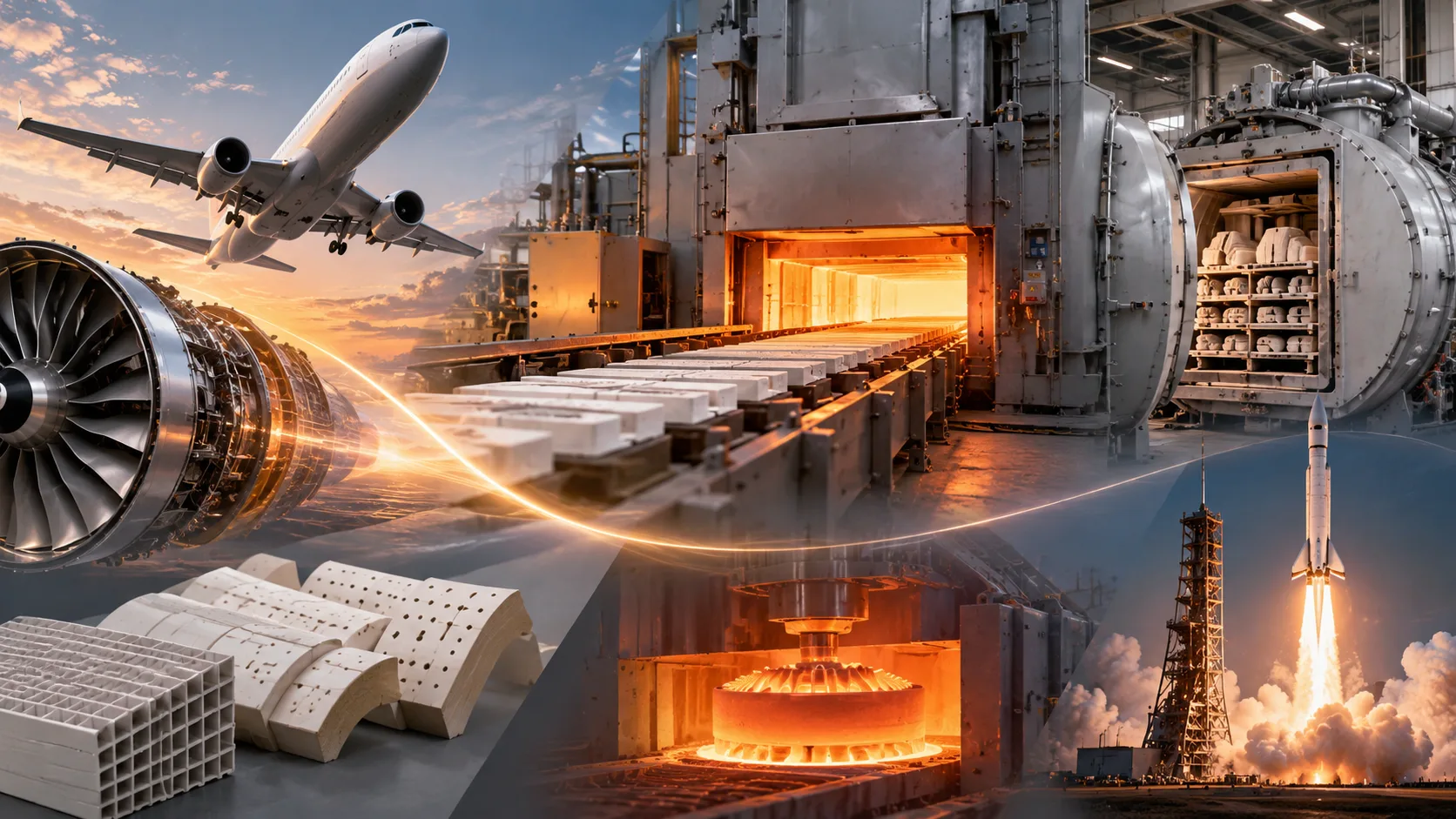
Selecting the appropriate ceramic material requires evaluating multiple physical and mechanical properties under the intended operating conditions. Thermal conductivity determines how heat is transferred through a component, while the coefficient of thermal expansion influences dimensional changes and stresses during heating and cooling. Flexural strength, fracture toughness, and elastic modulus affect resistance to mechanical loading and crack propagation. For furnace components exposed to sustained loads, high-temperature creep behavior and long-term dimensional stability must also be considered.
The following table provides representative room-temperature properties of common dense engineering ceramics. These values are intended for preliminary material comparison only. Actual properties depend on ceramic composition, purity, stabilizer content, microstructure, porosity, manufacturing process, and test method.
Typical Engineering Ceramic Material Properties
| Property | Alumina 99%+ | Y-TZP Zirconia | SiC | Si₃N₄ |
|---|---|---|---|---|
| Density (g/cm³) | 3.8–3.95 | 5.9–6.1 | 3.05–3.2 | 3.15–3.3 |
| Flexural Strength (MPa) | 250–400 | 800–1,200 | 300–500 | 600–1,000 |
| Thermal Conductivity (W/m·K) | 25–35 | 2–3 | 80–150 | 20–90 |
| CTE (×10⁻⁶/K) | 7–8.5 | 10–11 | 4–5 | 2.5–3.5 |
| Young’s Modulus (GPa) | 300–380 | 190–220 | 380–430 | 280–320 |
| Vickers Hardness (GPa) | 14–20 | 11–13 | 22–28 | 14–17 |
Frequently Asked Questions About High-Temperature Ceramic Components
1. Which ceramic material is most suitable for continuous operation above 1,000°C?
Selecting a ceramic material for continuous operation above 1,000°C requires evaluating more than its nominal maximum service temperature. High-purity alumina (Al₂O₃), selected silicon carbide (SiC) grades, and certain other engineering ceramics can provide suitable high-temperature performance, but their long-term reliability depends on furnace atmosphere, applied mechanical stress, thermal cycling frequency, and exposure duration. For example, high-purity alumina offers excellent electrical insulation and oxidation resistance, while silicon carbide provides higher thermal conductivity and lower thermal expansion, making suitable grades advantageous in applications involving significant thermal gradients.
Engineers must also consider high-temperature creep, grain-boundary behavior, oxidation kinetics, and chemical compatibility with adjacent materials. Components operating under sustained bending loads may require a different material selection from unloaded insulating sleeves or protection tubes. Therefore, continuous service temperature should be established through grade-specific technical data and evaluation of the actual operating conditions rather than relying solely on a published maximum temperature rating.
2. Why do ceramic components crack during furnace heating and cooling cycles?
Ceramic components commonly crack during thermal cycling when temperature differences within the material generate tensile stresses that exceed its local fracture strength. Rapid heating and cooling, nonuniform wall thickness, sharp geometric transitions, and uneven heat distribution can produce substantial thermal gradients. Because technical ceramics generally exhibit limited plastic deformation, they cannot redistribute concentrated stresses as readily as ductile metallic materials.
Another important factor is thermal expansion mismatch between ceramic components and surrounding metallic structures. Rigid mounting arrangements can restrict thermal movement and introduce additional stresses during temperature changes. Microcracks may initiate at surface defects, machined edges, or localized stress concentrations and gradually propagate under repeated cycling.
Improving thermal shock reliability requires evaluating thermal conductivity, coefficient of thermal expansion, fracture toughness, component geometry, and heating rates. Appropriate mounting clearances, rounded transitions, controlled temperature ramps, and suitable material selection can help reduce the likelihood of premature cracking.
3. How should ceramic materials be selected for vacuum furnace applications?
Ceramic material selection for vacuum furnaces requires careful evaluation of thermal stability, vapor pressure, outgassing behavior, and chemical compatibility under reduced-pressure conditions. Unlike conventional air furnaces, vacuum environments can alter oxidation and reduction reactions, influence material evaporation, and increase the significance of interactions between ceramics and surrounding metals or process materials.
High-purity alumina is frequently considered for electrical insulators, thermocouple protection tubes, and structural components because of its chemical stability and insulating properties in many controlled environments. However, its suitability depends on the operating temperature, vacuum level, residual gas composition, and possible contact with reactive metals.
Engineers should also consider contamination sensitivity, surface cleanliness, porosity, and potential reactions involving furnace heating elements or processed materials. For high-vacuum or contamination-sensitive applications, material purity, manufacturing history, and application-specific compatibility testing may be necessary to establish reliable long-term performance.
4. What is the difference between alumina and silicon carbide for industrial furnace components?
Alumina and silicon carbide are widely used engineering ceramics, but their thermal, electrical, and mechanical characteristics make them suitable for different furnace functions. Alumina provides excellent electrical insulation, high hardness, and good oxidation resistance, making it a common choice for ceramic insulators, thermocouple protection tubes, electrical feedthrough components, and furnace supports.
Silicon carbide generally exhibits significantly higher thermal conductivity and lower thermal expansion than alumina. These characteristics can reduce internal thermal gradients and improve resistance to certain thermal shock conditions. Suitable silicon carbide grades are therefore often used for furnace beams, kiln furniture, radiant tubes, and thermally loaded structural components.
However, silicon carbide is not an equivalent electrical insulator, and its oxidation behavior varies with temperature, atmosphere, and material grade. Alumina may be preferred where electrical isolation or chemical purity is critical, while silicon carbide may offer advantages where heat transfer, thermal shock resistance, or structural performance is more important. Final selection requires evaluating the complete service environment.
5. How can high-temperature creep affect ceramic furnace supports and fixtures?
High-temperature creep is the gradual, time-dependent deformation of a material subjected to sustained mechanical stress at elevated temperatures. Although engineering ceramics generally maintain good dimensional stability, creep can become an important design consideration when structural components operate under significant loads for extended periods.
In furnace beams, support plates, and load-bearing fixtures, creep deformation may lead to progressive bending, changes in component alignment, uneven load distribution, and eventual mechanical failure. The creep rate depends on temperature, applied stress, ceramic composition, grain size, grain-boundary phases, porosity, and exposure duration. Different grades of the same ceramic material may exhibit substantially different creep behavior.
Engineers should evaluate component geometry, support spacing, bending moments, and long-term temperature exposure when designing ceramic load-bearing structures. Reducing tensile stresses, increasing section stiffness, improving support arrangements, or selecting a ceramic grade with better high-temperature creep resistance can help maintain dimensional accuracy and structural reliability throughout the intended operating life.
6. Can ceramic components be manufactured according to custom engineering drawings?
Advanced ceramic components can be manufactured in a wide range of customized geometries, including tubes, rings, sleeves, plates, rods, spacers, insulating structures, and precision mechanical parts. However, ceramic manufacturing differs significantly from conventional metal machining because technical ceramics are extremely hard, brittle, and sensitive to localized tensile stresses.
Depending on the material and component requirements, manufacturing may involve powder forming, controlled sintering, green machining, and precision diamond grinding. Dimensional shrinkage during sintering must be considered, while tight tolerances and critical surface finishes may require additional machining after densification.
Design features such as thin walls, deep holes, sharp internal corners, narrow slots, and abrupt changes in cross-section can increase manufacturing difficulty and introduce stress concentrations. For custom components, engineers should provide detailed drawings, material specifications, dimensional tolerances, surface finish requirements, operating conditions, and expected production quantities. These details support an accurate assessment of material suitability, manufacturing feasibility, and component reliability.