Advanced Technical Ceramics, Precision Alumina, Silicon Carbide, Crucible Parts



Energy & Automotive Power Systems
Advanced Technical Ceramics for Energy & Automotive Power Systems
Modern energy and automotive power systems operate under increasingly demanding electrical, thermal, and mechanical conditions. Electric vehicle powertrains, high-voltage battery systems, power conversion equipment, industrial electric motors, and renewable energy installations require components that can maintain stable performance under elevated temperatures, repeated thermal cycling, electrical stress, vibration, and continuous mechanical loading.
As power density increases, component reliability becomes closely linked to material selection. Conventional metallic components offer mechanical strength and thermal conductivity but generally require additional electrical insulation. Polymer-based insulators provide electrical isolation but may be limited by operating temperature, thermal aging, and dimensional stability. Advanced technical ceramics address specific combinations of these requirements through controlled electrical, thermal, and mechanical properties.
Materials such as alumina (Al₂O₃), aluminum nitride (AlN), silicon nitride (Si₃N₄), boron nitride (BN), and silicon carbide (SiC) offer distinct performance characteristics for different engineering functions. Alumina provides electrical insulation and dimensional stability; aluminum nitride combines high thermal conductivity with electrical insulation; silicon nitride offers high strength and resistance to mechanical and thermal fatigue; boron nitride is useful for selected high-temperature insulating applications; and silicon carbide provides excellent wear resistance, thermal conductivity, and chemical stability.
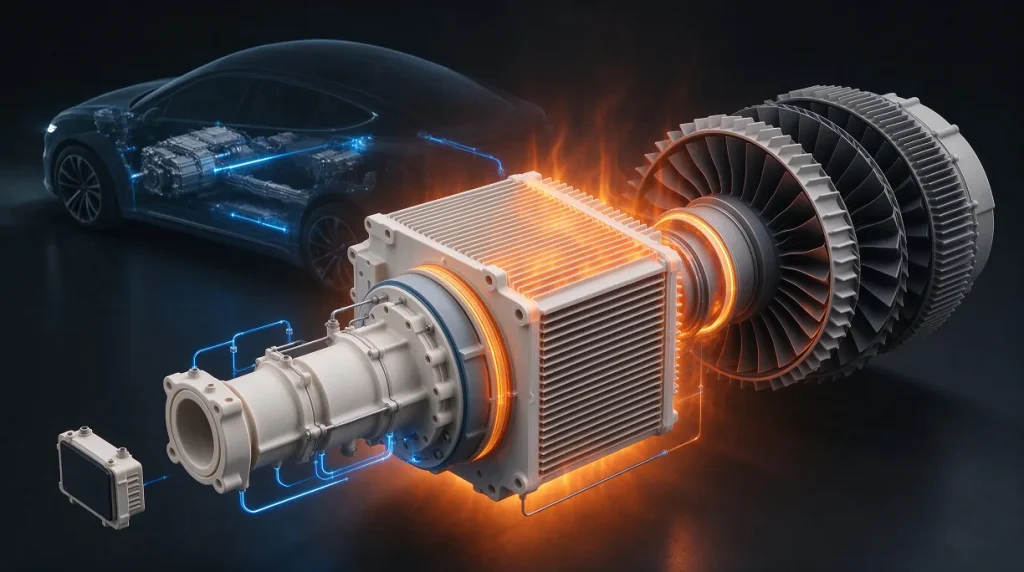
The appropriate ceramic material must be selected according to the complete operating environment rather than a single nominal property. Engineers should consider continuous and transient temperatures, voltage requirements, mechanical stresses, thermal expansion compatibility, environmental exposure, assembly constraints, and expected service life.
At Professional Ceramic, our range of advanced ceramic components supports engineering applications where conventional materials may not provide the required combination of performance characteristics. Material selection and component geometry can be evaluated against the specific requirements of energy conversion, electrical insulation, thermal management, and automotive mechanical systems.
Key Applications in Energy & Automotive Power Systems
Electric Vehicle Power Electronics and Inverter Systems
Electric vehicle traction inverters, onboard chargers, DC-DC converters, and power semiconductor assemblies generate concentrated heat while operating under substantial electrical potential differences. Insulating components used in these systems must provide reliable electrical separation without introducing excessive thermal resistance.
Aluminum nitride is particularly relevant because it combines high thermal conductivity with electrical insulation and a relatively low coefficient of thermal expansion. These properties make it suitable for evaluation in electrically insulating heat-transfer components and power electronic substrate applications.
Our Aluminum Nitride Ceramic range provides a material option for applications where thermal management and dielectric performance must be considered together.
For demanding power module designs, engineers must also evaluate ceramic thickness, metallization compatibility, bonding technology, thermal interface resistance, and cyclic thermal stress. High bulk thermal conductivity alone does not guarantee effective heat dissipation at the assembly level.
Battery Systems and High-Voltage Electrical Insulation
High-voltage battery systems require dependable electrical isolation between conductive components, mounting structures, and surrounding equipment. Insulating parts may experience temperature fluctuations, mechanical compression, vibration, humidity, and surface contamination throughout their service life.
Alumina ceramic is an established option for insulating spacers, sleeves, bushings, supports, and other structural electrical components because of its high electrical resistivity, hardness, and dimensional stability.
Boron nitride may also be considered in specialized thermal-electrical environments where electrical isolation, machinability, and controlled heat transfer are required. Its suitability depends on the grade, operating atmosphere, moisture exposure, and mechanical loading.
Ceramic insulators must be evaluated at both material and assembly levels. Dielectric strength, creepage distance, clearance, surface finish, and contamination conditions all influence insulation reliability. Ceramic components should therefore be selected in accordance with the electrical architecture and applicable system safety requirements.
Electric Motors, Bearings, and Rotating Mechanical Components
Electric motors and automotive rotating systems subject mechanical components to repeated contact stresses, high rotational speeds, vibration, and temperature changes. In these environments, wear resistance, fatigue performance, density, and dimensional precision are critical engineering considerations.
Silicon nitride provides a favorable combination of high flexural strength, relatively low density, fracture toughness, and wear resistance. It is particularly suitable for selected ceramic rolling elements, bearing components, and precision mechanical parts.
Compared with conventional steel rolling elements, silicon nitride offers lower density and electrical insulation, which can be advantageous in appropriately designed hybrid bearing systems. However, bearing performance also depends on raceway materials, lubrication, contact geometry, surface finish, and operating loads.
Our Silicon Nitride Ceramic products can be considered for mechanical applications requiring a combination of strength, thermal stability, and wear resistance.
Renewable Energy, Power Conversion, and Auxiliary Equipment
Solar inverters, energy storage converters, industrial power supplies, and associated thermal management equipment require components capable of operating under electrical and thermal loads over extended service periods.
Aluminum nitride and alumina can serve different roles in electrically insulating assemblies. Aluminum nitride is advantageous where efficient heat transfer is required, whereas alumina is often selected for general insulation and structural support where thermal conductivity is less critical.
Silicon carbide is relevant to mechanically demanding auxiliary equipment, including pumps, rotating assemblies, and fluid-handling systems. Its hardness, wear resistance, and chemical stability make it useful for selected sealing applications.
For example, Silicon Carbide Sealing Rings can be evaluated for pumps and related mechanical equipment where sealing-face wear, chemical compatibility, and dimensional stability are important.
It is important to distinguish silicon carbide structural ceramics from semiconductor-grade SiC power devices. Although they share the same primary chemical composition, their manufacturing methods, electrical characteristics, and intended functions are substantially different.
Technical Properties and Material Selection Guidelines
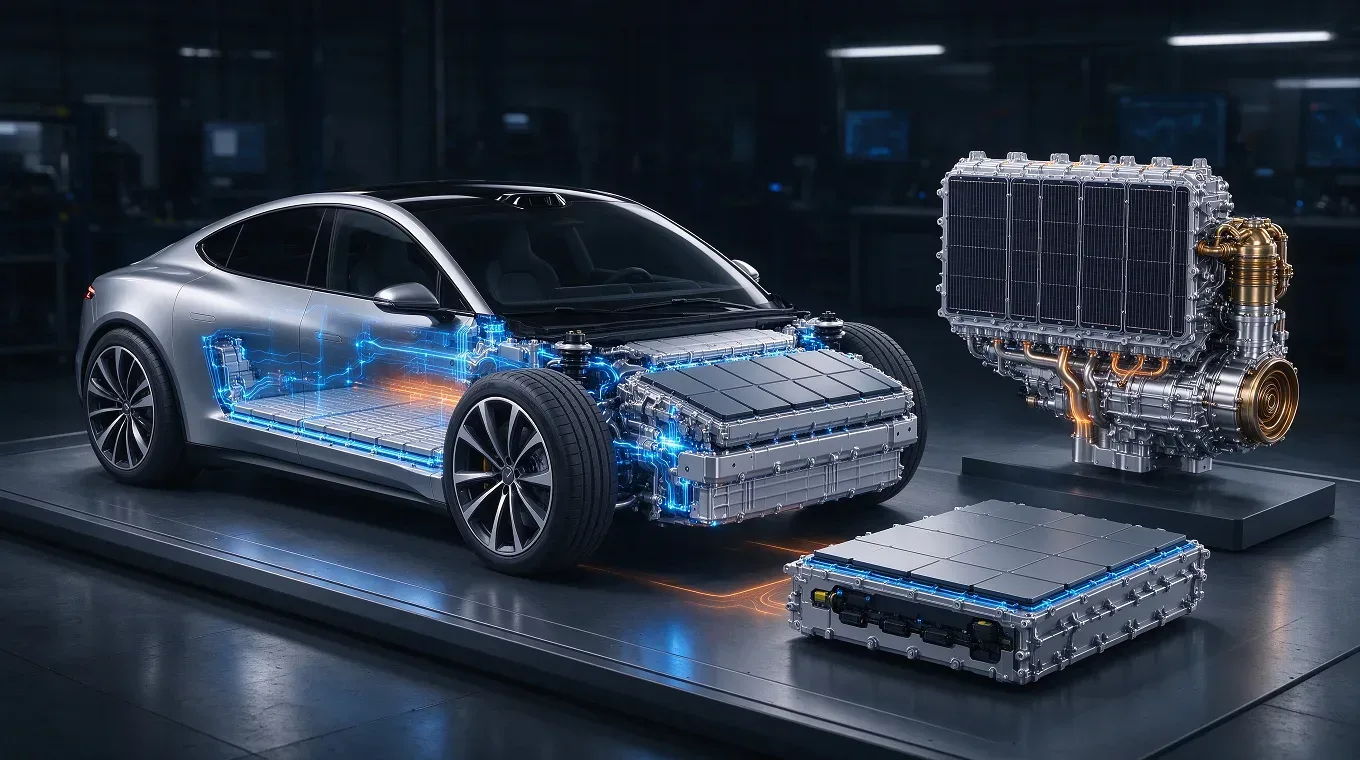
The selection of ceramic materials for energy and automotive power systems requires a balance between electrical insulation, thermal conductivity, mechanical strength, thermal expansion, and environmental resistance. Different ceramic compositions offer substantially different performance characteristics, and these differences directly influence component design and reliability.
The following table compares representative engineering properties of five ceramic materials relevant to energy conversion, electrical insulation, and mechanical power systems.
Comparative Technical Properties of Advanced Ceramics
| Property | Al₂O₃ | AlN | Si₃N₄ | BN | SiC |
|---|---|---|---|---|---|
| Density (g/cm³) | 3.6–3.95 | 3.2–3.3 | 3.1–3.3 | 1.8–2.2 | 3.1–3.2 |
| Flexural Strength (MPa) | 300–450 | 250–350 | 600–1000 | 50–100 | 350–500 |
| Thermal Conductivity (W/m·K) | 20–35 | 140–180 | 15–30 | 30–200* | 80–150 |
| CTE (×10⁻⁶/K) | 7–8 | 4–5 | 3–3.5 | 1–5* | 4–5 |
| Volume Resistivity (Ω·cm) | >10¹⁴ | >10¹³ | >10¹² | >10¹³ | Grade-dependent |
| Primary Function | Insulation | Thermal management | Structural reliability | Specialized insulation | Wear and sealing |
Material Selection Considerations
Alumina (Al₂O₃) — Electrical Insulation and Structural Support
Alumina is a practical material for insulating sleeves, ceramic spacers, mounting components, and structural supports. Its combination of high electrical resistivity, mechanical rigidity, and manufacturing maturity makes it suitable for many high-voltage and industrial electrical applications. However, its relatively moderate thermal conductivity can limit performance in highly concentrated heat-flux applications.
Explore our Alumina Ceramic Components for electrical insulation and precision structural applications.
Aluminum Nitride (AlN) — High Thermal Conductivity with Electrical Isolation
Aluminum nitride is appropriate where electrical insulation and efficient heat transfer are simultaneously required. Its high thermal conductivity helps reduce temperature differences across insulating components, while its coefficient of thermal expansion is comparatively compatible with several semiconductor packaging materials. Engineers should also consider moisture exposure, surface protection, joining methods, and mechanical stresses when specifying AlN.
Silicon Nitride (Si₃N₄) — Mechanical Strength and Thermal Fatigue Resistance
Silicon nitride is advantageous in components subjected to cyclic mechanical loads, thermal gradients, and repeated temperature changes. Its relatively high fracture toughness and low thermal expansion support applications involving rolling contact, structural loading, and mechanical reliability. Component surface integrity and flaw control remain essential because silicon nitride, like other monolithic ceramics, is not immune to brittle fracture.
Boron Nitride (BN) — Specialized High-Temperature Insulation
Boron nitride combines electrical insulation with useful thermal transport and low thermal expansion. Hexagonal BN can be particularly valuable for insulating sleeves, electrode supports, and thermal-processing equipment. However, its anisotropic thermal properties, comparatively low mechanical strength, and susceptibility to oxidation at elevated temperatures must be considered.
Our Boron Nitride Insulating Sleeves provide a relevant component option for selected high-temperature electrical assemblies.
Silicon Carbide (SiC) — Wear Resistance and Thermal Stability
Silicon carbide is suitable for demanding mechanical and thermal environments where hardness, wear resistance, chemical stability, and efficient heat transfer are important. It is particularly relevant to pump components, mechanical seals, and auxiliary equipment. SiC should not be treated as a universal high-voltage insulating material because electrical resistivity varies significantly with grade and manufacturing process.
The final material choice should be based on verified material data, component geometry, environmental conditions, and the required design safety margins.
4. Engineering Design Considerations and Custom Ceramic Components
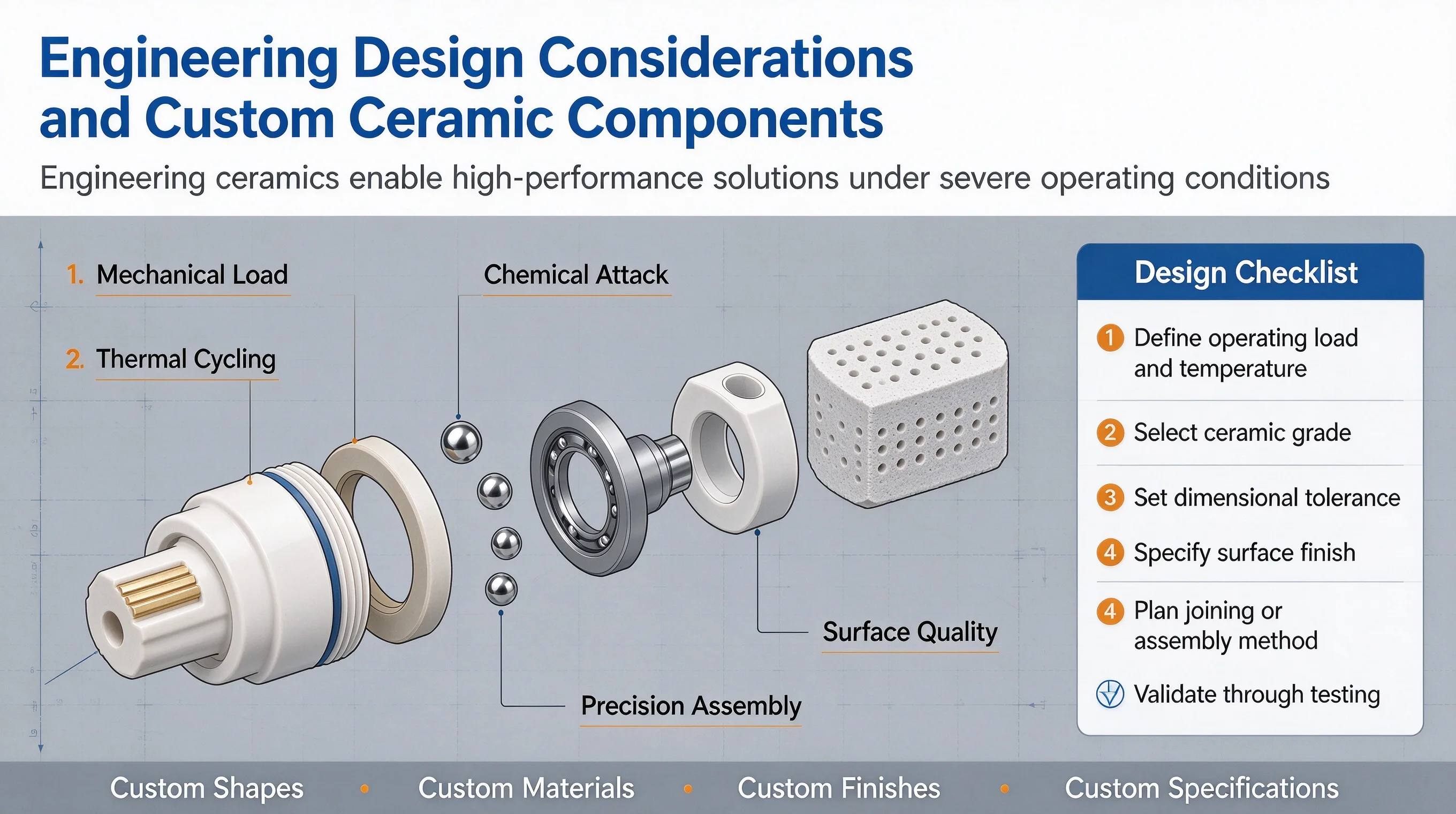
Selecting an appropriate ceramic material is only the first stage of developing a reliable component. The final performance of an energy or automotive ceramic part depends on geometry, surface condition, mounting design, operating environment, and manufacturing quality.
4.1 Thermal Expansion and Thermal Stress Management
Ceramic components frequently operate alongside metals, semiconductor packages, and other materials with different coefficients of thermal expansion. During heating and cooling, differential expansion can generate significant mechanical stress, particularly where the ceramic is rigidly constrained.
For a simplified, freely expanding component, thermal dimensional change can be estimated using:
\[ \Delta L=\alpha L_0\Delta T \]
where \(\alpha\) is the coefficient of thermal expansion, \(L_0\) is the original length, and \(\Delta T\) is the temperature change.
For example, a 50 mm alumina component with a thermal expansion coefficient of 7.5 × 10⁻⁶/K will undergo approximately 0.075 mm of free thermal expansion over a 200°C temperature increase.
In actual assemblies, differential expansion between mating materials, thermal gradients, and mechanical constraints can generate stress even when absolute dimensional changes are small. Engineers should therefore evaluate clearances, compliant interfaces, bonding materials, and local stress concentrations.
4.2 Electrical Insulation and Dielectric Reliability
Electrical insulation performance is determined by more than the nominal dielectric strength of the ceramic material.
For high-voltage applications, engineers must consider:
- Operating voltage, transient overvoltage, and required insulation coordination.
- Surface creepage distance and air clearance.
- Ceramic thickness and local electric-field concentration.
- Temperature-dependent volume and surface resistivity.
- Humidity, conductive contamination, and environmental aging.
- Mechanical defects, surface damage, and manufacturing variability.
A ceramic material may exhibit high dielectric strength under laboratory conditions while the assembled component experiences reduced insulation performance due to surface contamination, sharp electrode edges, or inadequate separation distances.
Electrical design should therefore be validated using application-specific test methods and relevant insulation standards rather than relying solely on nominal material properties.
4.3 Mechanical Design, Tolerances, and Surface Integrity
Advanced ceramics generally provide high compressive strength and rigidity but have limited capacity for plastic deformation. Tensile stress concentrations, impact loading, and surface flaws can therefore initiate cracks.
Component geometry should minimize sharp internal corners, abrupt cross-sectional transitions, unsupported thin walls, and excessive assembly interference. Appropriate radii, chamfers, and mounting clearances can improve mechanical reliability.
For precision ceramic components, dimensional tolerances should be specified according to functional requirements rather than applying unnecessarily tight tolerances to every feature. Critical dimensions may include:
- Inner and outer diameters of insulating sleeves and rings.
- Flatness and parallelism of ceramic plates and substrates.
- Concentricity and roundness of rotating or locating components.
- Surface roughness of sealing and contact interfaces.
- Hole position, edge quality, and minimum wall thickness.
For example, a silicon carbide mechanical seal requires careful control of sealing-face flatness and surface finish, while a ceramic insulating sleeve may be more sensitive to wall thickness, concentricity, and clearance around a conductive element.
4.4 Custom Ceramic Component Development and Quality Verification
Custom ceramic component development should begin with a clear engineering specification that identifies both material requirements and operating conditions.
For energy and automotive applications, the information provided during technical evaluation should include the component drawing, required material properties, operating temperature range, electrical loading, mechanical stresses, environmental exposure, dimensional tolerances, and expected production quantity.
Depending on the component and manufacturing process, production may involve ceramic forming, sintering, precision grinding, lapping, polishing, and dimensional inspection.
Quality verification should focus on the characteristics that directly influence the component’s function. These may include material density, visible and subsurface defects, critical dimensions, surface roughness, electrical insulation properties, and mechanical integrity.
For safety-critical automotive and high-voltage applications, additional qualification may be required at the component and assembly levels. Material specifications, inspection criteria, traceability, and acceptance requirements should be agreed upon before production.
Professional Ceramic provides a range of technical ceramic materials and component configurations for evaluating custom engineering requirements. By combining appropriate material selection with manufacturable geometry and clearly defined inspection requirements, ceramic components can be developed for reliable integration into energy and automotive power systems.
5. Frequently Asked Questions (FAQs)
Q1. Which ceramic materials are commonly used in electric vehicle power systems?
Alumina (Al₂O₃), aluminum nitride (AlN), and silicon nitride (Si₃N₄) are among the technical ceramics relevant to electric vehicle power systems. Alumina is commonly selected for electrical insulation and structural support, while aluminum nitride is suitable for components requiring electrical isolation combined with efficient heat dissipation. Silicon nitride is particularly valuable for mechanically demanding components and selected power electronic substrate applications where strength and thermal cycling reliability are important. The correct material depends on operating voltage, temperature, mechanical loading, thermal conductivity requirements, and assembly design.
Q2. Why is aluminum nitride suitable for high-power electronic applications?
Aluminum nitride combines high thermal conductivity with high electrical resistivity, allowing heat to pass through an electrically insulating ceramic component. This combination is valuable in power electronic assemblies where semiconductor devices generate substantial heat but must remain electrically isolated from adjacent structures. Compared with conventional alumina, aluminum nitride generally provides significantly higher thermal conductivity. However, effective thermal management also depends on ceramic thickness, thermal interfaces, bonding quality, metallization, and cooling conditions. Engineers should evaluate the complete thermal resistance path rather than relying only on bulk material conductivity.
Q3. What is the difference between alumina and silicon nitride in automotive applications?
Alumina and silicon nitride serve different engineering functions. Alumina offers a useful combination of electrical insulation, hardness, chemical stability, and cost efficiency, making it suitable for insulating and supporting components. Silicon nitride generally provides higher flexural strength, greater fracture toughness, and a lower coefficient of thermal expansion. These characteristics make it more suitable for selected mechanically loaded components, bearing applications, and structures exposed to repeated thermal cycling. Material selection should account for the component’s dominant failure mechanisms, manufacturing requirements, and expected operating conditions.
Q4. Can technical ceramics provide reliable high-voltage insulation?
Yes. Electrically insulating ceramic grades, including alumina, aluminum nitride, and boron nitride, can provide effective electrical isolation under appropriately designed operating conditions. However, insulation reliability depends on more than material resistivity. Ceramic thickness, electric-field distribution, operating temperature, humidity, contamination, creepage distance, and assembly geometry must also be considered. Silicon carbide should not be assumed to provide equivalent insulation because its electrical properties vary by grade. High-voltage components should undergo suitable dielectric and environmental qualification testing before use in critical systems.
Q5. How does thermal cycling affect the reliability of ceramic components?
Repeated heating and cooling generate dimensional changes and thermal stresses in ceramic components and their adjoining materials. When the coefficients of thermal expansion differ, mechanical constraints can produce tensile or shear stresses at interfaces. Over time, these stresses may contribute to cracking, joint degradation, or changes in component alignment. Materials with relatively low thermal expansion and favorable fracture resistance, such as silicon nitride, may offer advantages in demanding thermal cycling environments. However, reliability also depends on component geometry, thermal gradients, surface defects, joining methods, and the number and severity of operating cycles.
Q6. What dimensional tolerances can be achieved for custom ceramic components?
Achievable tolerances depend on the ceramic material, component size, geometry, manufacturing process, and required surface finish. Precision grinding, lapping, and polishing can improve dimensional accuracy after sintering, but not every geometry can be manufactured to the same tolerance. Thin walls, deep holes, complex internal features, and large flat surfaces may introduce additional manufacturing constraints. Engineers should identify functionally critical dimensions, including flatness, concentricity, wall thickness, and surface roughness, on the technical drawing. Final tolerance capability should be confirmed through a manufacturing feasibility review rather than assumed from a general ceramic specification.
Q7. What information is required to select a ceramic material for an energy or automotive application?
A reliable material selection process begins with the actual operating conditions. Engineers should provide the required function, operating temperature range, electrical voltage, thermal loading, mechanical forces, environmental exposure, and expected service life. Component drawings should identify critical dimensions, tolerances, surface finishes, and mating materials. For rotating or sealing components, speed, pressure, lubrication, and contact conditions are also important. This information allows candidate materials to be compared against the dominant design requirements and helps determine whether additional testing or design modifications are necessary before production.