Advanced Technical Ceramics, Precision Alumina, Silicon Carbide, Crucible Parts
 Technology Co., Ltd.(Luoyang) Technology Co., Ltd.科技品牌标志.webp)


Precision Machinery & Wear-Resistant Parts
Understanding the Demands of Precision Machinery & Wear-Resistant Components
In precision machinery and industrial equipment, even small amounts of wear can affect accuracy, product quality, and machine performance. Components that move, slide, rotate, or come into contact with other parts often face constant friction, repeated impact, and surface pressure. Over time, these conditions may cause abrasion, dimensional changes, and unexpected equipment downtime. To reduce these risks, engineers need materials that offer high hardness, excellent wear resistance, and dimensional stability. Advanced ceramics, including alumina (Al₂O₃), boron nitride (BN), and silicon carbide (SiC), provide useful solutions for demanding applications because of their hardness, corrosion resistance, and ability to maintain reliable performance in challenging working environments.
At Jenson(Luoyang) Technology Co., Ltd.(Luoyang) Technology Co., Ltd.(Luoyang) Technology, we supply high-performance ceramic components for precision machinery, automated production lines, fluid handling systems, and other industrial applications. Our product range includes ceramic rings, rods, tubes, plungers, shafts, sleeves, and custom-machined parts designed to meet different wear and accuracy requirements. Depending on the application, ceramic components can help reduce friction-related damage, limit contamination from metal wear, and extend maintenance intervals. We work with customers to select suitable ceramic grades, dimensions, surface finishes, and tolerances based on their operating conditions and technical drawings. Whether you need replacement wear parts or custom components for new equipment, our engineered ceramic solutions help improve equipment reliability, maintain consistent production, and support long-term operating efficiency.
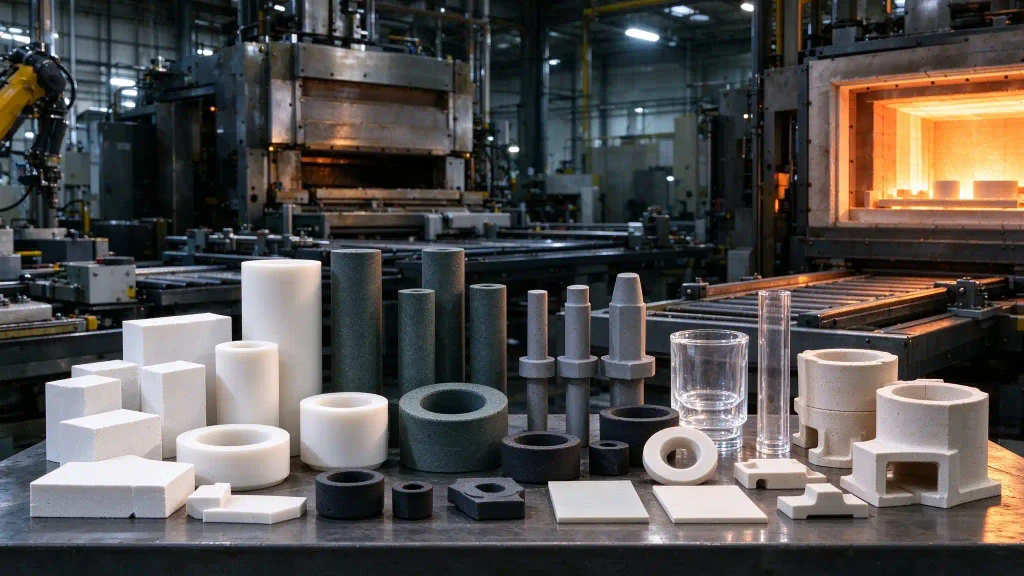
The performance of ceramic components depends on more than hardness alone. In applications involving sliding contact, repeated movement, or abrasive particles, surface finish, mechanical strength, and the design of mating parts all affect service life. For example, a ceramic plunger used in a fluid control system may need a smooth surface and close dimensional tolerances, while a wear-resistant sleeve may require high hardness and good resistance to chemical attack. In addition, ceramic materials behave differently under impact and bending loads, so the right grade must match the actual forces and movement involved. By considering friction, load, temperature, lubrication, and the properties of surrounding components together, engineers can make better material choices. Careful design and suitable installation are also important because ceramics are hard and wear-resistant but can be sensitive to sudden impact and excessive tensile stress.
Engineering Ceramics for High-Precision Machining & Abrasion Resistance
Precision machinery and automated production equipment depend on components that can maintain their shape and accuracy under constant movement, friction, and pressure. Over time, abrasive particles, repeated contact, and chemical exposure may damage conventional materials, leading to dimensional errors, product contamination, and unexpected maintenance. At Jenson(Luoyang) Technology Co., Ltd.(Luoyang) Technology Co., Ltd.(Luoyang) Technology, we provide advanced ceramic materials designed for demanding industrial applications. With properties such as high hardness, excellent wear resistance, and dimensional stability, materials including alumina (Al₂O₃), silicon carbide (SiC), silicon nitride (Si₃N₄), and boron carbide (B₄C) offer different solutions for improving component durability and equipment reliability.
High Hardness & Abrasion Resistance: When machine parts come into frequent contact with hard surfaces or abrasive particles, surface wear can reduce accuracy and shorten service life. Alumina ceramics provide a practical balance of hardness, wear resistance, and cost efficiency, making them suitable for wear plates, ceramic rings, sleeves, and other industrial components. For more demanding wear conditions, silicon carbide ceramics offer high hardness and strong resistance to abrasion, while boron carbide ceramics are valued for their exceptionally high hardness and low density. Choosing the right material according to the type of wear, contact pressure, and operating environment helps reduce replacement frequency and maintain stable equipment performance.
Precision Machining & Dimensional Accuracy: In precision equipment, even small dimensional changes can affect assembly, sealing, and movement. Ceramic rods, plungers, sleeves, rings, and other custom components may require tight dimensional tolerances and carefully controlled surface finishes. Through suitable grinding and polishing processes, ceramic parts can be manufactured to meet specific drawing requirements. However, the achievable tolerance depends on the material, component geometry, size, and manufacturing process. Careful review of technical drawings and operating requirements is therefore important before production begins.
Friction, Surface Finish & Material Compatibility: Smooth contact surfaces and suitable component design can help support consistent movement in fluid handling systems, automated machinery, and precision positioning equipment. The performance of a ceramic part depends on its material properties, surface finish, applied load, and contact conditions. For example, silicon nitride ceramics combine good wear resistance with high strength and toughness, making them worth considering for selected mechanical components exposed to repeated contact or stress. Meanwhile, alumina ceramics are widely used where hardness and electrical insulation are important. Proper clearances, suitable lubrication where required, and careful installation can further reduce friction-related damage and help extend component life.
Mechanical Loads, Chemical Resistance & Service Life: Industrial ceramic components may face repeated pressure, vibration, moisture, and corrosive fluids during operation. These conditions require careful consideration of mechanical strength, chemical resistance, and wear performance. Silicon carbide ceramics are valued for their hardness and resistance to many corrosive environments, while silicon nitride ceramics offer a useful combination of strength, toughness, and wear resistance. In applications where thermal management and electrical insulation are also important, aluminum nitride ceramics (AlN) may be suitable, although their selection should be based on the actual mechanical and thermal requirements. Since ceramics can be sensitive to sudden impact and excessive tensile stress, engineers should evaluate loading conditions, installation methods, and material compatibility before choosing a grade. At Jenson(Luoyang) Technology Co., Ltd.(Luoyang) Technology Co., Ltd.(Luoyang) Technology, we help customers identify suitable materials and custom component designs to improve equipment reliability, reduce maintenance needs, and support long-term performance.
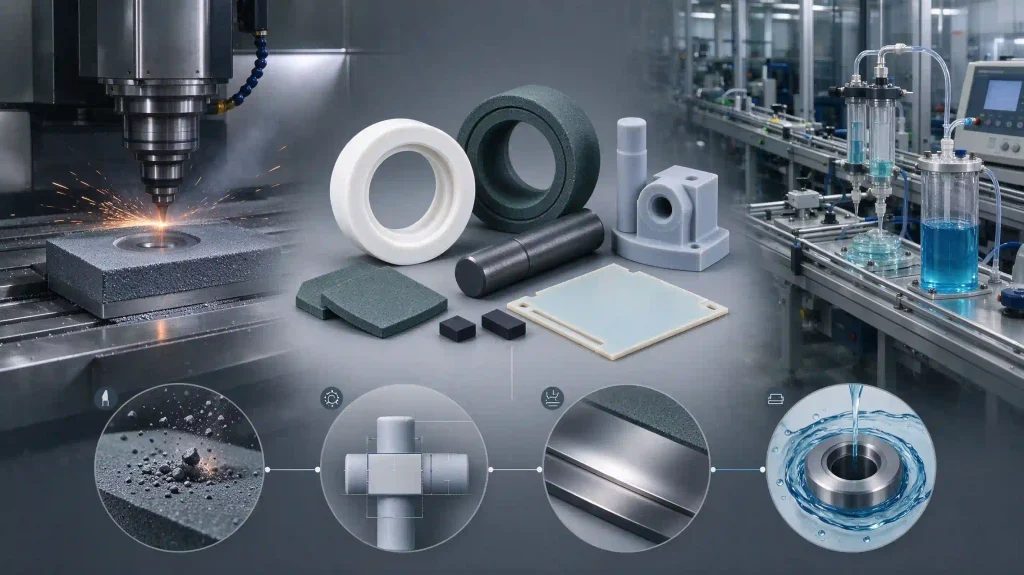
Advanced Ceramic Materials for Wear-Resistant Industrial Applications
Choosing the right ceramic material for wear-resistant industrial applications requires more than comparing hardness values. Components used in machinery, automated production lines, fluid handling systems, and material processing equipment may face continuous friction, abrasive particles, repeated pressure, and contact with corrosive substances. These conditions can lead to surface damage, dimensional changes, and frequent part replacement. At Jenson(Luoyang) Technology Co., Ltd.(Luoyang) Technology Co., Ltd.(Luoyang) Technology, we offer a range of advanced ceramic materials designed for different industrial needs. Alumina (Al₂O₃), silicon carbide (SiC), silicon nitride (Si₃N₄), and boron carbide (B₄C) each have distinct properties that affect wear resistance, mechanical strength, chemical stability, and service life. Understanding these differences helps engineers select materials that match actual working conditions rather than relying on a single performance value.
High-Purity Alumina (Al₂O₃): With its high hardness, good wear resistance, and excellent electrical insulation, alumina is a widely used material for industrial ceramic components. It is suitable for wear plates, ceramic rings, sleeves, plungers, tubes, and other parts that need stable dimensions and reliable performance. Different alumina grades can meet different requirements for purity, strength, and cost. For precision machinery, ground or polished alumina components can be made to meet specified dimensional and surface-finish requirements. However, impact loads, sharp contact points, and poor installation can still cause chipping or cracking, so component design and operating conditions must be considered.
Silicon Carbide (SiC): When equipment operates in abrasive, corrosive, or high-temperature environments, silicon carbide ceramics can provide a strong combination of hardness, wear resistance, and chemical stability. Common applications include mechanical seals, pump components, protective sleeves, wear plates, and parts used in material processing systems. Silicon carbide also offers good thermal conductivity and low thermal expansion, which can be useful when components experience temperature changes. Even so, its performance depends on the specific grade, surface finish, chemical medium, and operating temperature. Engineers should check these conditions before selecting SiC for demanding applications.
Silicon Nitride (Si₃N₄): For mechanical parts exposed to repeated loads, movement, and vibration, silicon nitride ceramics offer a useful balance of strength, toughness, and wear resistance. Compared with many traditional ceramics, silicon nitride has good resistance to mechanical damage and thermal shock, making it suitable for selected rollers, shafts, precision machine components, and other demanding industrial parts. Its relatively low density can also be helpful in applications where moving mass matters. However, machining requirements, component geometry, load direction, and contact conditions all affect performance. Proper material selection and precision finishing are important for achieving reliable operation.
Boron Carbide (B₄C): Known for its exceptionally high hardness and low density, boron carbide is suitable for specialized applications where resistance to severe abrasion is a key priority. It can be considered for selected wear-resistant components and parts used in abrasive material handling. However, high hardness does not automatically mean better performance in every situation. Boron carbide can be sensitive to impact and tensile stress, so its suitability depends on the loading conditions, component shape, and contact environment. Engineers should evaluate the balance between abrasion resistance, mechanical reliability, manufacturing requirements, and cost before choosing this material.
Boron Nitride (BN): For applications where lubrication, release properties, or electrical insulation are important, boron nitride ceramics offer a different set of advantages. Depending on the grade, BN can provide low friction, good thermal stability, and resistance to sticking, making it useful for selected industrial fixtures, insulation parts, and high-temperature processing equipment. Unlike alumina or silicon carbide, boron nitride is not normally chosen as the first option for severe abrasive wear. Instead, it is better suited to applications where surface contact, easy release, or insulation is a key concern. The correct grade should be selected according to the operating temperature, atmosphere, applied load, and required mechanical strength.
Aluminum Nitride (AlN): In precision equipment where heat must be transferred efficiently while electrical insulation is maintained, aluminum nitride ceramics can be a suitable choice. Their high thermal conductivity and electrical insulation make them valuable for electronic equipment, thermal management components, and selected industrial assemblies. However, AlN is not generally the first choice when maximum abrasion resistance is the main requirement. Its value lies in balancing heat dissipation with insulation, especially when temperature control affects equipment stability or the performance of nearby components. Surface finish, thermal contact, and mechanical loading should all be reviewed during design.
No single ceramic material is best for every wear-resistant industrial application. The right choice depends on the type of wear, contact pressure, operating speed, temperature, chemical exposure, and required dimensional accuracy. In addition, component geometry and machining quality can be just as important as the material itself. Alumina is a practical option for many general wear-resistant parts, while silicon carbide suits demanding abrasive and corrosive environments. Silicon nitride is worth considering where strength and toughness are important, and boron carbide serves specialized applications requiring exceptional hardness. At Jenson(Luoyang) Technology Co., Ltd.(Luoyang) Technology Co., Ltd.(Luoyang) Technology, we help customers compare material properties and component requirements to develop ceramic solutions that support reliable operation and longer service life.
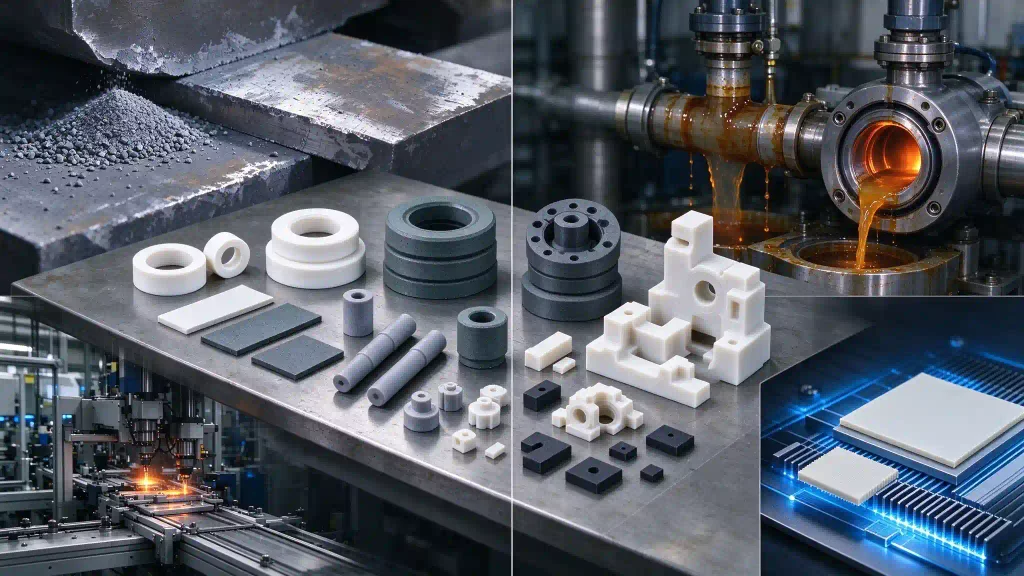
Technical Properties & Material Selection Guide for Precision Ceramic Parts
Selecting the right ceramic material for precision parts requires a clear understanding of the working environment, mechanical loads, wear conditions, and dimensional requirements. Hardness affects resistance to surface damage, while flexural strength and fracture toughness help determine how a component responds to force and impact. In addition, thermal expansion can affect dimensional accuracy when temperatures change, and thermal conductivity matters when heat needs to move through a part. By comparing these properties with the actual operating conditions, engineers can choose materials that support reliable movement, stable performance, and longer service life in precision machinery and industrial equipment.
The table below provides a general comparison of commonly used engineering ceramic materials for precision and wear-resistant applications. The values are representative ranges for preliminary reference, not guaranteed specifications for every grade. Actual performance may vary with material purity, composition, microstructure, manufacturing method, component size, and test conditions. For custom ceramic parts, final material selection should be based on the required drawings, tolerances, surface finish, and operating environment.
Typical Engineering Ceramic Material Properties
| Property | Alumina (Al₂O₃) | Silicon Carbide (SiC) | Silicon Nitride (Si₃N₄) | Boron Nitride (BN) | Aluminum Nitride (AlN) |
|---|---|---|---|---|---|
| Density (g/cm³) | 3.6–3.95 | 3.05–3.2 | 3.15–3.3 | 1.9–2.2* | ~3.26 |
| Flexural Strength (MPa) | 250–400 | 300–500 | 600–1,000 | 50–150 | 300–450 |
| Thermal Conductivity (W/m·K) | 20–35 | 80–150 | 20–90 | 20–60 | 170–230** |
| CTE (×10⁻⁶/K) | 7–8.5 | 4–5 | 2.5–3.5 | 1.0–4.0 | ~4.5 |
| Young’s Modulus (GPa) | 300–380 | 380–430 | 280–320 | 20–80 | 310–330 |
| Vickers Hardness (GPa) | 12–18 | 22–28 | 14–18 | 1–10 (Composite) | 11–14 |
| Key Advantages | Hardness, wear resistance, electrical insulation | Abrasion resistance, thermal conductivity, chemical resistance | Strength, toughness, thermal shock resistance | Low friction, release properties, electrical insulation | High thermal conductivity, electrical insulation |
| Typical Applications | Ceramic rings, plungers, sleeves, wear plates | Mechanical seals, wear parts, protective components | Precision mechanical parts, rollers, shafts | Release components, insulation parts, high-temperature fixtures | Thermal management parts, insulating substrates, electronic components |
* BN density and other properties vary significantly by grade, porosity, and manufacturing method. **AlN thermal conductivity varies by grade and processing; high-performance grades may reach higher values. All figures are indicative only. Confirm exact values with the relevant material data sheet before specifying or publishing them.
Material Selection for Precision Applications: For general-purpose wear-resistant ceramic components, alumina is often a practical starting point because it combines hardness, electrical insulation, and cost efficiency. When severe abrasion, chemical exposure, or heat transfer is a major concern, silicon carbide may be more suitable. Silicon nitride is worth considering for parts that need a balance of strength, toughness, and resistance to repeated mechanical loads. Meanwhile, boron nitride is often selected for applications requiring low friction or easy release rather than extreme abrasion resistance, while aluminum nitride is especially useful when heat dissipation and electrical insulation are both required.
Dimensional Tolerances & Surface Finish: Material properties alone cannot guarantee precision. The final accuracy of a ceramic component also depends on its geometry, dimensions, manufacturing process, and grinding or polishing requirements. Depending on the design and production method, precision-ground components may achieve tolerances in the range of ±0.01–0.05 mm, but this should not be treated as a universal guarantee. Customers should provide technical drawings, critical dimensions, surface roughness requirements, and operating conditions so the appropriate material and achievable tolerance can be reviewed before production.
Frequently Asked Questions About Precision Machinery & Wear-Resistant Ceramic Components
1. Which ceramic material is best for wear-resistant industrial components?
The best material depends on the type of wear, operating load, working environment, and required service life. Alumina (Al₂O₃) is a popular choice for general wear-resistant parts because it offers high hardness, good electrical insulation, and a practical balance of performance and cost. For applications involving severe abrasion or corrosive conditions, silicon carbide (SiC) may be more suitable. Silicon nitride (Si₃N₄) is worth considering when strength and toughness are important, while boron carbide (B₄C) is used in specialized applications requiring exceptionally high hardness.
Before making a decision, engineers should compare material properties with actual operating conditions. Buyers should also consider machining costs, expected service life, and replacement frequency rather than choosing a material based on hardness alone.
2. Can precision ceramic parts replace metal components in machinery?
In many applications, precision ceramic components can replace metal parts when wear resistance, corrosion resistance, electrical insulation, or stable performance is important. Ceramic rings, sleeves, plungers, rods, and other custom parts can help reduce wear-related maintenance and avoid certain forms of metal contamination. In addition, some ceramic materials retain their properties in environments where conventional metals may wear or corrode more quickly.
However, ceramics are generally more sensitive to sudden impact and tensile stress than many metals. Engineers should check the load, vibration, contact conditions, and assembly design before switching materials. A practical approach is to evaluate the ceramic component under real operating conditions to confirm its suitability.
3. What dimensional tolerances can custom ceramic parts achieve?
The achievable tolerance depends on the ceramic material, part size, shape, wall thickness, and manufacturing process. For some precision-ground components, tolerances of approximately ±0.01–0.05 mm may be achievable, although this range is not guaranteed for every design. More complex shapes or very thin sections may require additional engineering review because ceramic forming and sintering can introduce dimensional variation.
To help manufacturers assess feasibility, buyers should provide technical drawings with critical dimensions, tolerance requirements, surface finish, and application details. Specifying which dimensions are most important can also help balance machining cost, production time, and functional performance.
4. How do alumina, silicon carbide, and silicon nitride compare for wear resistance?
These three materials offer different advantages for industrial machinery. Alumina ceramics are widely used for wear plates, rings, sleeves, and insulating parts because of their hardness and cost efficiency. Silicon carbide ceramics combine high hardness with good thermal conductivity and resistance to many corrosive environments, making them suitable for demanding wear applications. Silicon nitride ceramics offer a useful balance of strength, toughness, and wear resistance, especially where repeated mechanical loads are involved.
The right choice depends on the main failure risk. For abrasive wear, silicon carbide may be a strong candidate; for general-purpose wear parts, alumina is often a practical option; and for components exposed to repeated mechanical stress, silicon nitride may deserve consideration. Final selection should be based on grade-specific data and actual working conditions.
5. What information should buyers provide when requesting a quotation for custom ceramic parts?
A clear technical specification helps suppliers recommend a suitable material and provide a more accurate quotation. Buyers should prepare technical drawings, material or grade requirements, component dimensions, dimensional tolerances, surface finish requirements, expected quantity, and intended operating conditions. Information about temperature, contact pressure, friction, chemical exposure, and required service life can further improve material selection.
If the exact ceramic grade has not yet been decided, buyers can describe the application and the main performance requirements instead. This allows the engineering team to compare options such as alumina, silicon carbide, silicon nitride, and other suitable ceramic materials. Providing complete information early can reduce repeated revisions and help avoid unnecessary manufacturing costs.
6. How can ceramic components achieve a longer service life in precision machinery?
Long service life depends on more than material selection. Proper surface finishing, correct dimensional tolerances, suitable contact conditions, and careful installation all help reduce premature wear and damage. Ceramic parts should be protected from sudden impacts, excessive bending loads, and uneven clamping pressure. Where the application requires lubrication, engineers should also confirm that the lubricant is compatible with the operating environment and the other components.
For buyers and equipment designers, it is useful to review wear patterns and maintenance records from existing parts before specifying a replacement. Matching the ceramic grade to the actual failure mechanism can improve reliability, reduce unplanned downtime, and support more predictable maintenance schedules.