Advanced Technical Ceramics, Precision Alumina, Silicon Carbide, Crucible Parts
 Technology Co., Ltd.(Luoyang) Technology Co., Ltd.科技品牌标志.webp)


Silicon Carbide vs. Silicon Nitride Ceramics: Which Is Better for Strength, Wear and Heat Resistance?
1. Why Compare Silicon Carbide and Silicon Nitride Ceramics?
Advanced ceramics are widely used in industrial equipment, precision machinery, chemical processing systems, and high-temperature applications. As operating conditions become more demanding, traditional materials may not provide enough hardness, wear resistance, mechanical strength, or thermal stability. This is why engineers and procurement teams increasingly consider advanced ceramic materials for critical components.
Among the available engineering ceramics, silicon carbide (SiC) and silicon nitride (Si₃N₄) are two important choices. Both offer high hardness, good chemical stability, and the ability to work under demanding conditions. However, their performance characteristics are different. Silicon carbide is generally known for its high hardness, excellent thermal conductivity, and strong resistance to abrasive wear. In comparison, silicon nitride often provides higher fracture toughness, high flexural strength, and excellent thermal shock resistance. These differences can affect component life, maintenance frequency, production efficiency, and total operating cost. Therefore, choosing between silicon carbide and silicon nitride requires more than comparing a single property. Engineers need to consider mechanical loads, working temperatures, friction conditions, chemical exposure, and component design.
This article compares their material properties, mechanical performance, wear resistance, thermal behavior, and industrial applications to help buyers select the right ceramic for their operating requirements.
2. Understanding Silicon Carbide and Silicon Nitride Ceramics
2.1 What Is Silicon Carbide (SiC) Ceramic?
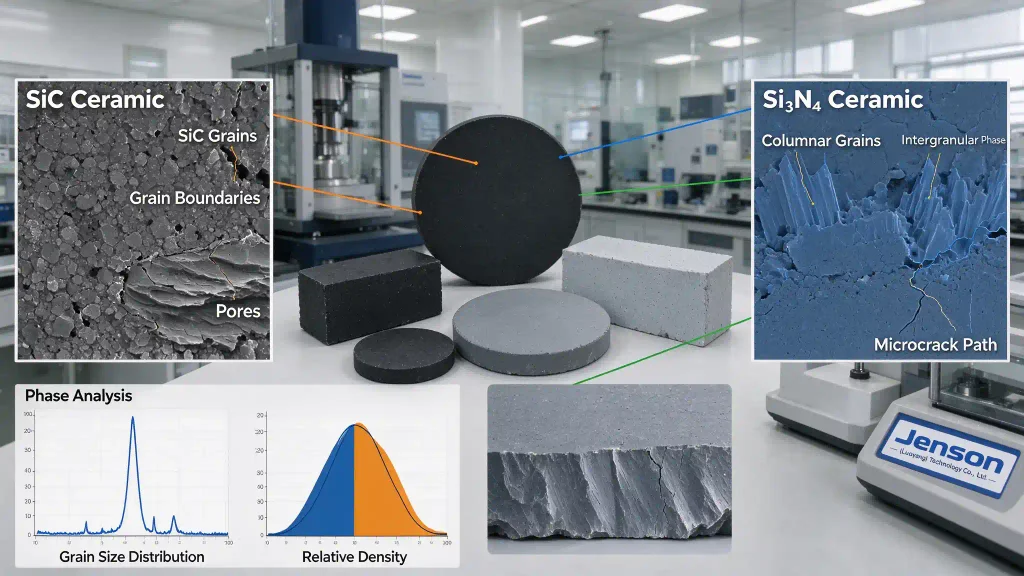
Silicon carbide is an advanced ceramic compound made from silicon and carbon. Its strong covalent bonds give it high hardness, stiffness, and excellent resistance to surface damage. It also has relatively high thermal conductivity compared with many other engineering ceramics. Different manufacturing routes are used to produce silicon carbide components. Common types include reaction-bonded silicon carbide (RB-SiC) and pressureless-sintered silicon carbide (SSiC). Reaction-bonded grades are produced through a process in which silicon reacts with carbon in a porous carbon-containing body. This process can leave a certain amount of residual free silicon in the final material. Pressureless-sintered silicon carbide is generally produced at high temperatures with sintering additives and can achieve a dense structure without the same reaction-bonded silicon phase.
These manufacturing differences influence density, chemical compatibility, strength, and machining requirements. For example, the residual silicon in RB-SiC may affect its performance in certain chemical environments. Therefore, buyers should confirm the material grade and manufacturing route rather than selecting a component based only on the general name of the material.
2.2 What Is Silicon Nitride (Si₃N₄) Ceramic?
Silicon nitride is a ceramic compound made from silicon and nitrogen. It is valued for its combination of high flexural strength, fracture toughness, wear resistance, and thermal stability. Its microstructure can include elongated grains that help slow crack growth and improve resistance to fracture. Common manufacturing methods include gas-pressure sintering, hot pressing, and other controlled sintering processes. These methods are used to achieve high density and suitable mechanical properties for different applications.
Compared with silicon carbide, silicon nitride generally has lower thermal conductivity but better fracture toughness in many commercial grades. It is therefore often selected for components exposed to repeated mechanical loads, vibration, or rapid temperature changes.
3. Silicon Carbide vs Silicon Nitride: Key Properties Compared
A direct comparison of silicon carbide vs. silicon nitride helps engineers understand how each material performs under different operating conditions. The following tables provide typical reference ranges for common engineering ceramic grades. Actual values vary with composition, manufacturing process, density, grain structure, and test method.
3.1 Physical and Mechanical Properties
| Property | Silicon Carbide (SiC) | Silicon Nitride (Si₃N₄) |
|---|---|---|
| Density (g/cm³) | 3.05–3.20 | 3.10–3.30 |
| Vickers Hardness (GPa) | 20–28 | 12–17 |
| Flexural Strength (MPa) | 300–600 | 600–1,000 |
| Fracture Toughness (MPa·m½) | 3–5 | 5–8 |
| Young’s Modulus (GPa) | 380–450 | 280–320 |
| Compressive Strength (MPa) | 2,000–3,900 | 2,000–3,500 |
| Typical Poisson’s Ratio | 0.14–0.19 | 0.24–0.29 |
The main difference is the balance between hardness and fracture resistance. Silicon carbide generally has higher hardness and elastic modulus, which makes it suitable for applications requiring surface durability and stiffness. Silicon nitride often provides higher flexural strength and fracture toughness, helping it resist crack growth under mechanical stress.
3.2 Thermal Properties
| Property | Silicon Carbide (SiC) | Silicon Nitride (Si₃N₄) |
|---|---|---|
| Thermal Conductivity (W/m·K) | 80–200 | 15–90 |
| Coefficient of Thermal Expansion (×10⁻⁶/K) | 3.5–4.5 | 2.5–3.5 |
| Specific Heat Capacity (J/kg·K) | 600–800 | 600–800 |
| Melting/Decomposition Behavior | Very high-temperature stability; does not have a simple practical melting point under all conditions | Decomposes at very high temperatures; behavior depends on atmosphere |
| Thermal Shock Resistance | High, grade- and design-dependent | Generally excellent |
| High-Temperature Strength Retention | Grade- and atmosphere-dependent | Grade- and atmosphere-dependent |
3.3 Chemical and Electrical Properties
| Property | Silicon Carbide (SiC) | Silicon Nitride (Si₃N₄) |
|---|---|---|
| Oxidation Resistance | Generally very good | Good, grade- and temperature-dependent |
| Acid Resistance | Good in many media; specific acids require testing | Good in many media; specific acids require testing |
| Alkali Resistance | Depends on concentration and temperature | Depends on concentration and temperature |
| Electrical Behavior | Can be semiconducting or resistive depending on grade | Generally electrically insulating |
| Moisture Absorption | Very low in dense grades | Very low in dense grades |
| Chemical Compatibility | Strong in many demanding environments | Good in many industrial environments |
The comparison shows that neither material is better in every category. Silicon carbide is often preferred when hardness and heat transfer are important. Silicon nitride is often more suitable when fracture resistance and thermal shock performance are major concerns.
4. Strength and Fracture Toughness: Which Ceramic Handles Mechanical Stress Better?
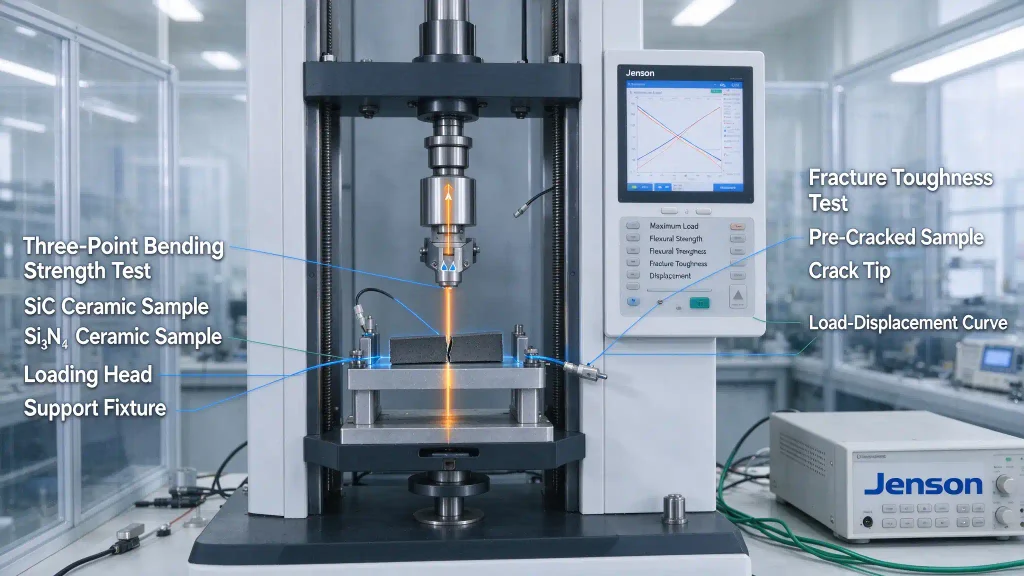
Mechanical strength is an important factor when selecting ceramic components for pumps, bearings, mechanical seals, and precision machinery. However, strength includes several different properties. Flexural strength measures resistance to bending failure, while fracture toughness describes the material’s resistance to crack growth. Hardness measures resistance to localized surface deformation.
Silicon carbide has a high elastic modulus, often around 380–450 GPa, which means it is very stiff under load. Its high hardness also helps protect surfaces from scratches and indentation. These properties make it useful for rigid components that require good dimensional stability and surface durability. However, silicon carbide has relatively moderate fracture toughness compared with many silicon nitride grades. It is still a brittle ceramic, so sharp corners, impact loading, machining defects, and uneven assembly pressure can increase the risk of cracking.
Silicon nitride generally offers higher fracture toughness, often around 5–8 MPa·m½, and flexural strength can reach approximately 600–1,000 MPa in suitable grades. Its elongated grain structure can help slow crack propagation. This makes it useful in components exposed to repeated contact loads, vibration, and bending stress.
For example, ceramic bearing balls are often made from silicon nitride because the material combines relatively low density, high strength, and good rolling-contact performance. Silicon carbide, on the other hand, is widely considered for rigid wear components and mechanical seal parts where hardness and chemical compatibility are important. The correct choice depends on the load type, component geometry, surface condition, and safety margin. A high flexural-strength value alone does not guarantee longer service life.
5. Wear Resistance and Friction: SiC vs Si₃N₄ in Industrial Environments
Both materials offer good wear resistance, but their performance depends on the type of wear and the operating conditions.
5.1 Abrasive Wear Resistance
Abrasive wear occurs when hard particles or rough surfaces remove material from a component. Because silicon carbide has very high hardness, it is often suitable for abrasive environments involving particles, powders, and hard contact surfaces. It is used in wear plates, pump components, nozzles, and mechanical seal rings. Silicon nitride also provides strong wear resistance. Although its hardness is generally lower than that of silicon carbide, its higher fracture toughness can be useful where surface damage is linked to repeated contact stress or small impact events.
5.2 Sliding Wear and Rolling Contact
In sliding applications, wear depends on the contact pressure, sliding speed, lubrication, surface finish, and the material used on the opposite surface. A harder ceramic does not always produce a lower wear rate because friction and surface damage also depend on the contact system. For rolling contact, silicon nitride is commonly used for ceramic bearing balls and hybrid bearings. Its strength, fracture toughness, and relatively low density make it suitable for repeated rolling loads. Silicon carbide may be more appropriate for certain abrasive sliding environments and corrosion-resistant components.
| Wear Evaluation Factor | SiC | Si₃N₄ |
|---|---|---|
| Vickers Hardness (GPa) | 20–28 | 12–17 |
| Fracture Toughness (MPa·m½) | 3–5 | 5–8 |
| Abrasive Wear Resistance | Generally excellent | Generally very good |
| Sliding Wear | Grade- and contact-dependent | Grade- and contact-dependent |
| Rolling Contact | Application-dependent | Often favorable |
| Impact Damage Resistance | Moderate | Generally higher |
| Typical Components | Seal rings, sleeves, wear parts | Bearing balls, rollers, precision parts |
For procurement, it is important to provide details about the wear mechanism rather than simply asking for the material with the highest hardness. Contact pressure, abrasive particle size, lubrication, and required surface roughness should all be considered.
6. Thermal Performance: Conductivity, Heat Resistance and Thermal Shock
Thermal performance is another major difference between silicon carbide vs silicon nitride. The selection should consider heat transfer, dimensional change, thermal cycling, and mechanical strength at operating temperature.
6.1 Thermal Conductivity and Heat Dissipation
Silicon carbide generally has higher thermal conductivity, commonly around 80–200 W/m·K for many engineering grades. Some specialized grades may fall outside this range. Its ability to transfer heat makes it suitable for heat exchanger components, furnace parts, and selected thermal management applications.
Silicon nitride generally has lower thermal conductivity, often around 15–90 W/m·K depending on grade and processing. Although it does not transfer heat as quickly as many SiC grades, it can be useful where mechanical strength and thermal shock resistance are more important than rapid heat transfer.
6.2 High-Temperature Stability
Both materials can operate in high-temperature environments, but their actual limits depend on atmosphere, load, exposure time, and material grade. Silicon carbide is known for its high-temperature stability and oxidation resistance in suitable conditions. Silicon nitride also maintains useful mechanical properties at elevated temperatures, although oxidation and grain-boundary behavior should be evaluated for the specific service environment. It is important to distinguish between a material’s melting or decomposition behavior and its recommended continuous operating temperature. A component that survives a short exposure may not maintain the same strength during long-term service under load.
6.3 Thermal Expansion and Thermal Shock Resistance
Thermal expansion affects component dimensions as temperature changes. A lower coefficient of thermal expansion can help reduce dimensional variation and thermal stress, especially when a component is fixed inside a metal assembly. For example, consider a ceramic component with an initial length of 100 mm and a temperature increase of 800 K. Using representative expansion coefficients of 4.0 × 10⁻⁶/K for SiC and 3.0 × 10⁻⁶/K for Si₃N₄:
| Parameter | SiC Example | Si₃N₄ Example |
|---|---|---|
| Initial Length (mm) | 100 | 100 |
| Temperature Increase (K) | 800 | 800 |
| Expansion Coefficient (×10⁻⁶/K) | 4.0 | 3.0 |
| Calculated Expansion (mm) | 0.32 | 0.24 |
| Final Length (mm) | 100.32 | 100.24 |
This simplified calculation shows how thermal expansion affects component dimensions. Actual expansion depends on the grade and temperature range.
Thermal shock occurs when rapid temperature changes create internal temperature differences and stress. Silicon nitride often performs well in this condition because of its low thermal expansion and relatively high fracture toughness. Silicon carbide also offers good thermal shock performance in suitable grades, supported by its thermal conductivity and strength. However, geometry, wall thickness, surface defects, and mounting conditions can change the result significantly.
7. Where Are Silicon Carbide and Silicon Nitride Ceramics Used?
Although both materials are used in demanding industrial environments, their different properties make them suitable for different component requirements.
7.1 Applications of Silicon Carbide Ceramics
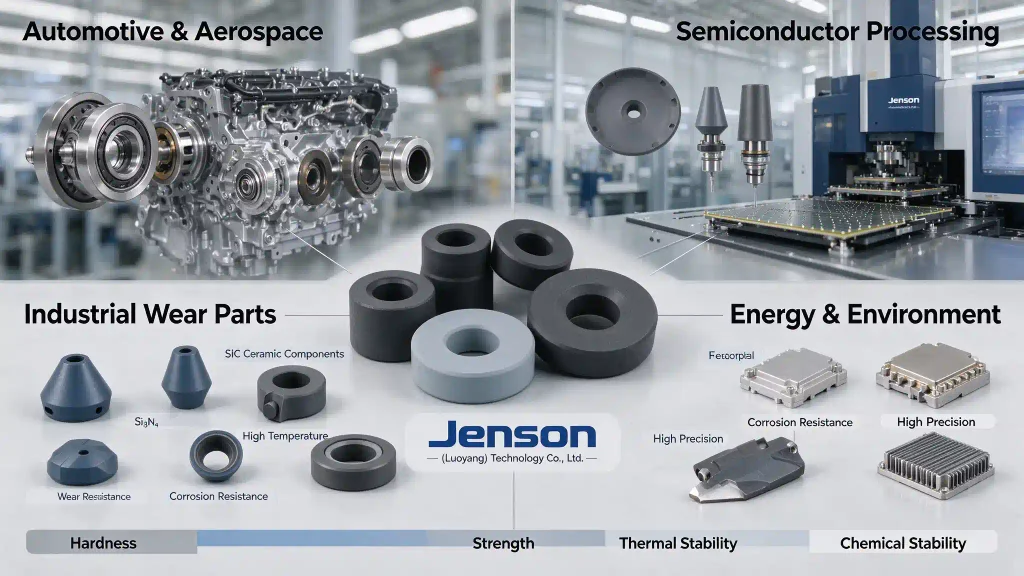
Silicon carbide ceramics are often selected for applications that require high hardness, wear resistance, thermal conductivity, and chemical stability. Typical components include mechanical seal rings, pump sleeves, wear-resistant liners, furnace parts, heat exchanger components, and industrial nozzles. In pump and sealing systems, SiC can provide good resistance to abrasive particles and many corrosive media. In high-temperature equipment, its thermal conductivity can support heat transfer and temperature control. However, the exact grade must be selected according to the process atmosphere and chemical exposure. Reaction-bonded grades, for example, may have different chemical compatibility from dense sintered grades because of residual silicon.
7.2 Applications of Silicon Nitride Ceramics
Silicon nitride ceramics are commonly used in ceramic bearing balls, hybrid bearings, precision rollers, wear-resistant parts, and components exposed to repeated thermal cycling. In hybrid bearings, silicon nitride balls are combined with steel rings. Their relatively low density and good mechanical properties can support high-speed operation and reduce some contact-related stresses. In other industrial systems, silicon nitride may be selected when resistance to crack growth, repeated loading, and thermal shock is more important than maximum thermal conductivity.
8. Advantages and Limitations of SiC and Si₃N₄
The following summary highlights the main advantages and limitations of each material.
| Material | Main Advantages | Main Limitations |
|---|---|---|
| Silicon Carbide | High hardness; high thermal conductivity; strong abrasive wear resistance; good chemical stability in suitable media; high stiffness | Lower fracture toughness than many Si₃N₄ grades; brittle under impact; machining requires specialized tools |
| Silicon Nitride | High flexural strength; higher fracture toughness; low thermal expansion; excellent thermal shock resistance; good rolling-contact performance | Generally lower thermal conductivity; specialized processing; precision machining can be costly |
Neither material is suitable for every application. Both are brittle ceramics and can fail under excessive impact, tensile stress, or poor assembly conditions. Component design should include suitable corner radii, controlled wall thickness, proper support, and appropriate tolerances. Surface defects and machining damage should also be considered during inspection.
9. How to Choose Between Silicon Carbide and Silicon Nitride Ceramics
The best material depends on the actual operating conditions. Buyers should define the most important performance requirements before requesting a quotation or selecting a grade. Choose silicon carbide when high hardness, abrasive wear resistance, heat transfer, and chemical stability are the main priorities. It is often a suitable option for mechanical seal rings, pump components, furnace parts, and other industrial wear components. Choose silicon nitride when high flexural strength, fracture toughness, low thermal expansion, and thermal shock resistance are more important. It is often considered for ceramic bearing balls, precision rollers, and components exposed to repeated mechanical or thermal loads.
Before ordering custom ceramic components, procurement teams should confirm the operating temperature, atmosphere, mechanical load, wear type, chemical medium, component dimensions, surface roughness, and required tolerances. They should also request the material grade and relevant inspection data. These details help suppliers evaluate whether the selected ceramic is suitable for the intended service conditions.
10. Manufacturing, Machining and Cost Considerations
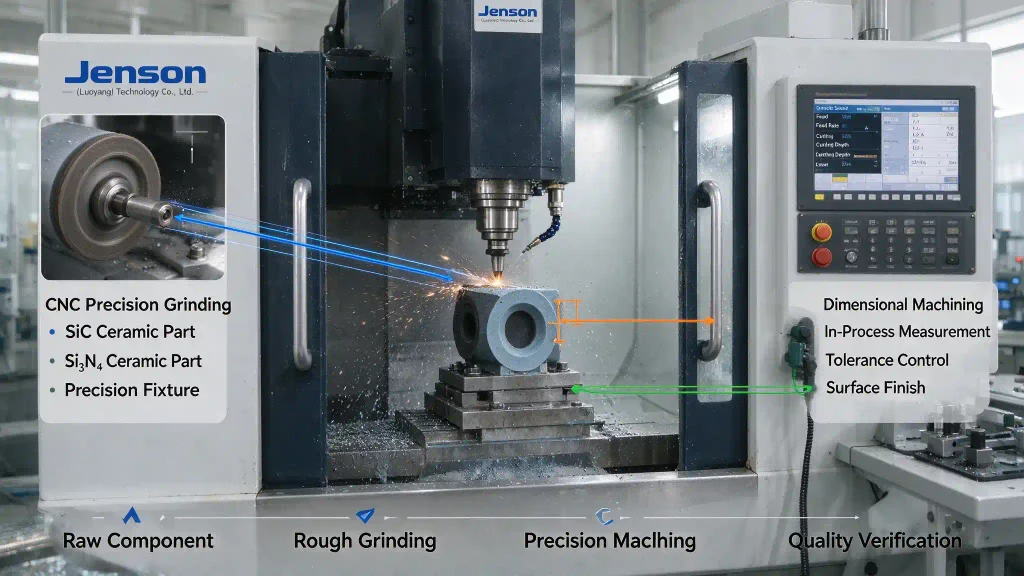
The final performance of a ceramic component depends not only on its material composition but also on powder preparation, forming, sintering, machining, and quality inspection. Silicon carbide can be produced through reaction bonding, pressureless sintering, and other specialized processes. Each route has different effects on density, residual phases, strength, and chemical compatibility. Silicon nitride is commonly produced through controlled sintering methods, including gas-pressure sintering and hot pressing. These processes help develop a dense microstructure with suitable mechanical properties. Both materials are difficult to machine after sintering because of their high hardness. Precision grinding, diamond tooling, and carefully controlled machining conditions are commonly required to achieve tight dimensions and good surface quality. Complex shapes, thin walls, small holes, and tight tolerances may increase production time and cost.
The total component cost is influenced by material grade, forming method, sintering route, machining allowance, geometry, tolerance, surface finish, inspection requirements, and order quantity. Therefore, buyers should compare the total manufacturing requirements rather than looking only at the raw material price. Quality evaluation may include density measurement, hardness testing, flexural strength testing, dimensional inspection, surface inspection, and microstructural analysis. For critical parts, the inspection plan should be agreed upon before production so that acceptance criteria are clear.
11. About Jenson
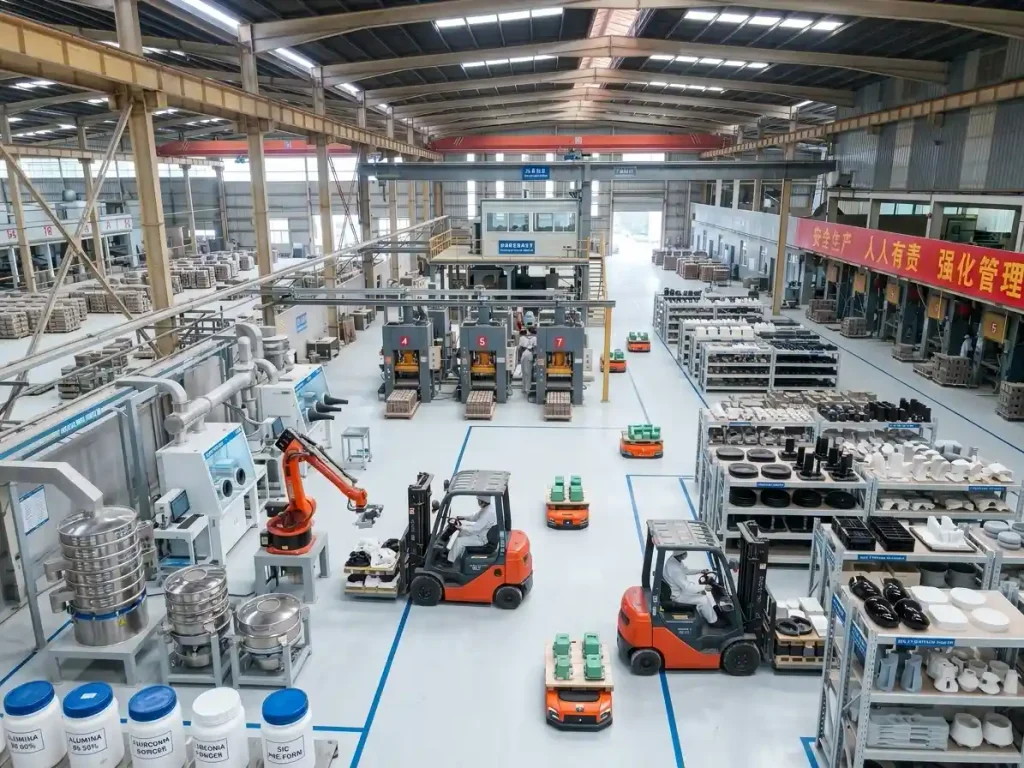
Jenson(Luoyang) Technology Co., Ltd. focuses on advanced ceramic materials and engineered ceramic components for industrial, high-temperature, electronic, and precision engineering applications. Its product range includes silicon carbide, silicon nitride, alumina, aluminum nitride, boron nitride, quartz, and other advanced ceramic products.
For custom ceramic components, material selection should be based on the actual working conditions and technical requirements. Jenson(Luoyang) Technology Co., Ltd. can discuss project needs using customer drawings, operating temperatures, mechanical loads, dimensional tolerances, surface finish requirements, and inspection criteria. This engineering-focused approach helps buyers evaluate suitable ceramic materials and component manufacturing requirements for their applications.
12. Frequently Asked Questions
Q1. What is the main difference between silicon carbide and silicon nitride ceramics?
The main difference between silicon carbide (SiC) and silicon nitride (Si₃N₄) is their balance of mechanical and thermal properties. Silicon carbide generally has higher hardness, elastic modulus, and thermal conductivity, making it suitable for components that require high stiffness, surface durability, and efficient heat transfer. Silicon nitride, on the other hand, often provides higher flexural strength and fracture toughness, which help it resist crack growth under mechanical stress. It also has a relatively low coefficient of thermal expansion and excellent thermal shock resistance. For industrial applications, SiC is often considered for abrasive wear and heat-transfer components, while Si₃N₄ is commonly selected for precision parts exposed to repeated loads or rapid temperature changes. The final choice should depend on the material grade and operating conditions.
Q2. Is silicon carbide stronger than silicon nitride?
It depends on the type of strength being evaluated. Silicon carbide generally has higher hardness and elastic modulus, so it offers strong resistance to surface indentation and elastic deformation. However, many silicon nitride grades have higher flexural strength and fracture toughness. Typical flexural strength values for SiC are approximately 300–600 MPa, compared with around 600–1,000 MPa for suitable Si₃N₄ grades. Fracture toughness is also often higher in silicon nitride. This means Si₃N₄ may be more suitable for components exposed to bending stress, repeated contact loads, or vibration. SiC remains a strong choice where hardness and stiffness are the main priorities. Engineers should compare grade-specific test data, component geometry, and loading conditions instead of judging strength from hardness alone.
Q3. Which ceramic has better wear resistance, SiC or Si₃N₄?
Both materials offer excellent wear resistance, but their advantages depend on the wear mechanism. Silicon carbide has very high hardness, commonly around 20–28 GPa in Vickers hardness measurements, making it suitable for abrasive environments where hard particles cause surface damage. It is widely considered for mechanical seal rings, pump sleeves, nozzles, and wear-resistant components. Silicon nitride has lower hardness in many grades, but its higher fracture toughness can help reduce damage associated with repeated contact stress and small impacts. It is often used in ceramic bearing balls and precision rolling components. In practice, wear performance also depends on contact pressure, sliding speed, lubrication, surface roughness, and the opposing material. Therefore, buyers should describe the actual wear conditions when requesting a material recommendation.
Q4. Which material has higher thermal conductivity?
Silicon carbide generally has higher thermal conductivity than silicon nitride. Many engineering SiC grades have thermal conductivity values of approximately 80–200 W/m·K, while common Si₃N₄ grades often fall within approximately 15–90 W/m·K. The exact values depend on purity, porosity, grain structure, sintering additives, and manufacturing process. Higher thermal conductivity allows heat to move through a component more efficiently, which can be useful in heat exchangers, furnace components, and selected thermal management applications. Silicon nitride transfers heat less efficiently in many grades, but its mechanical strength and thermal shock resistance can make it more suitable for components exposed to rapid temperature changes. If heat dissipation is the main design requirement, SiC is often a strong candidate, subject to grade-specific data and the complete thermal design.
Q5. Is silicon nitride better than silicon carbide for thermal shock resistance?
Silicon nitride often offers excellent thermal shock resistance because it combines relatively low thermal expansion with high fracture toughness. These properties help reduce thermal stress and improve resistance to crack growth when a component experiences rapid heating or cooling. Silicon carbide can also provide good thermal shock performance, particularly in grades with high thermal conductivity and suitable geometry. However, thermal shock resistance is not determined by one property alone. Component thickness, shape, surface defects, heating rate, cooling method, and mounting conditions all influence the result. For example, a thick component with sharp corners may develop higher local stress during temperature changes than a thinner component with rounded transitions. Buyers should evaluate the expected temperature range and cycling rate, then request grade-specific data or testing where thermal shock is a critical requirement.
Q6. Which ceramic is more suitable for high-temperature industrial applications?
Both silicon carbide and silicon nitride can be used in high-temperature industrial environments, but the better option depends on the operating conditions. Silicon carbide is often selected for furnace components, heat-transfer parts, and equipment exposed to abrasive or chemically demanding conditions. Its high thermal conductivity and good high-temperature stability are useful in these applications. Silicon nitride may be preferred when a component must maintain mechanical strength under repeated thermal cycling or mechanical loading. However, the maximum service temperature of either material depends on its grade, atmosphere, applied load, exposure duration, and component design. Oxidation behavior and chemical compatibility should also be checked. Buyers should distinguish between short-term temperature tolerance and continuous operating temperature, and should confirm the recommended working range with the supplier’s technical data.
Q7. Can silicon carbide and silicon nitride ceramics be precision machined?
Yes. Both silicon carbide and silicon nitride can be precision machined, although their high hardness and brittleness make processing more demanding than machining metals. Common operations include diamond grinding, cutting, drilling, lapping, and other specialized finishing processes. The achievable dimensional tolerance and surface roughness depend on the material grade, component size, geometry, machining allowance, and equipment used. Features such as thin walls, deep holes, narrow slots, and sharp internal corners may require additional engineering review because they can increase machining difficulty or fracture risk. For custom components, buyers should provide detailed drawings that specify dimensions, tolerances, surface finish, and critical inspection points. It is also useful to discuss whether the part will be supplied as-fired, ground, or polished, since the finishing method can affect both cost and lead time.
Q8. How do I choose the right SiC or Si₃N₄ ceramic grade for my application?
Start by identifying the most demanding conditions the component will face. These may include operating temperature, mechanical load, impact, vibration, abrasive particles, sliding or rolling contact, chemical exposure, and thermal cycling. If high hardness, abrasive wear resistance, and heat transfer are the main priorities, silicon carbide may be a suitable choice. If higher fracture toughness, flexural strength, and thermal shock resistance are more important, silicon nitride may be worth evaluating. Buyers should then compare specific grades rather than relying only on general material properties. Important information includes density, hardness, flexural strength, thermal conductivity, thermal expansion, dimensional tolerances, and surface finish. Providing a component drawing and clear operating conditions allows the manufacturer to assess material suitability, machining requirements, inspection criteria, and expected production cost more accurately.