Advanced Technical Ceramics, Precision Alumina, Silicon Carbide, Crucible Parts
 Technology Co., Ltd.(Luoyang) Technology Co., Ltd.科技品牌标志.webp)


High-Purity Silicon Carbide Ceramics: Manufacturing Processes and Quality Control
1. Why Manufacturing Quality Matters for High-Purity Silicon Carbide Ceramics
As industrial equipment becomes more precise and operating conditions become more demanding, manufacturers need ceramic materials that can maintain stable performance under high temperatures, mechanical loads, and corrosive environments. Silicon carbide (SiC) ceramics are widely used in semiconductor equipment, high-temperature furnaces, precision machinery, and chemical processing systems because of their high hardness, excellent wear resistance, good thermal conductivity, and strong chemical stability.
However, these properties do not depend on the chemical composition alone. The quality of a finished component is closely related to its raw materials, powder preparation, forming method, sintering conditions, and machining accuracy. Even small differences in impurity levels, porosity, or grain structure can affect the final product. For this reason, high-purity silicon carbide ceramics require careful process control throughout manufacturing. From selecting suitable powder to inspecting the finished component, each step helps determine material consistency, dimensional accuracy, and service reliability. Understanding these processes also helps engineers and procurement teams select the right material and evaluate suppliers more effectively.
2. What Defines High-Purity Silicon Carbide Ceramics?
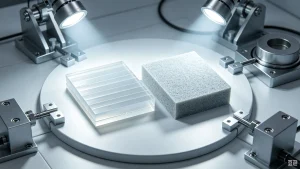
Silicon carbide compound is a ceramic material composed primarily of silicon and carbon. Its strong covalent bonds contribute to high hardness, high-temperature strength, and excellent wear resistance. Depending on the manufacturing process, silicon carbide ceramics can have different grain structures, porosity levels, and residual phases. High purity generally refers to a high SiC content and controlled levels of unwanted impurities. However, there is no single purity threshold that applies to every product. The required specification depends on the application, material grade, and measurement method. For semiconductor-related equipment, for example, trace metallic contamination may be more important than it is for some general industrial wear components.
Several factors should therefore be considered together. These include SiC content, metallic impurities, oxygen content, residual free silicon, bulk density, and open porosity. A material with high chemical purity may still be unsuitable if it has excessive porosity or poor dimensional stability.
| Material characteristic | Indicative range or reference | Why it matters |
|---|---|---|
| SiC content | Often above 98% for high-content grades; some specialty grades are higher | Indicates the proportion of the main ceramic phase |
| Bulk density, SSiC | Approximately 3.05–3.15 g/cm³ | Reflects the level of densification |
| Bulk density, RB-SiC | Approximately 2.90–3.05 g/cm³ | Influenced by residual silicon and pore structure |
| Open porosity, dense SSiC | Commonly below 1% | Affects fluid penetration and contamination risk |
| Open porosity, RB-SiC | Process- and grade-dependent | Related to infiltration and remaining pore structure |
| Vickers hardness | Approximately 2,000–2,800 HV, depending on grade and test conditions | Indicates resistance to indentation and wear |
| Thermal conductivity | Roughly 80–200 W/(m·K) for many grades | Influences heat transfer |
| Flexural strength | Approximately 300–600 MPa for many dense grades | Indicates resistance to bending loads |
These figures are indicative rather than universal acceptance limits. Test methods, specimen preparation, temperature, and material composition can all change reported results. Buyers should compare values measured under equivalent conditions and request the supplier’s technical data sheet.
3. Raw Material Selection and Silicon Carbide Powder Preparation
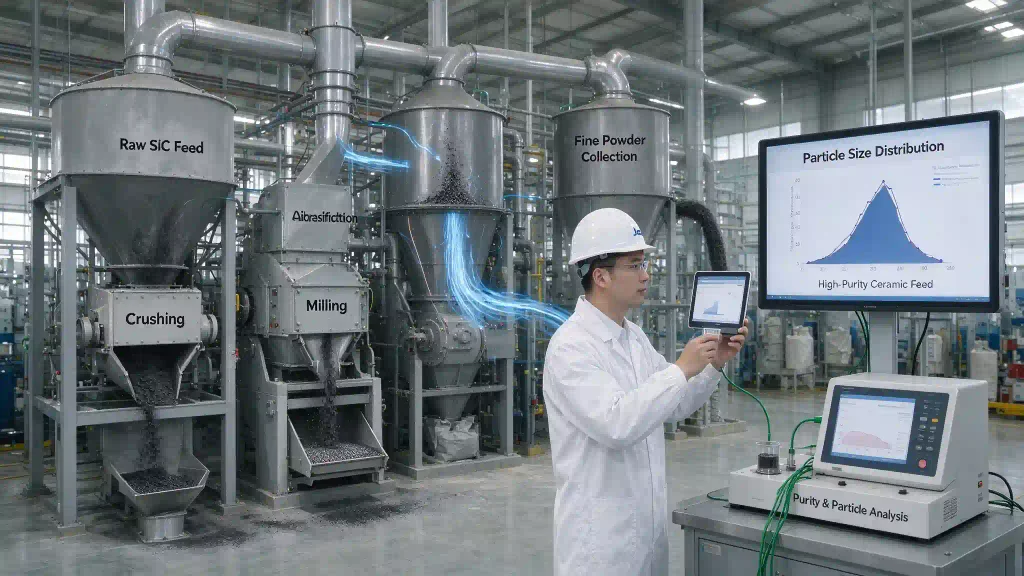
The manufacturing process begins with selecting suitable silicon carbide powder. Powder quality affects almost every later stage, including forming behavior, sintering shrinkage, grain growth, and final density. Manufacturers therefore need to consider not only the nominal purity but also particle size, particle size distribution, morphology, and batch consistency. Fine powders can provide a larger surface area for sintering and may support more uniform densification. However, very fine particles can also agglomerate, making mixing and forming more difficult. Coarser powders may improve packing in certain formulations, but they can affect surface finish and the final microstructure. The appropriate powder size depends on the selected forming and sintering route.
After incoming inspection, the powder may go through drying, milling, sieving, and mixing. Milling helps break down agglomerates and improve particle distribution. Sieving removes oversized particles, while controlled mixing helps distribute additives evenly where the selected process requires them. For example, a powder batch with a wide particle size distribution may pack differently from one with a narrow distribution. This can produce uneven green density and inconsistent shrinkage during sintering. To reduce this risk, manufacturers should establish powder specifications and monitor each incoming batch.
4. Powder Purification and Contamination Control
For applications with strict contamination requirements, powder purification is an important part of high-purity silicon carbide ceramic manufacturing. Raw materials may contain trace metallic elements, oxides, or other unwanted phases. These impurities can influence electrical behavior, thermal properties, chemical stability, and the cleanliness of the finished component. Depending on the powder chemistry, suitable purification methods may include controlled chemical treatment, acid washing, filtration, and repeated cleaning. The process must be selected according to the type of impurity and the powder’s physical and chemical characteristics. After treatment, the powder needs to be thoroughly washed and dried to avoid introducing new residues.
Contamination can also occur during production. Milling media, mixing containers, tools, storage vessels, and handling equipment may introduce unwanted elements. For this reason, manufacturers should select suitable contact materials, maintain clean processing equipment, and separate production batches when different contamination requirements apply. A reliable contamination-control system should include incoming material inspection, controlled storage, equipment cleaning, process records, and batch traceability. These measures help maintain consistency from powder preparation to final inspection.
5. Forming Processes for Silicon Carbide Ceramics
After powder preparation, the material is shaped into a green body. The forming method depends on component geometry, dimensions, production volume, and required density uniformity. The green body must have enough strength for handling while maintaining a consistent internal structure before sintering.
Dry pressing is commonly used for relatively simple shapes and repeat production. Powder is placed into a die and compacted under pressure. It can provide good production efficiency, although density gradients may develop if powder flow or pressure distribution is not properly controlled.
Cold isostatic pressing (CIP) applies pressure from multiple directions through a fluid medium. It is useful for larger or more complex preforms where uniform green density is important. Slip casting uses a ceramic slurry to form certain complex shapes, while extrusion is suitable for products with continuous cross-sections, such as tubes and rods.
| Forming method | Typical process pressure or condition | Suitable geometry | Main advantage | Main control concern |
|---|---|---|---|---|
| Dry pressing | Commonly about 20–200 MPa | Discs, plates, simple blocks | Efficient for repeat production | Density gradients and die wear |
| Cold isostatic pressing | Commonly about 100–300 MPa | Rods, tubes, larger preforms | More uniform pressure distribution | Bag design and green-body handling |
| Slip casting | Slurry-based; controlled by solids loading and casting time | Selected complex or hollow shapes | Flexible shape formation | Slurry stability and drying shrinkage |
| Extrusion | Pressure varies with die and slurry design | Tubes, rods, continuous profiles | Suitable for long components | Die design and cross-section consistency |
These are general process references, not fixed settings for every SiC formulation. The actual forming pressure, slurry composition, and drying conditions must be developed for the selected powder and product geometry. A key objective at this stage is to achieve uniform green density. If one area is significantly denser than another, the component may shrink unevenly during sintering. This can lead to warping, cracking, or dimensional variation.
6. Silicon Carbide Sintering Technologies and Densification
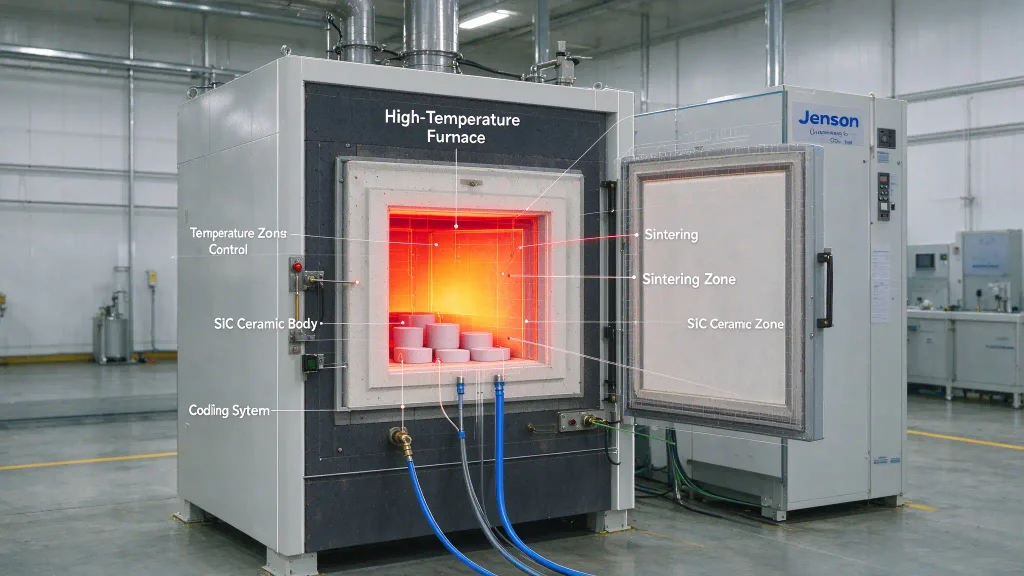
Silicon carbide sintering is one of the most important stages in ceramic manufacturing. It converts the formed powder compact into a strong ceramic body by developing bonds between particles and, depending on the process, reducing porosity. The selected sintering route has a major effect on density, purity, microstructure, mechanical strength, and final dimensions.
Pressureless Sintering
Pressureless sintering is used to produce dense silicon carbide ceramics without applying external mechanical pressure during the main sintering stage. The process generally uses high temperatures, a controlled atmosphere, and suitable sintering additives to support densification. Depending on the formulation, sintering temperatures are often in the range of approximately 2,000–2,200°C. This method can produce dense components with good wear resistance and chemical stability. It is suitable for parts that require a combination of mechanical strength and dimensional performance. However, the powder formulation and furnace conditions must be carefully controlled to avoid abnormal grain growth, residual porosity, and deformation.
Reaction Bonding
Reaction-bonded silicon carbide (RB-SiC) is produced by allowing molten silicon to infiltrate a porous carbon-containing SiC preform. The silicon reacts with carbon to form additional SiC, while some silicon may remain in the final structure. One advantage of reaction bonding is that it can support near-net-shape manufacturing and relatively low dimensional shrinkage. This can be useful for larger components or complex geometries. However, residual free silicon is an important material characteristic. It may limit the use of RB-SiC in certain high-temperature or chemical environments, so the operating conditions must be reviewed before selection.
Hot Pressing
Hot pressing combines high temperature with external pressure to improve densification. It can produce high-density ceramic bodies with controlled microstructures. However, the process is generally more limited by tooling, component size, and production cost than some other methods. It is often selected when the required material properties justify the additional process requirements.
Recrystallization
Recrystallized silicon carbide is produced through high-temperature processing that allows SiC particles to bond and develop a ceramic structure. It typically has a more open pore structure than dense pressureless-sintered SiC. This makes it suitable for selected high-temperature applications where thermal stability and permeability may be important, but it is not interchangeable with dense SiC grades.
| Process | Typical processing temperature | External pressure | Typical density | Residual free silicon | Main consideration |
|---|---|---|---|---|---|
| Pressureless sintering | About 2,000–2,200°C | No | 3.05–3.15 g/cm³ | Usually absent as an infiltration phase | High densification; formulation control is critical |
| Reaction bonding | Silicon infiltration commonly around 1,400–1,600°C | No external pressing during infiltration | 2.90–3.05 g/cm³ | Usually present | Low shrinkage; chemical compatibility must be checked |
| Hot pressing | About 1,900–2,100°C, depending on grade | Yes | Often 3.10–3.20 g/cm³ | Usually absent as an infiltration phase | High density; size and tooling constraints |
| Recrystallization | Often above 2,300°C | No | Commonly about 2.6–2.8 g/cm³ | Process-dependent | Porous structure and high-temperature stability |
The ranges above are representative process references. Actual temperature, density, and phase composition depend on powder characteristics, additives, furnace design, and production conditions. In particular, RB-SiC and dense sintered SiC should not be treated as equivalent materials. For engineers comparing processes, the key questions are whether the component needs very low porosity, whether residual silicon is acceptable, what temperature and atmosphere it will face, and how complex its geometry is.
7. Precision Machining and Surface Finishing
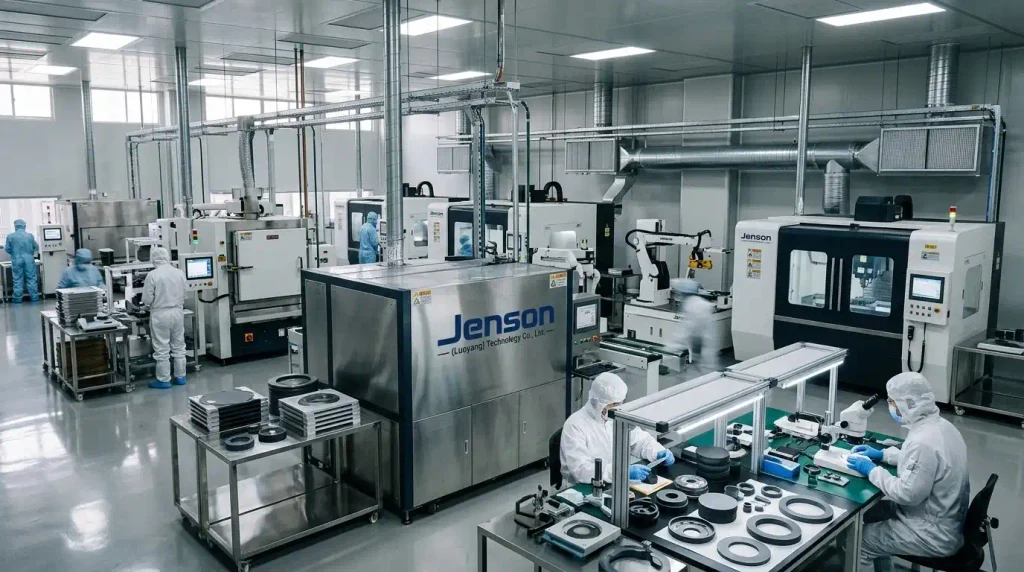
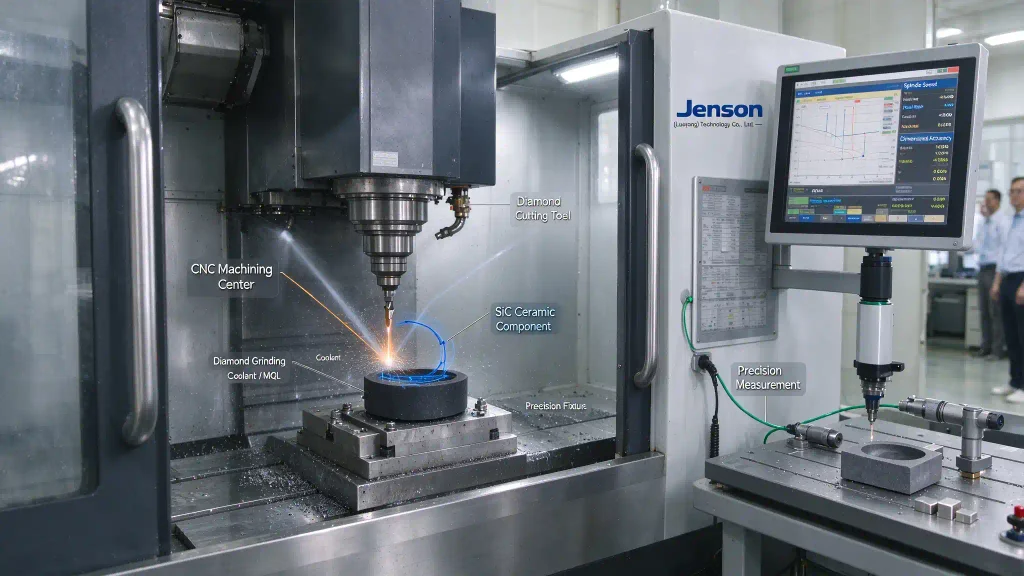
After sintering, many components require additional machining to meet drawing requirements. Because silicon carbide is extremely hard and brittle, conventional metal-cutting methods are generally unsuitable. Diamond grinding is widely used for dimensional correction, while diamond tools may also be used for cutting, drilling, and other precision operations. The machining plan should be developed around the component’s geometry and functional requirements. Important characteristics include diameter, thickness, flatness, parallelism, concentricity, and hole position. Surface roughness may also be important when a component contacts a seal, substrate, or other precision part.
| Machining operation | Typical application | Indicative capability or reference | Main risk |
|---|---|---|---|
| Diamond surface grinding | Flat faces and reference surfaces | Flatness may reach around 0.01–0.05 mm on suitable parts | Edge chipping and subsurface damage |
| Cylindrical grinding | Rods, shafts, and outer diameters | Diameter tolerance may reach around ±0.01–0.05 mm | Taper and roundness variation |
| Diamond drilling | Holes and passages | Hole diameter depends on tool and wall thickness | Cracks around hole edges |
| Precision cutting | Plates, blocks, and shaped blanks | Kerf and edge quality depend on thickness and tooling | Chipping and thermal damage |
| Lapping or polishing | Contact and sealing surfaces | Surface roughness may reach Ra 0.1–0.8 μm on suitable parts | Excessive material removal |
These values are indicative examples rather than guaranteed machining limits. Tighter tolerances may be possible for selected geometries, but feasibility depends on component size, wall thickness, material grade, and inspection method.
For example, a ceramic plate used as a precision support may require controlled flatness and parallelism, while a wear-resistant sleeve may place greater emphasis on inner and outer diameter tolerances. Buyers should therefore provide drawings that identify critical dimensions, surface finish, edge conditions, and inspection requirements.
8. Quality Control and Inspection of High-Purity Silicon Carbide Ceramics
Quality inspection verifies whether the finished component meets its material and dimensional requirements. For high-purity silicon carbide ceramics, inspection should cover chemical composition, physical properties, mechanical performance, microstructure, and surface quality.
Chemical analysis can be used to measure selected metallic impurities and evaluate material composition. Depending on the required detection limits, methods such as ICP-OES or ICP-MS may be appropriate. X-ray diffraction (XRD) can help identify crystalline phases, including SiC and other detectable phases.
Density and open porosity are also important. The Archimedes method is commonly used to measure bulk density and open porosity. Mechanical tests may include Vickers hardness and flexural strength, while dimensional inspection can use coordinate measuring machines (CMMs), micrometers, and other suitable instruments.
| Quality item | Common inspection method | Typical purpose | Example of reporting |
|---|---|---|---|
| Chemical composition | ICP-OES / ICP-MS | Evaluate selected elemental impurities | Element concentration in ppm or wt% |
| Phase composition | XRD | Identify crystalline phases | Phase identification and relative content |
| Bulk density | Archimedes method | Check densification | g/cm³ |
| Open porosity | Archimedes method | Evaluate connected pores | % |
| Hardness | Vickers test | Assess indentation resistance | HV |
| Flexural strength | Three- or four-point bending | Evaluate bending performance | MPa |
| Dimensions | CMM, micrometer, caliper | Verify drawing requirements | mm |
| Surface roughness | Contact or optical profilometer | Check surface finish | Ra, μm |
| Visual defects | Visual or magnified inspection | Identify cracks and edge damage | Inspection record |
Not every product needs every test. The inspection plan should match the component’s function and the buyer’s technical specification. For example, a semiconductor equipment component may require tighter contamination controls, while a general wear component may place more emphasis on hardness, density, and dimensional accuracy. A complete quality record should identify the material grade, production batch, inspection method, measured results, and acceptance criteria. This makes it easier for buyers to compare batches and trace potential quality issues.
9. Common Manufacturing Challenges and Process Optimization
Even with controlled equipment, silicon carbide ceramic manufacturing involves several technical challenges. One common issue is uneven green density. If powder distribution or forming pressure is inconsistent, different areas of the component may shrink at different rates during sintering. Better powder preparation, forming control, and green-body inspection can reduce this risk.
Residual porosity is another concern. It may result from unsuitable powder characteristics, insufficient densification, or an unsuitable sintering schedule. Manufacturers need to optimize the formulation and furnace conditions while monitoring density and porosity after processing. Large or complex components may also experience deformation during high-temperature treatment. In these cases, fixture design, support methods, controlled heating and cooling, and machining allowances should be considered together. Machining defects require a different approach. Excessive grinding force, unsuitable diamond tooling, poor coolant delivery, or incorrect feed rates can lead to cracks and edge chipping. Appropriate tooling, controlled machining parameters, and inspection between operations help reduce these risks.
| Manufacturing challenge | Possible cause | Process improvement |
|---|---|---|
| Uneven shrinkage | Non-uniform green density | Improve powder mixing and forming control |
| High residual porosity | Inadequate densification | Review powder grade and sintering schedule |
| Warping | Uneven heating or support | Optimize furnace loading and support design |
| Excessive impurities | Contaminated raw materials or equipment | Improve purification and equipment cleaning |
| Residual free silicon | Reaction-bonding process characteristics | Select the correct material route for the service environment |
| Edge chipping | Excessive grinding force or unsuitable tooling | Adjust diamond tooling and machining parameters |
| Batch variation | Inconsistent raw materials or process conditions | Strengthen batch records and inspection controls |
A practical example illustrates why process control matters. Consider a ceramic plate with an initial length of 100 mm. If the measured linear shrinkage during sintering is 16%, the approximate final length before machining is:
Final length = 100 × (1 − 0.16) = 84 mm
This is a simplified example. Actual shrinkage must be established through material-specific trials and may vary by direction, geometry, and forming conditions. The calculation shows why manufacturers need to account for shrinkage when designing forming tools and machining allowances.
10. How to Evaluate a High-Purity Silicon Carbide Ceramic Supplier
Choosing a supplier involves more than comparing the price per component. Buyers should first confirm whether the supplier can provide the required material grade and explain the differences between pressureless-sintered, reaction-bonded, hot-pressed, and recrystallized SiC. The supplier should also be able to discuss raw material control, forming methods, sintering conditions, machining capabilities, and inspection procedures. For critical components, buyers should request relevant technical data sheets, chemical analysis results, density measurements, dimensional reports, and batch traceability records.
Custom manufacturing capability is equally important. A technically useful quotation should be based on the component drawing and actual operating conditions rather than a general product description. Relevant information includes working temperature, atmosphere, chemical exposure, mechanical load, dimensions, tolerances, surface finish, and expected production quantity. Before placing an order, buyers should clarify the material grade, acceptance criteria, inspection scope, packaging requirements, and documentation to be supplied. This helps reduce misunderstandings and makes supplier comparisons more meaningful.
11. About Jenson
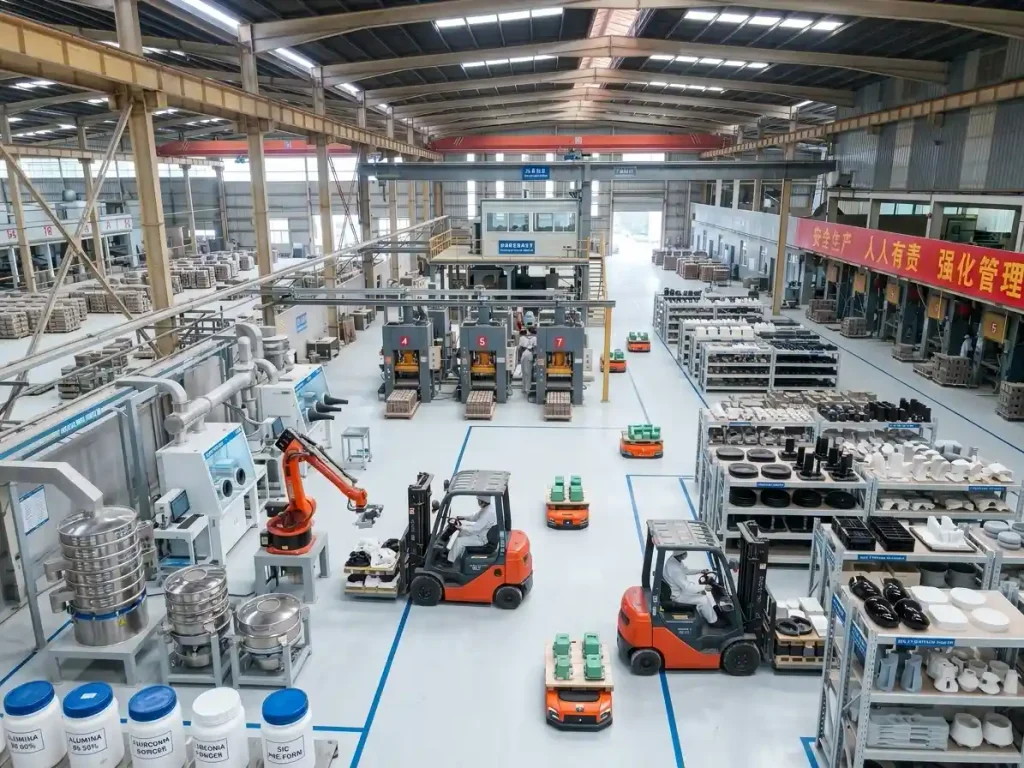
Jenson(Luoyang) Technology Co., Ltd. focuses on advanced ceramic materials and engineered ceramic components for industrial, high-temperature, electronic, and precision engineering applications. Its product range includes silicon carbide, alumina, aluminum nitride, boron nitride, silicon nitride, quartz, and other advanced ceramic products. These materials serve different technical requirements, including wear resistance, thermal management, electrical insulation, and dimensional stability.
For customized ceramic components, material selection and manufacturing requirements should be based on the customer’s drawings and actual operating conditions. Factors such as material grade, density, purity, thermal properties, machining requirements, dimensional tolerances, and inspection criteria all need to be considered. By reviewing these details at the beginning of a project, Jenson(Luoyang) Technology Co., Ltd. aims to support a more suitable material and component specification for each application.
12. Frequently Asked Questions About High-Purity Silicon Carbide Manufacturing
Q1. What is considered high-purity silicon carbide ceramic?
High-purity silicon carbide ceramic generally refers to a material with a high SiC content and controlled levels of metallic impurities and unwanted phases. However, the term does not have one universal purity threshold for every application. Some projects focus on trace metal contamination, while others prioritize density, porosity, or residual free silicon. Buyers should define purity requirements using measurable limits and request test reports that identify the analytical method and detection range.
Q2. How is silicon carbide powder purified before manufacturing?
Powder purification depends on the type of contamination present. It may involve chemical treatment, acid washing, filtration, repeated rinsing, and controlled drying. The purpose is to reduce unwanted metallic elements, oxides, and other residues without damaging the powder or introducing new contamination. The effectiveness of purification should be verified through chemical analysis rather than assumed from the process description alone.
Q3. What is the difference between reaction-bonded and sintered silicon carbide?
Reaction-bonded SiC is produced by infiltrating a porous carbon-containing preform with molten silicon. Some silicon reacts with carbon to form SiC, while residual free silicon usually remains. Pressureless-sintered SiC is densified through high-temperature sintering and generally does not contain residual silicon from an infiltration process. Reaction-bonded grades can offer low shrinkage and useful near-net-shape manufacturing, while dense sintered grades are often selected when low porosity and specific chemical or thermal properties are required.
Q4. Which sintering method produces the highest-density silicon carbide ceramics?
Hot pressing and pressureless sintering can both produce high-density SiC ceramics when the powder formulation and process are properly controlled. Hot pressing applies external pressure during high-temperature processing, which supports densification. Pressureless sintering can also achieve high density through suitable additives and carefully controlled furnace conditions. The best choice depends on component size, geometry, material purity, production volume, and cost. Density alone should not determine the selection; porosity, microstructure, and application conditions also matter.
Q5. How does sintering temperature affect silicon carbide ceramic properties?
Sintering temperature influences particle bonding, grain growth, densification, and residual porosity. If the temperature is too low for the selected formulation, the material may retain excessive pores and show reduced strength. If it is too high or the holding time is unsuitable, abnormal grain growth or deformation may occur. The correct temperature range depends on powder size, additives, atmosphere, and sintering technology. Manufacturers therefore need to establish process parameters for each material system rather than apply one temperature to all SiC products.
Q6. Can high-purity silicon carbide ceramics be precision machined?
Yes. Although SiC is extremely hard, it can be machined using suitable diamond grinding, cutting, drilling, and polishing methods. The achievable tolerance depends on component geometry, material grade, wall thickness, tool condition, and inspection method. Buyers should identify critical dimensions and surface finish requirements on the drawing. For thin walls, small holes, and sharp edges, the machining plan should also consider the risk of cracking and chipping.
Q7. How is the purity of silicon carbide ceramic components tested?
Purity evaluation may include chemical analysis for metallic impurities and phase analysis for identifying crystalline constituents. ICP-OES and ICP-MS are commonly used for elemental analysis when suitable detection limits are required, while XRD helps identify crystalline phases. Density, porosity, and microstructure tests provide additional information about the material but do not replace chemical purity testing. Buyers should confirm which elements are measured, the detection limits, sample preparation method, and whether the results apply to the supplied production batch.
Q8. What information should buyers provide when ordering custom silicon carbide components?
Buyers should provide a technical drawing with dimensions, tolerances, hole positions, surface finish, and edge requirements. They should also describe the working temperature, operating atmosphere, chemical exposure, mechanical load, and expected service conditions. If purity or contamination limits are important, these should be stated as measurable specifications. Production quantity, inspection requirements, packaging, and documentation should also be confirmed. Complete information helps the manufacturer recommend a suitable SiC grade and assess whether the requested geometry and tolerances are practical.