Advanced Technical Ceramics, Precision Alumina, Silicon Carbide, Crucible Parts



What Information Is Required to Get a Quotation for Semiconductor-Grade BN Ceramics?
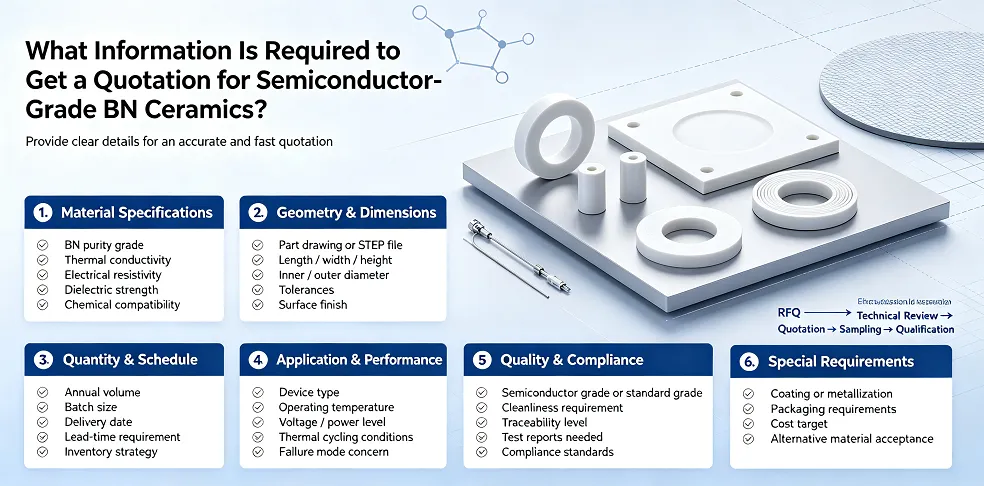
Obtaining a quotation for semiconductor-grade boron nitride ceramics is fundamentally different from requesting a price for a standard machined ceramic part. In semiconductor equipment, the cost of a BN component is determined not only by its external dimensions but also by material grade, purity, manufacturing route, geometry, dimensional tolerances, surface condition, operating environment, and inspection requirements. A supplier cannot accurately evaluate a component simply from a product name such as “BN ring” or “BN nozzle.” For boron nitride semiconductor manufacturing, the quotation process should begin with enough engineering information to determine whether HPBN, PBN, or another BN grade is appropriate for the intended process. PBN, for example, is produced by chemical vapor deposition and is valued for its high purity, thermal stability, and anisotropic properties, while hot-pressed BN offers greater flexibility for precision machining and complex geometries.
For boron nitride semiconductor manufacturing, the most important information is therefore the actual service condition rather than the nominal component name. Engineers should provide the working temperature, atmosphere or vacuum level, exposure to reactive gases, contact materials, heating or cooling cycles, and the position of the BN component within the equipment. A BN part used as a wafer support, electrical insulator, gas-flow component, or separation element may require completely different material characteristics even when the dimensions are similar. These operating conditions determine the required density, porosity, purity level, thermal conductivity, electrical resistivity, and chemical stability, and they also influence whether the component should be manufactured from HPBN, PBN, or another specialized BN grade. The more precisely these conditions are defined, the more reliably a supplier can select the material and calculate manufacturing, machining, inspection, and packaging costs.
1. Start With the Technical Drawing or Component Geometry
The most important information for a BN quotation is the component drawing. A professional drawing should define the overall dimensions, critical tolerances, hole diameters, wall thickness, grooves, steps, chamfers, radii, threads, flatness, concentricity, and other features that affect machining difficulty. This is particularly important because boron nitride is a machinable ceramic, but its behavior during machining is different from metals. Thin walls, sharp internal corners, deep holes, and asymmetric structures can significantly increase manufacturing difficulty and material loss. For boron nitride semiconductor manufacturing, the supplier also needs to understand which dimensions are functionally critical rather than treating every dimension on a drawing as equally important. A tolerance of ±0.02 mm on a critical sealing or positioning surface can have a very different manufacturing cost from a general ±0.10 mm dimensional requirement. When a CAD drawing is unavailable, a detailed sketch with dimensions, photographs, samples, or a description of the assembly can still provide a starting point for technical evaluation.
The drawing should also indicate the reference datums and inspection points used to verify the finished component. For boron nitride semiconductor manufacturing, this information is important when the BN part must interface with wafers, heaters, electrodes, quartz components, metal fixtures, or other precision parts. Features such as concentricity, parallelism, runout, flatness, and positional accuracy may directly affect assembly alignment and process stability, even when they appear secondary from a machining perspective. If only selected surfaces require tight control, identifying these critical features allows the manufacturer to allocate precision machining and inspection resources where they are actually needed. It also helps prevent unnecessary cost caused by applying tight tolerances to non-functional surfaces. For repeat orders, providing the revision-controlled drawing and clearly identifying any changes from the previous version can further reduce the risk of producing components to an outdated specification.
2. Specify the BN Grade and Purity Requirement
Material selection is one of the most important factors affecting the quotation because “boron nitride” does not describe a single material specification. Semiconductor-related components may use hot-pressed hexagonal BN, high-purity self-bonded BN, PBN, or other specialized grades. Commercial material data illustrates that BN grades can differ considerably in composition, density, strength, thermal conductivity, and temperature capability; some hot-pressed grades also contain binder phases while high-purity grades may be designed specifically to minimize contamination. PBN is generally associated with very high-purity applications because it is deposited by CVD rather than conventional powder hot pressing. Published technical data also shows that PBN can have very low metallic impurity levels and that its properties are direction-dependent because of its layered structure. Therefore, a quotation request should state the required BN grade, nominal purity, whether binder-free material is required, and whether trace-element analysis or a material certificate is necessary. If the customer does not know which grade is appropriate, providing the operating conditions allows the manufacturer to recommend a suitable material route before pricing.
Material selection also affects the quotation through the manufacturing route and achievable geometry. For boron nitride semiconductor manufacturing, HPBN and PBN should not be treated as interchangeable materials simply because both are based on hexagonal BN. HPBN is typically formed through powder processing and hot pressing, followed by machining, while PBN is deposited layer by layer through a CVD process and may require a different approach to forming, machining, and dimensional control. The selected route influences raw material utilization, achievable wall thickness, maximum component size, machining allowance, production cycle, and inspection requirements. It can also affect how the finished part behaves under thermal gradients because microstructure and crystallographic orientation influence thermal conductivity and thermal expansion. Therefore, when requesting a quotation, it is useful to specify not only the target purity but also the required density, thermal conductivity, electrical resistivity, mechanical strength, maximum service temperature, and any restrictions on binders or additives. These parameters give the supplier a technical basis for selecting the material rather than quoting simply according to the component’s shape and weight.
3. Define the Operating Temperature and Atmosphere
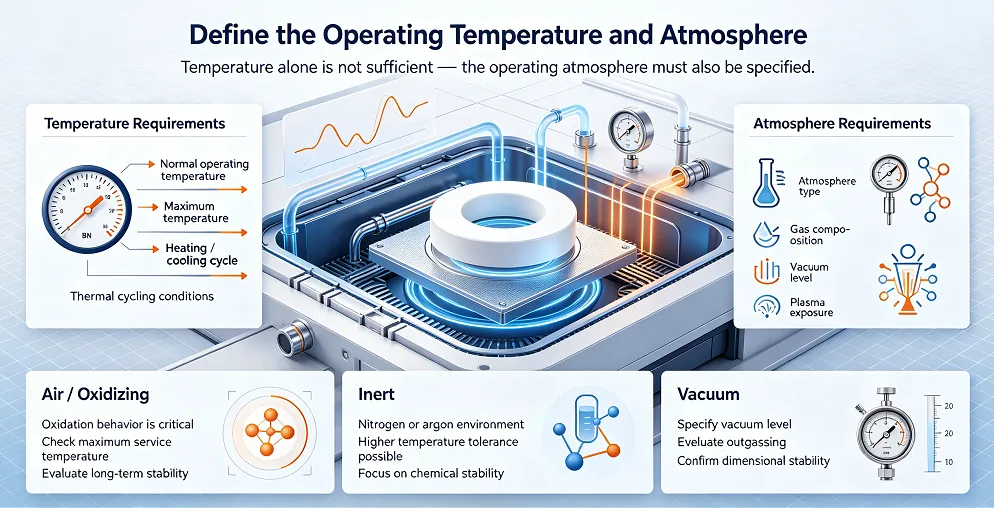
Operating temperature alone is not sufficient; the atmosphere in which the BN component operates must also be specified. Boron nitride can tolerate very high temperatures under vacuum or inert atmospheres, while oxidation becomes a much more important consideration in air or oxygen-containing environments. Commercial technical data shows substantial differences between BN grades in maximum service temperature depending on whether the environment is oxidizing, inert, or vacuum. The quotation request should therefore state the normal operating temperature, maximum temperature, heating and cooling cycle, atmosphere, gas composition, and vacuum level when applicable. For a semiconductor component, information such as nitrogen, argon, hydrogen-containing, vacuum, or plasma exposure can materially change material selection. In boron nitride semiconductor manufacturing, this information is also necessary for evaluating outgassing, chemical stability, thermal expansion, and long-term dimensional stability rather than simply determining whether the BN can survive a particular temperature.
4. Dimensional Tolerance, Surface Finish, and Inspection Requirements
Tolerance requirements have a direct effect on both machining time and inspection cost. BN can be precision machined, but tighter tolerances require more controlled machining sequences, additional finishing operations, and more detailed inspection. The quotation should therefore distinguish between general dimensions and critical dimensions. Flatness, parallelism, concentricity, perpendicularity, and surface roughness can be particularly important for rings, plates, wafer-support structures, and sealing components. If a customer specifies only “high precision,” the supplier cannot reliably determine the manufacturing route or cost. A better quotation request might identify an inner diameter tolerance, outer diameter tolerance, flatness requirement, and surface roughness requirement separately. For boron nitride semiconductor manufacturing, the inspection method should also be considered because a dimensional specification without a defined measurement method can create disagreement between supplier and customer. When the component is used in vacuum equipment or close to a wafer, surface condition may be just as important as dimensional accuracy because machining damage, loose particles, or residues can influence process cleanliness.
5. Technical Parameters That Should Be Included in an RFQ
The following information provides a practical engineering framework for requesting a quotation for semiconductor-grade BN ceramics. These are reference parameters rather than universal specifications; actual values should be established according to the selected BN grade and component design. Published commercial data confirms that density, thermal conductivity, coefficient of thermal expansion, resistivity, strength, and service temperature vary significantly between BN grades and material orientations.
| Parameter | Information to Provide | Why It Matters |
|---|---|---|
| BN Grade | HPBN, PBN, high-purity BN, etc. | Determines material route and cost |
| Purity | BN purity and trace-element limits | Controls contamination risk |
| Dimensions | OD, ID, length, thickness, overall size | Determines machining and material consumption |
| Tolerance | General and critical tolerances | Determines machining and inspection requirements |
| Wall Thickness | Minimum and average thickness | Affects machining feasibility and structural stability |
| Surface Finish | Ra or other specified requirement | Controls contact, particle and surface performance |
| Flatness | Required value where applicable | Important for plates, rings and wafer-related parts |
| Operating Temperature | Normal and maximum temperature | Determines thermal capability |
| Atmosphere | Vacuum, N₂, Ar, air, process gas, etc. | Affects chemical stability and service temperature |
| Vacuum Level | Working pressure where applicable | Important for outgassing evaluation |
| Quantity | Prototype, sample, batch or annual volume | Influences production and tooling economics |
| Inspection | Dimensional report, material certificate, purity analysis | Determines quality-control scope |
6. Quantity, Prototype Requirements, and Production Volume
Quantity should always be included in the quotation request because the economics of advanced ceramic manufacturing can change considerably between a single prototype and a production order. A one-piece prototype may require individual material preparation, programming, machining, inspection, and packaging, whereas repeated production can distribute setup and programming costs over a larger quantity. PBN introduces an additional consideration because the manufacturing process itself differs substantially from conventional machined HPBN. Commercial PBN suppliers commonly request the component type, dimensions, tolerance, wall thickness, purity, operating temperature, drawing, and quantity before quoting. For boron nitride semiconductor manufacturing, it is also useful to identify whether the order is for engineering samples, equipment qualification, pilot production, or recurring production. This helps the supplier evaluate whether the same material blank, machining process, inspection procedure, and packaging method can be maintained throughout the expected production volume.
Quantity should also be considered together with the expected order frequency and annual demand. For boron nitride semiconductor manufacturing, a supplier may approach a one-time order of 5 pieces differently from a program requiring 50 pieces per month for several years. Recurring demand can justify dedicated tooling, standardized machining programs, optimized material utilization, and a defined inspection procedure, while small-volume development orders may need more flexible processing and individual dimensional verification. If the component is expected to enter continuous production, the quotation request should ideally include the estimated annual quantity, forecasted batch size, required delivery frequency, and whether future orders will use the same drawing revision. This information allows the manufacturer to distinguish between prototype pricing and production pricing and to evaluate whether process standardization can improve consistency without unnecessarily increasing the initial investment.
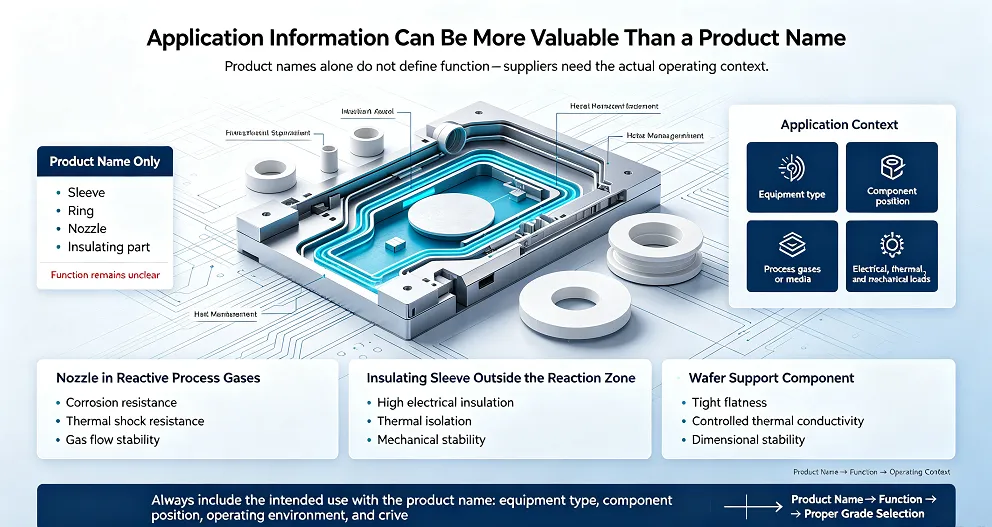
7. Application Information Can Be More Valuable Than a Product Name
One of the most useful pieces of information in a quotation request is the actual application. A customer may request a BN “sleeve,” “ring,” “nozzle,” or “insulating part,” but these names do not reveal how the component will function. A nozzle exposed to reactive process gases has different requirements from an insulating sleeve used outside the reaction zone. A thin BN separator may prioritize electrical insulation and thermal isolation, while a wafer-support component may require tight flatness and controlled thermal conductivity. Providing the equipment type and component position allows the supplier to evaluate the engineering requirements instead of quoting a generic BN grade. For example, Boron Nitride White Ring Paper, Boron Nitride Wrapping Paper, and Boron Nitride Insulating Sleeve can serve very different functions despite all being BN-based products, so the intended use should always accompany the product name when requesting a technical quotation.
8. Related BN Products Should Also Be Specified by Function
For semiconductor and high-temperature equipment, BN products are often part of a larger thermal or electrical assembly rather than isolated components. A Boron Nitride Nozzle may require controlled internal geometry and chemical stability because it interacts directly with process gases. An insulating component may instead prioritize dielectric performance, dimensional stability, and thermal isolation. The same principle applies when requesting quotation for BN paper, rings, sleeves, or other customized components: the supplier needs to understand what the part is expected to accomplish inside the equipment. In boron nitride semiconductor manufacturing, this functional information helps engineers avoid selecting a material solely according to nominal purity while overlooking thermal conductivity direction, mechanical loading, surface condition, or atmospheric compatibility.
JianXun Technology Co., Ltd.
JianXun Technology Co., Ltd. specializes in finished advanced ceramic components for semiconductor, high-temperature processing, thermal management, and electrical insulation applications. Our product range covers Boron Nitride, Alumina, and Silicon Carbide products, including customized BN components manufactured according to engineering drawings and application requirements. We focus on material selection, dimensional precision, thermal performance, purity control, and application-specific requirements to provide reliable ceramic solutions for demanding industrial processes.
Payment Terms: T/T, PayPal, Credit Card, Western Union, or other agreed methods.
Shipment Terms: Express, air freight, or sea freight according to product size, quantity, and customer requirements.
Storage Conditions: Store products in a clean, dry environment and keep the original protective packaging until use.
FAQs
Q1: What is the minimum information required to get a quotation for semiconductor-grade BN ceramics?
At minimum, the supplier should receive the component drawing or a sufficiently detailed dimensional description, BN material requirement, quantity, operating temperature, working atmosphere, and any critical tolerance or surface-finish requirements. For a customized component, the drawing should preferably identify overall dimensions, wall thickness, hole diameters, grooves, steps, radii, chamfers, threads, flatness, concentricity, and other features that influence machining difficulty. If the part operates inside a vacuum or semiconductor process chamber, the working pressure, gas composition, exposure time, contamination requirements, and cleaning requirements should also be included. These details allow the supplier to evaluate not only whether the component can be manufactured, but also which BN grade and manufacturing route are technically appropriate.
A drawing alone may define the shape but does not explain the process environment, while a material name alone does not define the required grade. For example, “high-purity BN” could still refer to different material systems with different densities, microstructures, thermal conductivities, impurity levels, and manufacturing processes. For boron nitride semiconductor manufacturing, combining geometry, material requirements, operating conditions, production quantity, and quality requirements gives the manufacturer a practical basis for determining material feasibility, machining route, inspection scope, expected lead time, and approximate production cost. If some parameters are not yet available, the customer should identify them as “to be confirmed” rather than leaving them ambiguous, so that the supplier can clearly separate assumptions from confirmed quotation conditions.
Q2: Do I need to specify PBN or HPBN when requesting a quotation?
Not necessarily. If the engineering team already has a qualified material specification or an approved supplier specification, the required grade should be stated directly, including purity, density, binder or additive restrictions, and any required material certification. However, if the customer only knows that the component must be “semiconductor-grade BN,” it is often better to provide the operating temperature, atmosphere, vacuum conditions, purity requirement, component geometry, electrical requirements, and contamination limits and allow the manufacturer to recommend a suitable BN route. This is particularly important for new equipment or prototype components where the final material specification has not yet been established.
PBN and HPBN are produced through substantially different manufacturing routes and therefore have different advantages in component design and production. PBN is deposited through a CVD process and is commonly selected where very high purity, low contamination, vacuum compatibility, and controlled material structure are important. HPBN, produced through hot pressing of BN powder, can provide greater flexibility for machining complex shapes and larger structural components, depending on the specific grade. For boron nitride semiconductor manufacturing, the correct choice should therefore be based on the complete process requirement rather than assuming that PBN is automatically preferable to HPBN. In some applications, the additional cost and manufacturing characteristics of PBN may be justified by contamination-control requirements; in others, a properly specified high-purity HPBN grade may provide the required performance with a more practical machining route.
Q3: Can I request a quotation without a technical drawing?
Yes, but the quotation will normally become more accurate as the amount of engineering information increases. If no formal drawing exists, the supplier can initially work from a hand sketch, sample, photograph, CAD model, previous component, or detailed written description. At a minimum, the information should identify the main dimensions such as outer diameter, inner diameter, length, thickness, wall thickness, hole pattern, hole diameter, and important interfaces with other components. If particular surfaces are used for sealing, positioning, electrical insulation, wafer support, gas flow, or thermal contact, these functional surfaces should also be identified because they may require tighter dimensional tolerances or better surface finish than non-functional areas.
For boron nitride semiconductor manufacturing, photographs alone are rarely sufficient for a final production quotation because they cannot reliably define dimensional tolerances, surface quality, concentricity, flatness, or hidden internal features. A supplier may still provide a preliminary budgetary quotation based on available information, but the final price may need to be revised after the formal drawing and specifications are confirmed. For development projects, a practical approach is to provide the available geometry together with the intended application and ask the manufacturer to identify the missing parameters. Once the preliminary design has been reviewed, a controlled engineering drawing with revision information should be used to establish the final manufacturing and inspection requirements.
Q4: Why does the operating atmosphere need to be included in the quotation?
The operating atmosphere is an essential part of the BN specification because the same ceramic component can experience very different thermal, chemical, and contamination conditions depending on its environment. A BN component operating in high vacuum, high-purity nitrogen, argon, hydrogen-containing gas, process gas, or ambient air cannot simply be evaluated using a single maximum-temperature value. Oxidizing conditions can significantly reduce the practical service temperature of BN compared with vacuum or inert environments, while reactive gases may interact with the surface or surrounding materials under specific process conditions. Vacuum operation also introduces additional considerations such as outgassing, surface cleanliness, particle generation, and contamination control.
For boron nitride semiconductor manufacturing, the supplier should ideally know the approximate operating temperature, pressure or vacuum level, gas composition, duration of exposure, thermal cycling frequency, and whether the BN component is directly exposed to the process atmosphere or located behind another component. This information helps determine whether the selected BN grade is suitable and whether additional requirements such as high-purity material, controlled machining, special cleaning, or vacuum-compatible packaging are necessary. It can also affect the expected service life and dimensional stability of the component. Therefore, stating only “maximum temperature: 1,500°C,” for example, is not sufficient to establish a meaningful quotation if the atmosphere and pressure are unknown.
Q5: What can make the quotation price of a BN ceramic component increase significantly?
The major cost drivers are usually the BN grade and purity, raw-material size, component geometry, material utilization, machining complexity, dimensional tolerances, surface-finish requirements, inspection requirements, and production quantity. Geometry has a particularly strong influence because the supplier may need to start from a substantially larger BN blank than the final component, especially for thin-wall rings, deep-hole structures, asymmetric parts, or components with extensive material removal. Tight dimensional tolerances can require additional finishing operations and more frequent inspection, while difficult geometries may increase machining time, tool consumption, scrap risk, and processing loss.
Material requirements can also produce a major difference in price. A conventional HPBN component and a high-purity PBN component with similar external dimensions should not be expected to have similar manufacturing economics because their material preparation and forming routes are fundamentally different. For boron nitride semiconductor manufacturing, additional requirements such as trace-element analysis, material certificates, lot traceability, controlled cleaning, particle inspection, vacuum-compatible packaging, special surface treatment, or individual dimensional inspection can further increase the total cost. Quantity is another important factor because programming, setup, inspection preparation, and material preparation costs can be distributed differently between a single prototype and a recurring production order.
For this reason, engineers should compare quotations against the complete technical specification, not simply the unit price. A lower quotation may correspond to a different BN grade, wider tolerances, less stringent inspection, a different surface condition, or fewer quality-control requirements. When evaluating a quotation, it is useful to confirm that the material grade, purity, manufacturing route, dimensions, tolerances, inspection method, certification, cleaning, packaging, quantity, and delivery conditions are all aligned. This makes the price comparison technically meaningful and reduces the risk of discovering specification differences only after the components have been delivered.