Advanced Technical Ceramics, Precision Alumina, Silicon Carbide, Crucible Parts
 Technology Co., Ltd.(Luoyang) Technology Co., Ltd.科技品牌标志.webp)


How Advanced Ceramics Help Manage Heat in High-Power AI Chips
1. Why Thermal Management Matters for High-Power AI Chips
Artificial intelligence is changing the way electronic devices process information. Large language models, AI servers, GPUs, and high-performance computing systems need to handle increasingly complex workloads. As a result, AI chips are becoming more powerful, but they also generate more heat during operation. Effective AI Chip Thermal Management is therefore an important part of modern electronic design. If heat cannot be transferred away from the chip efficiently, operating temperatures may rise. This can affect processing stability, reduce component reliability, and limit the performance of the entire system.
Traditional thermal management solutions, such as metal heat spreaders and cooling systems, remain important. However, they are not always sufficient on their own. Materials used inside electronic packages must also provide suitable thermal conductivity, electrical insulation, dimensional stability, and mechanical reliability. This is where Advanced Ceramics become valuable. Materials such as Aluminum Nitride (AlN), alumina, silicon nitride, and silicon carbide offer different combinations of thermal, electrical, and mechanical properties. They can be used in ceramic substrates, insulating components, and other thermal management structures in high-power electronics. For engineers and procurement teams, understanding these material differences is essential. The right ceramic material can support more effective heat transfer while helping maintain the reliability of electronic packaging.
2. Understanding the Thermal Challenges of High-Power AI Chips
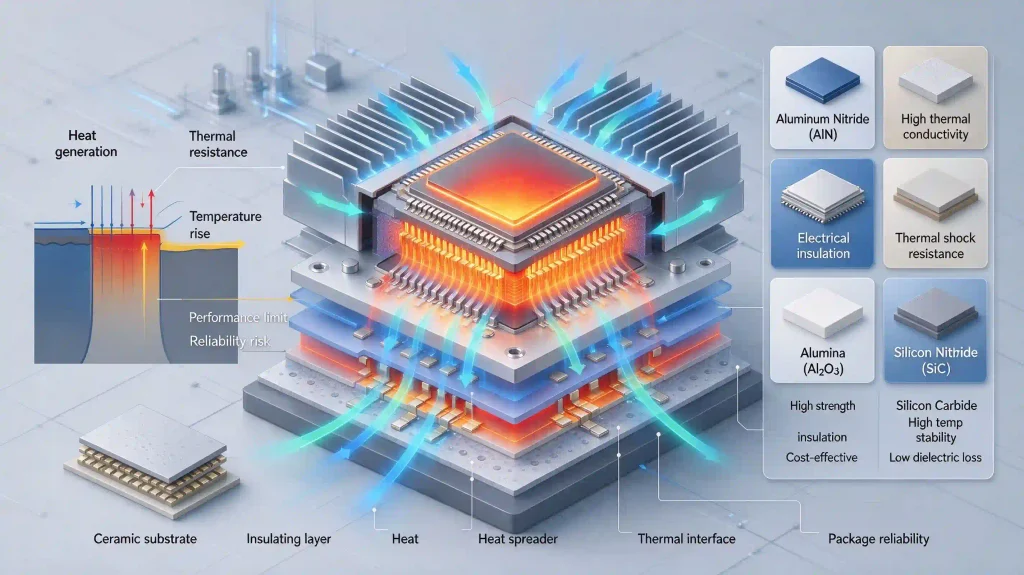
AI chips perform large numbers of calculations simultaneously. During intensive workloads, processors and accelerators can generate considerable heat within a relatively small area. This creates a high local heat flux, meaning that a large amount of heat must be transferred away from a limited surface area. The challenge becomes more complicated as chip designs become smaller and more integrated. Multiple processing units, memory components, and electrical connections may be placed close together. Consequently, heat can accumulate in specific areas rather than spreading evenly across the package.
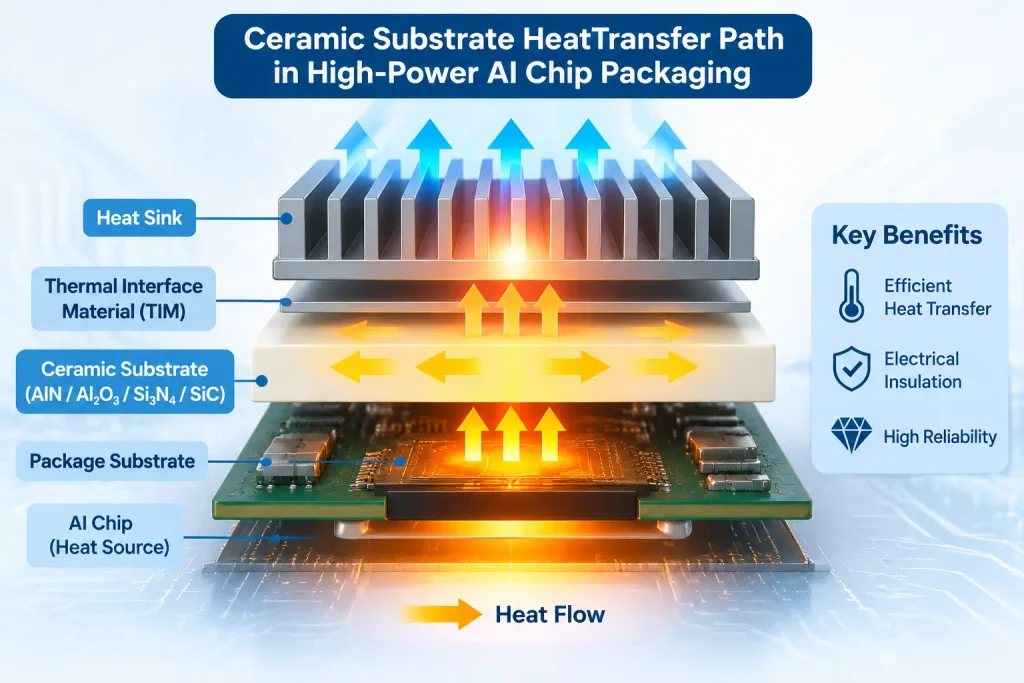
High temperatures can affect several aspects of chip operation. For example, excessive heat may increase electrical leakage, accelerate material aging, and create thermal stress between components with different coefficients of thermal expansion. Repeated heating and cooling can also cause mechanical stress at interfaces, which may eventually contribute to cracking, delamination, or connection failure. Another important factor is the complete thermal path. Heat does not move directly from the chip into the surrounding air. It usually passes through several layers, including the die attachment material, ceramic substrate, thermal interface material, heat spreader, and cooling structure. Each layer introduces some thermal resistance.
Therefore, improving AI chip thermal management materials requires more than choosing a material with high thermal conductivity. Engineers must consider the entire package structure, interface quality, component thickness, and operating conditions.
3. Why Advanced Ceramics Matter in AI Chip Thermal Management
Advanced ceramics are widely used in electronic applications because they can combine thermal performance with electrical insulation and dimensional stability. Unlike many metals, ceramic materials can provide electrical insulation while still transferring heat away from sensitive electronic components. This combination is particularly important in power electronics and semiconductor packaging. A ceramic substrate may need to support electrical circuits, isolate conductive areas, and provide a reliable path for heat to move toward a cooling structure.
Thermal conductivity is one of the most important properties in this process. A material with higher thermal conductivity can generally transfer heat more efficiently when other conditions are comparable. However, thermal conductivity alone does not determine the final performance of a ceramic substrate. Thickness, surface condition, bonding quality, and interface resistance also influence the actual heat transfer. Electrical insulation is another key advantage. In many electronic packages, conductive circuits must be separated from metal baseplates or other components. Ceramic substrates can provide this insulation while maintaining a relatively short thermal path.
In addition, advanced ceramics can offer good wear resistance, chemical stability, and high-temperature performance. These properties help support stable operation in demanding industrial and electronic environments. For manufacturers and procurement professionals, the main question is not simply which ceramic has the highest thermal conductivity. Instead, the material should match the required combination of heat transfer, insulation, mechanical strength, manufacturing precision, and cost.
4. Key Ceramic Materials Used in Thermal Management
Different ceramic materials have different strengths. The most suitable option depends on the thermal requirements, electrical design, mechanical loading, and manufacturing process.
4.1 Aluminum Nitride (AlN) Ceramic
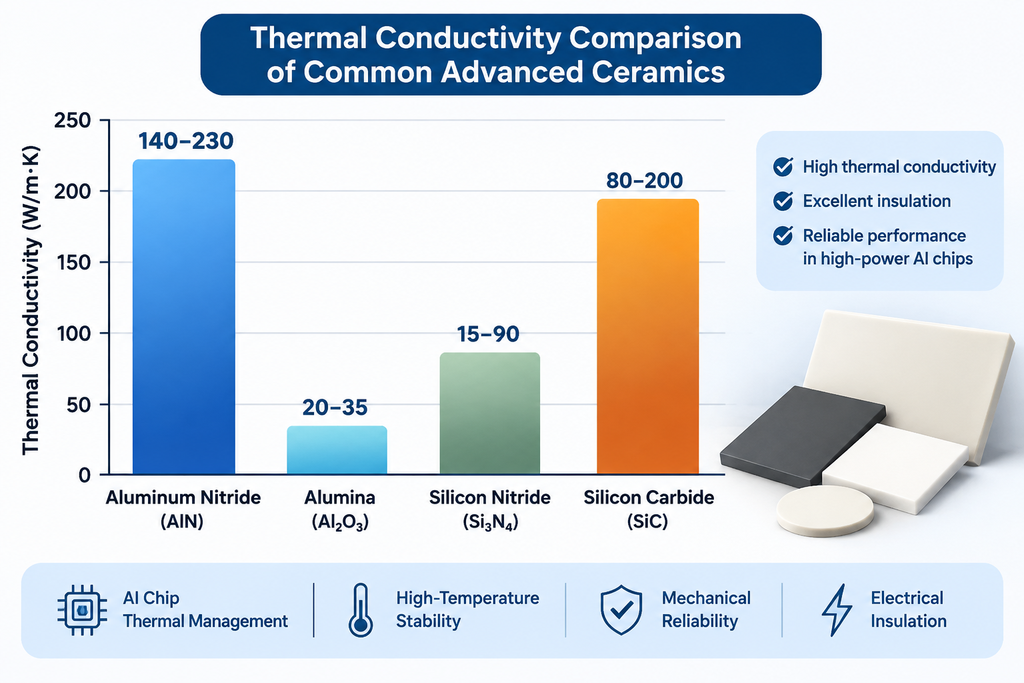
Aluminum Nitride Ceramic is one of the most important materials for high-performance thermal management. Its main advantage is its relatively high thermal conductivity combined with good electrical insulation. Typical thermal conductivity values for AlN ceramics are approximately 140–230 W/(m·K), depending on purity, microstructure, additives, and manufacturing conditions. This makes AlN a suitable option for applications where heat needs to move quickly through an electrically insulating component.
AlN also has a coefficient of thermal expansion (CTE) relatively close to that of silicon. This can help reduce thermal mismatch in certain semiconductor packaging structures. When a package repeatedly heats and cools, a closer CTE match may help reduce stress between connected materials. However, AlN performance depends strongly on material quality. Impurities, porosity, grain structure, and sintering conditions can influence thermal conductivity and mechanical properties. Therefore, procurement teams should not compare AlN products based only on a general material description. They should request the actual grade, measured thermal conductivity, density, dimensions, and relevant inspection data. AlN is often considered for ceramic substrates, heat-spreading components, and insulating parts in high-power electronic assemblies.
4.2 Alumina (Al₂O₃) Ceramic
Alumina Ceramic is one of the most widely used engineering ceramics in the electronics industry. It offers a practical balance of electrical insulation, mechanical strength, chemical stability, availability, and cost. Typical thermal conductivity is approximately 20–35 W/(m·K), depending on purity and grade. Although this is lower than the typical range of AlN, alumina remains suitable for many applications where the thermal load is moderate or where cost and general reliability are important selection factors.
Alumina is available in different purity grades, such as 95%, 99%, and 99.5%. Higher-purity grades may offer improved electrical, chemical, or thermal performance, but the final properties depend on the complete formulation and manufacturing process. For procurement teams, alumina can be an attractive option when the application requires stable insulation and dependable mechanical performance without the higher material cost that may be associated with high-conductivity ceramics.
4.3 Silicon Nitride (Si₃N₄) Ceramic
Silicon Nitride Ceramic is known for its high mechanical strength, fracture toughness, and thermal shock resistance. It is particularly useful when a ceramic component must withstand mechanical stress as well as temperature changes. Its thermal conductivity varies considerably with composition and production method. A broad indicative range is approximately 15–90 W/(m·K). Some specialized grades can achieve higher values, but these should be confirmed through supplier data.
Silicon nitride is not always selected because it has the highest thermal conductivity. Instead, it can be suitable when mechanical reliability, resistance to thermal cycling, and structural performance are important. For electronic applications, engineers may evaluate silicon nitride where a component needs to balance heat transfer with strength and resistance to cracking.
4.4 Silicon Carbide (SiC) Ceramic
Silicon Carbide Ceramic offers high thermal conductivity in many grades, together with excellent hardness, wear resistance, and high-temperature capability. Its thermal conductivity can vary widely depending on purity, porosity, grain structure, and manufacturing method. A broad indicative range is approximately 80–200 W/(m·K).
SiC is also electrically conductive or semiconductive in many forms, so it should not automatically be treated as an electrical insulating substitute for AlN or alumina. Its suitability depends on the electrical design and the specific grade. In thermal management systems, SiC may be considered for selected heat-resistant structures and components where its thermal and mechanical properties are useful. Engineers should evaluate electrical resistivity and the complete application requirements before selecting it.
5. Thermal Property Comparison of Common Advanced Ceramics
The following table provides a general comparison of commonly considered ceramic materials. These values are indicative ranges for material selection and are not guaranteed specifications for every grade.
| Property | Aluminum Nitride (AlN) | Alumina (Al₂O₃) | Silicon Nitride (Si₃N₄) | Silicon Carbide (SiC) |
|---|---|---|---|---|
| Typical thermal conductivity (W/m·K) | 140–230 | 20–35 | 15–90 | 80–200 |
| Coefficient of thermal expansion (×10⁻⁶/K) | 4.0–5.0 | 6.5–8.5 | 2.5–3.5 | 3.7–4.5 |
| Density (g/cm³) | 3.26–3.33 | 3.6–3.9 | 3.1–3.3 | 3.05–3.21 |
| Vickers hardness (GPa) | 10–12 | 12–18 | 13–16 | 22–28 |
| Flexural strength (MPa) | 300–450 | 250–400 | 600–1,000 | 300–600 |
| Young’s modulus (GPa) | 280–330 | 300–380 | 280–320 | 350–450 |
| Fracture toughness (MPa·m¹ᐟ²) | 2.5–3.5 | 3–5 | 5–8 | 3–5 |
| Specific heat capacity (J/kg·K) | 700–800 | 750–900 | 600–800 | 600–800 |
| Dielectric strength (kV/mm) | 10–20 | 8–15 | 8–15 | Grade-dependent |
| Volume resistivity (Ω·cm, at room temperature) | 10¹²–10¹⁴ | 10¹²–10¹⁴ | 10¹²–10¹⁴ | Grade-dependent; often much lower |
| Maximum service temperature in air (°C) | 800–1,000 | 1,400–1,600 | 1,000–1,400 | 1,300–1,600 |
| Typical electrical resistivity | Insulating | Insulating | Insulating | Conductive to semiconductive, depending on grade |
Note: These figures are indicative engineering ranges, not guaranteed specifications. Actual properties depend on purity, additives, porosity, grain structure, sintering process, and test conditions. Maximum service temperature also depends on atmosphere, load, and exposure time. Electrical properties should be verified for the specific grade and test method.
When comparing Alumina vs Aluminum Nitride thermal conductivity, the difference is significant. AlN generally transfers heat much more efficiently than conventional alumina. However, this does not mean AlN is always the better choice. If the application has a moderate thermal load, alumina may provide sufficient performance at a more economical cost. Engineers should also consider thermal expansion. A ceramic material with a CTE closer to the connected semiconductor or metal component may help reduce thermal stress. The best choice therefore depends on the complete package design rather than a single property.
6. Applications of Advanced Ceramics in AI and High-Performance Electronics
Advanced ceramics can support thermal management at different stages of electronic packaging. Their role depends on the design and the required combination of thermal conductivity, electrical insulation, and mechanical support. One important application is the ceramic substrate. A ceramic substrate can provide an electrically insulating base for conductive circuits while helping transfer heat toward a metal baseplate or cooling structure. AlN and alumina are common material candidates, although the final selection depends on thermal load, electrical requirements, manufacturing process, and cost.
Another application is in insulating components used in high-power electronic modules. These components must separate electrical conductors while maintaining a reliable thermal path. In this situation, ceramic materials with stable dielectric properties and suitable thermal conductivity are important. Advanced ceramics may also be used in selected heat-spreading or structural components. For example, a ceramic part may support a package structure, provide electrical isolation, or maintain dimensional stability under temperature changes. The exact role depends on the package architecture.
AI processors, GPUs, and high-performance computing systems often rely on multiple thermal management technologies working together. Ceramic materials are only one part of the overall solution. Heat spreaders, thermal interface materials, heat sinks, liquid cooling systems, and package design all contribute to the final thermal performance. It is also important not to assume that a particular processor family uses a specific ceramic material without verified package information. For example, AMD Ryzen AI represents a family of AI-enabled processors, but the use of any particular ceramic substrate or package material must be confirmed from the relevant product or packaging documentation.
7. How Ceramic Substrates Support Heat Transfer and Packaging Reliability
A ceramic substrate is not simply a flat insulating plate. It is an important part of the electronic package, and its design can influence both heat transfer and long-term reliability. In a typical structure, heat generated by the semiconductor device moves through the die attachment layer and into the substrate. It then passes through additional interfaces and structural layers before reaching the heat spreader or cooling system.
The thermal resistance of each layer affects the total heat transfer. A high-conductivity ceramic can reduce the resistance within the ceramic itself. However, if the bonding layer is too thick, contains voids, or has poor contact, the overall thermal performance may still be limited. Substrate thickness is another important factor. A thinner substrate may reduce the distance that heat needs to travel, but it must also provide sufficient mechanical strength and electrical insulation. A very thin ceramic component may be more difficult to handle and may be more sensitive to manufacturing defects or assembly stress.
Surface flatness and dimensional accuracy also matter. If the substrate is not sufficiently flat, the contact between connected layers may become uneven. This can create localized thermal resistance and mechanical stress. Therefore, surface finish, thickness tolerance, warpage, and edge quality should be included in the engineering review. For procurement teams, it is useful to confirm whether the supplier can provide the required substrate dimensions, thickness, surface treatment, flatness, and inspection records. These details can be as important as the nominal thermal conductivity.
8. Manufacturing and Quality Requirements for Ceramic Components
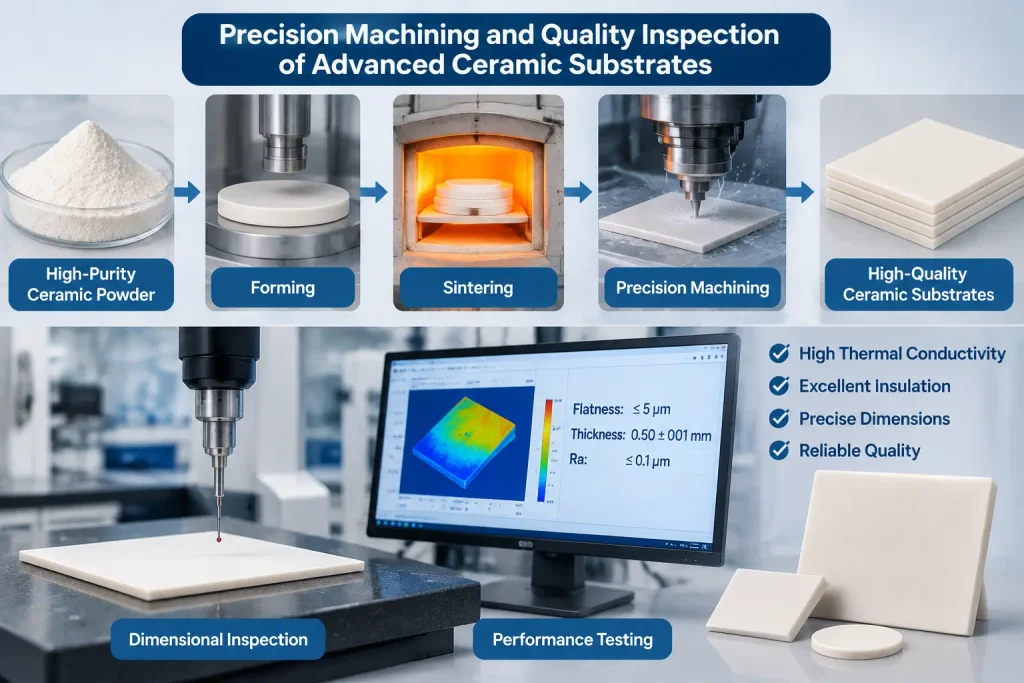
The performance of an advanced ceramic component is influenced not only by its raw material but also by its manufacturing process. Powder preparation, forming, sintering, machining, and final inspection can all affect the finished product. For AlN ceramics, powder purity and sintering conditions are especially important because they influence density, microstructure, and thermal conductivity. Poor control of impurities or porosity may reduce thermal performance. Manufacturers should therefore maintain stable process conditions and verify important properties through appropriate testing.
After sintering, ceramic components may require precision grinding, lapping, or polishing to achieve the required dimensions and surface condition. This is particularly important for substrates and components that need close contact with other package materials. Dimensional tolerance should be discussed before production. The achievable tolerance depends on the component size, geometry, material, machining method, and inspection requirements. A simple flat plate and a component with multiple holes or complex features may require different manufacturing approaches.
Quality inspection may include dimensional measurement, density testing, surface inspection, flatness measurement, and material-property verification. Depending on the application, customers may also require thermal conductivity data, electrical insulation testing, or other technical reports. For B2B buyers, a reliable supplier should be able to explain its material grades, manufacturing capabilities, inspection methods, and production limitations. It is also useful to confirm whether the supplier can provide samples for evaluation before moving to mass production.
9. How to Select the Right Ceramic Material for AI Chip Thermal Management
Selecting the right ceramic material requires a clear understanding of the application. Engineers and procurement teams should evaluate several factors together rather than choosing a material based only on its maximum thermal conductivity. First, define the thermal requirement. Consider the expected heat load, operating temperature, heat flux, and available cooling structure. If the design requires high heat transfer through an electrically insulating substrate, AlN may be a strong candidate. If the thermal load is moderate and cost control is important, alumina may be sufficient.
Second, review electrical requirements. Determine whether the ceramic must provide electrical insulation, what voltage it needs to withstand, and whether dielectric performance must be verified under specific operating conditions. This is particularly important when comparing materials such as SiC, whose electrical behavior depends on grade and composition. Third, consider thermal expansion and mechanical loading. The CTE difference between the ceramic and connected materials can influence stress during heating and cooling. Mechanical strength, fracture toughness, substrate thickness, and package geometry should also be considered.
Fourth, evaluate manufacturing feasibility. Confirm the required dimensions, thickness, flatness, surface finish, hole positions, and machining tolerances. A material may have excellent theoretical properties, but it is only suitable if the supplier can manufacture it consistently to the required specification. Finally, compare total cost rather than material price alone. A higher-performance material may reduce thermal resistance, but it may also increase material and processing costs. The most economical solution is the one that meets the actual performance and reliability requirements without unnecessary over-specification. For a practical supplier evaluation, buyers should request a technical data sheet, sample parts, inspection records, and a quotation based on the same drawing and specification. This makes it easier to compare suppliers on a consistent basis.
10. Future Trends in Advanced Ceramics for AI Electronics
As AI computing continues to develop, thermal management requirements are expected to become more demanding. Higher chip power, denser packaging, and more complex system architectures will increase the importance of materials that can provide stable thermal and electrical performance.
One important direction is the wider evaluation of high-thermal-conductivity ceramic substrates. AlN is likely to remain an important candidate because it combines relatively high thermal conductivity with electrical insulation. At the same time, manufacturers continue to focus on improving material consistency, reducing defects, and controlling production costs. Another trend is the development of more integrated packaging structures. As electronic packages become more complex, ceramic components may need tighter dimensional tolerances, improved surface quality, and more consistent bonding performance. This places greater demands on material suppliers and precision machining capabilities.
Material selection will also become more application-specific. Rather than using one ceramic material for every thermal management requirement, engineers may combine different materials according to their roles in the package. Alumina may remain suitable for cost-sensitive insulating components, while AlN may be considered for areas with higher heat-transfer requirements. Silicon nitride and SiC may serve applications where their mechanical, thermal, or structural properties provide a clear advantage. For manufacturers, the opportunity is not limited to supplying standard ceramic plates. Custom dimensions, precision machining, stable material grades, and reliable quality documentation will remain important factors in supporting advanced electronic packaging.
11. Company Profile
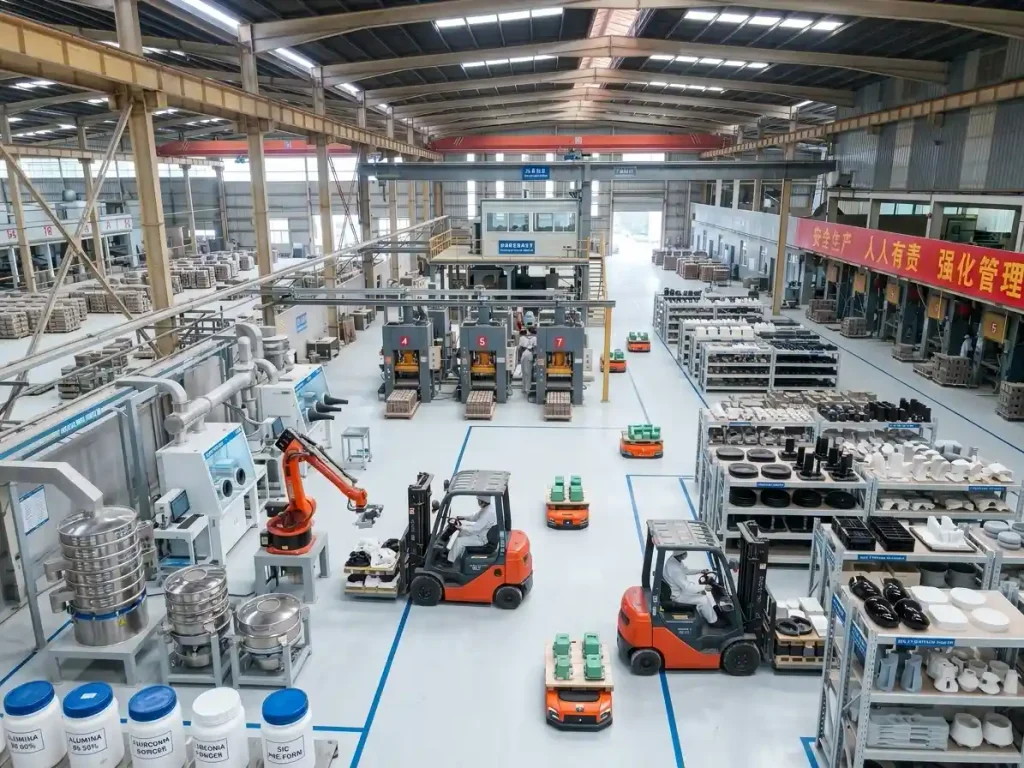
Jenson(Luoyang) Technology Co., Ltd. focuses on advanced ceramic materials and engineered ceramic components for demanding electronic, semiconductor-related, and high-temperature industrial applications. The company provides ceramic solutions using Aluminum Nitride (AlN), Alumina (Al₂O₃), Silicon Nitride (Si₃N₄), Silicon Carbide (SiC), and other advanced ceramic materials. These materials offer different combinations of thermal conductivity, electrical insulation, mechanical strength, dimensional stability, and temperature resistance to support the development of reliable thermal management components.
For high-power electronics and AI chip packaging, Jenson(Luoyang) Technology Co., Ltd. approaches ceramic material selection from an engineering perspective. Rather than focusing on thermal conductivity alone, the company considers key parameters such as operating temperature, heat transfer requirements, electrical insulation, coefficient of thermal expansion (CTE), density, mechanical strength, substrate thickness, surface roughness, dimensional tolerance, and thermal cycling conditions. These factors help determine whether Aluminum Nitride ceramic substrates, alumina insulating components, or other engineered ceramic parts are suitable for a specific application.
For customized ceramic components, the engineering process can begin with the customer’s technical drawing, operating conditions, and performance requirements. Based on the application, material grade, thermal properties, component dimensions, machining methods, surface finish, and inspection criteria can be evaluated before production. This approach is particularly relevant to AI chip thermal management, where effective heat transfer depends not only on the ceramic material itself but also on substrate quality, interface conditions, dimensional accuracy, and package design. By combining material selection with precision manufacturing and application-oriented engineering support, Jenson(Luoyang) Technology Co., Ltd.aims to help customers develop ceramic components for high-performance electronic packaging and thermal management systems.
12. Frequently Asked Questions About Advanced Ceramics for AI Chip Thermal Management
Q1: Why are advanced ceramics used in AI chip thermal management?
Advanced ceramics are used in AI chip thermal management because they can combine good thermal performance with electrical insulation, dimensional stability, and high-temperature resistance. These properties are important in high-power electronic packages, where heat must be transferred away from semiconductor devices without creating unwanted electrical connections between different components. For example, aluminum nitride (AlN) offers relatively high thermal conductivity while maintaining electrical insulation, making it suitable for ceramic substrates and heat-dissipation components. Alumina is another common option for applications that require stable electrical insulation and cost-effective performance.
In addition, advanced ceramics can maintain their mechanical and electrical properties under demanding operating conditions. This helps support the reliability of electronic packaging during repeated heating and cooling cycles. However, the final thermal performance also depends on substrate thickness, bonding quality, interface materials, and the overall cooling structure.
Q2: Is aluminum nitride better than alumina for thermal management?
Aluminum nitride generally provides much higher thermal conductivity than conventional alumina. Typical AlN thermal conductivity ranges from approximately 140–230 W/(m·K), while alumina is commonly around 20–35 W/(m·K), depending on the material grade and manufacturing process. This makes AlN a strong candidate for high-power electronic applications where efficient heat transfer is a priority. However, AlN is not automatically the best choice for every project. Alumina offers a good balance of electrical insulation, mechanical properties, availability, and manufacturing cost. For applications with moderate thermal loads, alumina may provide sufficient performance without requiring a higher-cost material.
When choosing between these two materials, engineers should consider the required thermal conductivity, operating temperature, electrical insulation, thermal expansion, component dimensions, and total project budget. Procurement teams should also compare actual supplier data sheets rather than relying only on general material specifications. In many cases, the most suitable material is the one that meets the application requirements with a reasonable manufacturing cost.
Q3: What is the main advantage of an AlN ceramic substrate?
The main advantage of an aluminum nitride ceramic substrate is its combination of relatively high thermal conductivity and excellent electrical insulation. This allows heat generated by a semiconductor device to pass through the ceramic substrate while maintaining electrical separation between conductive circuits and other package components. AlN also has a coefficient of thermal expansion (CTE) of approximately 4.0–5.0 × 10⁻⁶/K, which is relatively close to that of silicon. This can help reduce thermal mismatch in certain semiconductor packaging structures, especially when components experience repeated temperature changes.
Another advantage is its suitability for precision electronic components. AlN substrates can be manufactured in different thicknesses and dimensions according to application requirements. Depending on the design, additional processing such as precision grinding, lapping, polishing, or metallization may be required. When purchasing AlN substrates, buyers should pay attention to thermal conductivity, density, flatness, thickness tolerance, surface roughness, and electrical insulation performance. These parameters should be confirmed for the actual material grade and finished component, rather than assumed from general AlN specifications.
Q4: Can silicon carbide replace aluminum nitride in electronic substrates?
Silicon carbide (SiC) and aluminum nitride (AlN) both offer useful thermal properties, but they have different electrical and mechanical characteristics. SiC can provide high thermal conductivity, excellent hardness, and good high-temperature performance. However, many SiC grades are electrically conductive or semiconductive, while AlN is generally used as an electrically insulating ceramic. For this reason, SiC cannot directly replace AlN in every electronic substrate application. If a substrate must provide both efficient heat transfer and electrical insulation, AlN may be more suitable. SiC may be considered for selected thermal or structural components where its hardness, wear resistance, and temperature capability provide additional value.
The final decision should be based on the electrical design, operating environment, thermal load, and required mechanical properties. Engineers should also verify the electrical resistivity of the specific SiC grade before using it in a design that requires electrical isolation. From a procurement perspective, it is important to request grade-specific technical data sheets and confirm the material’s electrical behavior, thermal conductivity, and machining feasibility before approving a substitute material.
Q5: What information should buyers provide when requesting a ceramic substrate quotation?
To receive an accurate quotation, buyers should provide a technical drawing or detailed product specifications. Important information includes the material type, purity or grade, overall dimensions, thickness, quantity, dimensional tolerance, flatness requirement, and surface finish. The intended operating conditions should also be explained. For example, suppliers may need to know the operating temperature, thermal load, electrical insulation requirements, and whether the component will be exposed to repeated heating and cooling. This information helps manufacturers evaluate whether AlN, alumina, silicon nitride, or another ceramic material is suitable.
If the substrate includes holes, slots, grooves, steps, or other complex features, these details should be clearly shown in the drawing. Buyers should also specify whether additional processing, such as precision grinding, polishing, or metallization, is required. For projects with strict quality requirements, it is useful to discuss inspection standards before production. These may include dimensional inspection, flatness measurement, surface roughness, density, thermal conductivity, and electrical testing. Providing complete technical information at the quotation stage helps manufacturers assess production feasibility, select suitable processing methods, estimate lead times, and reduce the risk of specification misunderstandings during mass production.
Q6: How can buyers verify the quality of an advanced ceramic substrate?
Buyers can verify the quality of an advanced ceramic substrate through material documentation, sample evaluation, dimensional inspection, and application-specific performance testing. A technical data sheet is a useful starting point because it provides information about the material grade and its typical physical, thermal, mechanical, and electrical properties. However, a general data sheet alone may not be sufficient for precision electronic components. Buyers should also request inspection results for important finished-product dimensions, including thickness, length, width, flatness, and surface condition. For components requiring close contact with other package materials, flatness and surface finish can directly influence assembly quality and thermal interface performance.
Depending on the application, additional tests may include thermal conductivity measurement, density testing, dielectric strength, volume resistivity, and mechanical strength evaluation. Buyers should confirm the applicable test methods, sample conditions, and acceptance criteria with the supplier. Before mass production, evaluating samples is also recommended. Sample inspection allows engineering teams to check dimensional accuracy, machining quality, surface defects, and compatibility with the actual assembly process. For long-term supply projects, buyers should also review the manufacturer’s process consistency, inspection procedures, and ability to maintain the same material grade across different production batches.
Q7: Does higher thermal conductivity always mean better thermal management?
No. Higher thermal conductivity does not always result in better overall thermal management. Although a material with higher thermal conductivity can transfer heat more efficiently under comparable conditions, the performance of a complete electronic package depends on several other factors. For example, substrate thickness affects the distance heat must travel. A thinner ceramic substrate may reduce thermal resistance, but it must still provide sufficient mechanical strength and electrical insulation. The quality of the bonding layer and thermal interface material is also important. Voids, poor surface contact, or uneven bonding can increase interface resistance and reduce heat transfer efficiency.
Thermal expansion compatibility is another factor. If the ceramic substrate and connected components have significantly different CTE values, temperature changes may create additional mechanical stress. Over time, this stress can affect package reliability. Therefore, engineers should evaluate thermal conductivity together with CTE, thickness, interface resistance, mechanical strength, and operating conditions. A material with slightly lower thermal conductivity may provide better overall performance if it offers improved mechanical compatibility, more reliable bonding, or a more suitable manufacturing solution.
Q8: Can advanced ceramic manufacturers provide customized components?
Yes. Many advanced ceramic manufacturers can produce customized components according to customer drawings, technical specifications, and application requirements. Common customization options include material selection, purity grade, length, width, thickness, hole positions, surface finish, and precision machining. For AI chip thermal management and electronic packaging applications, customization may involve flat ceramic substrates, insulating plates, precision-ground components, or parts with special geometries. Depending on the design, manufacturers may offer processes such as diamond grinding, lapping, polishing, drilling, and other precision machining operations.
However, achievable tolerances depend on the material, component dimensions, geometry, machining process, and production quantity. Complex structures or very thin substrates may require additional engineering review before a tolerance can be confirmed. When discussing a customized project, buyers should provide drawings, material requirements, annual or batch quantities, and expected operating conditions. It is also helpful to request sample production and dimensional inspection reports before moving to mass production.
A capable manufacturer should be able to review the design, recommend suitable ceramic materials, explain production limitations, and provide clear technical documentation. This cooperation helps ensure that the finished ceramic component meets the functional and quality requirements of the intended electronic application.
RELATED POSTS
How to Choose Between Aluminum Nitride and Alumina Ceramics for High-Performance Thermal Applications
How Silicon Carbide Kiln Furniture Improves Energy Efficiency and Reduces Firing Costs
How to Custom Manufacture Boron Nitride Insulator Rings, Gas Nozzles, and Wafer Chuck Parts?
How Do You Select the Right Silicon Carbide Nozzle for Abrasive and Corrosive Environments?
Why Silicon Carbide Ceramics Are Essential for Semiconductor Wafer Processing Equipment