Advanced Technical Ceramics, Precision Alumina, Silicon Carbide, Crucible Parts
 Technology Co., Ltd.(Luoyang) Technology Co., Ltd.科技品牌标志.webp)

How Do You Select the Right Silicon Carbide Nozzle for Abrasive and Corrosive Environments?
1. Understanding the Applications and Advantages of Silicon Carbide Nozzles
Industrial nozzles play an important role in controlling the flow, direction, and distribution of liquids, gases, and solid-liquid mixtures. In many production environments, however, nozzles are exposed to more than ordinary fluid pressure. They may need to handle abrasive particles, corrosive chemicals, high-speed slurry, and frequent temperature changes. These conditions can cause conventional metal or standard ceramic nozzles to wear, deform, corrode, or lose their original spray performance. As a result, frequent replacement and unplanned equipment downtime may increase overall operating costs.
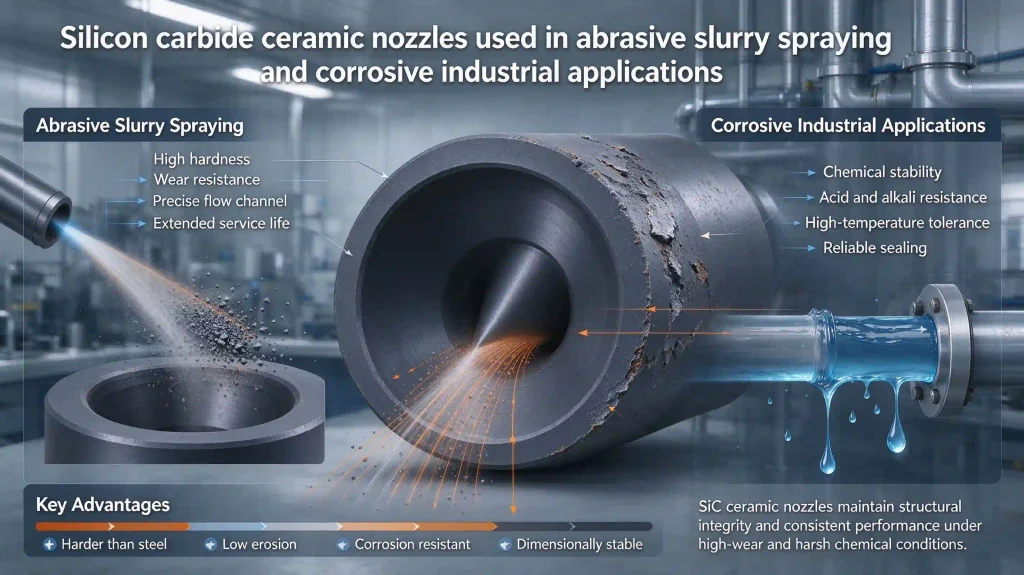
Silicon Carbide (SiC) is widely used in industrial equipment because it combines high hardness, excellent wear resistance, good thermal conductivity, and strong resistance to many chemical environments. These properties make silicon carbide nozzles a practical option for applications where both mechanical wear and chemical exposure are concerns. In mineral processing and mining operations, for example, nozzles may continuously handle slurry containing sand, mineral particles, or other hard solids. The particles can gradually erode the internal nozzle surface and enlarge the outlet opening. Even a small change in orifice size can affect flow rate, spray distribution, and process consistency. A properly selected SiC nozzle can help slow this wear process and maintain more stable operating performance. In chemical processing, nozzles may come into contact with acids, alkalis, salts, or mixed process liquids. Here, material selection is not based on hardness alone. The chemical composition of the ceramic, its bonding phase, and the operating temperature all influence long-term compatibility. Silicon carbide offers resistance to many corrosive media, but the exact material grade must be evaluated against the actual chemical conditions. Other applications include industrial cleaning, surface treatment, desulfurization systems, spray drying equipment, and selected cooling or gas-liquid contact processes.
In these systems, the nozzle must provide consistent flow while maintaining its structural integrity over extended operating periods. For procurement teams, the main advantage of choosing silicon carbide is the potential to reduce replacement frequency and maintenance interruptions. For engineers, its value lies in the combination of mechanical strength, thermal performance, and chemical stability. However, these benefits can only be achieved when the material, geometry, and manufacturing quality match the application. It is also useful to distinguish silicon carbide nozzles from other SiC products. A silicon carbide crucible or SiC crucible, for example, is designed to contain materials under high-temperature conditions, while a nozzle must control fluid flow and resist erosion around its internal passages. Although both products use a related ceramic material, their design priorities and quality requirements are different.
2. Key Operating Conditions That Affect Silicon Carbide Nozzle Selection
Selecting a suitable silicon carbide nozzle starts with a detailed understanding of the working environment. Buyers sometimes focus mainly on the nozzle dimensions or material price, but these details cannot provide a complete basis for selection. A nozzle that performs well in one production line may have a much shorter service life in another because of differences in particle characteristics, fluid chemistry, pressure, and operating temperature.
Abrasive Particle Size, Hardness, and Concentration
For applications involving abrasive slurry, the characteristics of the solid particles are among the most important selection factors. Particle size, hardness, shape, and concentration all influence the rate of erosion. Sharp particles can cause more severe surface damage than rounded particles, while larger or harder particles may create greater impact stress when they strike the nozzle wall.
The concentration of solids also matters. A fluid containing a high percentage of abrasive particles exposes the internal surface to more frequent particle impacts. In addition, higher flow velocity can increase the energy of these impacts. Therefore, simply choosing the hardest available material may not solve the problem if the nozzle geometry creates excessive turbulence or directs particles toward a small area. When requesting a quotation, buyers should provide the type of abrasive material, its approximate hardness, the average and maximum particle size, and the solid concentration in the fluid. If these values are not available, process descriptions, equipment specifications, or samples of the slurry may help the manufacturer assess the application.
Chemical Composition and Corrosion Conditions
Chemical compatibility requires equal attention. Different acids, alkalis, salts, and chemical mixtures can react differently with ceramic materials. Furthermore, the same chemical may become more aggressive as its concentration or temperature increases.
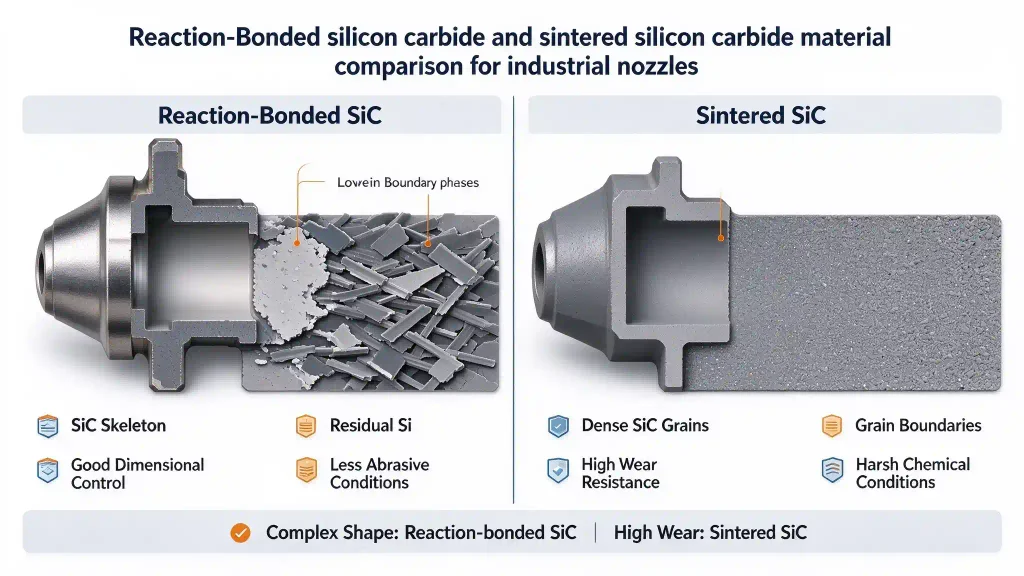
The performance of a silicon carbide compound also depends on its manufacturing route. For example, reaction-bonded silicon carbide may contain residual free silicon, while sintered silicon carbide generally has a different material structure. This difference can influence chemical resistance in certain environments. Buyers should therefore avoid describing the application simply as an acid-resistant or alkali-resistant requirement. Instead, provide the chemical name, concentration, temperature, exposure time, and whether the medium contains other substances. For mixed chemicals or particularly aggressive process conditions, material compatibility should be confirmed through technical review or testing.
Operating Pressure, Flow Rate, and Temperature
Pressure and flow rate influence the mechanical load and fluid behavior inside the nozzle. High operating pressure can produce high fluid velocity, which may improve spray performance but also increase erosion in abrasive systems. The nozzle wall thickness, inlet transition, outlet design, and mounting method must be considered together.
Temperature is another important factor. Silicon carbide has good thermal conductivity and thermal stability, but repeated rapid heating and cooling can still create stress. A nozzle installed near a hot process chamber, for example, may experience a different temperature profile from one operating at room temperature with a corrosive liquid. Engineers should also identify whether the equipment runs continuously or through frequent start-stop cycles. This information helps the manufacturer evaluate thermal cycling, pressure fluctuations, and the expected service conditions.
3. Comparing Different Silicon Carbide Materials for Nozzle Applications
The term silicon carbide refers to a family of engineering ceramic materials rather than one product with identical properties. Different manufacturing methods produce different microstructures, densities, bonding phases, and performance characteristics. For nozzle applications, reaction-bonded silicon carbide and sintered silicon carbide are two important material options.
Reaction-Bonded Silicon Carbide
Reaction-bonded silicon carbide (RB-SiC) is generally produced by infiltrating a porous carbon-containing SiC body with molten silicon. The silicon reacts with carbon to form additional silicon carbide, while some residual free silicon may remain in the finished material. This manufacturing route can produce components with high hardness, good thermal conductivity, and useful dimensional stability. It also allows manufacturers to produce certain relatively complex shapes. These characteristics make RB-SiC a candidate for industrial nozzles that need a combination of wear resistance, thermal performance, and manufacturing flexibility.
However, the residual free silicon should not be overlooked. In some chemical environments, it may influence the material’s corrosion performance. Therefore, RB-SiC should not automatically be considered suitable for every acidic or alkaline process. Buyers should request information about the material composition and confirm compatibility with the actual operating medium.
Sintered Silicon Carbide
Sintered silicon carbide (SSiC) is produced by densifying high-purity SiC powder at high temperatures. Unlike reaction-bonded SiC, it generally does not rely on a metallic silicon infiltration phase to form the finished structure. SSiC is known for its high hardness, high density, low porosity, and strong wear resistance. It is often considered for applications where material purity and resistance to demanding chemical conditions are important. Its dense structure can also help reduce the penetration of certain process media.
For abrasive and corrosive nozzle applications, SSiC may be a suitable option when both erosion resistance and chemical compatibility are major concerns. However, its hardness also makes machining more demanding. Complex internal passages, small orifices, and tight dimensional tolerances may require specialized diamond grinding and additional production time.
How Should Buyers Make the Material Decision?
There is no universal answer to whether reaction-bonded silicon carbide (RB-SiC) or sintered silicon carbide (SSiC) is better for industrial nozzle applications. Both materials offer high hardness, wear resistance, and thermal stability, but their compositions, microstructures, and manufacturing processes are different. These differences can affect nozzle service life, chemical compatibility, machining accuracy, and overall purchasing costs.
For buyers and engineers, material selection should start with the actual operating environment rather than the material’s general reputation. A nozzle handling high concentrations of abrasive particles may require a different material solution from one exposed to aggressive chemicals at elevated temperatures. Similarly, a component with a complex internal passage may require a different manufacturing approach from a simple straight-bore nozzle.
The following table provides representative physical and mechanical property ranges for comparing the two materials. These figures are based on published manufacturer technical data and are intended for preliminary material selection. They are not universal specifications or guaranteed values for every silicon carbide nozzle.
| Selection Factor | Reaction-Bonded SiC (RB-SiC) | Sintered SiC (SSiC) |
|---|---|---|
| Typical SiC content | 85–90 wt% | Generally above 98 wt% |
| Density | 3.00–3.10 g/cm³ | 3.10–3.16 g/cm³ |
| Vickers hardness | Approx. 2,000–2,300 HV | Approx. 2,300–2,550 HV |
| Flexural strength | Approx. 250–350 MPa | Approx. 350–450 MPa |
| Young’s modulus | Approx. 300–350 GPa | Approx. 390–440 GPa |
| Thermal conductivity | Approx. 45–170 W/(m·K) | Approx. 125–200 W/(m·K) |
| Thermal expansion coefficient | Approx. 4.5–6.0 × 10⁻⁶/K | Approx. 3.7–4.5 × 10⁻⁶/K |
| Apparent porosity | Typically below 0.1% | Typically very low; grade-dependent |
| Maximum service temperature | Approx. 1,000–1,380°C | Approx. 1,400–1,600°C |
| Machining difficulty | High | Very high |
| Relative manufacturing cost | Often moderate | Often higher |
Note: Values are indicative ranges compiled from different commercial material grades and manufacturer data sheets. They may use different test methods, temperatures, and specimen configurations. The maximum service temperature is particularly dependent on the atmosphere, load, and component design. Confirm all values with the selected manufacturer’s current technical data sheet.
The table shows that SSiC often has a higher density, hardness, and flexural strength than RB-SiC. These properties can be useful when a nozzle is exposed to continuous particle impact or demanding mechanical conditions. However, higher values do not automatically mean longer service life. Particle velocity, impact angle, slurry concentration, nozzle geometry, and installation conditions can have an equally important influence on actual wear.
Thermal conductivity also requires careful consideration. Although SSiC grades often provide high thermal conductivity, the values can vary considerably between manufacturers and material formulations. RB-SiC can also offer good thermal performance, but its residual silicon content and microstructure affect the final result. Buyers should compare values measured at similar temperatures and using comparable test methods rather than relying on a single general figure.
4. Nozzle Design, Geometry, and Flow Performance
Even when the correct SiC material is selected, poor nozzle geometry can still lead to unstable flow, uneven wear, or premature failure. The internal passage, orifice diameter, wall thickness, and outlet shape all influence how the fluid moves through the nozzle. For this reason, material selection and structural design should be reviewed together.
Orifice Diameter and Internal Passage
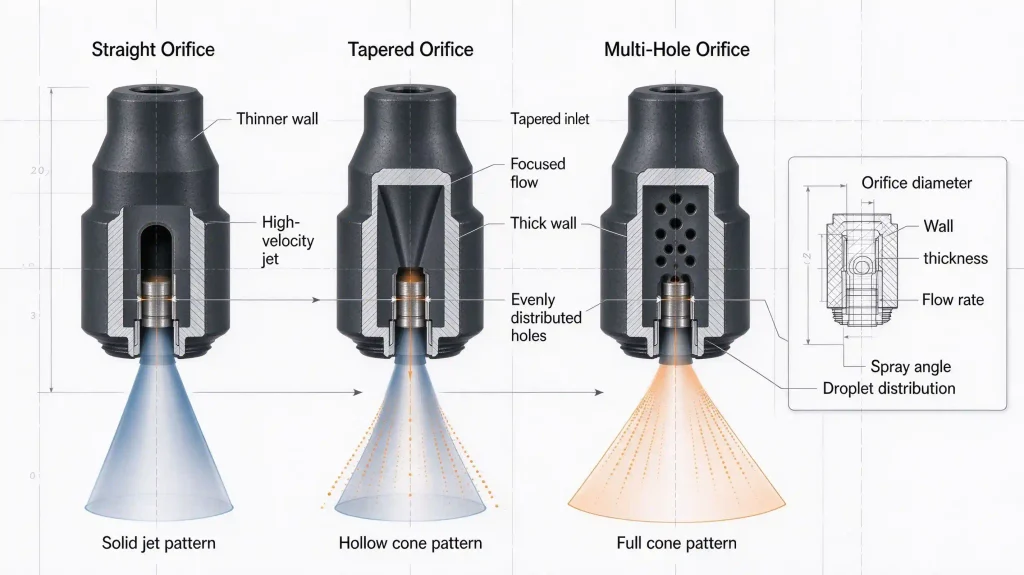
The orifice diameter directly affects the flow characteristics of a nozzle. A smaller opening may produce a higher-speed jet under certain pressure conditions, while a larger opening may allow a higher flow rate. However, the actual relationship depends on the fluid viscosity, pressure, nozzle geometry, and system design. In abrasive slurry applications, the orifice must also be considered in relation to the maximum particle size. If the opening is too small, solid particles may accumulate or block the passage. This can cause pressure changes, uneven spraying, and additional maintenance work.
The internal passage should provide a suitable transition from the inlet to the outlet. Sudden changes in direction or cross-sectional area may create turbulence and localized wear. A carefully designed flow path can help reduce unnecessary pressure loss and improve the consistency of fluid distribution.
Spray Pattern and Application Requirements
Different industrial processes require different spray patterns. A full-cone nozzle distributes liquid across a defined circular area, while a hollow-cone nozzle produces a ring-shaped spray. Flat-fan designs are commonly used for surface coverage, and solid-jet designs deliver a more concentrated stream. The choice should reflect the target area, spray distance, pressure, fluid characteristics, and required coverage. For example, a nozzle used for cleaning a large surface may require a different spray pattern from one used to inject abrasive slurry into a processing chamber.
Procurement teams should not rely only on product names or photographs when comparing suppliers. They should confirm the spray angle, flow rate, pressure range, and test conditions used to obtain the stated performance. Where spray consistency is critical, a sample test using the actual fluid or a representative test medium can provide useful information.
Wall Thickness, Mounting, and Structural Strength
Ceramic materials are hard and resistant to wear, but they are more brittle than many metals. This means the nozzle design must control stress concentration and avoid unnecessary mechanical loading. Thin sections, sharp internal corners, sudden changes in wall thickness, and uneven clamping can increase the risk of cracking. The mounting structure should support the nozzle evenly without applying excessive force to a small contact area. Sealing arrangements should also be selected to accommodate the operating temperature and pressure.
For custom designs, engineers should review the nozzle drawing before production. If an existing metal nozzle is being replaced with a ceramic version, its geometry may need adjustment because ceramic materials respond differently to impact, vibration, and installation stress.
5. Wear, Corrosion, and Common Failure Mechanisms
Understanding why nozzles fail is essential when selecting a replacement material or improving an existing design. In practice, nozzle damage is not always caused by one factor. Abrasive erosion, chemical attack, thermal stress, mechanical impact, and blockage may occur together.
Abrasive Erosion and Localized Wear
Abrasive erosion occurs when solid particles repeatedly strike the nozzle surface. Over time, the internal passage may become wider, the outlet shape may change, and the spray pattern may become less consistent. The rate of erosion depends on particle hardness, shape, size, concentration, impact angle, and fluid velocity. A nozzle may therefore wear much faster when the process changes, even if the material itself remains unchanged.
When a nozzle repeatedly wears in one area, engineers should examine the flow path and particle direction rather than simply replacing it with a harder material. Changes to the inlet transition, orifice geometry, or operating pressure may help reduce localized impact. A suitable SiC grade can improve resistance, but good system design is also necessary.
Chemical Corrosion and Material Degradation
Chemical corrosion may gradually affect the ceramic surface or its bonding phase. Depending on the medium, this can lead to surface changes, reduced material strength, or loss of dimensional accuracy. The chemical resistance of SiC should not be treated as universal. Reaction-bonded and sintered grades may behave differently in specific chemical environments because their compositions and microstructures are not identical.
For procurement teams, it is important to provide accurate chemical information before selecting a grade. For manufacturers, it is equally important to avoid making broad corrosion-resistance claims without considering concentration, temperature, and exposure time.
Thermal Cracking and Mechanical Damage
Rapid temperature changes can create thermal stress inside a ceramic nozzle. Repeated heating and cooling may gradually increase the risk of cracks, particularly when the component has uneven wall thickness or is installed under excessive mechanical pressure. Mechanical damage can also occur during transportation, installation, or maintenance. Ceramic nozzles should be handled carefully and protected from impact. During installation, excessive tightening and uneven support should be avoided.
Clogging and Unstable Flow
Clogging is another common issue in systems that handle slurry or particle-containing fluids. Deposits may build up inside the nozzle, while particles larger than the passage can become trapped at the inlet or outlet. To reduce this risk, the orifice should be matched to the particle characteristics, and the fluid filtration system should be reviewed where practical. Cleaning methods must also be compatible with the selected ceramic grade and process environment.
6. Technical Specifications and Quality Requirements for SiC Nozzles
A detailed specification is essential for comparing suppliers and ensuring that delivered nozzles meet the application requirements. If a purchase order only states the material name and overall dimensions, important details such as density, internal geometry, tolerances, and inspection standards may remain unclear.
For custom silicon carbide nozzles, buyers should define the material grade first. The specification should identify whether RB-SiC or SSiC is required, or whether the manufacturer may recommend the material after reviewing the operating conditions. Where chemical compatibility is important, the material composition and bonding phase should also be clarified. Physical and mechanical properties should be supported by test data. Density, hardness, flexural strength, porosity, and thermal conductivity are common reference parameters. However, values should only be compared when the test methods and conditions are clearly stated. A hardness number without a test method, for example, may not provide a reliable basis for supplier comparison.
Dimensional accuracy is equally important. The orifice diameter, inlet dimensions, overall length, concentricity, straightness, and internal profile can all affect nozzle performance. Buyers should identify the critical dimensions on the drawing and specify tolerances according to the actual application. Extremely tight tolerances may increase machining costs and production lead time, so they should be applied only where they provide a clear functional benefit. Surface quality should also be included in the specification. Internal roughness, visible chips, cracks, and machining marks may affect fluid flow or indicate potential manufacturing problems. For critical components, buyers can request dimensional inspection reports and material certificates as part of the delivery documentation.
| Technical Parameter | What Buyers Should Confirm |
|---|---|
| Material grade | RB-SiC, SSiC, or another specified grade |
| Composition | SiC content and bonding phase |
| Density | Bulk density and test method |
| Hardness | Value and test method |
| Flexural strength | Test standard and result |
| Porosity | Open porosity or other relevant indicators |
| Thermal conductivity | Value and measurement temperature |
| Dimensions | Overall size, inlet, outlet, and orifice |
| Tolerances | Critical dimensional and geometric tolerances |
| Surface quality | Internal and external finish requirements |
| Inspection records | Material certificates and dimensional reports |
The most useful specification is one that connects technical parameters with actual operating requirements. Rather than requesting the highest possible value for every property, buyers should identify which characteristics have the greatest influence on service life and process performance.
7. Manufacturing Processes and Quality Control of Silicon Carbide Nozzles
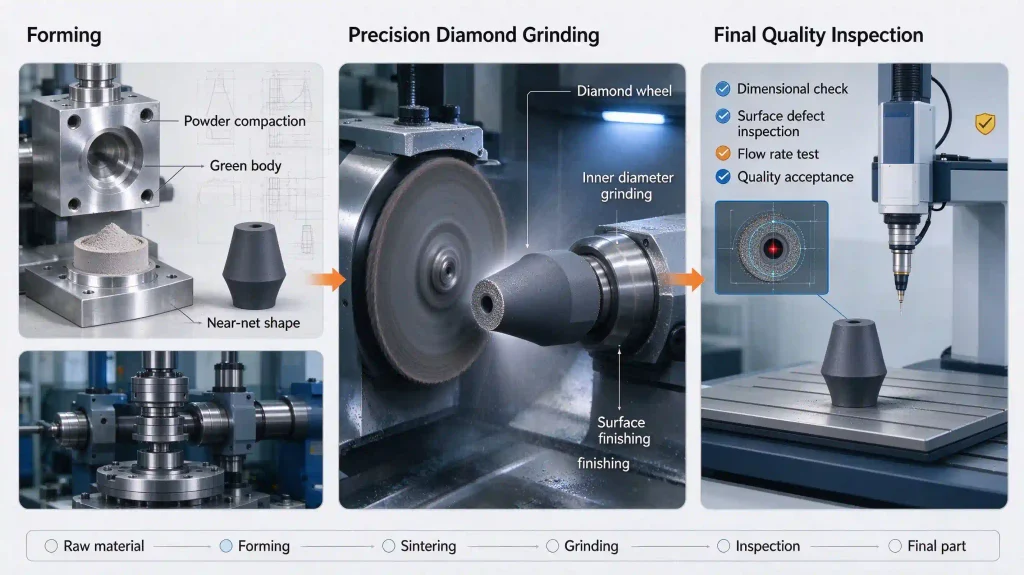
The quality of a finished SiC nozzle depends on the entire manufacturing process, from raw material preparation to final inspection. Even when two products are described as the same material, differences in powder quality, forming, densification, and machining may result in different performance.
Raw Material Preparation and Forming
Production begins with the preparation of silicon carbide powder or other specified raw materials. Powder purity, particle size distribution, and composition influence the final material structure. Consistent raw materials help manufacturers maintain stable density and mechanical properties between production batches. The forming method depends on the material grade and nozzle geometry. Pressing, extrusion, slip casting, and other forming methods may be used for different designs. A simple straight-bore nozzle and a nozzle with a complex internal passage may require different tooling and production arrangements.
Sintering and Reaction Bonding
After forming, the component is processed according to the selected material route. Sintered SiC is densified at high temperatures, while reaction-bonded SiC uses a silicon infiltration process. Temperature control, atmosphere, material composition, and processing conditions all influence the final microstructure. For manufacturers, maintaining stable process parameters is essential. For buyers, understanding the manufacturing route helps explain why different SiC grades may have different properties, prices, and lead times.
Precision Machining and Finishing
After forming and densification, machining may be required to achieve the specified dimensions and surface finish. Since silicon carbide is extremely hard, diamond grinding and other specialized machining techniques are commonly used. Nozzle machining requires particular attention to the internal passage and outlet. A component may meet its overall length and external diameter requirements but still fail to provide the required flow performance if the orifice or internal profile is inaccurate. The supplier should therefore have suitable machining equipment and inspection methods for the nozzle’s critical features. For complex designs, it is useful to review the manufacturing feasibility before confirming the final drawing.
Final Inspection and Batch Consistency
Final inspection should cover the dimensions and quality characteristics agreed upon in the purchase specification. Depending on the application, this may include material identification, density checks, dimensional measurement, visual inspection, crack detection, and flow testing. For repeat orders, batch consistency is especially important. A reliable manufacturer should maintain traceable production records and use consistent inspection criteria. This helps buyers compare deliveries over time and identify changes before they affect the production line.
8. Choosing a Reliable Silicon Carbide Nozzle Manufacturer and Evaluating Total Cost
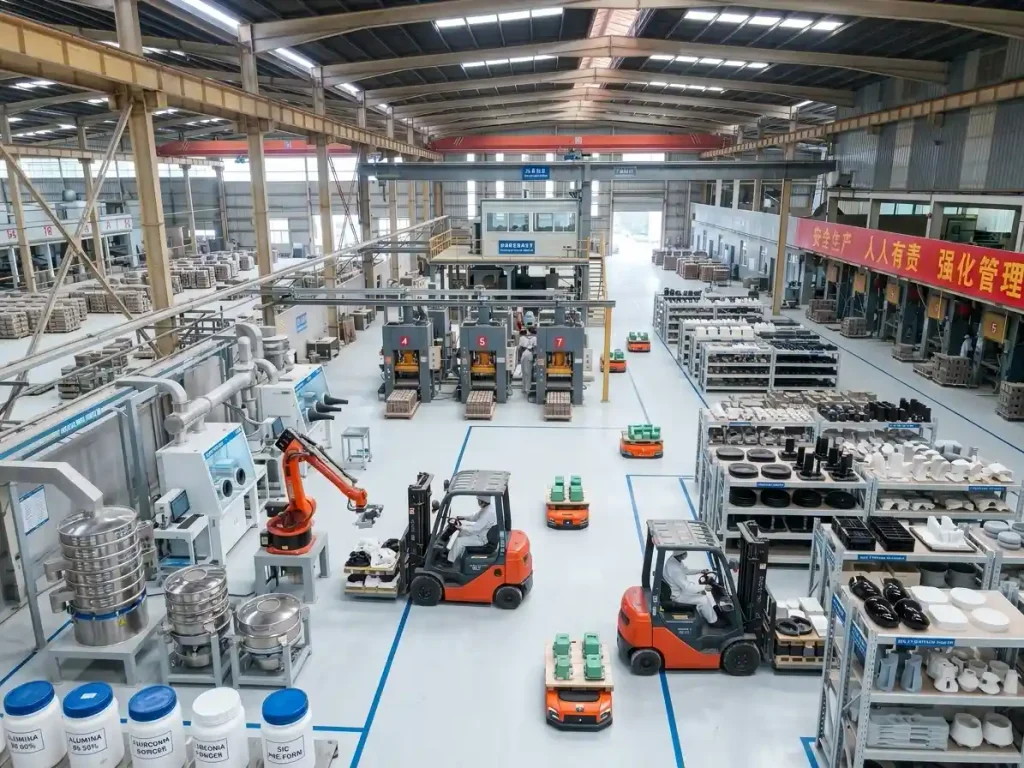
A reliable silicon carbide nozzle manufacturer should provide more than a product quotation. The supplier should understand the application, evaluate material suitability, review the drawing, and explain how the manufacturing process will meet the required specifications.
Evaluate Technical and Application Knowledge
One of the first things buyers should evaluate is the supplier’s understanding of SiC materials. A qualified manufacturer should be able to explain the differences between reaction-bonded and sintered silicon carbide, identify possible limitations, and recommend a suitable grade based on the process environment. During the inquiry stage, observe whether the supplier asks about particle size, chemical composition, temperature, pressure, and flow requirements. These questions show that the manufacturer is considering the complete application rather than simply matching a product name to a price.
Review Customization and Manufacturing Capabilities
Industrial nozzles often require non-standard dimensions, special spray patterns, or complex internal passages. Buyers should check whether the supplier can work from technical drawings and whether it has suitable forming and precision machining capabilities. It is also useful to ask about sample production. A prototype can help confirm dimensions, installation compatibility, and flow performance before a larger order is placed. If the nozzle is being developed as a replacement for an existing component, the supplier may also be able to review a physical sample, provided that the critical dimensions and material requirements can be verified.
Check Quality Management and Documentation
A professional supplier should be able to explain how raw materials are inspected, how production batches are controlled, and how finished components are checked before shipment. Depending on the project, buyers may request material data sheets, dimensional inspection reports, certificates of conformity, and traceability information. For long-term procurement, stable quality is often more valuable than a low initial price. Consistent production and clear documentation make it easier to manage repeat orders, maintenance planning, and supplier performance.
Compare Total Cost of Ownership
The purchase price is only one part of the cost of a nozzle. A lower-priced component may require more frequent replacement, create more maintenance work, or cause production interruptions. In contrast, a higher-priced SiC nozzle may offer better long-term value if it maintains its dimensions and flow performance for a longer period under comparable conditions. A meaningful cost comparison should include the initial unit price, expected service life, replacement frequency, installation labor, downtime, inspection costs, and delivery reliability. Buyers should also consider whether the supplier can maintain the same material grade and dimensions across repeat orders.
Where possible, compare suppliers using operating data from similar applications. If no service-life data is available, begin with sample testing under representative conditions. This provides a more reliable basis for purchasing decisions than relying on general claims about material hardness or wear resistance.
9. A Practical Checklist for Selecting and Purchasing SiC Nozzles
Before requesting a quotation, procurement teams and engineers should prepare a clear description of the application. This reduces repeated communication, helps manufacturers assess production feasibility, and makes supplier quotations easier to compare. Start with the operating environment. Explain what the nozzle is used for, whether the process involves abrasive particles, corrosive chemicals, or both, and whether the system operates continuously or intermittently. The operating temperature, pressure, flow rate, and any temperature or pressure fluctuations should also be included.
Next, describe the process medium in detail. For slurry applications, provide the particle type, approximate hardness, average and maximum particle size, and solid concentration. For chemical applications, identify the chemical composition, concentration, temperature, and exposure duration. If the exact values are unavailable, equipment specifications or process samples may help the manufacturer carry out an initial review. The technical drawing should identify the overall dimensions, inlet and outlet sizes, orifice diameter, wall thickness, internal geometry, and critical tolerances. If a specific spray angle, flow rate, or spray pattern is required, include these details as well. A drawing with clearly marked critical dimensions is more useful than a general sketch without tolerance information. Material and quality requirements should then be confirmed. State whether RB-SiC or SSiC is preferred, or ask the supplier to recommend a suitable grade. Specify which material properties and inspection documents are required. For critical applications, discuss sample testing and acceptance criteria before mass production.
Finally, confirm the commercial requirements, including order quantity, prototype needs, expected delivery time, packaging, and future demand. If the nozzle is part of a long-term maintenance program, it is worth discussing repeat-order consistency and the supplier’s ability to maintain the same specifications. A complete inquiry does not need to include every technical value from the beginning. However, the more clearly the operating conditions and functional requirements are explained, the more accurately a manufacturer can recommend a material and design.
10. Company Profile
Jenson(Luoyang) Technology Co., Ltd. focuses on advanced ceramic materials and engineered ceramic components for demanding industrial, high-temperature, electronic, and semiconductor-related applications. The company provides boron nitride solutions with attention to material purity, thermal conductivity, electrical insulation, dimensional accuracy, machining quality, and application-specific requirements.
For semiconductor applications, Jenson approaches BN component selection from an engineering perspective rather than relying on a single standard grade. Parameters such as operating temperature, process atmosphere, vacuum conditions, thermal conductivity, electrical resistivity, coefficient of thermal expansion, purity, density, surface roughness, dimensional tolerance, and thermal cycling can all be considered when determining the appropriate material specification.
For customized BN components, the engineering process can begin with the actual working conditions and component drawing. Based on the application, material grade, density, purity, thermal properties, machining requirements, and inspection criteria can then be established. This approach is particularly relevant to boron nitride semiconductor manufacturing, where process stability can depend on a combination of thermal behavior, contamination control, dimensional accuracy, and long-term material reliability rather than on a single material parameter.
11. FAQs About Silicon Carbide Nozzles
1. Why Is Silicon Carbide Used for Industrial Nozzles?
Silicon carbide (SiC) is widely used for industrial nozzles because it offers a combination of high hardness, excellent wear resistance, good thermal conductivity, and strong resistance to many chemical environments. These properties make it suitable for applications where conventional metal or standard ceramic nozzles may wear out or require frequent replacement.
In abrasive processing systems, solid particles continuously strike the internal surface of the nozzle. Over time, this can enlarge the orifice, change the spray pattern, and reduce process accuracy. The high hardness of silicon carbide helps resist this type of surface damage and maintain more stable nozzle dimensions. Chemical compatibility is another important advantage. SiC can perform well in many industrial chemical environments, although its resistance depends on the material grade, chemical concentration, temperature, and exposure time. For buyers working with corrosive liquids or mixed chemical solutions, it is important to provide detailed process information before confirming the material.
From a procurement perspective, a silicon carbide nozzle may offer better long-term value when its wear resistance helps reduce replacement frequency and equipment downtime. However, buyers should evaluate actual service performance rather than relying only on general material descriptions.
2. Is Reaction-Bonded or Sintered Silicon Carbide Better for Nozzles?
Both reaction-bonded silicon carbide (RB-SiC) and sintered silicon carbide (SSiC) are used in industrial components, but they have different material structures and manufacturing characteristics.
RB-SiC is produced through a silicon infiltration process. The finished material contains silicon carbide and may also contain residual free silicon. It generally offers good wear resistance, thermal conductivity, and dimensional stability. Its manufacturing process can also support certain complex component designs, making it a practical option for industrial nozzles with specific structural requirements. SSiC is produced by densifying silicon carbide powder at high temperatures. It generally has a dense structure, low porosity, and high hardness. It is often considered for applications where high purity, strong wear resistance, and demanding chemical compatibility are important. However, its high hardness can make precision machining more difficult, particularly when the nozzle has complex internal passages or tight dimensional tolerances.
The better option depends on the working environment. If the application involves severe chemical exposure, the bonding phase and chemical compatibility should receive particular attention. If complex geometry and manufacturing feasibility are major concerns, RB-SiC may be worth evaluating. Buyers should compare the actual technical data sheets and request an engineering review rather than selecting a material based on its name alone.
3. Can Silicon Carbide Nozzles Handle Strong Acids and Alkalis?
Silicon carbide offers resistance to many corrosive chemicals, but it should not be considered universally resistant to every acid or alkaline solution. Its performance depends on the chemical composition, concentration, operating temperature, exposure duration, and material grade.
Another important factor is the manufacturing method. Reaction-bonded SiC may contain residual free silicon, which can affect its behavior in certain chemical environments. Sintered SiC generally has a different composition and microstructure, so its chemical compatibility may also differ. For example, a nozzle used in a relatively mild chemical solution may experience very different conditions from one exposed to concentrated chemicals at elevated temperatures. Mixed chemical solutions can also behave differently from individual substances. Therefore, simply stating that the process involves acid or alkali is not enough to determine the correct material.
Before purchasing, buyers should provide the chemical name, concentration, temperature, and expected contact time. If the medium contains multiple chemicals, the complete composition should be shared where possible. For critical applications, a material compatibility assessment or immersion test under representative conditions can help reduce the risk of premature failure.
4. How Can I Reduce Wear in an Abrasive Silicon Carbide Nozzle?
Reducing nozzle wear requires more than selecting a high-hardness material. The particle characteristics, fluid velocity, internal geometry, and operating conditions all influence the actual erosion rate. First, buyers should understand the abrasive particles in the process medium. Particle hardness, size, shape, and concentration determine how frequently and how strongly particles impact the nozzle surface. Sharp particles and high solid concentrations may create more severe erosion than small, rounded particles at lower concentrations.
Second, the nozzle geometry should be reviewed. Sudden changes in the internal passage, poor inlet transitions, or unsuitable orifice dimensions may cause turbulence and localized particle impact. A properly designed flow path can help distribute the fluid more evenly and reduce unnecessary wear in specific areas. Operating pressure is another important consideration. Increasing pressure may improve spray performance, but it can also increase fluid velocity and particle impact energy. The correct pressure should therefore balance process efficiency and nozzle service life.
Finally, regular inspection helps identify wear before it affects the entire system. Buyers can compare the original orifice diameter with measurements taken after operation. Changes in flow rate, spray angle, or pressure may also indicate internal wear. Keeping these records allows engineers to determine whether the next purchase should involve a different SiC grade, revised nozzle geometry, or adjustments to operating conditions.
5. What Information Is Needed for a Custom Silicon Carbide Nozzle?
When requesting a quotation for a custom silicon carbide nozzle, buyers should provide enough information for the manufacturer to evaluate material selection, structural design, machining feasibility, and quality requirements. A technical drawing is the best starting point. It should include the overall length, external diameter, inlet and outlet dimensions, orifice diameter, wall thickness, and critical tolerances. If a specific spray pattern or angle is required, these details should also be included. Where no formal drawing is available, a physical sample, equipment photograph, or dimensional sketch can help the manufacturer understand the existing design.
Operating conditions are equally important. The manufacturer needs to know whether the nozzle handles water, slurry, chemicals, gases, or another process medium. For abrasive applications, particle size, hardness, and solid concentration should be provided. For corrosive applications, chemical composition and concentration are essential. Operating temperature, pressure, flow rate, and expected working hours also help determine the suitable material grade. Buyers should also explain their quality expectations. For example, they may require specific density or hardness data, dimensional inspection reports, material certificates, or sample testing. It is better to identify critical requirements before production than to request additional inspections after the order has been completed.
If some technical details are not yet confirmed, buyers can share the available information first. An experienced manufacturer can review the application, identify missing data, and suggest a practical starting design for further evaluation.
RELATED POSTS

How to Choose Between Aluminum Nitride and Alumina Ceramics for High-Performance Thermal Applications
How Silicon Carbide Kiln Furniture Improves Energy Efficiency and Reduces Firing Costs

What Are the Applications of Silicon Nitride Ceramics in EV Drive Systems and High-Temperature Mechanical Systems?
How to Custom Manufacture Boron Nitride Insulator Rings, Gas Nozzles, and Wafer Chuck Parts?

How Advanced Ceramics Help Manage Heat in High-Power AI Chips