Advanced Technical Ceramics, Precision Alumina, Silicon Carbide, Crucible Parts



How Does the Anisotropy (Directionality) of Boron Nitride Affect Thermal Conductivity in Chip Equipment?
Understanding the Directional Thermal Behavior of Boron Nitride in Semiconductor Equipment
In advanced semiconductor equipment, thermal management is no longer only a question of selecting a material with high thermal conductivity. As device structures continue to shrink and process temperatures become more precisely controlled, engineers must understand how heat moves through each component, in which direction heat should be transferred, and how material structure influences thermal uniformity. Boron nitride (BN) has become an important engineering ceramic in high-temperature semiconductor applications because it combines excellent electrical insulation, chemical stability, low thermal expansion, and unique thermal transport characteristics. However, unlike isotropic materials, boron nitride has strongly directional properties caused by its hexagonal layered crystal structure. This anisotropy means that thermal conductivity is not identical in every direction, and this characteristic directly influences component design in semiconductor processing equipment.
In boron nitride semiconductor manufacturing, understanding anisotropic thermal conductivity is essential because many critical components operate under extreme thermal gradients. Crucibles, insulating structures, wafer supports, thermal shields, and process fixtures must maintain controlled temperature distribution while preventing electrical interference and chemical contamination. A BN component may conduct heat efficiently along one direction while acting as a thermal barrier in another direction. For engineers, this is not a limitation but a design parameter that can be used to optimize heating efficiency, temperature uniformity, and equipment reliability.
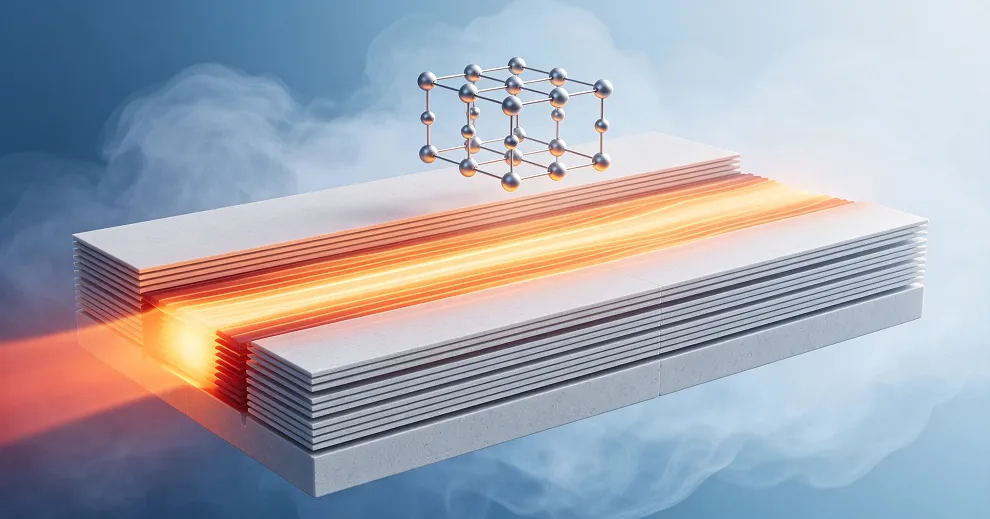
The directional thermal behavior of BN originates from its hexagonal boron nitride crystal structure, which consists of strongly bonded atomic layers stacked through weak van der Waals interactions. Within the basal plane of each layer, boron and nitrogen atoms are connected through strong covalent bonds, allowing phonons (the main carriers of heat in ceramics) to travel efficiently. However, heat transfer perpendicular to these layers is much less efficient because the interaction between layers is significantly weaker. This structural difference creates a large variation between in-plane thermal conductivity and through-thickness thermal conductivity. For semiconductor engineers, this means that the orientation of a BN component during manufacturing and installation can directly affect the thermal performance of the equipment. A component designed without considering BN anisotropy may produce unexpected temperature gradients, uneven heating, or localized thermal stress during operation.
Why Boron Nitride Has Directional Thermal Conductivity
The thermal conductivity of ceramic materials is primarily controlled by phonon movement. In metals, electrons contribute significantly to thermal transport, but in electrically insulating ceramics such as BN, heat transfer mainly occurs through lattice vibrations. The efficiency of this phonon movement depends strongly on crystal structure, defects, grain orientation, density, and manufacturing method. Hexagonal boron nitride has a crystal structure similar to graphite. Each BN layer forms a two-dimensional network where atoms are strongly bonded. Because the bonding within the layer is much stronger than the bonding between layers, heat can travel much faster along the plane of the layers than across them.
For pyrolytic boron nitride (PBN), this directional effect is especially significant because the CVD deposition process creates highly oriented layers. The deposited structure produces excellent thermal spreading in the plane of deposition while maintaining relatively low heat transfer through the thickness. This characteristic allows engineers to design components that spread heat laterally while reducing unwanted heat leakage. Hot-pressed boron nitride (HPBN) also exhibits anisotropic behavior, although the degree depends on the manufacturing process, powder characteristics, pressing conditions, and platelet orientation. During hot pressing, BN particles tend to align, creating preferential thermal pathways.
In boron nitride semiconductor manufacturing, this anisotropy allows BN components to perform multiple functions simultaneously. A component may need to distribute heat evenly across a wafer area while electrically isolating the process chamber. Another component may need to prevent excessive heat transfer to surrounding mechanical structures while maintaining dimensional stability at elevated temperatures. Therefore, the question is not simply whether BN has high thermal conductivity. The more important engineering question is: In which direction does the equipment need heat to move?
Thermal Conductivity Comparison of Different BN Materials
The following table provides representative thermal characteristics of different BN grades. Actual values vary depending on purity, density, manufacturing process, orientation, and supplier specifications.
| Material Type | Manufacturing Method | In-Plane Thermal Conductivity | Through-Thickness Thermal Conductivity | Main Thermal Characteristic |
|---|---|---|---|---|
| Hot-Pressed BN (HPBN) | Powder consolidation and hot pressing | Approximately 30–80 W/m·K | Approximately 2–30 W/m·K | Moderate anisotropy, good machinability |
| Pyrolytic BN (PBN) | Chemical vapor deposition | Approximately 50–200 W/m·K | Approximately 2–10 W/m·K | Strong anisotropy, excellent thermal direction control |
| Conventional Ceramic Insulators | Various sintering methods | Usually lower or isotropic | Similar in all directions | Limited thermal design flexibility |
| Graphite-Based Materials | Carbon processing | High along basal plane | Lower perpendicular direction | Similar layered structure |
The important engineering consideration is that the highest thermal conductivity value is not always the best solution. In semiconductor equipment, uncontrolled heat transfer can be just as problematic as insufficient heat transfer. A material that spreads heat too aggressively may reduce thermal isolation, while a material with controlled directional conduction can create a more stable thermal environment.
The Role of Anisotropy in MOCVD and CVD Equipment
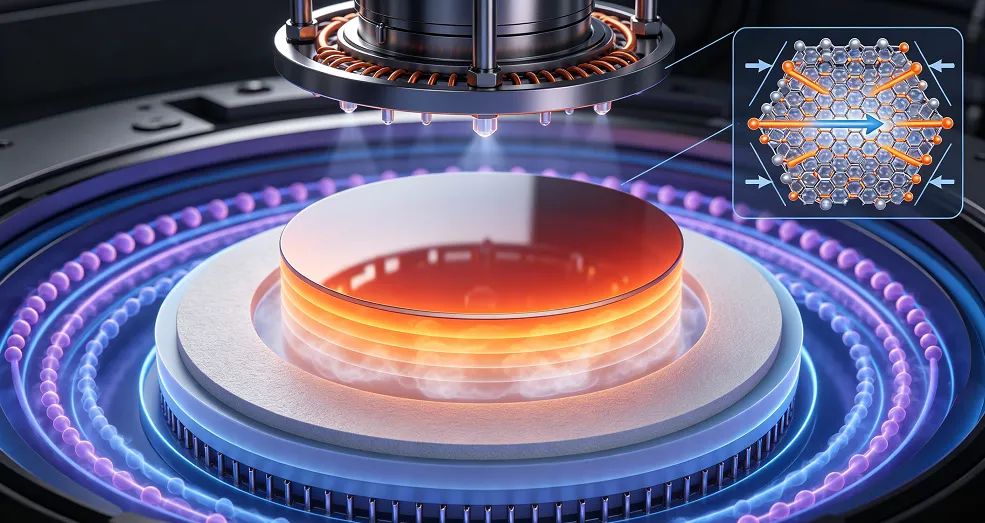
MOCVD and CVD processes require extremely precise temperature control because semiconductor film growth depends on surface reaction kinetics, precursor decomposition behavior, and gas-phase transport. Even small temperature differences across a wafer surface can influence deposition rate, crystal quality, stress distribution, and device performance. BN components used near the reaction zone must therefore manage heat in a controlled way. A PBN susceptor component, for example, may need to transfer heat efficiently across the wafer-supporting surface while limiting heat loss through the supporting structure. The anisotropic thermal conductivity of BN helps achieve this balance.
In boron nitride semiconductor manufacturing, engineers often design components according to the expected heat-flow path rather than simply selecting the material with the highest thermal conductivity. If heat needs to spread horizontally across a surface, the high in-plane conductivity of BN can be beneficial. If heat leakage toward mounting structures must be minimized, the lower through-thickness conductivity can provide thermal insulation. This principle is particularly important in vacuum semiconductor equipment. Without convection, heat transfer depends mainly on conduction and radiation. The directional thermal behavior of BN allows engineers to control conductive heat paths while maintaining high-temperature stability.
For example, a BN thermal component positioned between a heater and a wafer may be designed so that heat spreads uniformly across the wafer surface but does not excessively heat surrounding mechanical parts. This reduces thermal gradients and improves process repeatability.
Thermal Design Considerations for BN Components
When designing BN components for semiconductor equipment, engineers should consider several thermal parameters together rather than evaluating thermal conductivity alone.
| Design Parameter | Engineering Importance |
|---|---|
| In-plane thermal conductivity | Determines heat spreading capability across the component surface |
| Through-thickness thermal conductivity | Determines heat leakage through the component |
| Thermal expansion coefficient | Influences thermal stress during heating and cooling cycles |
| Density | Affects mechanical stability and thermal performance |
| Material orientation | Determines the direction of heat transfer |
| Surface condition | Influences contact thermal resistance |
| Component geometry | Controls actual heat-flow pathways |
| Operating atmosphere | Determines long-term thermal stability |
The thermal expansion coefficient of BN is another important factor. BN generally has a relatively low coefficient of thermal expansion compared with many engineering materials, which helps reduce thermal stress during repeated thermal cycling. However, because thermal conductivity and mechanical properties can be directional, engineers must consider both expansion behavior and heat-flow direction when designing assemblies. For example, a BN plate installed between two materials with significantly different thermal expansion coefficients may experience stress if the temperature changes rapidly. The orientation of the BN layers may influence how the component responds mechanically during these cycles.
How Manufacturing Method Influences BN Thermal Anisotropy
The thermal behavior of BN is strongly connected to how the material is manufactured. Different production methods create different microstructures, and these structures determine how heat moves. PBN is produced through chemical vapor deposition. During this process, BN layers are deposited atom by atom, producing a highly ordered structure. This creates strong directional thermal behavior because the deposited layers provide efficient heat conduction pathways along the deposition plane. HPBN is manufactured by pressing BN powder under high temperature. The resulting material contains oriented BN platelets, but the alignment is generally less controlled than in PBN. As a result, HPBN typically has lower anisotropy compared with PBN, while providing better bulk machinability and larger component flexibility.
| Property | PBN | HPBN |
|---|---|---|
| Manufacturing Process | CVD deposition | Hot pressing |
| Crystal Orientation Control | Very high | Moderate |
| Thermal Anisotropy | Strong | Moderate |
| Purity Level | Extremely high | Grade dependent |
| Large Complex Components | Limited | Excellent |
| Machining Capability | More limited | Excellent |
| Semiconductor Compatibility | Excellent for critical areas | Excellent for structural components |
In boron nitride semiconductor manufacturing, choosing between PBN and HPBN requires balancing thermal performance with mechanical and manufacturing requirements. PBN is often selected for highly sensitive process areas where purity and thermal direction control are critical. HPBN is frequently selected for larger fixtures, insulating structures, and components requiring machining flexibility.
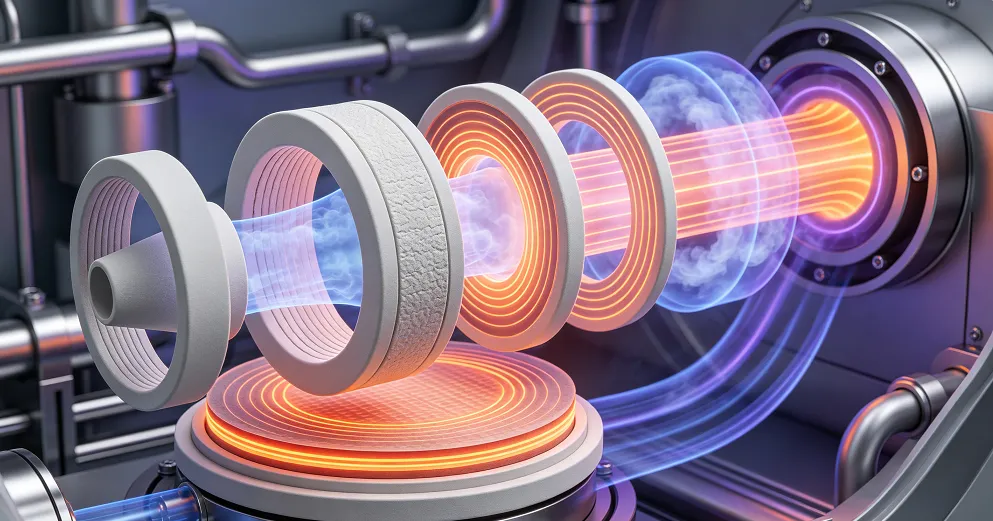
Using BN Anisotropy in Practical Semiconductor Components
The directional thermal characteristics of BN are applied in many semiconductor-related components. For example, insulating components may require electrical isolation while still controlling local heat flow. A BN electrical insulation component can prevent current leakage while allowing engineers to manage thermal gradients. Products such as Boron Nitride Gasket are often used where high-temperature sealing, electrical insulation, and chemical stability are required simultaneously. The thermal behavior of the gasket material influences how heat is distributed around the sealing interface, especially in vacuum or high-temperature equipment.
Similarly, flexible BN materials such as Boron Nitride Insulating Paper provide thermal insulation and electrical isolation in areas where rigid ceramic components are unsuitable. Because BN maintains stability at elevated temperatures, these thin insulating layers can help control localized heat transfer without introducing metallic contamination. For applications requiring separation between high-temperature surfaces, Boron Nitride Release Paper can provide a non-reactive barrier layer. Its low friction characteristics and thermal stability make it useful where components must be separated during heating processes. In all these applications, engineers must consider not only the material type but also the orientation, thickness, contact area, and expected heat-flow direction.
Thermal Management Challenges in Advanced Chip Equipment
As semiconductor manufacturing technology advances toward smaller feature sizes, higher power density, and more complex deposition processes, thermal management has become one of the most critical engineering challenges. Modern semiconductor equipment is required to maintain extremely stable temperature conditions because thermal fluctuations can directly influence film thickness uniformity, crystal quality, residual stress, and process repeatability. In these environments, boron nitride is not selected simply because it can withstand high temperatures. Many ceramic materials can survive elevated temperatures, but they cannot provide the same combination of electrical insulation, chemical stability, low thermal expansion, and directional heat control. The anisotropic thermal conductivity of BN gives engineers another degree of freedom: instead of only controlling how much heat moves, they can control the direction in which heat moves.
For example, a semiconductor heater assembly may require rapid heat distribution across a wafer surface but limited heat transfer toward mechanical support structures. Using an isotropic high-conductivity ceramic could cause excessive heat loss and increase energy consumption. By contrast, a properly oriented BN component can spread heat laterally while reducing vertical thermal leakage. This design concept is especially valuable in boron nitride semiconductor manufacturing, where process stability often depends on maintaining a carefully controlled thermal profile rather than achieving the highest possible thermal conductivity.
Thermal Direction Control in Wafer Processing Components
Wafer processing equipment contains many components that operate under complex thermal conditions. These components may include wafer carriers, thermal shields, insulation structures, support rings, process fixtures, and high-temperature spacers. Each component has a different thermal function, meaning the ideal BN orientation and grade may also be different. A wafer support component, for example, often requires uniform heat distribution across the wafer contact area. Uneven thermal transfer can create hot spots and cold regions, resulting in non-uniform deposition or inconsistent material properties.
A thermal isolation component, however, may require the opposite behavior. Its purpose is not to spread heat but to prevent heat from reaching surrounding structures. In this case, the lower through-thickness thermal conductivity of BN becomes advantageous. This difference explains why engineers cannot simply compare ceramic materials using one thermal conductivity number. A material with a thermal conductivity of 100 W/m·K is not automatically better than a material with 20 W/m·K. The correct choice depends on whether the equipment requires heat spreading, thermal isolation, or controlled heat transfer. In boron nitride semiconductor manufacturing, the directional thermal characteristics of BN allow engineers to design components with specific thermal functions rather than using a single material solution for every application.
Relationship Between BN Anisotropy and Thermal Stress
Thermal stress is another important consideration in semiconductor equipment design. When a component experiences uneven heating, different regions expand at different rates, creating internal stress. Repeated thermal cycling can eventually lead to cracking, deformation, or premature failure. Because BN has directional thermal conductivity, it can influence how quickly different areas of a component heat and cool. If the material orientation is properly selected, heat can be distributed more evenly, reducing localized temperature differences. However, incorrect orientation can also create problems. For example, if a component relies on heat spreading but is installed with poor alignment relative to the BN layers, thermal gradients may become larger than expected. Therefore, engineers should consider material orientation during both manufacturing and assembly.
| Thermal Design Factor | Effect on BN Component Performance |
|---|---|
| Layer orientation | Controls primary heat-flow direction |
| Component thickness | Determines resistance to through-thickness heat transfer |
| Contact area | Influences thermal interface resistance |
| Heating rate | Determines thermal shock loading |
| Cooling rate | Influences stress development |
| Assembly constraint | Affects expansion and deformation |
For critical semiconductor components, thermal simulation combined with experimental validation is often recommended. The anisotropic thermal conductivity values used in simulation should reflect the actual BN grade and orientation, rather than using a simplified isotropic assumption.
Why Thermal Conductivity Direction Matters in Vacuum Equipment
Vacuum semiconductor equipment presents unique thermal challenges because convection is almost eliminated. In atmospheric environments, heat can be transferred through air or gas, but in vacuum systems, conduction through solids and radiation become the dominant mechanisms. This makes material selection much more important. A ceramic component inside a vacuum chamber can significantly influence the thermal balance of the entire system. Boron nitride is particularly valuable because its thermal properties can be engineered according to the required heat-transfer pathway. A PBN component can provide controlled heat spreading while maintaining electrical insulation and chemical resistance.
For example, in high-temperature deposition equipment, a BN component may be placed between a heater and a process area. The component must allow sufficient heat transfer to maintain process temperature but prevent excessive thermal loss to the chamber structure. This balance is one reason BN materials are widely considered in advanced semiconductor systems. In boron nitride semiconductor manufacturing, thermal design is directly connected with process efficiency, equipment lifetime, and product consistency.
Comparison of BN With Other Semiconductor Ceramic Materials
Boron nitride is not the only ceramic used in semiconductor equipment. Alumina, aluminum nitride, silicon carbide, quartz, and other advanced ceramics also play important roles. However, BN has a unique combination of properties because of its anisotropic layered structure.
| Material | Thermal Conductivity | Electrical Insulation | Thermal Shock Resistance | Machinability | Typical Advantage |
|---|---|---|---|---|---|
| Boron Nitride | Directional, medium to high | Excellent | Excellent | Excellent for HPBN | Thermal direction control |
| Aluminum Nitride | High and relatively isotropic | Excellent | Good | Difficult | High heat dissipation |
| Alumina | Moderate | Excellent | Moderate | Difficult | Cost-effective insulation |
| Silicon Carbide | High | Semiconductor properties | Excellent | Difficult | Mechanical strength |
| Quartz | Low | Excellent | Moderate | Moderate | Transparency and purity |
The advantage of BN is not maximum thermal conductivity. Aluminum nitride, for example, may provide higher overall heat transfer capability. Instead, BN provides a combination of controlled thermal direction, electrical insulation, chemical stability, and excellent machinability. This makes BN especially suitable where engineers need both thermal control and manufacturing flexibility.
Engineering Guidelines for Selecting BN Components
When selecting BN components for semiconductor equipment, engineers should evaluate the material according to the actual heat-flow requirements. If the component must spread heat across a surface, a BN grade with high in-plane thermal conductivity should be considered. If the component must reduce heat transfer between two regions, the lower through-thickness conductivity may become beneficial.
The following engineering considerations should be reviewed before selecting a BN component:
| Selection Parameter | Engineering Question |
|---|---|
| Heat-flow direction | Should heat spread laterally or vertically? |
| Operating temperature | Can the BN grade maintain properties at process temperature? |
| Atmosphere | Vacuum, inert gas, nitrogen, hydrogen, or other environment? |
| Purity requirement | Is contamination control critical? |
| Mechanical load | Does the component require structural strength? |
| Dimensional tolerance | Are precision machining requirements necessary? |
| Thermal cycling | How frequently will heating and cooling occur? |
| Electrical requirement | Is insulation required? |
This evaluation method is particularly important for boron nitride semiconductor manufacturing because different components within the same piece of equipment may require completely different thermal behaviors. A crucible may prioritize purity and thermal uniformity. A gasket may prioritize sealing performance and thermal stability. An insulation layer may prioritize low heat transfer. Treating all BN components as identical can lead to inefficient designs.
Engineering Applications of BN Directional Thermal Properties
The anisotropic thermal behavior of BN enables several practical applications in semiconductor and high-temperature equipment. A BN thermal spacer can reduce unwanted heat transfer while maintaining electrical insulation. A BN gasket can provide sealing performance under high-temperature conditions while controlling local heat flow. Flexible BN insulation materials can protect sensitive components from excessive thermal exposure. For example, Boron Nitride Gasket components are often considered for applications requiring stable performance under high temperature, vacuum, and chemically demanding environments. The gasket’s thermal behavior affects the temperature distribution around the sealing area, which can influence long-term reliability.
Boron Nitride Insulating Paper provides another approach by creating a thin thermal barrier where rigid ceramics are unsuitable. Its flexibility allows engineers to adapt insulation according to complex equipment geometries while maintaining BN’s chemical and thermal advantages. For separation and protection applications, Boron Nitride Release Paper can act as a non-reactive interface layer between high-temperature materials. This reduces sticking, improves component handling, and helps protect surfaces during thermal processing. These examples demonstrate that BN anisotropy is not merely a material characteristic. It is an engineering tool that allows designers to control heat flow at the component level.
Company Profile
JianXun Technology Co., Ltd. specializes in finished advanced ceramic components for semiconductor, high-temperature, thermal-processing, and electrical-insulation applications. The company provides Boron Nitride, Alumina, and Silicon Carbide ceramic products, including customized components manufactured according to technical requirements, drawings, and application conditions.
JianXun focuses on providing reliable ceramic solutions with controlled thermal properties, electrical insulation performance, chemical stability, and dimensional accuracy for demanding industrial applications.
Payment Terms: T/T, PayPal, Credit Card, Western Union, or other agreed payment methods.
Shipment Terms: Products can be shipped by express, air freight, or sea freight according to product dimensions, quantity, and customer requirements.
Storage Conditions: Store ceramic components in a clean and dry environment. Keep products in protective packaging until installation to avoid contamination, moisture, and mechanical damage.
FAQs
Q1: Why does boron nitride have different thermal conductivity in different directions?
The directional thermal conductivity of boron nitride comes from its hexagonal layered crystal structure. Within each BN layer, boron and nitrogen atoms are connected through strong covalent bonds, allowing phonons to transfer heat efficiently along the plane. However, the bonding between individual layers is much weaker, which reduces heat transfer perpendicular to the layers. This creates a significant difference between in-plane and through-thickness thermal conductivity. In boron nitride semiconductor manufacturing, engineers use this anisotropic behavior to design components that either spread heat across a surface or limit heat transfer through a structure. The thermal direction of the BN component must therefore be considered during material selection, machining, and assembly.
Q2: Is higher thermal conductivity always better for semiconductor equipment?
No. Higher thermal conductivity is not always the optimal solution because semiconductor equipment often requires controlled heat distribution rather than maximum heat removal. A component with extremely high thermal conductivity may transfer heat away too quickly and disturb the intended temperature profile. BN is valuable because its anisotropic structure allows engineers to manage heat directionally. For example, a BN component can spread heat uniformly across a wafer-support surface while reducing heat loss through the mounting direction. In boron nitride semiconductor manufacturing, thermal uniformity, temperature stability, and process repeatability are often more important than achieving the highest possible thermal conductivity value.
Q3: How does PBN anisotropy differ from HPBN anisotropy?
PBN generally exhibits stronger anisotropic thermal behavior because its CVD manufacturing process produces highly oriented BN layers. Heat transfer along the deposition plane can be significantly higher than through the thickness. HPBN also shows anisotropic characteristics because hot pressing aligns BN platelets, but the orientation is usually less controlled. Therefore, PBN is often selected for applications where precise thermal direction control and high purity are required, while HPBN is preferred when machining flexibility, larger geometries, and structural performance are more important. For boron nitride semiconductor manufacturing, the selection between PBN and HPBN should consider thermal design requirements together with mechanical and manufacturing factors.
Q4: How should engineers consider BN anisotropy when designing semiconductor components?
Engineers should define the expected heat-flow direction before selecting the BN material and component orientation. The design should consider whether heat needs to spread across the surface, transfer through the thickness, or remain isolated from surrounding structures. Thermal conductivity data should be applied according to the actual orientation of the component rather than using a single isotropic value. In addition, thermal expansion, mechanical loading, operating atmosphere, and thermal cycling should be included in the design evaluation. In boron nitride semiconductor manufacturing, ignoring anisotropy during simulation or component installation can lead to inaccurate thermal predictions and reduced equipment performance.
Q5: Can BN products such as gaskets and insulation papers benefit from anisotropic thermal properties?
Yes. Although BN gaskets, insulating papers, and release materials are often selected for electrical insulation, chemical stability, and high-temperature resistance, their directional thermal behavior can also influence equipment performance. A Boron Nitride Gasket can help control heat transfer around sealing interfaces, while Boron Nitride Insulating Paper can provide localized thermal protection in areas where rigid ceramic insulation is impractical. Boron Nitride Release Paper can create a stable thermal barrier between high-temperature surfaces while preventing unwanted adhesion. For engineers designing semiconductor equipment, understanding these thermal characteristics helps optimize both component reliability and process stability.