Advanced Technical Ceramics, Precision Alumina, Silicon Carbide, Crucible Parts
 Technology Co., Ltd.(Luoyang) Technology Co., Ltd.科技品牌标志.webp)


How to Choose Between Aluminum Nitride and Alumina Ceramics for High-Performance Thermal Applications
1. Why Ceramic Material Selection Matters in Thermal Management
As electronic devices become more compact and power densities increase, effective thermal management has become a critical consideration in industrial equipment, semiconductor manufacturing, power electronics, and precision instrumentation. Excessive heat can reduce component efficiency, accelerate material degradation, and shorten the service life of an entire assembly. Therefore, selecting the right ceramic material is essential for maintaining stable operating conditions and reliable performance.
Aluminum Nitride (AlN) and Alumina Ceramics (Al₂O₃) are two widely used materials for applications requiring electrical insulation and thermal stability. However, their thermal properties, manufacturing requirements, and procurement costs differ considerably. Aluminum nitride is particularly attractive when high thermal conductivity is required without sacrificing electrical insulation. Alumina, on the other hand, offers a practical balance of insulation performance, mechanical stability, established manufacturing processes, and material cost.
So, which material should you choose for your thermal management application? The answer depends on heat generation, allowable temperature rise, component geometry, operating conditions, and budget. This guide compares both materials from engineering and procurement perspectives, helping you identify the most suitable option for your application.
2. Aluminum Nitride vs. Alumina: Understanding the Key Material Differences
Before comparing individual applications, it is important to understand how these two technical ceramics differ in composition and performance.
Aluminum nitride is a non-oxide ceramic known for its high thermal conductivity and relatively low coefficient of thermal expansion. It is frequently considered for power semiconductor substrates, electronic packages, ceramic heaters, and other components that must transfer heat efficiently while maintaining electrical isolation.
Alumina, or aluminum oxide, is an oxide ceramic available in several purity grades, including 95%, 99%, and 99.5%. It provides reliable electrical insulation, good hardness, chemical stability, and a well-established manufacturing supply chain. Its properties vary with purity, additives, microstructure, and processing conditions.
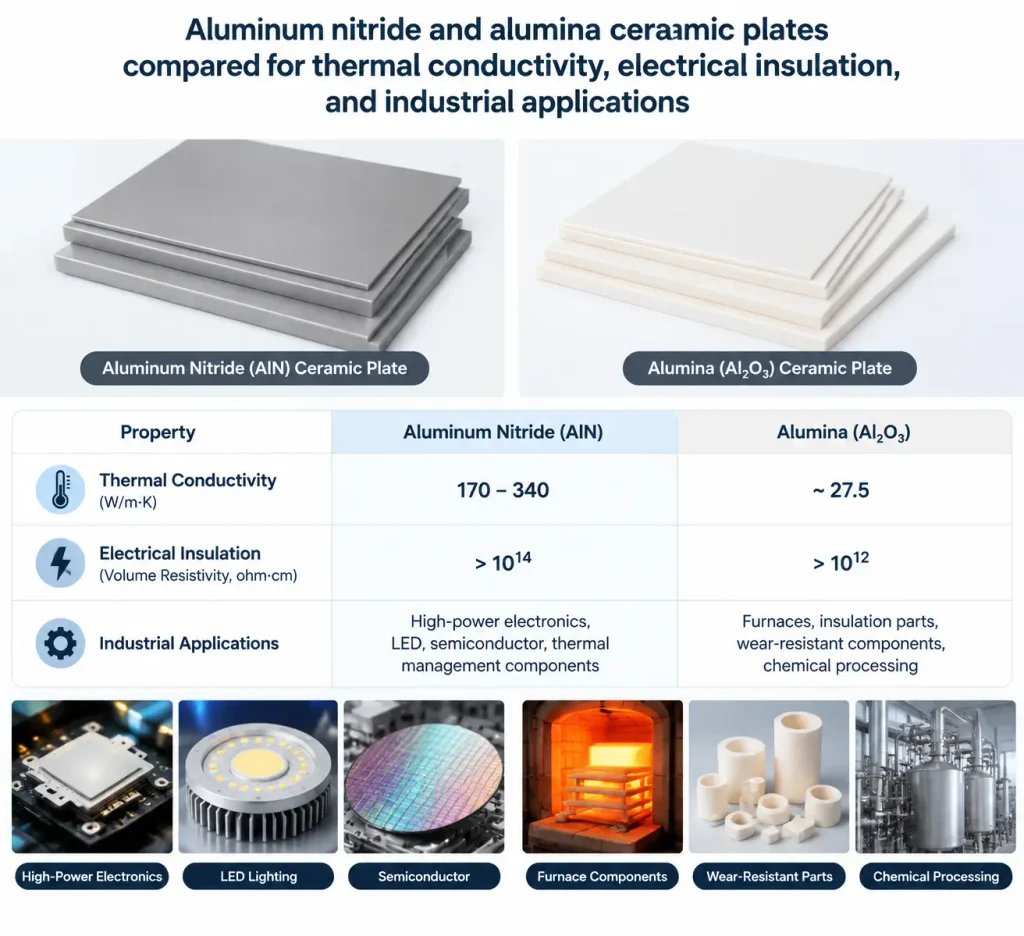
Key Properties Comparison
| Property | Aluminum Nitride (AlN) | Alumina Ceramics (Al₂O₃) |
| Typical thermal conductivity | Approximately 140–230 W/(m·K) | Approximately 20–35 W/(m·K) |
| Coefficient of thermal expansion | Approximately 4.0–5.0 × 10⁻⁶/K | Approximately 6.5–8.5 × 10⁻⁶/K |
| Electrical insulation | Excellent | Excellent |
| Typical material cost | Higher | Lower |
| Common purity specification | High-purity grades available | Commonly 95%, 99%, and 99.5% |
| Main thermal advantage | High heat-transfer capability | Cost-effective thermal and electrical insulation |
| Typical applications | Power modules, ceramic substrates, electronic heaters | Insulators, ceramic substrates, structural components |
| Manufacturing considerations | Processing atmosphere, machining, and moisture-related handling require attention | Established forming and sintering routes, with precision grinding available |
Note: These figures are indicative screening ranges, not guaranteed specifications. Actual values depend on the material grade, manufacturing process, test method, and supplier data sheet.
The most significant difference is thermal conductivity. Aluminum nitride generally transfers heat several times more effectively than conventional alumina grades. Nevertheless, this does not automatically make it the better choice for every component.
The thermal performance of a finished assembly also depends on ceramic thickness, heat-transfer area, mounting interfaces, metallization, and cooling conditions. Consequently, engineers should evaluate the complete thermal path rather than selecting a material based on one property alone.
3. When to Choose Aluminum Nitride Ceramics for High-Performance Thermal Applications
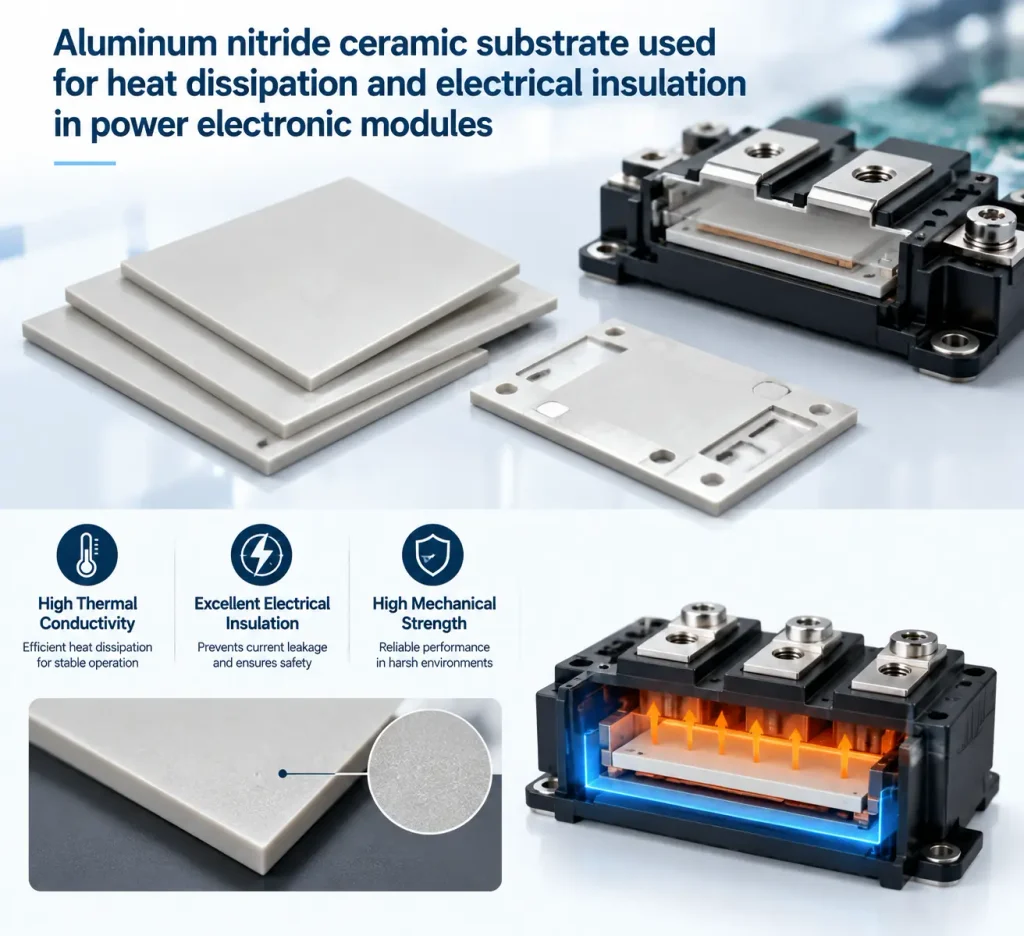
Aluminum nitride is a strong candidate when a component must dissipate significant heat while remaining electrically insulating. Its combination of thermal conductivity and electrical properties makes it particularly valuable in high-performance electronic systems.
Power Electronics and Semiconductor Modules
Power semiconductor devices generate heat during operation. If this heat cannot be removed efficiently, junction temperatures may exceed the design limit, affecting electrical performance and long-term reliability.
Aluminum nitride ceramic substrates can provide an effective thermal path between semiconductor devices and cooling structures. They are often considered for power modules, including designs using silicon carbide (SiC) or other high-power semiconductor technologies.
In these applications, engineers should assess thermal resistance, substrate thickness, dielectric requirements, bonding methods, and thermal cycling performance before finalizing the material specification.
High-Power LED and Laser Packages
High-power LEDs and laser diodes can generate concentrated heat within a relatively small area. Aluminum nitride may help spread this heat while electrically isolating the active device from other conductive components.
Its relatively low thermal expansion coefficient can also be advantageous when the substrate must work alongside silicon-based components or other materials with relatively low thermal expansion.
Ceramic Heaters and Semiconductor Processing Equipment
Aluminum nitride is also used in selected ceramic heaters and thermal-control components. Depending on the design, the ceramic body may support heating elements, electrical insulation, and heat transfer.
For these applications, the appropriate grade must be selected according to operating temperature, atmosphere, thermal uniformity, electrical requirements, and component construction. The suitability of aluminum nitride should not be inferred from thermal conductivity alone.
When Is Aluminum Nitride Worth the Higher Cost?
Aluminum nitride is most attractive when the thermal requirements cannot be met comfortably by a lower-cost material. Before specifying it, engineers should determine whether its higher conductivity will produce a meaningful improvement in operating temperature, component size, or system reliability. If interface resistance or inadequate cooling is the dominant limitation, changing the ceramic material alone may deliver less improvement than expected.
4. When Alumina Ceramics Are the More Practical Choice
Although alumina has lower thermal conductivity than aluminum nitride, it remains an important material for industrial thermal management. Its combination of electrical insulation, hardness, chemical stability, and established processing methods makes it suitable for a broad range of applications.
Electrical Insulators and Structural Supports
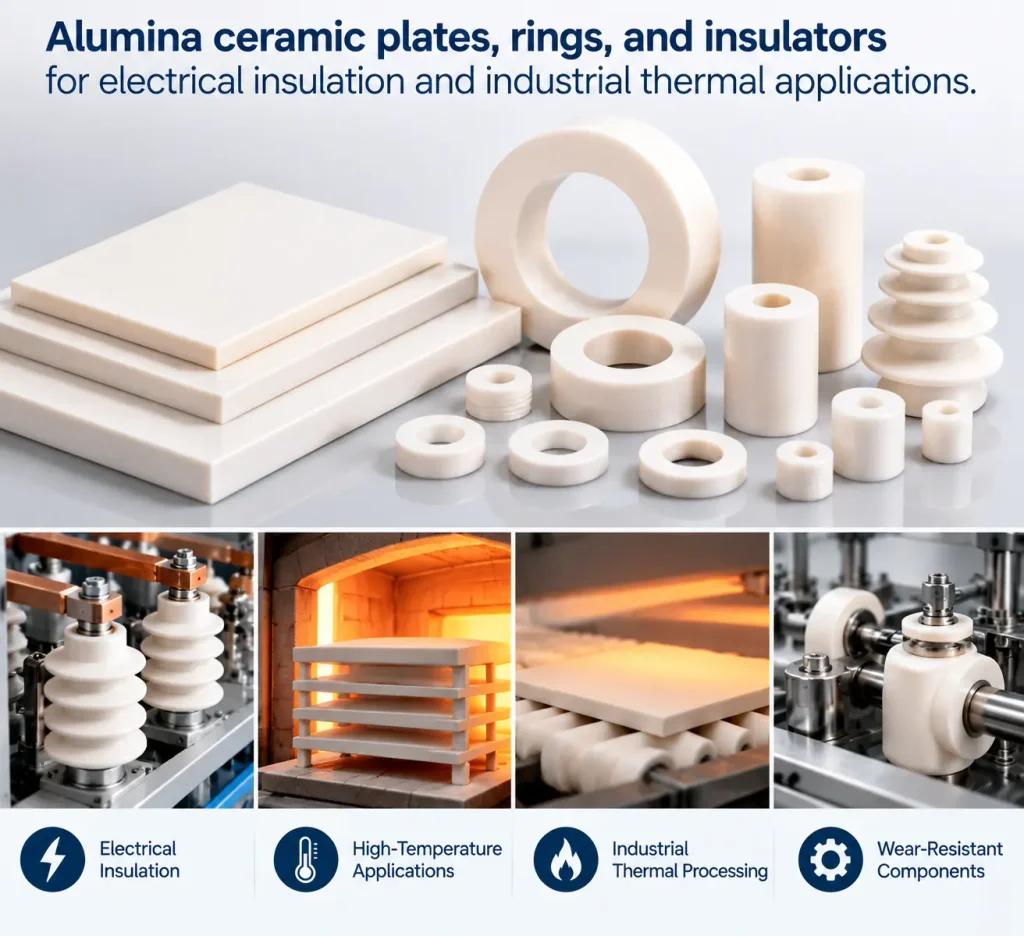
Alumina is commonly used for insulating plates, spacers, rings, tubes, supports, and other components that must maintain electrical separation while withstanding mechanical and thermal demands.
When the thermal load is moderate, the material may provide sufficient heat-transfer performance without the additional expense associated with aluminum nitride.
Ceramic Substrates and Electronic Components
Alumina substrates are used in electronic circuits, sensors, and various electrical assemblies. They offer a mature manufacturing ecosystem and can be suitable for applications where the required thermal performance can be achieved with a conventional ceramic substrate.
The choice between 95%, 99%, and 99.5% alumina should consider dielectric requirements, mechanical performance, surface finish, contamination limits, and the properties specified for the intended application. Higher purity should not be treated as an automatic guarantee of superior performance in every category.
Ceramic Casting and Custom Components
For complex shapes, alumina casting may be considered as part of the forming process. Ceramic slip casting, for example, uses a ceramic suspension introduced into a suitable mold before drying and subsequent firing. Other applications may be better suited to pressing, extrusion, injection molding, or machining from existing stock.
The appropriate process depends on component geometry, wall thickness, production volume, dimensional requirements, and the capabilities of the manufacturer. Casting does not eliminate the need to control shrinkage, porosity, and dimensional variation during drying and sintering.
When Is Alumina the Better Business Decision?
Alumina is often the more practical option when:
- The design can tolerate its lower thermal conductivity.
- Electrical insulation and mechanical stability are the primary requirements.
- Budget and production volume are important purchasing considerations.
- Established manufacturing processes can meet the required dimensions and quality standards.
In short, the objective is not to select the most thermally conductive ceramic available. It is to select the material that meets the engineering requirements at an appropriate total cost.
5. Thermal Conductivity and Thermal Resistance
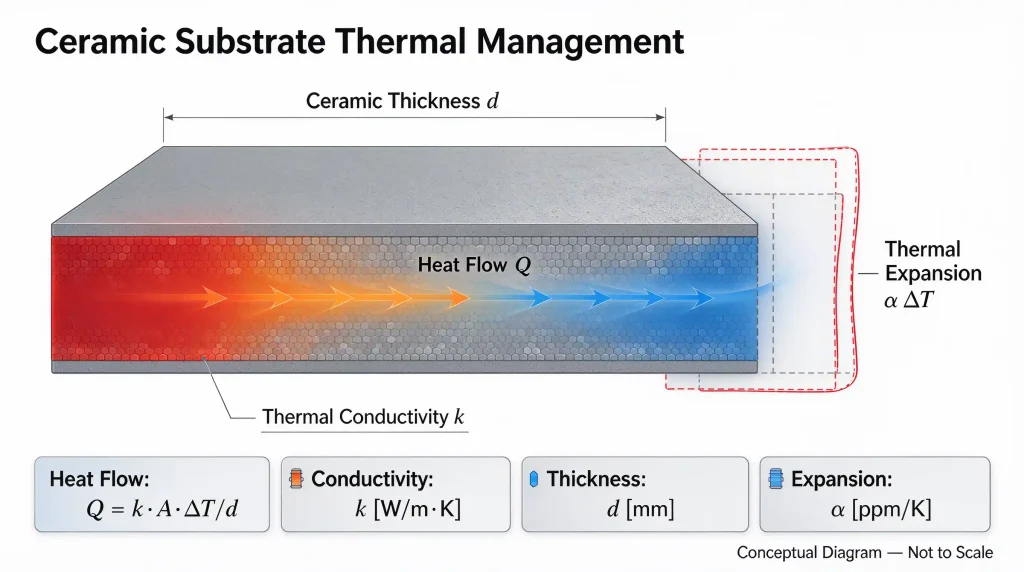
Thermal conductivity indicates how readily heat moves through a material. However, the thermal resistance of a simple, uniform ceramic layer also depends on its thickness and effective heat-transfer area. For one-dimensional heat conduction through a flat layer, the approximate relationship is:
R = t / (k × A)
Where:
- R is thermal resistance in K/W.
- t is the ceramic thickness in meters.
- k is thermal conductivity in W/(m·K).
- A is the effective heat-transfer area in square meters.
A thinner layer, larger heat-transfer area, or higher thermal conductivity can reduce the layer’s thermal resistance, assuming other conditions remain unchanged. However, this calculation does not include interface resistance, heat spreading, metallization, or cooling limitations. A complete design should account for these additional factors.
Coefficient of Thermal Expansion
The coefficient of thermal expansion (CTE) describes how a material changes dimension as its temperature changes. When ceramic substrates are joined to metals, semiconductor dies, or other structural materials, differences in CTE can create mechanical stress during heating and cooling. Aluminum nitride’s relatively low CTE can be advantageous in some semiconductor packaging applications.
Nevertheless, the appropriate choice depends on the complete material stack, bonding process, component geometry, and expected thermal cycling. CTE matching alone cannot guarantee long-term reliability.
Electrical Insulation and Dielectric Requirements
Both aluminum nitride and alumina can provide electrical insulation. The required dielectric strength, operating voltage, insulation thickness, surface condition, and environmental exposure should be specified for the actual design. Engineers should also consider creepage distance, clearance, electrode configuration, and applicable electrical safety requirements where relevant.
Operating Temperature and Thermal Cycling
Maximum service temperature is not a single universal value for either material. Oxidizing or inert atmospheres, mechanical loading, thermal gradients, metallization, and joining materials can all affect the usable operating range. Repeated thermal cycling may also produce stresses that eventually lead to cracking or interface failure. Therefore, qualification should reflect the intended temperature range, ramp rates, dwell times, and number of cycles.
6. Manufacturing, Customization, and Quality Requirements
Material selection and manufacturing feasibility should be evaluated together. Even a suitable ceramic grade may fail to meet the application requirements if the finished component cannot achieve the necessary dimensions, surface quality, or batch consistency.
Precision Machining and Dimensional Tolerances
Technical ceramic components are often formed and sintered before final machining. Grinding, lapping, drilling, and other finishing operations may be required to achieve the specified dimensions.
When preparing a drawing, buyers should identify critical dimensions, flatness, parallelism, surface roughness, hole locations, edge conditions, and inspection requirements. Tolerances should reflect functional needs rather than being tightened unnecessarily, because demanding tolerances can increase machining time, inspection effort, scrap risk, and cost.
Material Grade and Process Control
For aluminum nitride, processing quality can influence thermal conductivity and other material properties. Buyers should specify the required grade and request relevant technical data rather than assuming that every AlN product has the same thermal performance.
For alumina, purity, additives, density, and microstructure can affect electrical, mechanical, and thermal behavior. The material specification should match the application’s requirements instead of relying on a generic description such as high-purity alumina.
Sample Validation and Batch Consistency
Before approving a production order, consider requesting:
- A material data sheet with relevant properties and test conditions.
- Dimensional inspection results for critical features
- Surface finish and flatness measurements where required.
- Applicable material or batch inspection certificates.
- Sample testing under representative operating conditions.
For demanding applications, qualification should include the finished component or assembly wherever practical. A material coupon alone may not reproduce the effects of metallization, joining, mounting, or thermal cycling.
7. Cost vs. Performance: How to Make the Right Procurement Decision
The purchase price is important, but it does not represent the complete cost of a ceramic component. Material selection should account for manufacturing, inspection, delivery, expected service life, and the consequences of failure.
Understanding Alumina Price per kg
Buyers researching alumina price per kg should first distinguish between industrial alumina powder and finished alumina ceramic components. Raw powder prices depend on purity, particle size, chemical composition, order volume, and market conditions. Finished ceramic prices include additional costs associated with forming, sintering, machining, inspection, packaging, and production yield.
Therefore, there is no single price per kilogram that reliably represents all alumina ceramic products. A precision-ground 99.5% alumina component may have a very different unit cost from a simple component made from a lower-purity grade, even if their weights are similar. For custom parts, the most useful quotation is based on the drawing, material grade, tolerance requirements, order quantity, and inspection scope.
Evaluating the Total Cost of Ownership
A useful procurement comparison should include:
| Cost Factor | What Buyers Should Evaluate |
| Material | Grade, purity, required thermal properties |
| Manufacturing | Forming, sintering, machining, and finishing |
| Quality control | Inspection scope, documentation, and testing |
| Delivery | Lead time, packaging, freight, and inventory needs |
| Service life | Wear, thermal cycling, and replacement frequency |
| Failure risk | Downtime, maintenance, and potential equipment damage |
Aluminum nitride may justify its higher initial cost when its thermal performance addresses a critical design limitation. Alumina may provide better overall value when it meets the requirements with adequate margin. A practical decision should therefore compare the cost of qualified, usable components—not just the quoted price of raw materials.
8. How to Select a Reliable Aluminum Nitride or Alumina Ceramic Supplier
A capable supplier should do more than provide a material quotation. The supplier should understand the intended application and help translate engineering requirements into a manufacturable specification.
Technical Capability and Documentation
Check whether the manufacturer can supply the required ceramic grade, component geometry, machining accuracy, surface finish, and inspection documentation. Ask for evidence that the stated thermal properties apply to the proposed material grade. For custom components, drawing review and manufacturability feedback are especially valuable. Early communication can identify unrealistic tolerances, unnecessary finishing operations, or design features that increase cost.
Production Capacity and Delivery Reliability
Lead time may depend on raw material availability, forming methods, sintering schedules, tooling, machining workload, and inspection requirements. Buyers should confirm realistic sample and production schedules instead of relying on general lead-time estimates. For recurring orders, consider how the supplier manages batch identification, specification changes, production records, and repeat-order consistency.
Preparing an Effective RFQ
To obtain a meaningful quotation, provide:
- Material preference or required performance specifications.
- Product drawings and critical dimensions.
- Operating temperature, thermal load, and working environment.
- Electrical insulation requirements, where applicable.
- Surface finish, tolerances, and testing requirements.
- Estimated quantity and expected annual demand.
If the material has not yet been finalized, explain the thermal and electrical requirements and ask the supplier to assess both aluminum nitride and alumina options.
9. Jenson(Luoyang) Technology Co., Ltd.
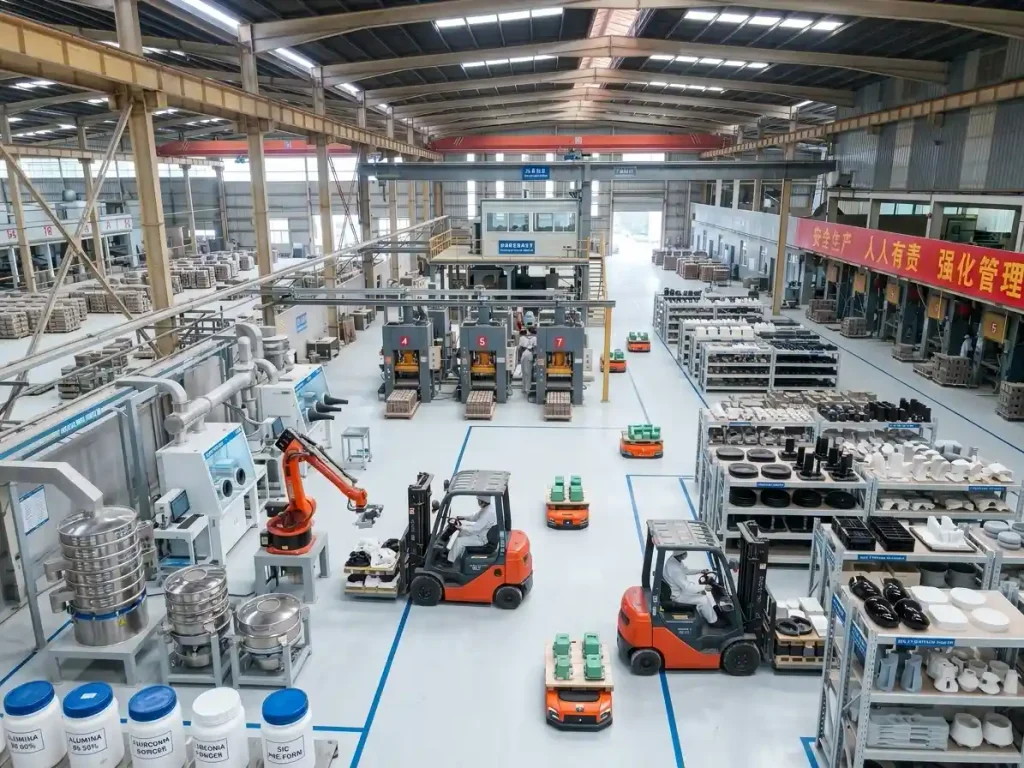
Jenson(Luoyang) Technology Co., Ltd. specializes in the manufacturing and supply of finished advanced ceramic components, including Boron Nitride, Alumina, and Silicon Carbide products for semiconductor equipment, high-temperature processing, thermal management, and electrical insulation applications.
With engineering-focused manufacturing capabilities, Jenson(Luoyang) Technology Co., Ltd. provides customized ceramic solutions according to customer drawings, material requirements, operating conditions, and performance specifications. The company focuses on delivering reliable ceramic components with controlled purity, stable thermal properties, precision dimensions, and excellent chemical resistance.
Jenson supports applications requiring customized BN components such as insulating parts, thermal fixtures, protection components, and semiconductor-related ceramic structures. Through material selection, precision machining, quality inspection, and customized production processes, Jenson aims to provide advanced ceramic solutions for demanding industrial environments.
10. FAQs: Aluminum Nitride vs. Alumina Ceramics
Q1: Is aluminum nitride more thermally conductive than alumina?
Yes. Aluminum nitride (AlN) generally offers significantly higher thermal conductivity than conventional alumina ceramics (Al₂O₃). Depending on the grade, aluminum nitride may achieve thermal conductivity of approximately 140–230 W/(m·K), while many alumina grades typically fall within 20–35 W/(m·K). Actual values depend on purity, microstructure, manufacturing processes, and measurement conditions. This difference makes aluminum nitride particularly suitable for power electronic substrates, semiconductor packages, and other components that must transfer heat efficiently while maintaining electrical insulation. Alumina, however, remains a practical choice for applications where moderate heat transfer is sufficient, and cost control is important.
When comparing materials, engineers should consider more than thermal conductivity alone. Ceramic thickness, contact resistance, mounting conditions, and cooling design also affect overall heat dissipation. Reviewing the complete thermal path can help determine whether aluminum nitride provides a meaningful performance improvement over alumina.
Q2: Is aluminum nitride worth the higher material cost?
Aluminum nitride can justify its higher initial cost when thermal management is a critical performance requirement. Its high thermal conductivity may help reduce temperature differences across a ceramic substrate, improve heat transfer from electronic devices, and support more compact component designs.
However, the value of aluminum nitride depends on the application. If the heat load is relatively low or the system already meets its thermal requirements with alumina, upgrading to aluminum nitride may not deliver enough additional benefit to justify the expense. For procurement teams, the decision should consider total cost of ownership rather than material price alone. Relevant factors include component manufacturing costs, machining requirements, inspection, expected service life, maintenance, and the consequences of thermal failure.
A practical approach is to compare both materials against the same engineering specification. Thermal calculations and prototype testing can help establish whether the performance improvement justifies the additional investment.
Q3: Which ceramic is better for electrical insulation and heat dissipation?
Both aluminum nitride and alumina provide electrical insulation, but their thermal performance differs considerably. Aluminum nitride is often preferred when efficient heat transfer and electrical isolation must be achieved simultaneously. Alumina is widely used when dependable insulation, mechanical stability, and reasonable material cost are the primary considerations. For example, an aluminum nitride substrate may be appropriate for a high-power electronic module where heat must pass efficiently from the semiconductor device to a cooling structure. Alumina may be sufficient for insulating supports, terminal blocks, sensor components, and electronic substrates operating under less demanding thermal conditions.
The final choice should be based on the required dielectric strength, operating voltage, thermal conductivity, component geometry, and service environment. Engineers should also consider creepage distance, electrical clearances, surface contamination, and the insulation requirements of the complete assembly. Neither material should be selected solely because it has a favorable thermal conductivity or dielectric property listed on a data sheet. The finished component must satisfy both electrical and thermal requirements under actual operating conditions.
Q4: Can alumina replace aluminum nitride in thermal management applications?
In some applications, yes. Alumina can replace aluminum nitride when the system can maintain acceptable operating temperatures and reliability using alumina’s lower thermal conductivity. Such a substitution may reduce material costs and provide access to established manufacturing processes.
Before making the change, engineers should assess the heat generated by the component, the available heat-transfer area, ceramic thickness, interface materials, and cooling capacity. A thermal simulation or comparative prototype test can help determine whether alumina provides sufficient performance margin. The substitution also requires attention to thermal expansion, dielectric performance, mechanical loading, and the manufacturing tolerances of the finished component. Changes in ceramic thickness or assembly geometry may affect thermal resistance even when the replacement material meets the basic electrical requirements.
For procurement teams, material substitution should be formally reviewed and documented. Samples should be validated against the original design requirements before the alternative material is approved for production. If thermal performance is already close to the design limit, replacing aluminum nitride with alumina without testing may introduce unnecessary reliability risks.
Q5: How do operating temperature and thermal cycling affect material selection?
Operating temperature and thermal cycling can significantly influence the performance and service life of ceramic components. Both aluminum nitride and alumina can be used in demanding thermal environments, but their suitability depends on the material grade, surrounding atmosphere, mechanical stress, and component design.
During repeated heating and cooling, differences in the coefficient of thermal expansion between a ceramic and adjacent materials can generate stress. These stresses may contribute to cracking, interfacial separation, or changes in assembly reliability, particularly when temperature gradients are steep or the component is constrained. Aluminum nitride’s relatively low coefficient of thermal expansion can be advantageous in selected semiconductor packaging designs. Alumina may also perform reliably when the surrounding materials, geometry, and operating conditions are appropriately matched.
Engineers should specify the normal and maximum operating temperatures, heating and cooling rates, dwell times, cycle frequency, and expected service life. The atmosphere must also be considered because oxidation, chemical exposure, or interactions with joining materials can influence the performance of the complete assembly. For critical applications, qualification testing should reproduce representative thermal cycling and mechanical conditions instead of relying only on a nominal maximum-temperature rating.
Q6: What information should buyers provide when requesting a custom ceramic component?
A complete request for quotation (RFQ) helps suppliers evaluate technical feasibility, estimate manufacturing costs, and provide realistic delivery schedules. Missing specifications can lead to inaccurate quotations, unnecessary revisions, or differences between the delivered component and the buyer’s expectations.
At a minimum, buyers should provide the following information:
- Material requirements: Aluminum nitride, alumina, or the required performance characteristics if the material has not yet been selected.
- Technical drawings: Dimensions, thickness, hole locations, critical tolerances, flatness, and other functional features.
- Thermal conditions: Operating temperature, heat load, temperature gradients, and expected thermal cycling.
- Electrical requirements: Operating voltage, dielectric performance, insulation thickness, and relevant safety requirements.
- Surface specifications: Surface roughness, polishing requirements, metallization, or other finishing processes.
- Quantity and delivery: Prototype quantity, production volume, annual demand, and target delivery date.
- Quality documentation: Inspection reports, material certificates, traceability, and any customer-specific acceptance criteria.
If the engineering team is unsure which ceramic is most suitable, the RFQ should describe the actual operating conditions and performance targets. A capable technical ceramic supplier can then compare feasible material options and explain the trade-offs among thermal performance, manufacturability, cost, and lead time.
RELATED POSTS
How to Custom Manufacture Boron Nitride Insulator Rings, Gas Nozzles, and Wafer Chuck Parts?

What Properties Make Boron Nitride Suitable for Semiconductor Manufacturing?

Why Silicon Carbide Ceramics Are Essential for Semiconductor Wafer Processing Equipment
What Are the Applications of Silicon Nitride Ceramics in EV Drive Systems and High-Temperature Mechanical Systems?
How Do You Select the Right Silicon Carbide Nozzle for Abrasive and Corrosive Environments?