Advanced Technical Ceramics, Precision Alumina, Silicon Carbide, Crucible Parts
 Technology Co., Ltd.(Luoyang) Technology Co., Ltd.科技品牌标志.webp)


How Silicon Carbide Kiln Furniture Improves Energy Efficiency and Reduces Firing Costs
1. Why Energy Efficiency Matters in Industrial Ceramic Firing
Energy efficiency has become an important consideration for manufacturers operating high-temperature industrial kilns. In ceramic production, a significant amount of energy is required not only to heat the products but also to raise the temperature of kiln furniture, refractory structures, and other internal components. As energy costs and production requirements continue to change, manufacturers are looking for practical ways to improve thermal efficiency without compromising product quality or production reliability.
One effective approach is to improve the design and material selection of kiln furniture. Conventional refractory shelves and supporting components can contribute considerable thermal mass to a kiln, especially when multiple layers of furniture are used during each firing cycle. This additional mass requires energy during heating and may influence the overall thermal response of the system.
Silicon Carbide kiln furniture provides an advanced ceramic solution for many demanding industrial firing applications. Its combination of high-temperature mechanical strength, relatively high thermal conductivity, and good thermal shock resistance allows manufacturers to design durable supporting structures with optimized dimensions and weight. When properly applied, these characteristics can help reduce the energy required to heat kiln furniture, improve loading efficiency, and limit maintenance-related expenses. However, the benefits depend on the operating temperature, kiln atmosphere, product load, firing cycle, and selected ceramic grade. Understanding these factors is essential when evaluating the long-term performance and economic value of silicon carbide kiln furniture.
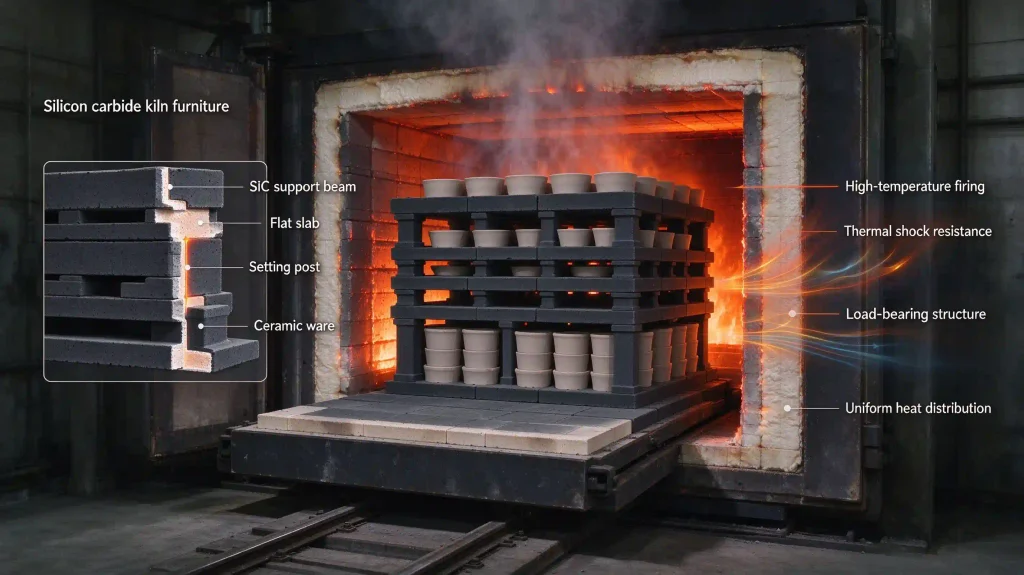
2. What Is Silicon Carbide Kiln Furniture and Where Is It Used?
Kiln furniture refers to the refractory components used to support, separate, position, or transport products during thermal processing. These components operate directly in the kiln environment and must maintain sufficient mechanical strength and dimensional stability under elevated temperatures, repeated thermal cycling, and prolonged mechanical loading.
Silicon carbide is an advanced technical ceramic composed of silicon and carbon atoms in a strongly bonded crystal structure. Its chemical formula is SiC, and it is widely recognized for its hardness, thermal conductivity, wear resistance, and high-temperature performance. Although the phrase silicon carbon sometimes appears in online material searches, silicon carbide is the correct industrial name for this ceramic material. The term SiC compound refers to the chemical combination of silicon and carbon rather than a simple physical mixture of the two elements.
In kiln furniture applications, these material characteristics provide practical engineering advantages. High thermal conductivity helps distribute heat through ceramic components, while high-temperature mechanical strength allows appropriately designed shelves and supports to carry loads without excessive deformation. Good thermal shock resistance also improves suitability for operations involving repeated heating and cooling.
Common Types of Silicon Carbide Kiln Furniture
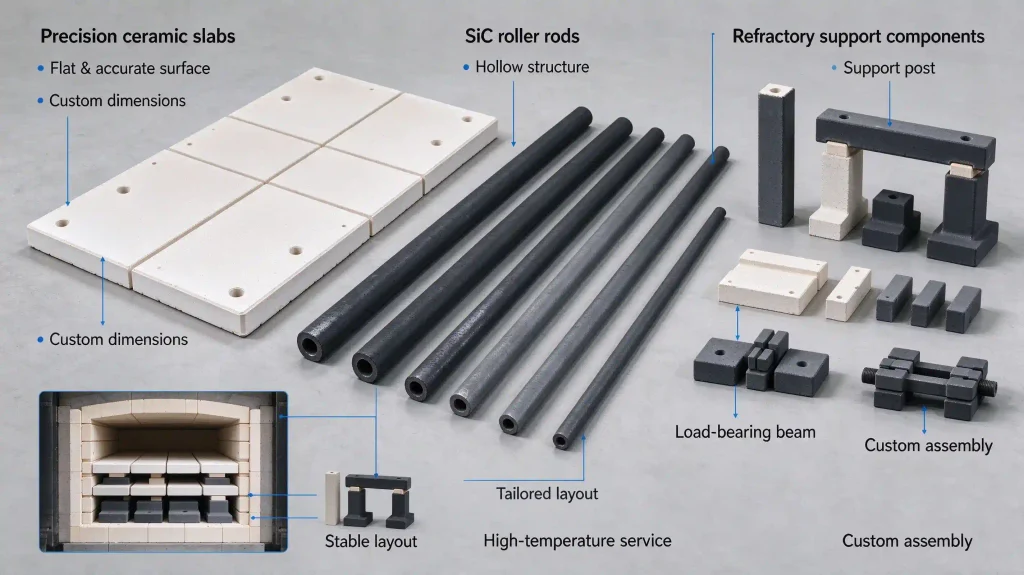
Industrial kiln furniture includes flat shelves, structural slabs, supporting beams, refractory bricks, and roller rods. Kiln furniture slabs provide stable surfaces for products during firing, while roller rods support continuous movement through roller-hearth kilns. Refractory bricks and supporting structures are used in selected areas where mechanical strength, temperature resistance, and compatibility with the kiln environment are important.
The geometry of each component influences its performance. For example, a shelf must provide sufficient bending resistance over its supporting span, whereas a roller rod must maintain straightness and rotational stability while carrying a moving load. Consequently, different components may require different silicon carbide grades and manufacturing methods.
Typical Industrial Applications
Silicon carbide kiln furniture is widely associated with sanitary ware, tableware, technical ceramics, porcelain, and selected ceramic tile production processes. It is also used in certain industrial heat-treatment operations where refractory components must maintain reliable performance over repeated operating cycles. The suitability of a particular design depends on more than its nominal temperature resistance. Manufacturers must also consider chemical exposure, product weight, heating rates, support arrangements, and the expected service life of the component.
3. How Does Silicon Carbide Kiln Furniture Improve Energy Efficiency?
The energy efficiency of an industrial kiln is influenced by several interacting factors, including insulation, heat recovery, combustion or electrical heating efficiency, product loading, and the thermal mass of internal components. While kiln furniture is only one part of this system, its material properties and structural design can affect the amount of energy required during firing.
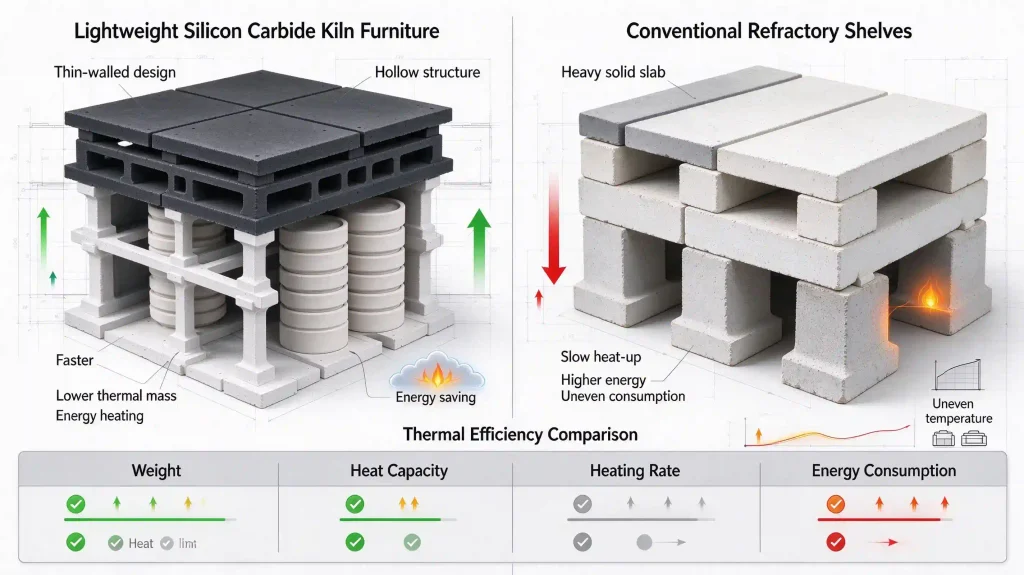
Reducing Thermal Mass Through Lightweight Structural Design
Thermal mass describes the amount of heat energy required to raise the temperature of a component. For a simplified calculation over a limited temperature range, sensible heat can be estimated by multiplying mass, specific heat capacity, and temperature increase. For a more accurate calculation over a large temperature range, the temperature dependence of specific heat must be considered.
This relationship explains why reducing the weight of kiln furniture can improve energy efficiency, particularly in batch kilns. However, a lighter component does not automatically require less heating energy if the replacement material has a substantially different specific heat capacity. Because silicon carbide offers useful mechanical strength at elevated temperatures, certain kiln furniture structures can be designed with thinner sections while maintaining the required load capacity. Replacing a heavy conventional shelf with a properly engineered SiC alternative may therefore reduce the mass that must be heated during each firing cycle.
The potential benefit becomes more significant when many shelves or supports are installed in the same kiln. Nevertheless, the final reduction in energy consumption must be evaluated using the complete kiln system, including heat losses, firing schedules, and production loading.
Improving Heat Transfer and Temperature Distribution
Thermal conductivity is another important characteristic of silicon carbide ceramics. Compared with many conventional oxide-based refractory materials, SiC typically transfers heat more effectively, although the actual conductivity depends on material grade, porosity, temperature, and microstructure. In suitable kiln designs, this property allows heat to move through shelves and supporting components more readily. Improved heat transfer within the furniture can reduce local temperature differences and contribute to a more predictable thermal response.
However, product temperature uniformity is influenced by many additional factors, including airflow, radiation, kiln geometry, heating element arrangement, and product spacing. Therefore, higher material conductivity should be regarded as a supporting characteristic rather than a guarantee of uniform firing.
Supporting More Efficient Thermal Cycling
Repeated heating and cooling expose kiln furniture to thermal stresses caused by temperature gradients and differences in thermal expansion. Components with poor thermal shock resistance may develop cracks, lose mechanical strength, or require frequent replacement. Suitable silicon carbide grades offer favorable thermal shock performance because of their thermal conductivity and other material characteristics. This can make them useful in kilns operating under repeated thermal cycles.
When lower furniture mass is combined with appropriate structural design, the kiln may respond more efficiently to changes in temperature. In some applications, this can support adjustments to the firing schedule. However, the allowable heating and cooling rates must always be determined by the ceramic products, kiln equipment, and furniture specifications.
4. How Can Silicon Carbide Kiln Furniture Reduce Overall Firing Costs?
Reducing firing costs requires a broader evaluation than simply measuring fuel or electricity consumption. Industrial manufacturers must consider the cost of kiln furniture, maintenance labor, replacement frequency, production downtime, and the quantity of acceptable products produced during each firing cycle. Well-designed silicon carbide kiln furniture can influence several of these factors, making total cost of ownership an important part of the purchasing decision.
Reducing Energy Requirements per Firing Cycle
In batch firing operations, the kiln furniture is repeatedly heated from a lower temperature to the required firing temperature. The energy absorbed by shelves, supports, and other internal structures contributes to the total heating demand. When suitable lightweight SiC components replace heavier alternatives, the energy required to heat the furniture itself may decrease. The value of this reduction depends on the difference in total heat capacity, the operating temperature range, and the number of cycles completed over the equipment’s service life.
For continuous kilns, the energy balance is more complex because kiln furniture, products, and kiln structures may experience different heating conditions. In these systems, throughput, heat recovery, and steady operating temperatures can be more important than furniture weight alone.
Extending Service Life and Reducing Maintenance
Kiln furniture operates in an environment where high temperatures, thermal cycling, mechanical stress, and chemical reactions can progressively reduce material performance. Common damage mechanisms include cracking, excessive deformation, oxidation, and mechanical wear. Appropriately selected silicon carbide ceramics offer high-temperature strength and thermal shock resistance that can improve reliability under compatible conditions. Their durability may help reduce replacement frequency and the labor associated with routine maintenance.
However, SiC materials are not immune to degradation. Oxidation, corrosive kiln atmospheres, excessive loads, and inappropriate operating temperatures can still cause damage. Service life therefore depends on both material quality and correct application design.
Improving Kiln Capacity and Production Efficiency
Kiln loading efficiency also affects the cost of producing finished ceramic products. Thick shelves and bulky support systems occupy space that could otherwise contribute to the effective loading arrangement. Where structural calculations permit, thinner silicon carbide slabs and optimized support designs may increase usable kiln volume. This can create opportunities to improve loading arrangements or accommodate additional products without expanding the external dimensions of the kiln.
Any increase in loading density must preserve sufficient space for airflow, heat transfer, and safe product separation. The objective is not simply to maximize the number of pieces inside the kiln, but to improve the quantity of acceptable finished products produced per unit of energy.
Understanding Total Cost of Ownership
The initial purchase price of advanced SiC kiln furniture may exceed that of some conventional refractory components. Nevertheless, the purchase price represents only one part of the total operating expense. A meaningful economic assessment should include the initial investment, expected service life, energy consumption, maintenance requirements, production downtime, and usable output. For instance, a more durable shelf may offer better long-term value if it requires fewer replacements and maintains consistent production performance.
Manufacturers should therefore compare actual operating data under equivalent conditions before calculating potential savings. This provides a more reliable basis for investment decisions than assuming a fixed percentage reduction in firing costs.
5. Which Silicon Carbide Material Is Best for Kiln Furniture?
Although different ceramic products may share the same basic chemical composition, their properties can vary considerably depending on the manufacturing process, density, porosity, grain structure, and bonding phase. Selecting the correct silicon carbide material is therefore essential for balancing high-temperature performance, dimensional accuracy, service life, and production cost.
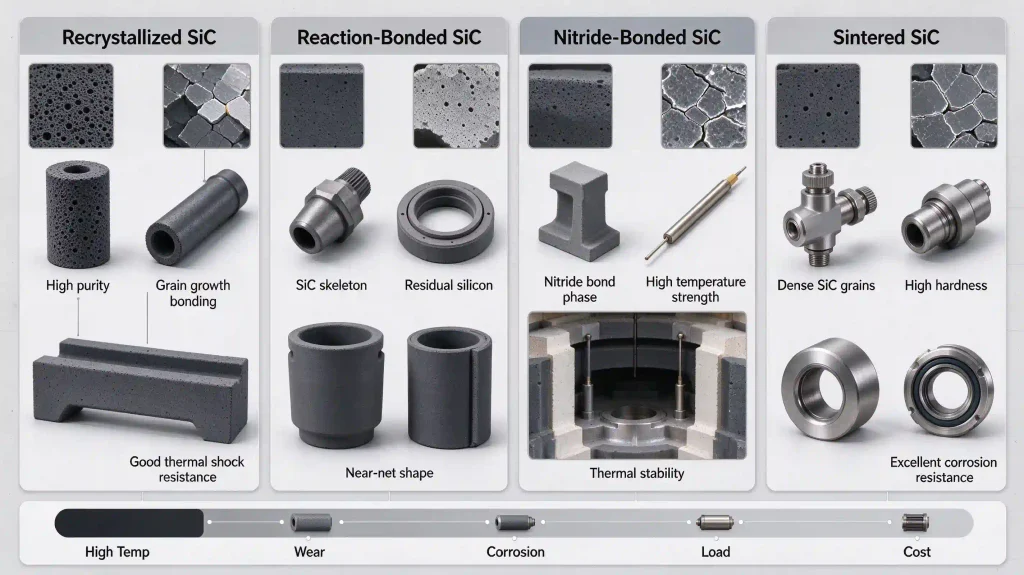
Recrystallized Silicon Carbide (RSiC)
Recrystallized silicon carbide, commonly known as RSiC, is manufactured through high-temperature processing that promotes bonding between SiC grains. The resulting structure typically contains controlled open porosity and can provide a useful combination of high-temperature performance and thermal shock resistance.
One important advantage of RSiC is its suitability for lightweight structural components operating under demanding thermal conditions. It is frequently considered for kiln shelves, slabs, and supporting components where thermal stability and reduced furniture mass are important. Its performance under load depends on material quality, component geometry, temperature, and exposure time. Therefore, shelf thickness and supporting span must be evaluated carefully to control long-term deformation.
Reaction-Bonded Silicon Carbide (RBSiC)
Reaction-bonded silicon carbide, also known as RBSiC or SiSiC, is produced by infiltrating a porous carbon-containing structure with molten silicon. The silicon reacts with available carbon to form additional SiC, while some residual silicon typically remains in the finished material. This manufacturing method provides relatively low processing shrinkage and supports the production of components with complex shapes and good dimensional accuracy. RBSiC also offers high strength, good thermal conductivity, and excellent wear resistance.
These characteristics make it suitable for selected kiln furniture slabs, structural beams, and other industrial ceramic components. However, the presence of residual silicon limits its suitability for certain very high-temperature applications, especially where prolonged loading is involved. Consequently, RBSiC should be selected according to the manufacturer’s specified temperature limits and the actual mechanical and chemical operating conditions.
Silicon Nitride-Bonded Silicon Carbide (NBSC)
Silicon nitride-bonded silicon carbide consists of SiC grains held together by a silicon nitride bonding phase. This structure provides a useful balance of refractory performance, mechanical strength, and resistance to thermal shock. NBSC is commonly used in refractory bricks, kiln supports, and selected industrial furnace components. Its performance is influenced by the bonding phase, manufacturing quality, operating temperature, and chemical environment.
For applications involving demanding thermal conditions or mechanical wear, NBSC may provide a practical balance between performance and cost. However, its suitability must be evaluated for the specific kiln atmosphere and expected service conditions.
Pressureless-Sintered Silicon Carbide (SSiC)
Pressureless-sintered silicon carbide, or SSiC, is generally characterized by a dense microstructure, high hardness, excellent wear resistance, and good chemical stability in many environments. It is particularly valuable for precision ceramic components such as sealing rings, wear-resistant parts, and selected high-temperature components. However, its manufacturing requirements and cost structure may make it less economical for some large kiln furniture applications. The choice between RSiC, RBSiC, NBSC, and SSiC should therefore be based on operating conditions rather than assuming that one material grade is universally superior.
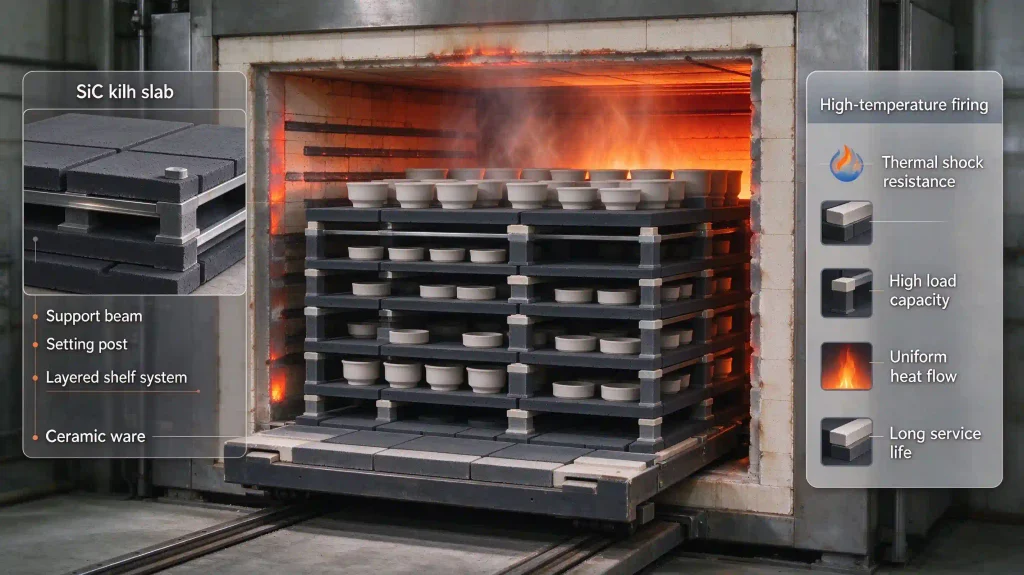
6. Silicon Carbide Kiln Shelves and Slabs: Reducing Weight Without Sacrificing Load Capacity
Kiln shelves and slabs provide the primary supporting surfaces for ceramic products during firing. Their structural stability directly affects product positioning, load distribution, and the reliability of the overall kiln furniture system. In conventional systems, relatively thick refractory shelves may be required to provide sufficient mechanical strength. Although these designs can perform reliably, their weight increases the thermal mass of the kiln furniture assembly.
Properly engineered silicon carbide kiln slabs can offer advantages through a combination of material strength, structural stiffness, and optimized thickness. Under suitable operating conditions, these properties allow some designs to use less material while maintaining the required load-bearing capacity. Reducing shelf thickness can lower the weight of individual components and may improve the use of available kiln space. In multi-layer installations, these benefits can become more significant because the mass of the complete supporting system is affected.
However, shelf performance must be evaluated under actual high-temperature conditions. Mechanical properties measured at room temperature do not fully describe behavior during prolonged firing. High-temperature creep, bending stress, support spacing, and temperature distribution all influence dimensional stability. For example, a large shelf carrying sanitary ceramic products may experience considerable bending stress across its unsupported span. Selecting an appropriate SiC grade and thickness is essential to prevent excessive deformation while maintaining the intended thermal and structural benefits.
Silicon carbide kiln slabs are therefore most effective when material selection and component geometry are considered together rather than treating reduced thickness as the only design objective.
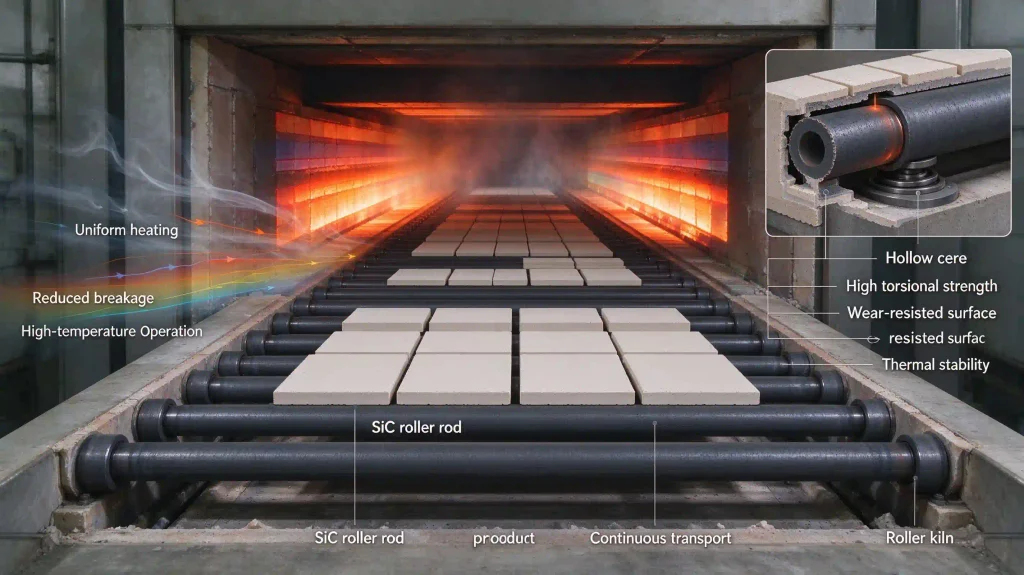
7. Silicon Carbide Roller Rods: Supporting Efficient Roller Kiln Operations
Roller kilns are widely used in continuous ceramic production because they allow products to move through heating and cooling zones at controlled speeds. The rollers form an essential part of the transport system and must maintain dimensional accuracy while operating under repeated thermal and mechanical stresses. The performance of roller rods directly affects product movement, production stability, and equipment maintenance requirements.
Suitable silicon carbide roller rods provide useful mechanical strength, wear resistance, and thermal stability for selected high-temperature roller kiln systems. Their relatively high thermal conductivity can also help reduce temperature differences within the ceramic roller, although actual performance depends on roller geometry and operating conditions. During continuous operation, roller rods experience forces from product weight, rotational movement, and the supporting mechanism. Excessive bending or loss of straightness can interfere with product transport and may contribute to uneven positioning or equipment problems.
For this reason, roller selection must consider diameter, length, wall thickness where applicable, supporting span, load distribution, rotation speed, and maximum operating temperature. Thermal shock resistance is another important factor, particularly during kiln startup, shutdown, or unexpected temperature changes. Proper material selection can help reduce the risk of damage, but the permissible thermal cycle depends on the component’s dimensions and design. In suitable applications, silicon carbide roller rods can support reliable continuous production and reduce the risk of maintenance interruptions. However, their economic value should be assessed through actual operating performance and service life.
8. Silicon Carbide vs Traditional Kiln Furniture: Which Offers Better Long-Term Value?
The selection of kiln furniture materials requires a balance between thermal performance, mechanical reliability, operating conditions, and cost. Conventional materials remain suitable for many industrial processes, while advanced SiC ceramics offer additional advantages in selected demanding environments. Understanding the differences helps manufacturers avoid unnecessary material costs and select components that match their actual operating requirements.
Silicon Carbide vs Cordierite Kiln Furniture
Cordierite is commonly used in kiln furniture because of its low thermal expansion and favorable thermal shock resistance. It is often suitable for moderate-temperature ceramic firing processes and applications where mechanical loads remain within its design limits. In comparison, silicon carbide generally provides higher thermal conductivity and can offer superior high-temperature structural performance in certain applications. These characteristics may support thinner shelves or more demanding load-bearing designs.
However, cordierite may remain the preferred choice when its properties are sufficient, and its lower initial cost provides better overall economic value.
Silicon Carbide vs Alumina Kiln Furniture
Alumina-based kiln furniture is valued for its refractory properties, chemical stability in many environments, and suitability for a range of high-temperature processes. By comparison, silicon carbide generally provides higher thermal conductivity and may offer advantages in applications requiring strong, lightweight supporting structures.
Nevertheless, material compatibility is especially important in chemically demanding kilns. SiC and alumina-based materials respond differently to operating atmospheres and chemical exposure, so neither material should be considered universally preferable.
Comparing Performance Over the Complete Service Life
A meaningful comparison should include operating temperature, thermal cycling, mechanical loading, corrosion resistance, component dimensions, and replacement requirements. For example, a conventional refractory shelf may have a lower initial price but require more frequent replacement under demanding conditions. A suitable SiC alternative could offer better long-term value if it maintains dimensional stability and reduces maintenance costs.
Conversely, an advanced ceramic component may provide limited additional benefit in a lower-temperature application where a conventional material already delivers sufficient performance. The best solution is therefore the material and design that meet the process requirements at the lowest practical total cost, rather than the material with the highest individual performance rating.
9. How to Choose the Right Silicon Carbide Kiln Furniture for Your Application
Selecting suitable kiln furniture requires a clear understanding of the intended operating environment. Even within the same material family, differences in composition, porosity, processing method, and component geometry can produce significant differences in performance.
Operating Temperature and Exposure Time
The maximum operating temperature is one of the first parameters to consider. However, peak temperature alone is not sufficient for material selection. Manufacturers should also evaluate the continuous working temperature, duration of exposure, mechanical loading, and expected thermal cycles. For example, a component exposed briefly to a high peak temperature may behave differently from one carrying a constant load for many hours. Long-term deformation and material degradation must therefore be included in the design assessment.
Mechanical Loading and Component Dimensions
Component dimensions influence stress distribution and resistance to bending. A kiln shelf with a long unsupported span may require greater thickness or a different material grade than a smaller shelf supporting the same total weight. Similarly, roller rods must be designed to withstand bending and rotational loads under elevated temperatures. Choosing silicon carbide components according to actual mechanical requirements helps maintain structural reliability while avoiding unnecessary material usage.
Kiln Atmosphere and Chemical Compatibility
Kiln atmosphere has a major influence on the performance of ceramic materials. Oxidizing, reducing, and chemically aggressive conditions can affect the stability of different SiC grades. Under certain oxidizing conditions, SiC can form a protective silica layer, but this protection may be affected by temperature, water vapor, deposits, and chemical contaminants. Therefore, the expected chemical environment must be reviewed before selecting a material grade. This is particularly important for kilns processing materials that release corrosive vapors or reactive compounds during firing.
Thermal Cycling and Maintenance Requirements
Repeated temperature changes generate thermal stresses within kiln furniture. Although suitable silicon carbide ceramics provide good thermal shock resistance, cracks may still develop when components experience excessive temperature gradients or mechanical damage. Manufacturers should therefore consider startup and shutdown procedures, cooling rates, inspection schedules, and handling practices. Regular maintenance can help identify deformation, surface deterioration, or early cracking before these problems cause unexpected production interruptions.
Understanding Related SiC Components in High-Temperature Systems
Industrial customers researching advanced ceramic materials may encounter several related products that serve different functions. A silicon carbide heating element, for example, is an electrically resistive component designed to generate heat inside certain industrial furnaces. Kiln furniture performs a different task by supporting products and internal structures during thermal processing.
Similarly, a silicon carbide crucible, also described in some searches as a SiC crucible, is used for holding or processing materials at elevated temperatures. Its design requirements differ from those of kiln slabs, rollers, and refractory supports. The term SiC semiconductor refers to the electronic applications of this material, particularly in power devices. Although both electronic and structural ceramic applications involve the same fundamental SiC compound, their material purity, manufacturing processes, and functional requirements are substantially different. For industrial kiln furniture, purchasing decisions should focus primarily on mechanical performance, thermal stability, dimensions, and environmental compatibility.
Custom Manufacturing and Technical Specifications
Standard kiln furniture does not always meet the requirements of specialized industrial kilns. Custom-designed ceramic components may be necessary to achieve the required fit, load capacity, and thermal performance. When requesting silicon carbide kiln furniture, customers should provide technical drawings, component dimensions, maximum and continuous operating temperatures, support arrangements, mechanical loads, and details of the kiln atmosphere.
Information about the heating and cooling schedule, expected production volume, and service conditions can also help determine the most appropriate material and manufacturing process. Close communication between the ceramic manufacturer and kiln operator helps reduce design uncertainty, improve component compatibility, and support reliable long-term operation.
10. Company Profile
Jenson(Luoyang) Technology Co., Ltd. focuses on advanced ceramic materials and engineered ceramic components for demanding industrial, high-temperature, electronic, and semiconductor-related applications. The company provides boron nitride solutions with attention to material purity, thermal conductivity, electrical insulation, dimensional accuracy, machining quality, and application-specific requirements.
For semiconductor applications, Jenson(Luoyang) Technology Co., Ltd. approaches BN component selection from an engineering perspective rather than relying on a single standard grade. Parameters such as operating temperature, process atmosphere, vacuum conditions, thermal conductivity, electrical resistivity, coefficient of thermal expansion, purity, density, surface roughness, dimensional tolerance, and thermal cycling can all be considered when determining the appropriate material specification.
For customized BN components, the engineering process can begin with the actual working conditions and component drawing. Based on the application, material grade, density, purity, thermal properties, machining requirements, and inspection criteria can then be established. This approach is particularly relevant to boron nitride semiconductor manufacturing, where process stability can depend on a combination of thermal behavior, contamination control, dimensional accuracy, and long-term material reliability rather than on a single material parameter.
11. FAQs About Silicon Carbide Kiln Furniture
1. How does silicon carbide kiln furniture reduce energy consumption?
Silicon carbide kiln furniture can improve energy efficiency when its mechanical properties allow lighter structural designs. Reducing the mass of shelves and supports may decrease the energy required to heat these components during each firing cycle. Its relatively high thermal conductivity can also support effective heat transfer through the furniture. However, actual energy savings depend on the total heat capacity of the replacement components, kiln insulation, firing schedule, product loading, and operating conditions. Manufacturers should compare measured energy consumption before and after installation to evaluate the results.
2. Is silicon carbide kiln furniture better than cordierite kiln furniture?
The better material depends on the intended application. Cordierite offers low thermal expansion and good thermal shock resistance, making it suitable for many conventional ceramic firing processes. Silicon carbide generally provides higher thermal conductivity and useful mechanical strength at elevated temperatures, which can support lightweight structural designs in suitable applications. However, these advantages do not automatically make it the more economical choice. Operating temperature, mechanical load, chemical exposure, expected service life, and total cost should all be considered.
3. What is the difference between RSiC and RBSiC kiln furniture?
Recrystallized SiC and reaction-bonded SiC differ primarily in their manufacturing processes and resulting microstructures. RSiC generally contains controlled open porosity and provides excellent thermal shock resistance and useful high-temperature performance. RBSiC is typically denser and offers high mechanical strength, good dimensional accuracy, and flexibility in producing complex shapes. However, residual silicon in RBSiC can restrict its recommended operating temperature. Material selection should therefore consider long-term temperature exposure, loading conditions, component dimensions, and the kiln atmosphere.
4. How long does silicon carbide kiln furniture last?
The service life of silicon carbide kiln furniture varies according to the material grade, component design, operating temperature, mechanical loading, and thermal cycling frequency. Under compatible conditions, high-quality SiC components can provide reliable performance over repeated firing cycles. Nevertheless, oxidation, chemical corrosion, excessive stress, and improper handling may shorten their service life. Because industrial kilns operate under different conditions, there is no single service-life figure that applies to every application. Routine inspection and maintenance are essential for evaluating component condition.
5. What is the maximum operating temperature of silicon carbide kiln furniture?
The maximum operating temperature depends on the specific SiC grade and its manufacturing process. Certain recrystallized SiC products can operate around 1600°C or above under appropriate conditions, while reaction-bonded grades usually have lower recommended limits because of their residual silicon content. Silicon nitride-bonded materials also have grade-specific temperature restrictions. These values should not be treated as universal specifications. The actual permissible temperature depends on kiln atmosphere, exposure duration, component geometry, and mechanical load. Customers should always confirm the manufacturer’s recommended operating range.
6. Can silicon carbide kiln shelves withstand rapid heating and cooling?
Suitable silicon carbide kiln shelves provide good thermal shock resistance because of their thermal and mechanical characteristics. This makes them useful for industrial processes involving repeated heating and cooling. However, thermal shock resistance does not eliminate the possibility of cracking. Large temperature gradients, excessive heating or cooling rates, existing surface damage, and unsuitable structural designs can still cause failure. The recommended thermal cycle should therefore be determined according to the material grade, shelf thickness, support conditions, and the requirements of the ceramic products.
7. Is silicon carbide kiln furniture worth the higher initial cost?
Silicon carbide kiln furniture can provide favorable long-term value when its performance advantages lead to lower energy use, reduced maintenance, longer replacement intervals, or improved production efficiency. However, these benefits depend on the operating environment and component design. A realistic cost evaluation should compare initial purchase expenses with energy consumption, service life, maintenance labor, downtime, and acceptable production output. In applications where traditional refractory materials already meet the required performance level, a more expensive SiC solution may not provide sufficient economic benefit.
8. Can silicon carbide kiln furniture be customized for different kiln designs?
Yes. Silicon carbide kiln furniture can be manufactured in various shapes, sizes, and structural configurations to meet specific industrial requirements, subject to material and processing limitations. Custom components may include kiln slabs, roller rods, refractory supports, and other heat-resistant parts. Successful customization requires accurate information about component dimensions, operating temperature, mechanical loading, supporting structure, kiln atmosphere, and expected production conditions. Providing technical drawings and clear application specifications helps the manufacturer recommend an appropriate ceramic grade and component design.
RELATED POSTS
How Do You Select the Right Silicon Carbide Nozzle for Abrasive and Corrosive Environments?
How to Custom Manufacture Boron Nitride Insulator Rings, Gas Nozzles, and Wafer Chuck Parts?

Why Silicon Carbide Ceramics Are Essential for Semiconductor Wafer Processing Equipment

How Advanced Ceramics Help Manage Heat in High-Power AI Chips

How to Choose Between Aluminum Nitride and Alumina Ceramics for High-Performance Thermal Applications