Advanced Technical Ceramics, Precision Alumina, Silicon Carbide, Crucible Parts
 Technology Co., Ltd.(Luoyang) Technology Co., Ltd.科技品牌标志.webp)


Alumina Ceramic Buying Guide: Key Specs Engineers Should Verify Before Ordering
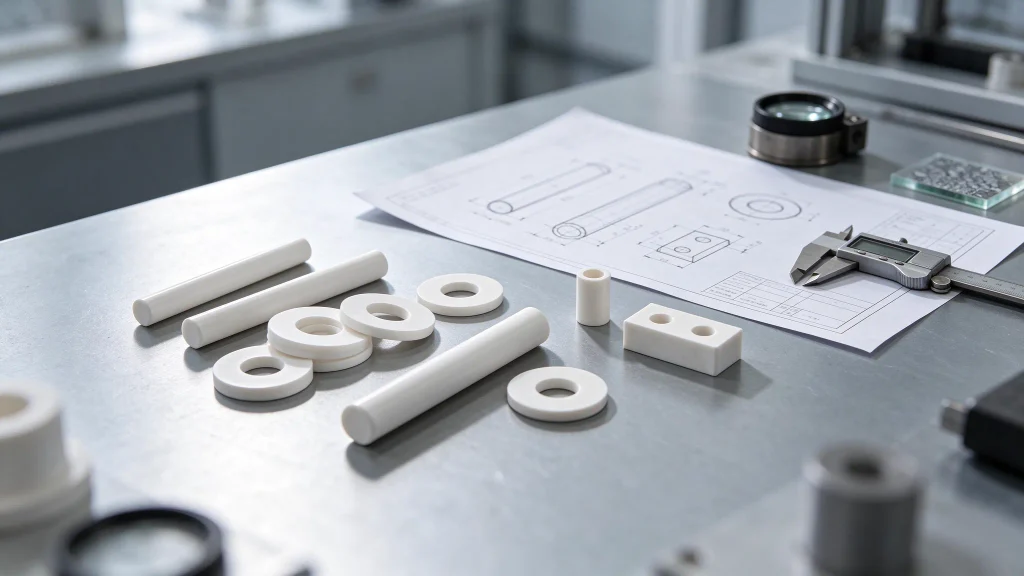
Writing “99% Alumina” in a drawing title block without defining acceptable density, porosity test methods, or which surfaces require post-sintering finishing leaves too much room for interpretation. Two suppliers can meet that nominal purity callout and still deliver alumina ceramic parts with different microstructures, surface finishes, and unit costs.
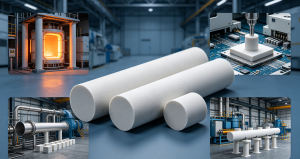
Alumina ceramic (aluminum oxide, Al₂O₃) is widely selected for electrical insulation, wear resistance, and high-temperature applications because commercial grades offer a practical balance of hardness, electrical insulation, chemical stability, and cost. However, specification gaps—rather than material defects—are a common source of delays, rework, or unexpected performance in service.
This technical alumina buying guide reviews room-temperature reference data across standard commercial grades, explains common specification pitfalls involving porosity and test standards, and outlines an RFQ checklist for drawing release. It also examines key alumina ceramic properties and explains how buyers can translate material data into clear purchasing and inspection requirements.
Composition and Microstructure: Why Purity Percentage Alone Is Incomplete
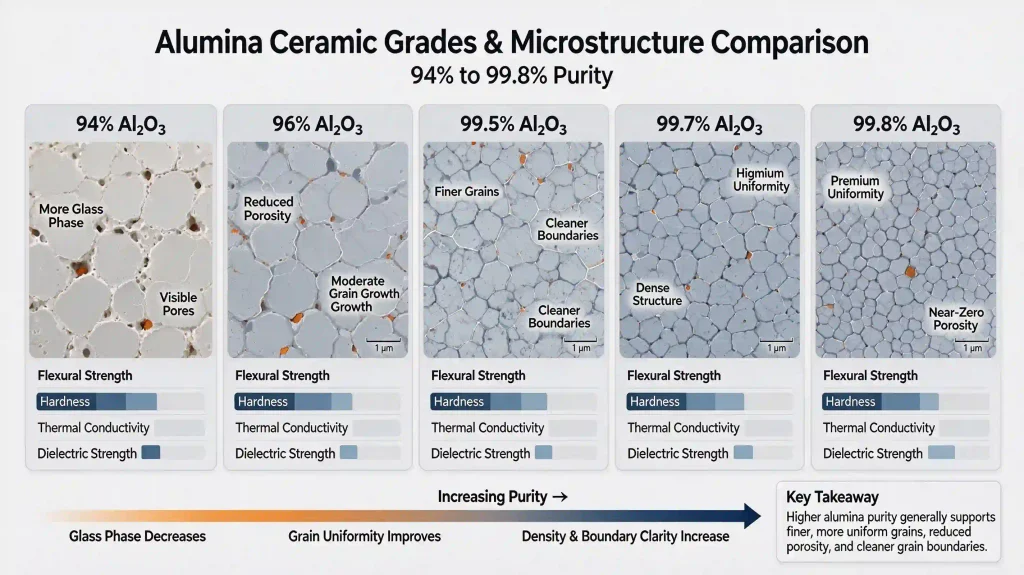
Many dense technical aluminas are sintered primarily into polycrystalline alpha-phase aluminum oxide (α-Al₂O₃). According to Accuratus, aluminum oxide can exist in several crystalline phases that revert to the stable hexagonal alpha phase at elevated temperatures, giving structural alumina its stiffness, hardness, and refractoriness.
Commercial grades typically range from 94% to 99.8% Al₂O₃, and the remaining balance is not simply uncontrolled contamination. Depending on the manufacturer and formulation, controlled oxide additions are used to adjust sintering behavior, mechanical or optical properties, or surface metallization response. For example, Accuratus notes that chrome oxide or manganese oxide additions can be used to modify hardness and color, while other targeted body additions improve the consistency of fired metal films for subsequent brazing or soldering. Because sintering aids, grain-boundary phases, and firing schedules vary by producer, stepping up in nominal Al₂O₃ percentage does not automatically improve suitability for every assembly. When evaluating alumina ceramic specifications, buyers should consider the complete formulation and intended manufacturing process rather than relying on purity percentage alone.
For instance:
- 94%–96% commercial grades: Often selected for general insulators and metallized assemblies where cost and brazeability matter. Accuratus specifically describes its 94% grade as an easily metallizable composition; however, compatibility with a specific molybdenum-manganese (Mo-Mn) or active-metal brazing process depends on the exact ceramic formulation and metallizing system and should be confirmed with the supplier.
- 99.5%–99.8% high-purity grades: Lower secondary-phase content can support higher density, higher room-temperature thermal conductivity, and lower dielectric loss in certain formulations. Specific semiconductor grades are engineered for strict impurity caps—for example, Morgan Technical Ceramics states that its AL-998 (99.8% Al₂O₃) eliminates free grain-boundary silica with low sodium levels, and AL-998A (99.8% Al₂O₃) holds combined soda and silica below 100 ppm. Those impurity limits belong to those specific grades and should not be assumed for all 99.5%–99.8% aluminas.
96% vs 99.5% Alumina: What Does the Purity Difference Mean?
The comparison of 96% vs 99.5% alumina is particularly relevant when selecting materials for electrical, thermal, and precision industrial components. Higher purity may offer advantages in density, thermal conductivity, and dielectric performance in certain formulations. However, the actual difference depends on the manufacturer’s composition, sintering process, and grade-specific properties.
A 99.5% grade should not automatically be considered the better option for every application. A 96% grade may be sufficient for general insulation or metallized assemblies where cost and processing compatibility are important. Buyers should compare the required performance with the actual datasheet values before specifying a higher-purity material.
Key Alumina Ceramic Properties: Reference Data and Boundary Conditions
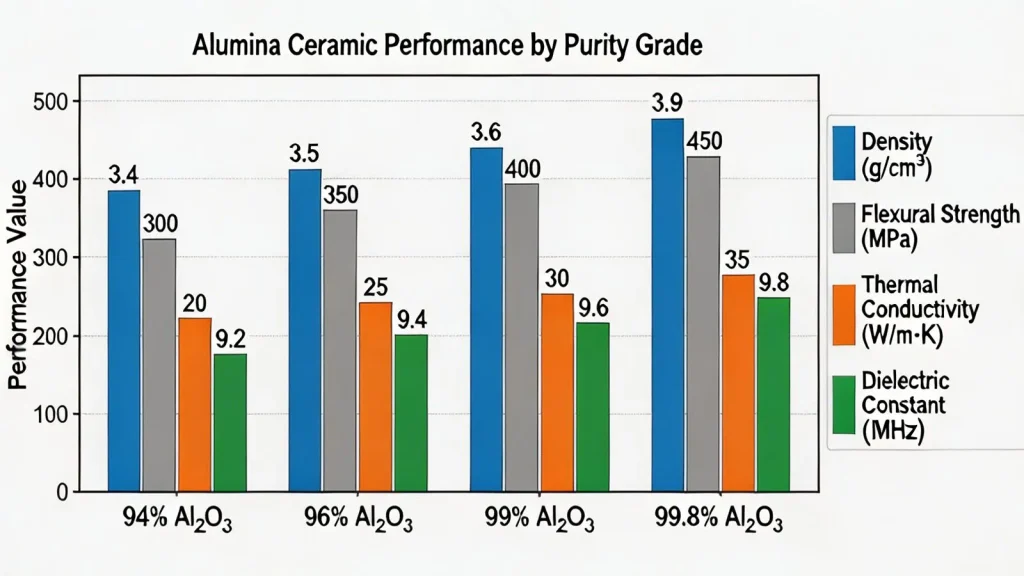
When comparing grades, review mechanical, thermal, and electrical properties together rather than relying on purity alone. Understanding these alumina ceramic properties helps engineers assess whether a material can meet the operating requirements of a specific component. The table below lists published room-temperature typical values for three commercial grades from Accuratus.
| Property (Room Temp. unless noted) | Accuratus 94% Al₂O₃ | Accuratus 96% Al₂O₃ | Accuratus 99.5% Al₂O₃ | Design & Procurement Context |
|---|---|---|---|---|
| Bulk Density (g/cm³) | 3.69 | 3.72 | 3.89 | Indicator of densification for a given formulation |
| Porosity (%) | 0 | 0 | 0 | Datasheet nominal value; define verifiable test limits |
| Flexural Strength (MPa) | 330 | 345 | 379 | Bending load capacity; sensitive to surface finish |
| Compressive Strength (MPa) | 2,100 | 2,100 | 2,600 | Substantially higher than flexural or tensile strength |
| Elastic Modulus (GPa) | 300 | 300 | 375 | Structural stiffness/deflection resistance |
| Hardness (kg/mm²) | 1,175 | 1,100 | 1,440 | Relevant to abrasive and sliding wear resistance |
| Fracture Toughness KIC (MPa·m½) | 3.5 | 3.5 | 4.0 | Reflects brittle fracture behavior under impact |
| Thermal Conductivity (W/m·K) | 18 | 25 | 35 | Room-temperature value; drops at elevated temperature |
| CTE (10⁻⁶/°C) | 8.1 | 8.2 | 8.4 | Check differential expansion against mating metals |
| Max No-Load Temp. (°C) | 1,700 | 1,700 | 1,750 | No-load ceiling; mechanical load lowers usable limit |
| Dielectric Strength (AC kV/mm) | 16.7 | 14.6 | 16.9 | Depends on specimen thickness, waveform, and test setup |
| Dissipation Factor (@ 1 kHz) | 0.0007 | 0.0011 | 0.0002 | Low-frequency value; do not extrapolate to GHz RF |
| Volume Resistivity (Ω·cm) | >10¹⁴ | >10¹⁴ | >10¹⁴ | Room-temperature baseline; drops at elevated temperature |
Scope note: All values above are room-temperature typical values published by Accuratus for its corresponding commercial grades. They are provided for comparison only and do not represent guaranteed minimums across other manufacturers or production lots. Final design calculations and purchase acceptance must use the selected supplier’s grade-specific datasheet and mutually agreed inspection criteria.
How to Interpret Alumina Ceramic Properties Without Over-Extrapolating
The figures in a material datasheet need to be interpreted in relation to the actual operating environment. The following points explain several important differences in the Accuratus reference data.
- Thermal conductivity depends on both grade and temperature: Within the Accuratus room-temperature dataset above, moving from 96% to 99.5% alumina raises typical thermal conductivity from 25 to 35 W/m·K (a 40% increase for this specific pair of grades at room temperature). That ratio should not be treated as a universal rule across all suppliers, and high-temperature thermal models should use conductivity values measured at the actual operating temperature rather than 20 °C figures.
- Compressive vs. flexural asymmetry: In the Accuratus data, typical compressive strength (2,100–2,600 MPa) is roughly six to seven times higher than flexural strength (330–379 MPa). Designing joints and mounts to keep the ceramic primarily in compression against flat, compliant mating faces helps reduce bending stress.
- Low-frequency dielectric loss does not predict GHz behavior: A 1 kHz dissipation factor (such as 0.0002 for Accuratus 99.5% at room temperature) cannot be used to qualify a part for gigahertz RF or microwave duty. For high-frequency applications, request dielectric constant and loss tangent measured at your target operating frequency and temperature.
- Chemical resistance is condition-dependent: Accuratus reports that dense alpha-phase alumina resists common process gases except wet fluorine and common reagents except hydrofluoric and phosphoric acids, while hot alkali metal vapors can attack lower-purity grades. In practice, chemical compatibility depends on the specific grade, reagent concentration, temperature, and exposure duration—request supplier compatibility data for your actual service media.
The comparison of 96% vs 99.5% alumina should therefore be based on the complete property profile. A higher-purity grade may offer a useful advantage in one parameter but may not provide a meaningful benefit for a component whose main requirement is general electrical insulation or mechanical support.
Porosity, Density, and Failure Analysis: Avoiding Common Specification Pitfalls
Specifying nominal Al₂O₃ purity without defining density and porosity acceptance criteria leaves a critical quality gap. Research on porous α-Al₂O₃ ceramics demonstrates that internal voids can degrade both mechanical strength and heat transfer; for example, in a 4-point bending and laser-flash study on intentionally porous alumina structures (PMC8232101), flexural strength and thermal conductivity declined substantially as porosity increased, with clustered pores acting as brittle fracture origins. The exact impact on any commercial part depends on pore size, morphology, distribution, and material condition.
When troubleshooting cracked, leaking, or electrically degraded parts, porosity should be treated as one potential factor rather than a presumed root cause. A thorough failure investigation should also check part geometry, edge chips or micro-defects, assembly and clamping loads, thermal ramp history, post-sintering machining damage, and test fixture conditions.
Specifying Verifiable Porosity and Density Acceptance Criteria
The following requirements are useful when preparing alumina ceramic specifications for supplier evaluation and incoming inspection.
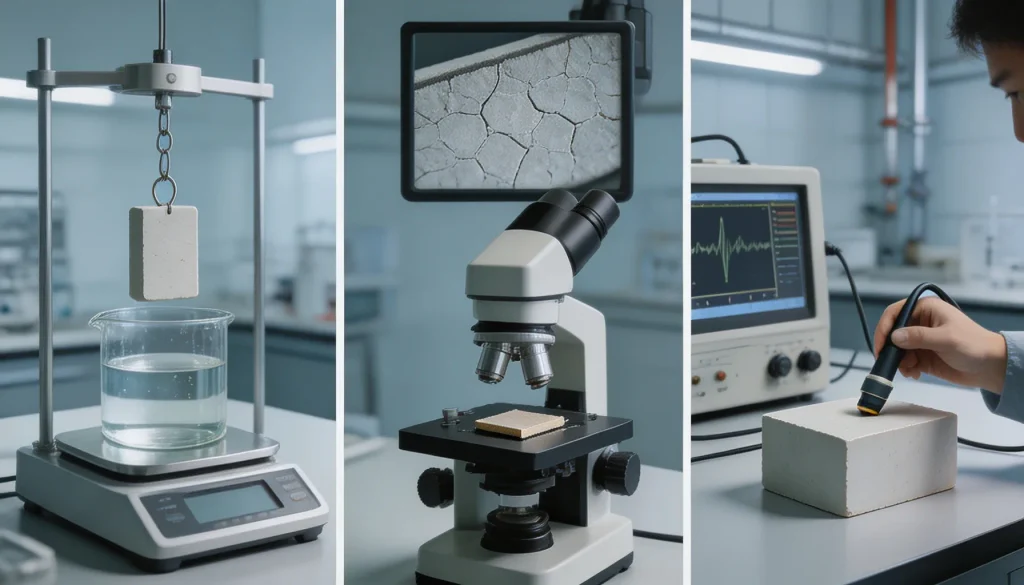
- Replace “0% water absorption” with verifiable test limits: A datasheet listing “0%” porosity is a nominal indicator, not proof of absolute zero void volume. Define a numerical maximum acceptance limit for water absorption or apparent porosity, specify the test method and reporting precision, and note that low water absorption only evaluates open (surface-connected) pores—it does not confirm the absence of closed internal pores.
- Confirm the right test standard for your part type: Do not default to a single ASTM standard for every engineering ceramic. ASTM C373-18(2023) covers water absorption, bulk density, apparent porosity, and apparent specific gravity for specific ceramic tiles, glass tiles, and non-tile fired whiteware products; ASTM C20-00(2022) applies to burned refractory brick and shapes. Confirm with your supplier which test method (such as an applicable Archimedes density method, dye penetrant check, or helium leak test) is valid for your specific grade and component geometry.
- Pair apparent porosity with bulk density: Because closed internal voids can reduce bulk density even when water absorption is negligible, specify a minimum bulk density tied to the selected grade’s datasheet and confirmed with the supplier.
Application-to-Grade Selection Reference Matrix
The matrix below provides starting reference points for grade screening. Example bulk density values reflect published datasheet figures for specific commercial grades rather than universal industry thresholds; final material limits must be set by grade, part function, and supplier confirmation.
| Application Category | Typical Components | Typical Purity Range to Evaluate | Example Datasheet Bulk Density (Reference Only) | Key Specs to Confirm With Supplier |
|---|---|---|---|---|
| Electronic Insulation & Brazed Assemblies | Substrates, feedthroughs, standoffs, RF insulators | 94%–99.5% Al₂O₃ | 3.69–3.89 g/cm³ (Accuratus 94%–99.5% typical) | Dielectric strength at actual thickness; dielectric constant & loss tangent at target frequency/temp; metallization compatibility for specific Mo-Mn or brazing system |
| Abrasive Wear & Fluid Control | Pump plungers, seal rings, grinding balls, wear liners | 95%–99.5% Al₂O₃ | 3.72–3.89 g/cm³ (Accuratus 96%–99.5% typical) | Hardness, wear test relevance, verifiable apparent porosity limit, ground/lapped surface finish (Ra), edge chamfer specs |
| High-Temperature Furnace & Structural Parts | Thermocouple tubes, kiln rollers, refractory bricks, crucibles | 99%–99.7% Al₂O₃ | Grade-specific (confirm per datasheet) | Continuous & peak temperature under actual load, thermal ramp rate, atmosphere (air, vacuum, or corrosive vapors) |
| Semiconductor Plasma & Etch Chambers | Chamber liners, focus rings, dielectric windows, wafer fixtures | 99.5%–99.8% Semiconductor Grades | Grade-specific (confirm per datasheet) | Impurity caps for specific etch grades (e.g., Morgan Technical Ceramics AL-998 eliminates free grain-boundary silica; AL-998A holds soda + silica <100 ppm); vacuum tightness; surface cleanliness |
The matrix provides a starting point for material screening, not a universal grade specification. For applications involving high mechanical impact or rapid thermal quenching, where alumina’s fracture toughness (typically 3.5–4.0 MPa·m½ in Accuratus room-temperature data) may be limiting, engineers should review the component design and evaluate suitable alternative material solutions before committing to tooling.
RFQ Checklist: 6 Items to Include Before Requesting a Quote
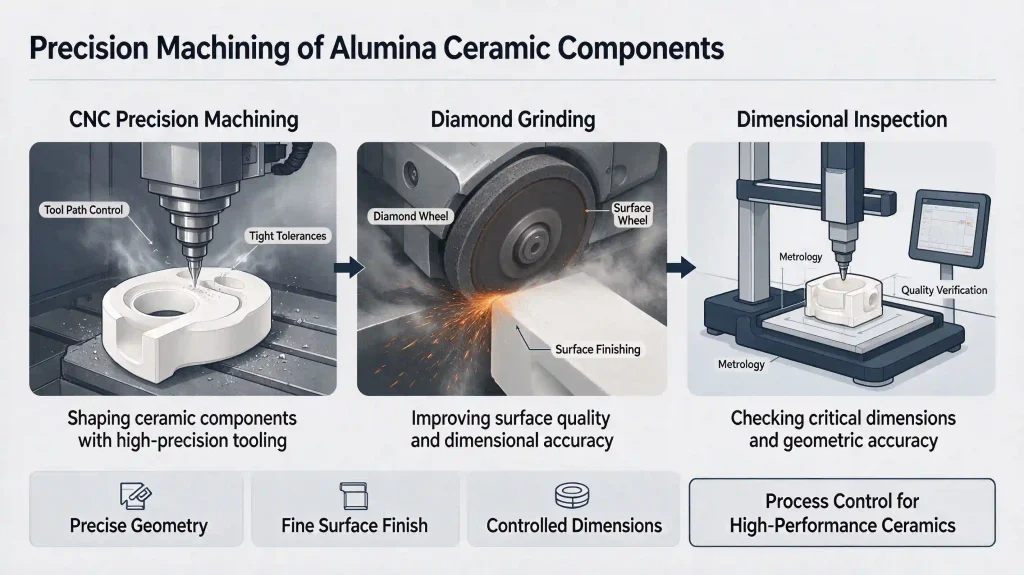
Sintering shrinkage and post-firing machining cost depend heavily on forming method, material grade, part geometry, and specified tolerances. Because sintered alumina has high hardness, holding tight post-firing tolerances typically requires specialized finishing processes such as diamond grinding, lapping, or polishing. Providing clear functional boundaries upfront helps suppliers quote accurately without unnecessary machining allowances.
For buyers preparing alumina ceramic specifications, the following six items should be included alongside the 2D drawing and 3D STEP file.
- Grade, Density, and Porosity Acceptance Criteria: State the target Al₂O₃ grade, any required impurity limits (such as sodium or silica caps for semiconductor or molten-metal duty), and the mutually agreed density and porosity/water-absorption test method and acceptance limits.
- As-Fired vs. Finished Surfaces: Identify which faces can remain as-fired and which functional mating, sealing, or heat-transfer surfaces require diamond grinding, lapping, or polishing (with explicit Ra and flatness callouts). As a reference point for one specialized product type, Kyocera Fineceramics Europe lists outer-dimension tolerances within ±0.25% max for its thick-film alumina substrates; actual as-fired tolerances for pressed, extruded, or slip-cast parts vary by forming route and must be confirmed with the manufacturer.
- Operating Temperature, Ramp Rate, and Atmosphere: Specify continuous temperature, peak excursions, heating/cooling rates, mechanical loads at temperature, and chemical/gas atmosphere. For high-temperature vacuum applications, note that Accuratus reports vacuum weight loss of 10⁻⁷ to 10⁻⁶ g/cm²·s for high-purity alumina between 1,700 °C and 2,000 °C.
- Electrical & Hermeticity Targets: List operating voltage (AC or DC), target frequency, temperature at voltage, and whether helium leak testing or vacuum-tight qualification is required.
- Mating Parts & Edge Conditions: Note mating pin or shaft diameters for tight-clearance bores, and specify edge chamfers or radii so sharp 90° edges are protected against handling chips.
- Quantities & Quality Documentation: Separate prototype quantities from projected annual volume, and list required documentation such as a Certificate of Analysis (COA), batch density/porosity test report, or CMM dimensional inspection sheet.
For custom alumina ceramic balls, discs, plungers, refractory bricks, rings, or tubes, buyers can share their drawing package and service conditions with Professional Ceramic to confirm grade selection and manufacturing tolerances.
About Jenson
Jenson(Luoyang) Technology Co., Ltd. focuses on advanced ceramic materials and engineered ceramic components for industrial, high-temperature, electronic, and precision engineering applications. Its product range includes silicon carbide, silicon nitride, alumina, aluminum nitride, boron nitride, quartz, and other advanced ceramic products.
For custom ceramic components, material selection should be based on the actual working conditions and technical requirements. Jenson(Luoyang) Technology Co., Ltd. can discuss project needs using customer drawings, operating temperatures, mechanical loads, dimensional tolerances, surface finish requirements, and inspection criteria. This engineering-focused approach helps buyers evaluate suitable ceramic materials and component manufacturing requirements for their applications.
Frequently Asked Questions
Q1: Why can two datasheets for the same alumina purity show different flexural strength values?
Flexural strength results depend on test geometry (such as 3-point vs. 4-point bending), specimen dimensions, surface finish, and test standard—not just Al₂O₃ percentage. A smaller stressed volume in 3-point bending or a finely polished test bar typically produces higher apparent strength than a larger as-fired bar tested in 4-point bending. Always compare flexural values alongside the test method and specimen surface condition. When evaluating alumina ceramic properties, buyers should also confirm whether the reported value is typical, minimum, or guaranteed for the supplied production batch.
Q2: When should I request CNC green machining instead of dry-pressing tooling?
Dry pressing uses dedicated hard tooling, which lowers per-piece cost at higher volumes but adds upfront mold cost and lead time. For prototypes, complex geometries, or small batches, CNC green machining from an isostatically pressed blank (followed by sintering and selective diamond grinding) often avoids tooling investment while allowing design revisions. Confirm the volume crossover point with your supplier based on part geometry. For a custom alumina ceramic component, the forming and machining route should be assessed together with the required tolerances, production quantity, and final surface condition.
Q3: What is the difference between a Certificate of Analysis (COA) and a dimensional inspection report?
A COA documents material-level verification for the production batch—typically powder/material grade identification, chemical composition or impurity compliance (where agreed), and physical properties such as bulk density. A dimensional inspection report (such as a CMM report) verifies part-level geometry, critical tolerances, flatness, and surface finish against your drawing. High-reliability assemblies commonly require both. For alumina ceramic specifications with strict acceptance requirements, buyers should define the required documentation and inspection scope before production begins.
RELATED POSTS
Is Boron Nitride Machinable to Tight Tolerances for Semiconductor Parts?
What Is the Difference Between Pyrolytic Boron Nitride (PBN) and Hot-Pressed Boron Nitride (HPBN) in Chip Fabrication?
What Should Buyers Know Before Ordering Custom Ceramic Components?
Which Boron Nitride Grade Is Best for MOCVD/CVD Crucibles and Wafer Applications?