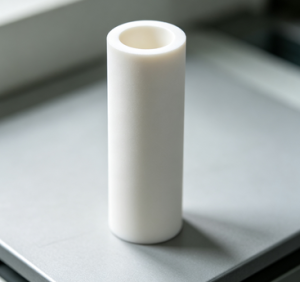
Advanced Technical Ceramics, Precision Alumina, Silicon Carbide, Crucible Parts



Wear Resistance 99% Round Al2o3 Alumina Ceramic Insulation Plate Alumina Ceramic Disc



PRODUCT PARAMETERS
Description
Alumina ceramic discs are high-performance ceramic components manufactured from high-purity alumina (Al₂O₃) through high-temperature sintering and precision machining. Thanks to the excellent physical and chemical properties of alumina ceramics, these products are widely used in demanding applications such as semiconductor equipment, precision instruments, valve sealing cores, high-temperature insulation, and wear-resistant components.
Wear Resistance 99% Round Al2o3 Alumina Ceramic Insulation Plate
Overview
The alumina ceramic discs is a high-performance precision ceramic component manufactured from high-purity, ultra-fine alumina powder (Al₂O₃; purity ranging from 95% to 99.8%). The production process involves spray granulation, isostatic or dry pressing, and sintering (either at high temperature under atmospheric pressure or via hot pressing), followed by multiple processing steps such as double-sided grinding, precision polishing, and laser cutting.
At the microstructural level, the product features a dense crystalline structure and extremely low porosity (bulk density ≥ 3.90 g/cm³; water absorption near zero), endowing it with mechanical strength, surface hardness, electrical insulation, high-temperature resistance, and chemical stability that far surpass those of conventional metals and standard engineering plastics. Regarding material formulation, toughening or reinforcing phases—such as zirconia (ZrO₂), silicon carbide (SiC), or magnesium oxide (MgO)—can be incorporated into the matrix to meet specific, differentiated mechanical and thermal performance requirements based on the application scenario.
Thanks to the aforementioned combination of excellent physicochemical properties,alumina ceramic discs have become deeply integrated into various sectors of modern high-end manufacturing. In the semiconductor and microelectronics industries, alumina ceramic discs serve as wafer transport carriers, insulation components for plasma etching equipment chambers, and supports for high-temperature diffusion furnace tubes. In fluid control, they function as core sealing and wear-resistant components for faucet ceramic cartridges, high-pressure plunger pump sealing faces, and corrosion-resistant shut-off valves used in the chemical industry. For precision measurement and medical analysis instruments, they provide ideal substrates for highly stable titration platforms and X-ray diffraction sample stages. Furthermore, they play an indispensable role as high-temperature insulation and structural load-bearing components in high-temperature heat treatment equipment, vacuum coating systems, and sintering kilns for new energy battery materials. With an operating temperature range extending from room temperature to 1,450°C (and up to 1,800°C for high-purity grades in no-load applications), they reliably handle diverse industrial environments, ranging from cryogenic conditions to high-temperature oxidizing atmospheres.
Whether for high-voltage electrical applications requiring a dielectric strength of up to 20 kV/mm, or for heavy-load mechanical seal applications involving loads of hundreds of newtons and a sliding friction pair wear rate of less than 0.01 mm/year, alumina ceramic discs—thanks to their outstanding comprehensive properties—serve as the material of choice for engineers addressing common challenges such as wear, corrosion, insulation issues, and thermal failure.
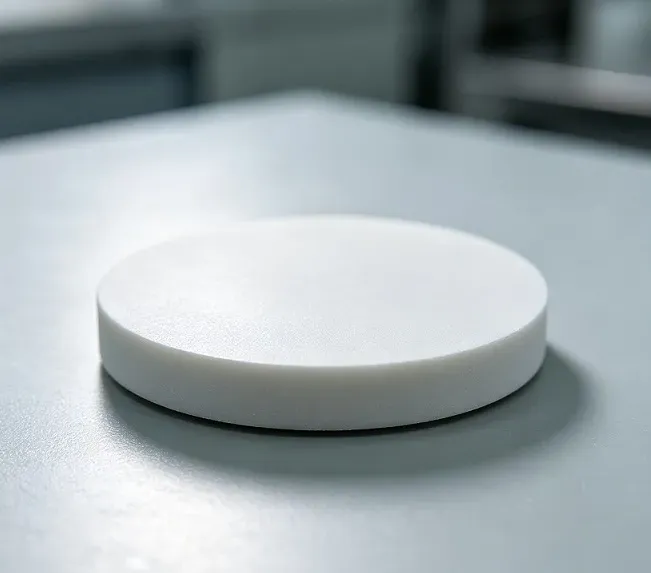
Alumina Oxide Ceramic Disk
Technical Specifications
| Parameter | Typical Value | Unit | Remarks |
|---|---|---|---|
| Material Composition | Al₂O₃ ≥ 96% | — | Approx. 96% alumina grade (based on density) |
| Density | Approx. 3.76 | g/cm³ | — |
| Rockwell Hardness | HRA 80 – 90 | HRA | Equivalent to Vickers ~1100 – 1400 HV |
| Max. Service Temperature | 1600 | °C | Long-term use under no load |
| Flexural Strength | 280 – 350 | MPa | 3-point bending test |
| Compressive Strength | 2000 – 2400 | MPa | — |
| Coefficient of Thermal Expansion | 7.0 – 7.8 | ×10⁻⁶/°C | RT to 1000°C |
| Thermal Conductivity | 18 – 24 | W/m·K | At room temperature |
| Thermal Shock Resistance | ΔT > 200 | °C | Water quenching test |
| Volume Resistivity | >10¹⁴ | Ω·cm | At room temperature |
| Dielectric Strength | 15 – 18 | kV/mm | — |
| Dielectric Constant | 9 – 10 | — | At 1 MHz |
| Water Absorption | 0 | % | Fully dense, non-porous |
| Surface Roughness | Ra ≤ 0.6 – 1.0 | µm | Ground surface; mirror polish available upon request |
| Flatness | ≤ 0.01 – 0.02 | mm | Depends on diameter |
Alumina Oxide Ceramic Disk
Key performance advantages
1. Superior hardness and exceptional wear resistance
Alumina Oxide Ceramic Disks achieve a Rockwell hardness of HRA 80–90 (equivalent to approximately 1100–1400 HV)—surpassed only by diamond and cubic boron nitride, and far exceeding that of mold steels and cemented carbides. In highly abrasive applications—such as valve sealing surfaces, slurry transport liners, and powder classifier blades—their service life can reach five to eight times that of components made from stainless steel or hardened steel. This advantage significantly reduces maintenance frequency, spare parts inventory costs, and losses from unplanned downtime, delivering quantifiable economic benefits to users over the component’s entire lifecycle.
2. Excellent high-temperature stability and thermal properties
This product offers long-term stability at high temperatures up to 1600°C, far exceeding the limits of stainless steel (approx. 900°C) and nickel-based alloys (approx. 1200°C). With a linear expansion coefficient of only 7.0–7.8×10⁻⁶/°C, it exhibits excellent thermal compatibility with various metals, effectively reducing thermal stress in ceramic-to-metal sealed assemblies. Additionally, its thermal conductivity of 18–24 W/m·K ensures rapid dissipation of localized heat, preventing structural deformation or fatigue damage caused by heat concentration.
3. Excellent electrical insulation performance and dielectric properties
Its volume resistivity remains stable at over 10¹⁴ Ω·cm at room temperature and stays above the functional level of 10¹⁰ Ω·cm even in the high-temperature range of 300–500°C. With a dielectric strength as high as 15–18 kV/mm, a disc just a few millimeters thick can reliably prevent high-voltage dielectric breakdown. Its dielectric constant remains stable at 9–10 (at 1 MHz), and combined with low dielectric loss, this makes it an indispensable insulating component for plasma etching equipment, high-voltage relays, and ultra-high-voltage power transmission and transformation systems.
4. Excellent chemical corrosion resistance
With a water absorption rate of 0% and a bulk density exceeding 95% of the theoretical maximum, the material’s dense structure virtually eliminates pathways for corrosive media to penetrate via pores, thereby conferring exceptional resistance to chemical attack. It exhibits high inertness toward most inorganic acids (with the exception of hydrofluoric acid and hot phosphoric acid), strong alkalis, and organic solvents, ensuring long-term stability across a broad pH range (1–14). Furthermore, the material releases no heavy metals and complies with FDA and RoHS standards, guaranteeing the purity and batch-to-batch consistency of process media.
5. Precision control of dimensional tolerances and surface quality
Utilizing advanced CNC grinding and polishing processes, surface roughness can reach Ra ≤ 0.6–1.0 µm (ground finish) and as low as Ra ≤ 0.05–0.1 µm after mirror polishing. Flatness is controlled within ≤ 0.01–0.02 mm, and thickness tolerance can be maintained at ±0.03–±0.05 mm. Crucially, the ceramic material exhibits virtually no aging-induced deformation or dimensional drift during long-term service, thereby ensuring the sustained stability of key performance metrics—such as alignment precision in semiconductor wafer transfer, volumetric efficiency in high-pressure plunger pumps, and leakage ratings in precision valve assemblies.
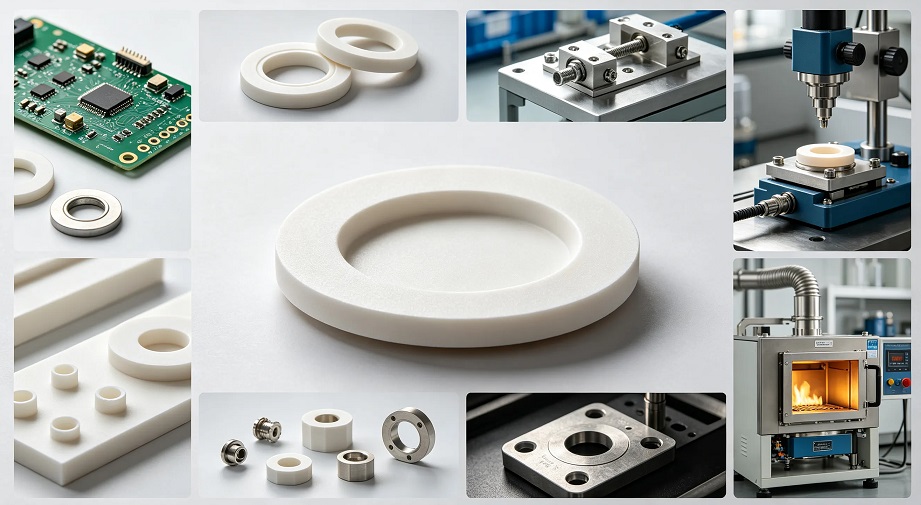
Application Scenarios of Alumina ceramic discs
Application Scenarios
1. Semiconductor Manufacturing Equipment
Alumina ceramic discs serve as wafer handling platforms, plasma etching chamber insulation components, and diffusion furnace tube support structures. Their high purity, excellent electrical insulation, and thermal stability ensure contamination-free operation and precise positioning in critical semiconductor front-end processes, effectively minimizing particulate generation and device failure risks.
2. Fluid Control & Sealing Systems
As core components of ceramic valve discs, mechanical face seals, and high-pressure plunger pump sealing surfaces, these discs deliver exceptional wear resistance and corrosion resistance. In water faucet cartridges, chemical shut-off valves, and slurry handling systems, they maintain leak-tight performance (typically ANSI Class VI) over millions of cycles, far outperforming traditional metallic sealing materials.
3. High-Temperature Furnace & Thermal Processing Equipment
The discs perform reliably as high-temperature electrical insulators, hearth plates, and kiln furniture supports in sintering furnaces, annealing ovens, and vacuum brazing systems. Capable of withstanding 1600°C under no-load conditions without deformation or oxidation, they ensure stable material processing in both oxidizing and inert atmospheres.
4. Wear-Resistant Components in Mining & Powder Processing
In applications involving high-velocity abrasive media—such as slurry transport pipelines, cyclone separators, pneumatic conveying elbows, and classifier rotor blades—these discs provide outstanding erosion and abrasion resistance. Their hardness (HRA 80–90) enables service life 5–8 times longer than hardened steel, significantly reducing maintenance downtime and replacement costs.
5. Medical & Analytical Instrumentation
The discs function as precision titration platforms, X-ray diffraction sample holders, and chromatography column support bases in medical devices and analytical equipment. Their chemical inertness (no heavy metal leaching), high flatness, and excellent dimensional stability guarantee measurement accuracy and sample integrity without cross-contamination risks.

JianXun Warehouse
Company Profile
Luoyang JianXun Tech Co., Ltd. is a professional new material supplier dedicated to the research, development, production, and global distribution of advanced ceramic materials, powder metallurgy products, and nano-scale functional materials. Headquartered in Luoyang, Henan Province — a renowned industrial hub in central China — the company benefits from a complete supply chain ecosystem and convenient logistics networks, enabling efficient delivery to customers worldwide.
Payment Term:
T/T, Paypal, Credit Card, Western Union etc.
Shipment Term:
By air, by sea, by express, as customers request.
Storage Conditions
Store in a dry, ventilated place at 5–40°C, humidity < 65%. Keep in original sealed packaging to prevent contamination. Do not stack heavy objects on top. Avoid corrosive gases and chemicals. No expiration limit. For temperature changes >100°C, warm at ≤3°C/min to avoid thermal shock.
FAQs of Alumina Ceramic Disc
1. What is the maximum service temperature of the alumina ceramic disc?
The maximum continuous service temperature is 1600°C under no-load conditions. For applications involving mechanical load or thermal cycling, we recommend maintaining operating temperatures below 1400°C to ensure long-term reliability.
2. Can the alumina ceramic disc be machined into custom shapes and sizes?
Yes. We support custom machining including center holes, threaded holes, stepped surfaces, grooves, chamfers, and laser marking. Diameters range from Φ5 mm to Φ600 mm (larger sizes available upon request), with thickness tolerances as tight as ±0.03 mm.
3. Is the alumina ceramic disc suitable for food or medical applications?
Yes. The material is chemically inert with no heavy metal leaching, fully compliant with FDA and RoHS standards. It is widely used in food processing equipment, pharmaceutical manufacturing, and medical analytical instruments.
4. How should the alumina ceramic disc be stored and handled?
Store in a dry, ventilated place at 5–40°C with humidity < 65%. Keep in original sealed packaging until use. Avoid stacking heavy objects on top, and handle with care to prevent chipping or cracking.
5. What is the typical lead time and minimum order quantity (MOQ)?
Standard sizes are typically available from stock with lead time of 3–5 working days. Custom orders generally require 10–15 working days depending on quantity and machining complexity. MOQ is flexible — please contact us with your specific requirements.